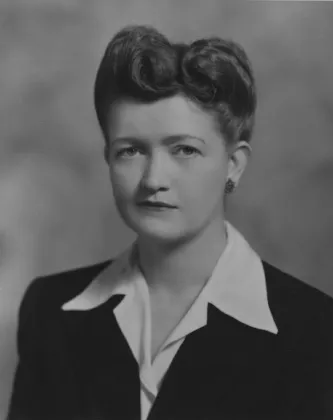
From Tennessee Williams and Carson McCullers to Arthur Kopit and Brian Friel, agent Audrey Wood encouraged and guided the unique talents of playwrights in the Broadway theatre of her day. Her quiet determination and burning enthusiasm brought America's finest mid-century playwrights to prominence and altered stage history.
Audrey Wood, c. 1937. Billy Rose Theatre Division, The New York Public Library for the Performing Arts, Astor, Lenox, and Tilden Foundations.
1. Stagestruck
To lose a troupe of full-grown elephants is not an easy feat.1
The Century Play Company at 1440 Broadway was the place of Audrey Wood’s seven-year apprenticeship that followed a childhood of weekend matinees of vaudeville shows and touring productions in New York theaters managed by her father. She was stagestruck at an early age by Weber and Fields’ Dutch act in mock-Germanic accents, by the reenactment of the English derby in The Sporting Life, and by the tribute to the Divine Sarah, seated in a high-back chair while assembled stars paid homage by crowning her with a golden wreath on the stage of Broadway’s Palace Theatre.
Nevertheless, nothing rivaled the breathless anticipation of the eight-year-old in the manager’s box at the Palace for the opening act with a family of elephants. The elephants, guided by their trainer, lumbered up Broadway in single file from the Forty-second Street ferry to the entertainment of passersby, and, just as the Palace orchestra began the overture, the pachyderms arrived at the stage door on Forty-seventh Street to make their entrance.
Born on a dining-room table in a New York apartment on West Fifty-first Street on February 28, 1905, Audrey Violet Wood called herself a “cut-rate baby.”2 The physician, who delivered her, was also the “house doctor” on 24-hour call at the Broadway Theatre on Fortieth Street where her father was then employed as business manager. Her parents, William H. Wood and Ida Gaubatz Wood, named their daughter for a character in a dramatized novel by Mary Johnston produced on Broadway before Audrey was born. They added Violet as a middle name, but Audrey became less than thrilled with “Violet” and managed to rid herself of her middle name without serious complaint from her parents.3
The Wood family had immigrated to Milwaukee from a “genteel suburb” in London when William was seven years old. The Gaubatz family had come to America from Germany in the 1860s, and eventually migrated to Milwaukee where Ida May Gaubatz was born. After completing eighth grade, Audrey’s future parents decided to get on with the serious business of their adult lives. Her mother became a bookkeeper at a local bookshop, and her father, after several adventures as a legal clerk and a book salesman, so impressed impresario Jacob Litt of Milwaukee’s Bijou Theatre, who owned and managed other theaters in the Midwest, that he gave the young man his choice of managing theaters in Chicago or New York. William Wood chose the theater capital of the United States.
Once established as Jacob Litt’s up-and-coming manager of his various touring shows, Wood was promoted to the staff of the Broadway Theatre at Fortieth Street. At this point, Wood sent for Ida and they were married. Their daughter was born in Manhattan and grew up six blocks from where she would eventually reign over the Leibling-Wood Agency at 551 Fifth Avenue.
Playing in the aisles of the Broadway Theatre while her father reviewed box-office statements on weekends, Audrey was infected by the show business bug. Seeing shows at matinee performances, “usually from a good seat,” the manager’s daughter vividly recalled the great spectacles of The Sporting Life, Shenandoah, and Ben Hur. Nevertheless, around the family dinner table, Audrey came to understand that behind the scenes the theater business was not so glamorous. Oftentimes it was a treadmill of constant hard work with low pay, harsh living and travel conditions, and frequent exploitation of the hapless performers by small-time managers.4
When the popularity and cheap prices of motion pictures forced the Broadway Theatre to close as a home for legitimate theater, William Wood, disdaining the “five-and-ten-cent entertainment,” accepted producer B. F. Keith’s invitation to work with him and with vaudeville impresario Martin Beck at a new theater they were building at Forty-seventh Street and Broadway. The Palace opened in the spring of 1913, and the eight-year-old Audrey marveled at the progression of vaudeville turns by actors and actresses in one-acts, along with magicians, acrobats, jugglers, and animal acts. At the Palace, Audrey saw the reigning queen of the French theater, Sarah Bernhardt, with members of her company, perform scenes from The Lady of the Camellias and other plays on the same bill.
From her matinee house seat (granted as a weekly treat from her parents), Audrey saw the Palace headliners and discovered Ethel Barrymore, Alla Nazimova, W. C. Fields, Sophie Tucker, and Bert Williams. When she was not at the Palace, she attended Public School No. 84 on West Fiftieth Street, and on Sundays sporadically attended Lutheran Sunday School at Sixty-fifth Street and Central Park West. Her parents were indifferent to her churchgoing but her neighborhood girlfriends insisted that she accompany them on Sundays to learn something more than the names of headliners at the Palace.
Her father was a shrewd manager and was selected by B. F. Keith’s executive office to manage the Hudson Theatre, part of the Keith-Albee circuit in Union Hill (later Union City) across the Hudson River in New Jersey. Audrey and her mother now acquired a new routine on weekends. Every Friday evening, they took the ferry from Forty-second Street across the river, and then a streetcar or bus ride to the theater, where they were ushered into the manager’s box. They would see a show and return to their Manhattan apartment long after normal bedtime hours for a preadolescent. The same schedule was repeated for Sunday matinees. At no time did her parents censor the plays that she saw.
Audrey recalled a smorgasbord of entertainment at the Hudson: the melodrama The Traffic (billed as “An Astounding White Slave Play”), Graustark (later known to moviegoers as The Prisoner of Zenda), Rip Van Winkle (who awakened from a long sleep a changed man), Uncle Tom’s Cabin (with Eliza crossing the ice, clutching her infant in her arms), along with the many personalities appearing at the Sunday vaudeville matinees. On one such occasion, the “Sultan of Swat,” Babe Ruth, made a personal appearance to the audience’s delight.
In a moment of fatherly pride when his daughter was 11, William Wood sent her a press photograph of himself inscribed,
To little auburn Audrey:
If you grow up to be as good a woman as your mother, and
as smart as your father—Gee, what a success you’ll be.
W. H. Wood, alias “Father,” March 18, 1916.5
Audrey Wood’s not-so-formal education took place in the theater, where she was exposed to classic and not-so-classic plays.6 During weekdays at Public School No. 84 and then at Washington Irving High School, 40 Irving Place, Audrey, by her own account, was “never a really good student.” She was proficient in English classes and was encouraged to write for the school magazine, The Sketch Book. She took pride in knowing as much about the theater as Alexander Woollcott of the Times and Heywood Broun of the Morning World whose columns she read every morning in the subway on the way to Irving Place. When she became editor of the school magazine, she started a drama review department and cleverly gave all of the assignments to herself. Mesmerized by Eleonora Duse’s performance as Mrs. Alving in Henrik Ibsen’s Ghosts at the Century Theatre, the novice reviewer gave Duse a “rave,” as did her better-known compatriots Woollcott and Broun.
In the hope that she would become an actress, her father gave his daughter a small part in Booth Tarkington’s Seventeen at the Hudson. At 16, she played the bit part “as though I had been playing on Broadway for years!” She marveled that she experienced no stage fright and reasoned, “I had such belief in myself I was unafraid.”7
After high school, she enrolled in Hunter College of the City University of New York, but by the end of the third month her father suffered a stroke (he died shortly thereafter) and Audrey withdrew from college. She felt an obligation to support her mother and turned to theatrical agent Max Hart, a friend of her father’s, to secure an acting job. She auditioned for Richard Herndon, and the ingénue was offered a job in his Chicago company, but in the face of the cold reality of supporting two households on $75 a week, she turned down the offer. In later years, she mused, “My loss was the audience’s gain.”8
She was very much aware that the theater business was a male fiefdom with limited opportunities for a young woman who was not an actress. Nevertheless, as the daughter of a successful manager with many contacts in front offices, she was determined to break down doors. In 1923, she knocked on Tom Kane’s door at the Century Play Company, and found her way into the business for the next 50 years.
2. Starting Out
Many, many scripts call, but few are chosen.1
Aware that the seat of theatrical power in the front offices of managers, booking agents, and producers was male turf, the 22-year-old Audrey Wood was too busy looking for a job to be concerned about what was later called the glass ceiling. She knew that most women in theatrical offices labored as telephone operators, receptionists, and typists in undistinguished and badly paid jobs. Even in the mid-1920s, when Rachel Crothers, Zoë Akins, Rose Franken, and Anne Nichols were making names as playwrights, there were few opportunities for women to be hired at the managerial level. As she walked down Broadway toward the offices of the Century Play Company, she did not consider herself a modern-day heroine breaking down doors to invade male territory. She wanted a job—any job.
For the second time, Audrey found that her father’s connections opened doors for her. Owned by Tom Kane and James Thatcher, the Century Play Company at 1440 Broadway acted as agents for playwrights. Kane had been a friend of William Wood, and when approached by his daughter, he offered the young woman the lowest-rung position on Century’s corporate ladder. He hired her as a playreader for $3 a report. The Century’s mail room was filled with an endless stream of manuscripts submitted by aspiring writers. It was Audrey’s job to take home a stack of scripts, read them, and write reports on their potential for the commercial stage.
In 1927, Century was hugely successful. Tom Kane advanced playwrights large sums of money for their plays produced on Broadway to secure the “stock rights” for the firm. He proceeded to secure touring productions for his clients’ work chiefly with road impresarios Poli in New England and Henry Duffy in key cities in California and the Northwest. Touring companies changed bills of fare weekly, thereby generating enormous incomes for Century and its playwrights along with a large volume of paperwork and bookkeeping.
Audrey’s future in the business increased a rung on Century’s corporate ladder when she arrived at the office one morning to deliver her reports and found Gus Diehl, manager of Century’s stock department (also a friend of her father’s), waist-deep in problems with licensing and touring schedules.
In those days, the stock business was Century’s “cash cow.” There were literally hundreds of local stock companies in cities and towns and each license had to be negotiated 50-odd times a year. In this thriving market, a playwright, managed by Century, could sell a play to Henry Duffy for his theaters in Los Angeles, then San Francisco, and then northward in the circuit to Portland and Seattle. This business, in which the stock company’s entertainment or bill changed weekly in myriad towns and cities, generated an enormous income for Century and its playwrights. Harry Delf’s family comedy, The Family Upstairs, with little impact on Broadway, could still make the writer a fortune in royalties for years to come. In the absence of computers, the company’s bookkeeping and contracts were handled by hand, and the manager of Century’s stock department lived in a state of disarray in his effort to keep up with the coast-to-coast business.
Face to face one morning with the highly agitated Gus Diehl, Audrey spoke up with little forethought: “You know, Mr. Diehl, it seems to me you need somebody to help you and I think I’m the one to do this job.”2 Diehl looked at the small woman with the quiet, cultivated voice and nodded in agreement. The next morning, Audrey Wood went to work as a full-time employee for the Century Play Company and forever after remained a play agent.
Not only was Audrey Wood a skillful taskmaster, but she had acquired in her younger play-going days a vast knowledge of the dramas and comedies of the recent past. Whenever there was a question about a dramatic property, Audrey could usually remember what the play was about and who had been in the cast. With her encyclopedic memory, she became indispensable to Century.
In a serendipitous moment, the woman running Century’s new play department went on hol...
Table of contents
Cover
Title Page
Copyright
Dedication
Epigraph
Contents
List of Photographs
Preface
Acknowledgments
Introduction
Part I Genesis of an Agent 1905–1940
Part II The Fearful Path 1941–1970
Part III Entrances and Exits 1971–1986
Appendix: The Liebling-Wood Agency’s Client List of Playwrights, 1938–1958
Notes
Bibliography
Author’s Note
Index
Trusted by 375,005 students
Access to over 1.5 million titles for a fair monthly price.
Study more efficiently using our study tools.
Frequently asked questions
Yes, you can cancel anytime from the Subscription tab in your account settings on the Perlego website. Your subscription will stay active until the end of your current billing period. Learn how to cancel your subscription
No, books cannot be downloaded as external files, such as PDFs, for use outside of Perlego. However, you can download books within the Perlego app for offline reading on mobile or tablet. Learn how to download books offline
Perlego offers two plans: Essential and Complete
Essential is ideal for learners and professionals who enjoy exploring a wide range of subjects. Access the Essential Library with 800,000+ trusted titles and best-sellers across business, personal growth, and the humanities. Includes unlimited reading time and Standard Read Aloud voice.
Complete: Perfect for advanced learners and researchers needing full, unrestricted access. Unlock 1.5M+ books across hundreds of subjects, including academic and specialized titles. The Complete Plan also includes advanced features like Premium Read Aloud and Research Assistant.
Both plans are available with monthly, semester, or annual billing cycles.
We are an online textbook subscription service, where you can get access to an entire online library for less than the price of a single book per month. With over 1.5 million books across 990+ topics, we’ve got you covered! Learn about our mission
Look out for the read-aloud symbol on your next book to see if you can listen to it. The read-aloud tool reads text aloud for you, highlighting the text as it is being read. You can pause it, speed it up and slow it down. Learn more about Read Aloud
Yes! You can use the Perlego app on both iOS and Android devices to read anytime, anywhere — even offline. Perfect for commutes or when you’re on the go. Please note we cannot support devices running on iOS 13 and Android 7 or earlier. Learn more about using the app
Yes, you can access Audrey Wood and the Playwrights by M. Barranger in PDF and/or ePUB format, as well as other popular books in Media & Performing Arts & Art General. We have over 1.5 million books available in our catalogue for you to explore.