- English
- ePUB (mobile friendly)
- Available on iOS & Android
eBook - ePub
About this book
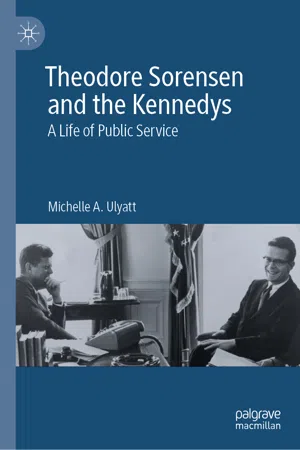
Of the hundreds of books written about John F. Kennedy, none have yet taken the full measure of the role that Theodore Sorensen played in shaping his presidency. Serving as President Kennedy's speechwriter from 1952 until 1963, Sorensen was a key advisor in the White House and a gatekeeper of the Kennedy legacy in the years after his assassination. This book presents a compelling portrait of Sorensen's life and place in the American political landscape. He became an outspoken critic of corruption in politics, a vocal opponent of the militarist foreign policy approach that successive administrations adopted, and an advisor to Democratic presidential candidates such as Robert F. Kennedy and Barack Obama. Taking up questions about the role of presidential advisors and the concept of public service, an ideal that was central to the most famous of the speeches that Sorensen wrote for President Kennedy, Michelle A. Ulyatt offers new insight into Sorensen's influence on the Kennedy years andthe generation of leaders who came after.
Information
© The Author(s) 2019
Michelle A. UlyattTheodore Sorensen and the Kennedyshttps://doi.org/10.1007/978-3-030-15796-8_11. Growing Up on the Great Plains
Michelle A. Ulyatt1
(1)
Kent, UK
Michelle A. Ulyatt
Theodore C. Sorensen was born in Lincoln, Nebraska on May 8, 1928 to second-generation American parents as the nation teetered on the brink of the Great Depression. This chapter explores how Sorensen’s upbringing with politically active parents in a Great Plains state developing a reputation for independence and progressivism helped to shape the political beliefs that later became his trademark. It explores how Sorensen ’s early life influenced his view of the world and the ideals that became central to the political philosophy that underpinned his work as a public servant.
At the time of Sorensen’s birth, Nebraska state politics and national politics in the USA as a whole were in a state of flux. Progressive politics were growing in influence as the rapid growth of the nation’s immigrant population and economic challenges fueled political change. Senator George W. Norris had cemented his position as a leading liberal progressive on the national stage and dominated state politics. His influence over the Sorensen household was also significant, with Theodore’s father, Christian , campaigning on his behalf in every national election from 1918 until 1942. The pair worked closely on changes to the state’s constitution when Christian assumed office as state Attorney General in 1929. This chapter charts how Norris ’ beliefs, influence and impact helped to shape Theodore Sorensen’s ideas about public service and its purpose.
The progressivism that emerged at the turn of the century in the USA later informed the approach of President Franklin D. Roosevelt , whose New Deal programs gave the federal government a transformative influence over the lives of American citizens. It built on the progressive belief that effective government intervention could improve the lives of the population, provided its actions were based on the common good. Roosevelt was an activist president who became the benchmark against which subsequent Democratic Party presidents were judged. He was also one of the key reasons that Sorensen chose to become a Democrat, although he did not formally register as such until 1950. Like many of his generation, Sorensen was inspired by Roosevelt’s leadership and his programs. He entered politics with the conviction that government could and should intervene to improve the lives of its citizens and that, as a means to help those less fortunate and make a difference to the future of the nation, public service was a noble career choice.
In examining the early influences on Theodore Sorensen, the chapter identifies his parents, Christian and Annis, as the most important actors. His father’s political activism and dedication to the law as a means to secure justice informed Theodore’s choice of career. In addition, Christian ’s involvement in state politics and strong support for Senator Norris encouraged political interest among his children and provided an example to which Theodore aspired. He saw his father as a role model, and he was inspired by his sense of duty to his fellow citizens. Equally significant was the role of Annis Chaikin Sorensen, who was an outspoken opponent of war, a political campaigner and an advocate of equal rights. Her pacifism and egalitarianism were inherited by her son, who was also inspired by her work as an educator and writer. They shared a love of storytelling and an interest in the technical craft of writing. Combining this passion and political idealism with his father’s talent for advocacy and sense of public duty , Sorensen became one of America’s greatest political speechwriters and a lifelong servant to the interests of his country.
Progressive Traditions
The Great Plains, including the territory that would eventually become Nebraska, became part of the USA in 1803, having been acquired under Thomas Jefferson’s expansion of its territory to the west (Naugle et al. 2014, 41). The area was soon labeled the Great American Desert as expeditions led by representatives of Jefferson’s government discovered its arid, seemingly inhospitable landscape, home to a small number of Native Americans. In the years between 1830 and 1870, initially prompted by President Andrew Jackson’s determination to solve what he conceived to be ‘the Indian problem,’ the Native Americans were resettled to reservations west of the Platte River, which would later lay at the heart of the Nebraska territory.
For a quarter of a century between 1840 and 1865, the main purpose of the Great Plains area was to provide a transit-way for emigrants from the North East and middle border states who were making the long journey to the newly discovered lands of California and Oregon. They travelled in search of prosperity and the chance to start a new life or to escape persecution in the case of some religious groups. The first settlers began to organize for recognition of the Nebraska territory in the early 1850s and the Kansas-Nebraska Act of 1854, which established the territory in law, was revolutionary. It legislated that the settlers had the right to determine whether it should be free or a slave state, establishing the principle of popular sovereignty for the first time in the USA (Naugle et al. 2014, 85–87). The Act was notably opposed by Abraham Lincoln and other national political leaders in the north of the country, who had hoped to prevent the spread of slavery to the new territories by taking a stronger stance against its practice. It ignored their concerns and allowed political leaders to dodge the issue. However, the Act informed the rise of populism in Nebraska and later played an important role in the development of the settlers’ political identity. The roots of their independence and progressive views can in part be traced back to this recognition of their right to determine their own destiny.
The territory’s first legislature was formed in 1864 by Thomas B. Cuming, the acting governor and territorial secretary appointed to oversee the early development of the area. He selected the members of the new legislature, which was not truly representative of the people and was weighted in favor of the interests of those living north of the Platte River. That early legislature and Cuming’s role in wrangling over the site of the state capital, initially located at Omaha, sowed the seeds of corruption that would plague the territory’s politics in the early years (Naugle et al. 2014, 94). Its structure followed the norms established in other states, with an upper and lower chamber, while its work focused on establishing transportation links, organizing public services including education and the courts, and setting down some cultural markers for the moral standards expected of state citizens. This included the prohibition of the manufacture, sale and consumption of alcohol. Temperance was the watchword for the territory’s early lawmakers, in a tradition that lasted well into the next century. Its leaders held conservative views and introduced laws modeled on those adopted by neighboring territories, rather than innovating to meet the specific needs of their own area.
Nebraska politics began to take on a more formal and organized shape when a territorial Democratic Party was established in 1858. A small People’s Party, largely supportive of the Republican platform, also formed the following year, but it was the Democrats who controlled area politics over the next decade. The territory’s early politicians used their positions to satisfy their own personal and financial ambitions, courting the attention of industry and providing legislative favor in return for bribes. Even their efforts to achieve statehood were motivated by the need to assuage influential groups who were keen to exploit the territory’s agricultural benefits for their own profit and by railroaders who saw its location as crucial to the development of new transcontinental transportation networks. While the legislators saw it as an opportunity to secure economic benefits for the area and for themselves, the people valued their independence and were wary of having their future dictated by a federal government that they would also be required to fund through taxation. Repeated attempts to establish a state constitution failed between 1864 and 1866 due to lack of public support, and then, when the issue finally reached Congress in early 1867, it was derailed by the question of voting rights for the black community. For many ordinary Nebraskans, the issue of statehood was overshadowed by the great national crisis that enveloped the nation as the American Civil War raged. More than one-third of all the eligible men in the territory served on the Union side during the civil war and the Nebraska regiments played a significant role in several of the war’s most important campaigns. As forts and garrisons in the region were disbanded to allow the resources to be used to meet the needs of war, Nebraska’s frontier was opened up to attack by Native Americans, creating a more pressing need to attend to the defense of property and to seek a more acceptable political settlement of their differences with the original inhabitants of their land. These were significant distractions for a population already unconvinced by the idea of statehood.
As the war came to an end and with statehood finally decided in February 1867, Nebraska became home to growing numbers of settlers and Homesteaders seeking a new way of life. Farming became the dominant economic activity in the area, with manufacture of timber, agricultural products, flour and clothing making up a substantial proportion of the territory’s remaining output. President Abraham Lincoln’s choice of Nebraska as a key point on the Union Pacific Railroad route created new incentives for development in the state and attracted economic migrants searching for a more prosperous future. He had also, unwittingly, set the tone for the inhabitants of the new state offices, who once again saw an opportunity for enrichment in awarding contracts for work to establish the required infrastructure (Naugle et al. 2014, 127–128; Locke 1945, 274).
Nebraska’s population increased 20-fold in the years between the end of the American Civil War and the start of the 1890s. Among the new wave of European immigrants who settled there were Theodore Sorensen’s paternal and maternal grandparents. They were part of a large group of Danish and Polish immigrants to choose Nebraska as their new home and their arrival coincided with a period of significant change. In 1890, the Democratic Party secured a landslide victory in the national congressional elections and Lincoln lawyer William Jennings Bryan was elected to represent Nebraska in the Senate. Bryan’s emergence provided a political step-change in the state, indicating the influence of the new settlers and their desire for a more representative form of politics that was less tied to corporate interests (Elazar 1980, 267; Brogan 1999, 426). His populism responded to the needs of the state’s agrarian interests, representing the working man (and woman) and arguing for the expansion of suffrage, popular election of Senators, and a more interventionist form of government that would work to protect the welfare of ordinary individuals, whom he labeled the ‘common man.’ Here was the foundation of the idea of government as a force for progress and a powerhouse of social reform. It was the start of a tradition that heavily influenced Theodore Sorensen ’s political philosophy and laid the groundwork for a progressive movement that dominated Nebraska politics for the next quarter century. It also left its mark on American national politics in the half century that followed.
Bryan built his reputation on taking up the cause of hard-pressed Nebraska farmers and arguing that the country’s monetary policy was seriously damaging their ability to make a good living. He was the man who started the long association that developed between the Democrats and the underprivileged, which continues today (Brogan 1999, 431; Naugle et al. 2014, 270). Bryan blamed the Panic of 1893, which was the worst depression America had faced to date, on the inflexibility of the government’s policies and called for tariff reform and the free coinage of silver. He framed his politics as a fight between corporate greed and the common interest, attacking the powerful influences that he believed kept government wedded to its policy of protecting the gold standard and placing high tariffs on manufactured goods (Kazin 1998, 45). His success lay in his ability to create a sense of national crisis and position himself as a protest candidate who attacked vested interests and argued for more direct democracy where politicians would rule in the interests of all of the people. While his style of politics won considerable support in his home state, it had limited appeal in the wider nation. Bryan ’s strongest supporters were groups who felt underrepresented and economically vulnerable, and he alienated voters in the east who prospered from the corporate economies operating there. This resulted in his failure to secure the presidency in 1896 and in 1900.
Bryan’s populism was a direct forerunner of the progressive era that followed. Although the historian Richard Hofstadter is right to point out that the progressivism that emerged in 1900 was very different to the populism of the 1890s, it focused on the same moral arguments for a more collective view of the national interest and for the introduction of social legislation that would transform the fortunes of all citizens, not just the wealthy (Hofstadter 1955, 131). While the progressives supported the idea of a more representative and democratic form of government, they were less wedded to the idea of popular rule and instead advocated a system of representation that was similar to that described by Plato in Republic, with leadership provided by an educated class of ‘philosopher rulers.’ The public would then judge their performance at regular elections.
George Norris was elected to the Senate to represent Nebraska in 1912 and served for thirty years, establishing a reputation as an effective legislator and a skilled politician. The liberal progressivism that he advocated was distinct from the populism that arose in his home state in the 1890s. It replaced the somewhat empty rhetoric of the populists with a firmer set of political beliefs based on a moral core. While Norris and other progressives of his generation continued to oppose the concentration of power among a small and wealthy group, they included a stronger commitment to political democracy, believed that all citizens had a personal obligation to uphold the common interest, argued for the use of government to improve the economic welfare of all along egalitarian lines and promoted a deep humanitarianism built on the idea of the brotherhood of man (Hofstadter 1955, 5–9; Lovitt 1977, 398). The populists opposed the status quo and stirred up a desire for reform but provided little in the way of a vision for the future, in turn breeding distrust of the political process. For progressives, restoring trust in government was essential to relieving the nation’s problems and active participation by its citizens was crucial to the effective functioning of the state.
It was this form of progressivism to which Theodore Sorensen’s father, Christian, turned when he sought to establish his political identity and find an outlet for his political activism. After leading the ‘Farmers for Norris’ in support of the Senator’s campaign for re-election in 1...
Table of contents
- Cover
- Front Matter
- 1. Growing Up on the Great Plains
- 2. Meeting Kennedy
- 3. Making Kennedy Matter
- 4. Running with Kennedy
- 5. Into the White House
- 6. The Domestic Agenda
- 7. Early Foreign Policy Challenges
- 8. From Arrows to Olive Branches
- 9. Life After Kennedy
- 10. A Private Life in Public Service
- 11. Epilogue
- Back Matter
Trusted by 375,005 students
Access to over 1.5 million titles for a fair monthly price.
Study more efficiently using our study tools.
Frequently asked questions
Yes, you can cancel anytime from the Subscription tab in your account settings on the Perlego website. Your subscription will stay active until the end of your current billing period. Learn how to cancel your subscription
No, books cannot be downloaded as external files, such as PDFs, for use outside of Perlego. However, you can download books within the Perlego app for offline reading on mobile or tablet. Learn how to download books offline
Perlego offers two plans: Essential and Complete
- Essential is ideal for learners and professionals who enjoy exploring a wide range of subjects. Access the Essential Library with 800,000+ trusted titles and best-sellers across business, personal growth, and the humanities. Includes unlimited reading time and Standard Read Aloud voice.
- Complete: Perfect for advanced learners and researchers needing full, unrestricted access. Unlock 1.5M+ books across hundreds of subjects, including academic and specialized titles. The Complete Plan also includes advanced features like Premium Read Aloud and Research Assistant.
We are an online textbook subscription service, where you can get access to an entire online library for less than the price of a single book per month. With over 1.5 million books across 990+ topics, we’ve got you covered! Learn about our mission
Look out for the read-aloud symbol on your next book to see if you can listen to it. The read-aloud tool reads text aloud for you, highlighting the text as it is being read. You can pause it, speed it up and slow it down. Learn more about Read Aloud
Yes! You can use the Perlego app on both iOS and Android devices to read anytime, anywhere — even offline. Perfect for commutes or when you’re on the go.
Please note we cannot support devices running on iOS 13 and Android 7 or earlier. Learn more about using the app
Please note we cannot support devices running on iOS 13 and Android 7 or earlier. Learn more about using the app
Yes, you can access Theodore Sorensen and the Kennedys by Michelle A. Ulyatt in PDF and/or ePUB format, as well as other popular books in History & North American History. We have over 1.5 million books available in our catalogue for you to explore.