In the wake of same-sex marriage legalization, most religious conservatives realize that they now share a minority viewpoint on many social issues. Such change has forced those formerly trying to forestall social evolution to instead seek legal recusal from engaging in matters that conflict with their religious beliefs. Not surprisingly, these recent legislative attempts to "affirm" religious free expression all focus upon the rights of the religious adherent, while mostly failing to consider the potential harm to third parties. In the provision of government services, this omission can do significant, lasting damage to public perceptions of administrative legitimacy—often already perilously maligned. Should government officials be legally obligated to grant their employees religious accommodations that they know will result in negative public perceptions, or worse, inflict dignitary harm among citizens seeking its services? This book draws attention to the threat to effective government that proposed expansions to religious accommodation laws can create. From damaging public opinion, to the myriad implementation concerns such as what even constitutes a religious belief to be accommodated, these challenges should serve as a warning to legislators and religious accommodation advocates to reconsider application of these enhanced obligations to the civil service.
eBook - ePub
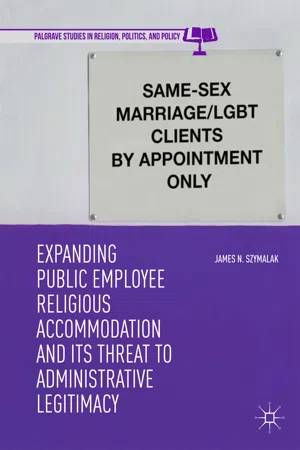
Expanding Public Employee Religious Accommodation and Its Threat to Administrative Legitimacy
- English
- ePUB (mobile friendly)
- Available on iOS & Android
eBook - ePub
Expanding Public Employee Religious Accommodation and Its Threat to Administrative Legitimacy
About this book
Information
© The Author(s) 2019
James N. SzymalakExpanding Public Employee Religious Accommodation and Its Threat to Administrative LegitimacyPalgrave Studies in Religion, Politics, and Policyhttps://doi.org/10.1007/978-3-319-97831-4_11. Introduction
James N. Szymalak1
(1)
University of Wisconsin–La Crosse, La Crosse, WI, USA
In physics, every action has its equal and opposite reaction. In politics, every action has its predictable overreaction.1There is an almost endless parade of horribles that could accompany the implementation of HB 1523 [“Protecting Freedom of Conscience from Government Discrimination Act”]2—U.S. District Court Judge Carlton W. Reeves in Barber v. Bryant
These two observations made by Judge Reeves in his decision to enjoin implementation of Mississippi’s freedom of conscience bill accurately reflect what this book seeks to illuminate and avert. In the wake of the Supreme Court’s Obergefell v. Hodges 3 decision granting marriage equality to same-sex unions, a renewed push for exemptions from mandates conflicting with sincerely held religious beliefs is underway. Religious conservative interest groups are actively lobbying legislators for statutory protections to freely exercise their beliefs. Similar to conscience clauses enacted to exempt individuals from facilitating abortions, legislators across the country, both federal and state, are introducing bills to protect an individual’s beliefs as to what constitutes marriage and sexuality. As Judge Reeves notes, however, such political reactions are often excessive, if not unnecessary, and they can inflict significant third-party harms.
This book focuses on one particular “horrible” that will likely result from a continued push for religious exemptions—the impairment of administrative legitimacy. This threat is explained in far greater detail in Chapter 7; however, a brief summary now of how this book conceptualizes administrative legitimacy will provide beneficial context. For this discussion, legitimacy is the manifestation of the public’s collective trust and confidence that a public organization is acting in the public’s interest—as conceptualized by the public itself.4 This perceived legitimacy promotes civic cooperation and compliance with the agency’s activities and directives.5 It reduces cynicism and increases public support for agency policies.6 Agencies foster legitimacy in several ways, but most productively by ensuring procedural justice—treating people with respect and dignity in an open and neutral manner7—and acting consistent with societal values.8
It may seem odd to consider the public bureaucracy in need of protection, but if we are to grant sweeping religious exemptions that apply to individuals as both citizens and employees, then the public’s perception of its government risks diminution due to observed harm resulting from public employees expressing their right to avoid performing tasks to which they object on religious grounds. This can either be a first-person observation, or one experienced through social media. Two recent incidents in the policing context illustrate this point. In Philadelphia, a Starbucks employee called local authorities when two African-American males sat down in the coffee shop, would not make any purchases, and then refused to leave. The responding officers repeatedly asked the individuals to leave, per the request of Starbucks, but they continued to refuse and were subsequently arrested—all the while patrons were recording the incident and sharing it online. The online video was viewed over 10 million times within a short period after the incident. Not only did it generate a public backlash against Starbucks, but also against the City of Philadelphia Police Department—which subsequently issued a policy for handling trespassing arrests.9 The department’s perceived legitimacy was undoubtedly impaired to some extent, but was it fair? True, officers have arrest discretion, but in the case of trespassing, when those in control of the property want the offender removed, could they have reasonably just walked away because they determined that Starbucks was acting unreasonably? One could see that scenario being far more damaging to perceived legitimacy if residents begin to wonder if their calls for assistance will be ignored. This is an instance where law enforcement was being responsive to the citizenry, and appeared to be enforcing the law in a procedurally just manner, yet they still paid a price from a legitimacy standpoint.
Less than a month later, the Yale University Police Department would experience an almost identical incident. At Yale, police were called to a university graduate student apartment complex by a tenant that observed an African-American female that she did not recognize sleeping in the common area. University police responded and it took several minutes to conform her identity due to a name difference between her ID card and the Yale database, but once confirmed, the officers wished her a good night and departed. As is now typical, the opposing students recorded the encounter and shared it online, which resulted in a significant public outcry.10 As with Starbucks, what were the alternatives for the officers? In this case no arrest was made, yet many faulted the officers for either indulging the complaining student by investigating, or by the length of the interaction to confirm the sleeping student’s identity. University police have an obligation to ensure the safety of those on campus, and if someone calls them alleging that there is a trespasser, then officers have an obligation to follow through on confirming identity. It was not law enforcement’s fault that the student elected a name for her ID card that differed from her student record, and this was the only reason for the extended encounter. Again, if the police had done anything less, the public would have been just as, if not more, offended. The point of these two examples is to highlight how the public administrator operates in a hypersensitized, technology-saturated environment when compared to the past. Not only must administrators be concerned for errors in judgment that will affect legitimacy, they must also be cognizant of the potential for adverse public reactions to administrators doing what is asked or mandated of them. In the case of mandated religious accommodations, administrators cannot just be concerned with meeting their legal obligations to employees; rather, they must also be prepared for the potential negative public response to observing the accommodation’s application.
Few would disagree that dignitary harm will sometimes result from employees exercising their religious recusal rights. In the past, such offense would be limited to a small group of individuals, but today such incidents have the potential to go viral, like those above, with a vast audience becoming aware. Unfortunately, for the government entity, the legally mandated religious accommodations may be erroneously perceived as condoning the employee’s beliefs, thus creating perceptions of a lacking commitment to equal protection, or worse, as outright hostility to certain groups.
Public faith in its government and its administration is already weak, and further impairment from an avoidable harm should not occur. Legislators, if they insist on passing new religious belief protections, must understand the unique and fragile nature of public administrative legitimacy. Title VII’s existing framework for accommodating employee religious belief and expression works. Recent proposals to change this standard are solutions seeking a problem. Rather than “solving” a nonexistent problem, this book intends to show how such proposed expansions of religious accommodation obligations will weaken citizen perceptions of administrative legitimacy and will trigger far greater concerns for those responsible for effective administration.
Post-Obergefell Political Mobilization
The first major shot across the bow was the Supreme Court’s Windsor decision invalidating the Defense of Marriage Act’s federal definition of marriage as being between one man and one woman.11 Religious conservatives knew it would be a matter of time before state restrictions on same-sex marriage would either be overruled by the courts or at the ballot box, but few predicted the swiftness of Obergefell changing the landscape. Though many disapprove of the Court’s decision,12 acceptance of same-sex relationships has continued...
Table of contents
- Cover
- Front Matter
- 1. Introduction
- 2. The Obligation to Accommodate
- 3. What Even Constitutes Religion?
- 4. Expanding Religious Accommodation
- 5. Applying the Heightened Standard
- 6. Challenges of an Expanded Obligation
- 7. Threatening Legitimacy
- 8. Accommodation as a Sword
- 9. Conclusion
- Back Matter
Trusted by 375,005 students
Access to over 1.5 million titles for a fair monthly price.
Study more efficiently using our study tools.
Frequently asked questions
Yes, you can cancel anytime from the Subscription tab in your account settings on the Perlego website. Your subscription will stay active until the end of your current billing period. Learn how to cancel your subscription
No, books cannot be downloaded as external files, such as PDFs, for use outside of Perlego. However, you can download books within the Perlego app for offline reading on mobile or tablet. Learn how to download books offline
Perlego offers two plans: Essential and Complete
- Essential is ideal for learners and professionals who enjoy exploring a wide range of subjects. Access the Essential Library with 800,000+ trusted titles and best-sellers across business, personal growth, and the humanities. Includes unlimited reading time and Standard Read Aloud voice.
- Complete: Perfect for advanced learners and researchers needing full, unrestricted access. Unlock 1.5M+ books across hundreds of subjects, including academic and specialized titles. The Complete Plan also includes advanced features like Premium Read Aloud and Research Assistant.
We are an online textbook subscription service, where you can get access to an entire online library for less than the price of a single book per month. With over 1.5 million books across 990+ topics, we’ve got you covered! Learn about our mission
Look out for the read-aloud symbol on your next book to see if you can listen to it. The read-aloud tool reads text aloud for you, highlighting the text as it is being read. You can pause it, speed it up and slow it down. Learn more about Read Aloud
Yes! You can use the Perlego app on both iOS and Android devices to read anytime, anywhere — even offline. Perfect for commutes or when you’re on the go.
Please note we cannot support devices running on iOS 13 and Android 7 or earlier. Learn more about using the app
Please note we cannot support devices running on iOS 13 and Android 7 or earlier. Learn more about using the app
Yes, you can access Expanding Public Employee Religious Accommodation and Its Threat to Administrative Legitimacy by James N. Szymalak in PDF and/or ePUB format, as well as other popular books in Politics & International Relations & Public Affairs & Administration. We have over 1.5 million books available in our catalogue for you to explore.