eBook - ePub
Revisiting Holocaust Representation in the Post-Witness Era
- English
- ePUB (mobile friendly)
- Available on iOS & Android
eBook - ePub
Revisiting Holocaust Representation in the Post-Witness Era
About this book
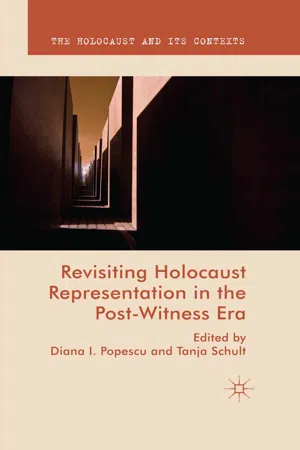
This volume explores post-2000s artistic engagements with Holocaust memory arguing that imagination plays an increasingly important role in keeping the memory of the Holocaust vivid for contemporary and future audiences.
Information
1
Introduction: Memory and Imagination in the Post-Witness Era
Diana I. Popescu
Memory and imagination are the unusual companions of creative thought, the domain of creativity being located in the in-between spaces of the two faculties. Structurally very similar, memory and imagination can easily slip into one another, since displacements of the self occur both when one remembers and imagines (Sokolowski, 2000: 71). While imagination relies on memory to reconfigure the present in ways that ensures a certain commitment to remembering the past, memory has the potential to invest ‘imagination with social responsibility observable in calls to “never forget” or indictments of “never again”’ (Keightley and Pickering, 2012b: 123).1
Despite these phenomenological insights, in the context of Holocaust Studies the relationship between memory and imagination continues to elicit considerable unease. The notion that imagination is an assault on both the history and the memory of the Holocaust is prominent in the scholarly discourse of the late 1990s and the early 2000s.2 Memory has been viewed as imagination’s opposite, since remembering involves reconstructing the past as it was, unspoilt by the distortive capacities of imagination. Those opposing the imaginative discourse invoke the dangers of giving warrant to Holocaust denial, while others conjure Theodor W. Adorno’s statement as a prohibition forbidding poetic licence. Imagination was perceived as incapable of dealing with the rupture that was caused by the Holocaust since, argued Hannah Arendt, ‘the horror of the concentration and extermination camps can never be fully embraced by the imagination for the very reason that it stands outside of life and death’ (Arendt, 1966: 444). In a similar vein, Saul Friedländer invoked ‘the total dissonance between the apocalypse that was and the normality that is makes adequate representation elusive, because the human imagination stumbles when faced with the fundamental contradiction of apocalypse within normality’ (Friedländer, 1993: 51).
In the arising discursive arena of the post-witness era, this volume endeavours to shift focus from discussions on the ethics of representation and the limits ensuing from it, to the relevance of imagination in representing the Holocaust. Imagination, it will be argued, can play a significant role for the post-memory generations as it offers the possibility to work against closure and silence. Within an imaginative discourse, silence can become an articulate silence (Tanja Schult) that lends a sense of urgency to remembering. The transfer of memory and the domain of post-ness itself are increasingly dependent on a capacity to imagine.
History needs to be translated through imagination, so that its meaningfulness can be passed on to future generations and become part of a vivid memory. Yann Martel, author of Beatrice and Virgil, praises art’s potential to convey the urgency of active memory, arguing that: ‘If history does not become story it dies to everyone except the historian. Art is the suitcase of history, carrying the essentials. Art is the life buoy of history. Art is seed, art is memory, art is vaccine’ (Martel, 2010: 16). The imaginative investigations of the Holocaust discussed in this volume confirm a moral commitment – not only valid for survivor artists and direct descendants, but also for distant inheritors of memory – to repair what was broken despite the possibility of failing that this effort entails. They remind of the fact that imagination can serve as a humble tool that opposes oblivion. Hence, acts of imagining the Holocaust in popular or highbrow culture need not be rejected, but subjected to critical interrogation not for the sake of distinguishing between good and bad, correct and incorrect Holocaust representation, but for reaching a better understanding of how mediation works in lending the historical past a sense of urgency that speaks to and about the present. While not all representations are effective in conveying an anti-redemptive stance, each one of them deserves attention, if only for the new questions that they may unwittingly raise. In the absence of full evidence, one can only assume that an educated public is able to distinguish between history and its cultural representation, and recognize the latter as a form of translation that does not entirely include or exclude history.
In addition to historical narrative, imagination becomes a vital way to connect with the past that is likely to provide new possibilities to carry out the work of memory. Georges Didi-Huberman’s plea for the role of imagination gives further meaning and depth to this volume’s essays. To ‘imagine for ourselves … the hell of Auschwitz’, is, he argues, ‘a response that we must offer, as a debt to the words and images that certain prisoners snatched, for us, from the harrowing Real of their experience’ (Didi-Huberman, 2008: 3).
Through imagination one establishes an emotional relationship with what one encounters. Didi-Huberman reminds that even the archival image, a metonym for any historical evidence of the Holocaust or any other historic event, ‘is merely an object … an indecipherable and insignificant photographic printing so long as I have not established the relation – the imaginative and speculative relation – between what I see here and what I know from elsewhere’ (Didi-Huberman, 2008: 112). These imaginative and speculative relations are also the domain of post-memory and of mediated memory. It is through imaginative practices that the ‘deep memory’ articulated by the survivors’ generation can be glimpsed once again by post-war generations (Delbo, 1995).
Holocaust Representation in the Post-Witness Era acknowledges imagination as a tool by means of which younger generations can translate the past in a way that serves their memory work. The contributors of this anthology ask why are artistic imaginative representations of the Holocaust important now – when we are drawing near a crucial transfer of the Holocaust legacy from the realm of ‘living memory’ contained by the survivors and their families to a culturally and politically mediated memory work realized by post-witness generations. Consequently, this transfer begs the question of what are the effects of the looming disconnect with the past and what it may bring to bear? How do artistic representations tackle this rupture and work around this sense of ‘afterwardness’?
The guardianship of Holocaust memory does not rest only in the hands of the descendants of the survivors of World War II. Within the creative domain many artists with no biographical ties to the Holocaust engage this topic using a variety of media. In the growing distance and soon de facto the absence of ‘a sense of living connection’ (Hoffman, 2004: xv), a turn to the imaginative discourse is not only desirable but essential in lending a sense of urgency and relevance to why the genocide of the European Jews should be kept alive in contemporary public consciousness.
Many of this volume’s essays explore what Andreas Huyssen defined as the ‘constitutive gap between reality and its representation in language [and] image … which cannot be closed by any orthodoxy of correct representation’ (Huyssen, 2003: 19). The contributors present examples of artworks, memorial art, film, comics and literature which point to a diversification of approaches and re-presentations of the Holocaust, where memory and imagination are more intimately intertwined. They offer snapshots of the latest artistic engagements with Holocaust memory, in particular from Central and Northern Europe. These examinations make apparent the genuine struggle among those born after the Holocaust, whether Polish, German, Austrian or Swedish, to make the past relevant in the present, well aware that one cannot fully own or comprehend the past.
The discussed cultural representations emerge after important developments of the 1990s, such as the boom of filmic and pop-cultural productions dealing with the Holocaust, the memorial and representational debates, the establishment of institutional and political Holocaust commemoration, and the turn to perpetrator studies. They engage critically with the impact these representational legacies have upon post-2000s artistic engagements. Questions of afterwardness are raised. How can one remember after the witnesses have gone? What forms do cinematic representations take after Steven Spielberg’s Schindler’s List? What does German memorial culture look like after Peter Eisenman’s Memorial to the Murdered Jews of Europe has been integrated within the German politics of national self-representation? What happened with European comic books after Art Spiegelman’s Maus? What shape does Holocaust remembrance take after Austria’s public recognition of historical guilt, or after the intense public debates caused by Jan T. Gross’s Neighbors in Poland? What are the repercussions of the 2000 Stockholm declaration in Sweden on the European politics of memory?
The essays are organized in four parts whose thematic concerns overlap and merge rather than remain separate. Familiar thematic engagements with the return of the repressed and the presence of the uncanny in recent commemorative practices and devices, questions of transfer of memory from living to mediated memory, the relations of memory sites with identity politics, and the preoccupation with Auschwitz as a site and a symbol are revisited against new and hardly discussed artworks. Taken as a whole, the essays offer a diverse range of insights upon the relevance of a creative and reflective mediation of the Holocaust within the evolving temporal and ethical framework in the post-witness era.
Part I reconsiders the aesthetics and politics of practices of commemoration. The rise of the device of listing, frequently employed in Holocaust memorialization, needs critical attention especially because listing is already contaminated by Nazi history. Its unreflective adoption by commemorative culture cannot go unnoticed or unchallenged, argues Ernst van Alphen. The continued need for reflective art and its potential to make visible that which is concealed emerges in Jacob Lund’s and James E. Young’s engagements with Esther Shalev-Gerz’s installations Between Listening and Telling: Last Witnesses, Auschwitz 1945–2005 (2005) and The Human Aspect of Objects (2006). Both essays are concerned with how deep memory is communicated through gestures and silences from the prism of the ‘countermonument’ (Young), and the lens of philosophical reflections upon the meaning of silence (Lund). In the post-witness era, memory needs imagination’s resourcefulness to decipher, interpret and translate the silences of survivors and endow them with meaning.
Observing the effect memorial art has upon the public can tell us more about the next directions public commemoration may take to meet the audiences’ expectations, imaginations and memories. Tracy Jean Rosenberg’s reading of Berlin’s memorials through the notion of the sacred and the profane reveals visitors’ expectations and behaviours at memory sites and makes visible how recent memorial design, through its blurring of separation between sacred and profane, challenges us to rethink our engagement with these sites. The current focus on Berlin as the centre of Germany’s national remembrance may also shift. Hence, Imke Girßmann explores the notion of decentralized memory work by comparing Renata Stih and Frieder Schnock’s well-known project Places of Remembrance in Berlin-Schöneberg (1993) with Michaela Melián’s audio project Memory Loops (2010) in Munich.
Part II asks what happens when younger generations of Poles, Jews or Swedes encounter the sites of mass murder. What perspectives do physical proximity to Auschwitz make possible? What is gained or lost through temporal lapse? Why is it (ir)relevant to gain distance? How can one reconcile the urgency for remembrance and the moral responsibilities of preserving the legacies of the Holocaust with the tendency to take a step backward from this past? Conceptual, emotional and intellectual struggles with places where horrific crimes were committed are made apparent in Tanja Schult’s and Jan Borowicz’s examination of Polish and Swedish contemporary art and literature, Ceri Eldin’s analysis of Swedish video art, and Erica Lehrer’s and Magdalena Waligórska’s reading of Spring in Warsaw, an Israeli public participatory performance in the Polish capital. Questions of engagement with the site of Auschwitz re-emerge in Tim Cole’s interrogation of the changes and continuities in tourist practices at Auschwitz from their wartime origins to the present. These Polish landscapes become witnesses themselves to new forms of memorial work and are perpetually renewed through the diverse perceptions and experiences of contemporary visitors.
Part III deals with aspects of style, genre and narrative structure underpinning filmic and literary restagings of the Holocaust. What happens when, as Huyssen feared, the ‘imagined past is sucked into the timeless present of the all-pervasive virtual space of consumer culture?’ Is popular media fostering ‘uncreative forgetting [and] the bliss of amnesia?’ (Huyssen, 2003: 10). How does the past continue to haunt contemporary literary imagination? These unresolved questions surface in Hampus Östh Gustafsson’s comparison of Norwegian-American Siri Hustvedt’s What I Loved (2003) and Swedish Bodil Malmsten’s The Last Book from Finistère (2008). Elizabeth M. Ward’s analysis of German filmmaker Uwe Boll’s Auschwitz (2011) grapples with historical authenticity and cinematic manipulation. How can contemporary filmmakers expose the very mechanisms of image formation? Issues of filmic re-presentations and how they involve the viewers are also central in Ingrid Lewis’s investigation of women perpetrators in recent European films. The interplay between fact and fiction is tackled by Christine Gundermann through a comprehensive survey of European comics dealing with the Holocaust.
The concluding section of the volume is concerned with how the Holocaust is invoked in public debates, state memorialization and EU politics. Christian Karner looks at Austrian Jewish memory of the Holocaust from a fresh interpretative angle inspired by Avishai Margalit’s categories of morality and ethics of memory. While there is much division and disagreement about how the Holocaust is invoked, its centrality for Jewish contemporary identities in Europe and in shaping interpretations of present circumstances remains unshakable. In a similar vein, through revealing case studies of art exhibitions held by the Swedish public authority the Living History Forum, Kristin Wagrell investigates the extent to which staging the Holocaust within exhibition settings can teach the country’s youth about contemporary intolerance and racism. How effective is this approach in conveying historical responsibility? Concluding the volume, Larissa Allwork evaluates the role of the Stockholm International Forum in institutionalizing Holocaust memory as a civil religion in liberal Western nation-states, and seeks to nuance our understanding of Holocaust memory within a European political discourse prone to encourage narratives that sacralize the past.
It is worth noting that the majority of the essays enclosed in this collection are authored by a younger generation of emerging researchers and academics for whom the past is largely mediated and imagined. Their contributions, read alongside essays by well-established scholars in the field document recent developments in the representation of the Holocaust as an imaginative discourse concerned with memory influenced by what the loss of the ‘living connection’ will signify in the future. Their contributions draw attention to a certain vicariousness of representation which invokes the workings of imagination as well as the obligation to remember. It is our wish that this volume will inspire new thoughts on the relation between memory and imagination in the context of the post-witness era, and serve as a useful resource to both specialists i...
Table of contents
- Cover
- Title
- Copyright
- Contents
- List of Illustrations
- Acknowledgements
- Notes on Contributors
- Chapter: 1 Introduction: Memory and Imagination in the Post-Witness Era
- Part I Revisiting Artistic Practices of Holocaust Commemoration
- Part II Sites of Struggle with Haunting Pasts
- Part III Rethinking Representation in Literature and Popular Culture
- Part IV Memory Politics in Post-2000 (Trans)National Contexts
- Index
Trusted by 375,005 students
Access to over 1.5 million titles for a fair monthly price.
Study more efficiently using our study tools.
Frequently asked questions
Yes, you can cancel anytime from the Subscription tab in your account settings on the Perlego website. Your subscription will stay active until the end of your current billing period. Learn how to cancel your subscription
No, books cannot be downloaded as external files, such as PDFs, for use outside of Perlego. However, you can download books within the Perlego app for offline reading on mobile or tablet. Learn how to download books offline
Perlego offers two plans: Essential and Complete
- Essential is ideal for learners and professionals who enjoy exploring a wide range of subjects. Access the Essential Library with 800,000+ trusted titles and best-sellers across business, personal growth, and the humanities. Includes unlimited reading time and Standard Read Aloud voice.
- Complete: Perfect for advanced learners and researchers needing full, unrestricted access. Unlock 1.5M+ books across hundreds of subjects, including academic and specialized titles. The Complete Plan also includes advanced features like Premium Read Aloud and Research Assistant.
We are an online textbook subscription service, where you can get access to an entire online library for less than the price of a single book per month. With over 1.5 million books across 990+ topics, we’ve got you covered! Learn about our mission
Look out for the read-aloud symbol on your next book to see if you can listen to it. The read-aloud tool reads text aloud for you, highlighting the text as it is being read. You can pause it, speed it up and slow it down. Learn more about Read Aloud
Yes! You can use the Perlego app on both iOS and Android devices to read anytime, anywhere — even offline. Perfect for commutes or when you’re on the go.
Please note we cannot support devices running on iOS 13 and Android 7 or earlier. Learn more about using the app
Please note we cannot support devices running on iOS 13 and Android 7 or earlier. Learn more about using the app
Yes, you can access Revisiting Holocaust Representation in the Post-Witness Era by Tanja Schult, Diana I. Popescu, Tanja Schult,Diana I. Popescu in PDF and/or ePUB format, as well as other popular books in History & European History. We have over 1.5 million books available in our catalogue for you to explore.