eBook - ePub
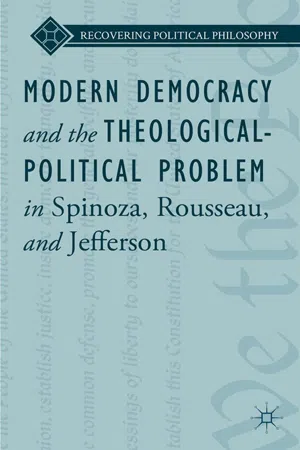
Modern Democracy and the Theological-Political Problem in Spinoza, Rousseau, and Jefferson
- English
- ePUB (mobile friendly)
- Available on iOS & Android
eBook - ePub
Modern Democracy and the Theological-Political Problem in Spinoza, Rousseau, and Jefferson
About this book
The book examines the intersection of two philosophical developments which define define contemporary life in the liberal democratic west, considering how democracy has become the only legitimate and publicly defensible regime, while also considering how modern democracy attempts to solve what Leo Strauss called the "theologico-political problem."
Information
CHAPTER 1
SPINOZA AND DEMOCRACY AS THE BEST REGIME
Several commentators have observed that Benedict (or Baruch) Spinoza was arguably “the first democrat in the history of philosophy” (Feuer 1980: 139; see also Rosen 1987: 456 and Smith 1997: 22). As we have seen, every major school of political philosophy prior to Spinoza was either reluctant to endorse, or openly hostile toward, the idea of democracy. Thus, it makes sense to begin our investigation of the philosophical origins of modern democracy with Spinoza. However, in order to understand his democratic political commitments and how they derive from his view of the theologico-political problem, it is first vital to examine Spinoza’s formative intellectual experiences in the unique historical context of seventeenth century Holland and his own family’s history of persecution and emigration.
Spinoza was born, in 1632, into the Portuguese Jewish community in Amsterdam. As a first generation Dutch-born child of Marrano parents, young Bento Espinosa grew up in a community still somewhat traumatized by a cruel history of forced conversion, official distrust, state persecution, and eventual expulsion from its Spanish and Portuguese homeland. The Dutch Republic, and Amsterdam in particular, was a haven for Jewish émigrés, well known for its commercial ambitions and its relatively tolerant attitudes toward religious minorities. As successful traders in imported dried foods from the Indies, Spinoza’s family was a respected, if not particularly prominent, part of Amsterdam’s Jewish community.
The United Provinces, or Dutch Republic, of the seventeenth century was a remarkable political entity by any measure.1 The rationale of the Dutch revolt, in the 1570s, from the Spanish Empire was essentially a defense of local rights and privileges, notably but not uniquely religious, against the centralizing project of Catholic Spanish rule. The Union of Utrecht of 1579, which bound the seven northern provinces of the Netherlands together, was conceived originally as a military alliance of independent provinces all of which swore to adhere to a perpetual union for their common defense against the empire. The tension in the notion of a union constructed for the sake of preserving provincial independence would become one of the central features of political life in what eventually would be called the Dutch Republic.
The Englishman William Temple shrewdly observed that the United Provinces were a “Confederacy of Seven Sovereign Provinces,” and that “each of these Provinces is likewise composed of many little States or Cities, which have several marks of Sovereign Power within themselves, and are not subject to the sovereignty of their Provinces” (Temple 1972: 52). Temple captured the essential characteristic of the Dutch Republic: it was a state form, yet one in which sovereignty by any conventional measure was difficult to locate. The general government (States-General) had no legislative, judicial or taxation power and had only limited control even over military policy, the presumptive rationale for the union in the first place. The provinces dominated the States-General government, as each province was equally represented, most matters required unanimity, and the delegates to the general government were selected by the Provincial-States and operated as agents under strict instructions from their principals. Moreover, the provincial-states controlled taxation by which power they—particularly Holland—supplied the general government with funds and could effectively hold it hostage. However, the provincial-states were themselves composed of delegates appointed by the city assemblies under the same rule of instructions governing delegates to the States-General, and typically operated on the basis of unanimity and equality of the constituent members. Each city had its own magistrates as well as legislative and judicial power generally not subject to the provincial states. The city councils of regents were thus the real source of political power in the Dutch Republic.
The only other quasi-national institutions in the Dutch Republic were the Stadtholderate and the Grand Pensionary. The Stadtholderate, identified with the aristocratic House of Orange, was, at least formally, a steward and military commander appointed by and to each of the separate provinces. However, the real strength of the Stadtholder was in his power as a symbol of national unity and in his role as the champion of formidable interests such as the orthodox Calvinist clergy, the rural nobility, smaller provinces wary of Holland’s dominance, and the urban multitudes that were largely excluded from a share in government by the oligarchy of regents. Because of its wealth and power, the Grand Pensionary or chief advocate of Holland held unique status in the Republic and as representative of the regent class of urban commercial elites—the Grand Pensionary was a natural rival of the Stadtholder. The ascendancy of Dutch statesman and advocate of toleration, Johan Oldenbarnevelt, in the early republic, and kindred spirits, the brothers Johann and Cornelius de Witt, in the stadtholderless period from 1650–72 revealed the potential strength of this position. However, their demise in 1619 and 1672 respectively at the hands of the Orange faction indicates its clear limits. Arguably, the power of both the Stadtholder and the Pensionary was rooted in the economic and cultural reality of Dutch society rather than the formal structures of the republic.
The most important conflicts in the Dutch Republic were along political and religious lines (Balibar 1998: 1–24). The political dynamic was dominated by the struggle for supremacy between the Orange faction representing the rural aristocracy, traditional Calvinists, and smaller provinces, on one hand, and the regent class representing the urban commercial interests centered in Holland and especially its largest city, Amsterdam, on the other. It would be misleading to call the regents democratic, as there was little real popular control or even public voice in the city and town councils of Holland and the provinces. However, they were republicans who resisted the centralizing tendencies and monarchical ambitions of the House of Orange. Spinoza was associated with the regent class politically, culturally, and even personally, as he came into maturity in the era of the de Witt ascendancy from 1650–72. This was a period marked by a climate of religious tolerance and intellectual freedom in philosophy and science, especially with the new scientia of Descartes, which proved enormously influential among the academic and political elites in the urban centers of Holland.
The political divisions in the Dutch Republic also coincided with serious religious controversies. Article 13 of the 1579 Treaty of Utrecht, which created the United Provinces, declared that “every individual should remain free in his religion, and no man should be molested or questioned on the subject of divine worship” (Nadler 2011: 27). This general commitment to toleration, which proved to be very attractive to Jewish refugees such as the Spinozas, actually tended to mask some of the profound cleavages within the Dutch Calvinist protestant majority. As far back as 1610 Dutch Calvinism broke into two factions that were bitterly opposed on the theological issue of predestination. The liberal Remonstrants rejected predestination while advocating religious tolerance and civil supremacy over the churches. The Remonstrants’ principles became the guiding philosophy of the regent class throughout the seventeenth century. The Counter Remonstrants were led by the orthodox Calvinist clergy supported by the House of Orange, who advocated a strict variety of Calvinism and opposed the principle of toleration. Given the loose legal structure of the confederacy and the deeply rooted theological disputes within Dutch Calvinism, it is not surprising that the Dutch Republic of Spinoza’s time was marked by the perpetual, if often latent, possibility for internal political violence.
These divisions within the republic had a profound impact on Spinoza’s philosophical career and personal life, especially his tendency toward a semi-reclusive existence among a small circle of friends and admirers far from the public eye. In 1656, at the age of 24, Spinoza was the subject of a cherem, or formal excommunication, from the Jewish community. This was the stunning conclusion to what had hitherto been a fairly traditional Jewish education. The specific charges in the excommunication relate to Spinoza’s reputed questioning of Moses’ authorship of the Torah and to his doubt about the immortality of soul. The more fundamental accusations that emerged over time, and followed him throughout his life, were that he was a follower of Cartesian materialist philosophy and shared the views of radical Protestant groups such as the Collegiants, who endorsed natural theology against scripture and harbored strong democratic sympathies. In addition to the stigma of expulsion from his synagogue, Spinoza also had the turbulence of Dutch politics to thank for his celebrated caution. Spinoza witnessed, at times personally, the persecutions and spasms of political violence that punctuated life toward the end of the stadtholderless period and that culminated in a French invasion and the lynching of the de Witt brothers by an Orange mob in 1672. Much of his adult life was thus spent quietly in small towns around Holland grinding lenses and working on treatises, the Ethics and the Theologico-Political Treatise, that he would complete and, in the case of the latter, publish anonymously in the last decade of his life.
Spinoza’s early experience of excommunication and sectarian division in Dutch political life made him acutely sensitive to the dangers attending thinkers who are not careful about how they conduct their research and craft their writings. In this intellectual climate, it is perhaps not surprising that Spinoza, the first philosophical democrat, made examining issues about textual analysis and various modes of discourse central to his own philosophical project. In this respect, two features of his thought stand out.
The first is Spinoza’s adoption of the “geometric method” of philosophical discourse in the Ethics. After his expulsion from the synagogue (if not earlier), Spinoza’s philosophical career began with his studies of Descartes under the guidance of the former Jesuit Franciscus Van den Enden, as well as his time as a student at the University of Leiden. The new, Cartesian approach to philosophy encouraged the replacement of traditional scholastic reliance on Aristotelian categories with novel ideas about proof, evidence, and reasoning drawn from Descartes’ geometric model of “clear and distinct” ideas. The Ethics is a prime example of a philosophical work inspired by geometry, with its Euclidean structure of a dense, almost impenetrable, network of propositions, proofs, axioms, and scholia. Spinoza quite self-consciously reveals that in this instance, the medium is indeed a big part of the message, when he promises to consider “human actions and appetites just as if it were an investigation into lines, planes or bodies.”2
Part I of the Ethics lays out the metaphysical basis upon which Spinoza grounds his entire philosophy. The radically new conception of God and nature that emerges in these propositions is unrecognizable from the perspective of traditional religious belief. Nature, Spinoza reasons, is a series of immutable physical laws determined by necessity. Everything that happens in nature, on some level, had to happen as it did. That is to say, everything can be explained in terms of natural laws. The effect of this necessitarian conception of nature is to banish any teleological consideration from philosophy. As Spinoza explains, all the prejudices that plague human understanding derive from “the widespread belief among men that all things in Nature are like themselves in acting with an end in view” (E1. App. 24). Spinoza asserts that the venerable Aristotelian “doctrine of Final Causes turns Nature completely upside down, for it regards as an effect that which is in fact a cause” (E1. App. 26). Spinoza’s conception of God in this necessitarian metaphysic is the infinite, necessarily existing, unique substance of the universe (Nadler 1999: 227). In other words, Spinoza’s God is the totality of nature expressed in the concept of substance. Every specific entity in nature is but a mode of this universal substance.
The implications of this identification of God with substance profoundly shaped Spinoza’s understanding of political theory and theology. This is not the God of the biblical tradition who exists and acts independently of the laws of physical matter. One would not have much reason to pray to Spinoza’s God. Moreover, Spinoza’s idea of substance amounts to a rejection of the concept of human nature as something distinct from non-human nature. There is no human essence, but rather a vast multitude of singular modes of similar beings (Sharp 2011: 86). The effect of this integration of humanity into a single concept of substance is to shatter what Spinoza takes to be the anthropocentric illusions about teleology and natural purposes that have historically prevented human beings from attaining a true scientific understanding of natural causation. Like the “tiny worm living in the blood” who is capable only of discerning among the various particles in its vicinity, human beings also tend to naturally mistake parts for the whole, and not recognize that “all bodies are surrounded by others and are reciprocally determined to exist and to act in a fixed and determinate way” (Spinoza 2006: 269). For Spinoza, truly appreciating our “insignificance” in the grand scheme of nature is perhaps paradoxically the first psychological hurdle that must be cleared in order to acquire knowledge (Den Uyl 2008: 105). To know nature scientifically is to know God, and thus to understand ourselves as human beings.
We shall argue that there is a deep connection between Spinoza’s metaphysics and his democratic politics. The doctrine of substance breaks down all hierarchy, even as redefining what is human as an exclusively natural phenomenon determined in the same way as every other natural phenomenon naturalizes and de-sacralizes the political community (Israel 2004: 15). The geometrical method incorporates necessitarian principles into Spinoza’s philosophical discourse insofar as “the structure of the universe, with its causally necessary connections, is mirrored by the structure of ideas, with their logically necessary connections” (Nadler 1999: 226). The Ethics, then, while clearly designed for a narrow audience of Cartesian philosophers in academic circles, would have a serious impact on political and theological debate precisely because of the radical implications for theology Spinoza embedded in a dense network of reasoning and “necessary” conclusions. As we shall see, while an anti-democratic thinker such as Thomas Hobbes would begin from similar necessitarian metaphysical premises as Spinoza, the latter would reach very different political conclusions from that of his English predecessor.
The other important feature of Spinoza’s philosophical approach is his use of the “historical method” of biblical exegesis in the Theologico-Political Treatise. Perhaps the most controversial aspect of Spinoza’s writings was the way in which the philosophical naturalism characterizing his metaphysics informed his interpretation of scripture. Not only was the Bible the authoritative text on religion, morality, and even politics in seventeenth-century Europe, it was also linked to the religious controversies that rocked the Dutch Republic throughout Spinoza’s life. Spinoza was well aware that presenting the Theologico-Political Treatise as an attack on superstition and bigotry would constitute an assault on the political pretensions of the Calvinist clergy who supported the House of Orange. It is for this reason that Etienne Balibar calls the treatise a “democratic manifesto” (Balibar 1998: 25). Whereas Spinoza partly concealed the radical teaching of the Ethics in its dense and opaque style, the deeply subversive character of the Theologico-Political Treatise was simply impossible to conceal. The primary audience of the two works is essentially the same: the “philosophical reader.”3 Spinoza pointedly discourages the “common people,” plagued as they are with superstition, from even reading the treatise. For the non-philosophical masses, it is best not “to read these things” as it would enflame their prejudices against “others who would philosophize more freely were they able to surmount the obstacle of believing that reason should be subordinate to theology” (TTP Pref. 15; Strauss 1952: 162–63). Balancing the goal to liberate philosophy from theology with what he took to be the need to preserve the moral authority of religion, that is, of the Bible, among the “common people” would be Spinoza’s central challenge in the treatise.
Spinoza’s historical method of biblical interpretation was part of a larger project of de-sacralization of the text, the basic tenets of which were twofold. First, Spinoza claims that scripture is not intended to convey knowledge or truth. In this respect, he challenges the authority of medieval Jewish philosopher Moses Maimonides, who insisted that nothing in scripture contradicts reason, therefore if a passage appears to be contradictory or illogical, it must be interpreted metaphorically to discern its true meaning (TTP 7.20). Spinoza assumes rather that scripture is “composed of historical narratives and revelations” that have nothing to do with natural knowledge and speculative philosophy (TTP 7.3). Scripture is thus directed exclusively toward moral instruction. Yet even as the historical method distinguished between philosophy and faith, it also encourages a degree of suspicion toward the text. As Warren Montag explains, whereas traditional scriptural interpretation rested on the assumption that to read means to “move from the appearance of disorder . . . to a hidden order and harmony,” for Spinoza, reading scripture involves moving from the specious unity attributed to the text by theologians toward “inconsistency, disorder, and absence” (Montag 2011: 164). As such, scripture can be interpreted only in light of evidence within the text itself. As we shall see, one of the central features in Spinoza’s stance toward Scripture was the tension between his insistence that the Bible is meant to serve as moral instruction, on one hand, and his encouragement of a certain suspicion toward the text, on the other.
The second element of Spinoza’s historical method is to treat scripture like any other human-created text. That is to say, the interpreter must be aware of the natural history of the Bible which includes thorough knowledge of the nature and properties of the language used, the life and character of each writer, and a thorough analysis of every ambiguous, obscure and contradictory passage in the text (TTP 7.5).4 Spinoza explains that when we approach scripture with a critical eye, we can begin to appreciate the enormous obstacles confronting interpreters seeking its real meaning. To start, modern people have only very imperfect knowledge of the syntax and grammar of ancient Hebrew. What we do know from the text, Spinoza observes, is that most of the Old Testament prophets were uneducated, ignorant, and parochial men with no philosophical or scientific training whatsoever. In addition, Spinoza claims that the biblical text that has survived to the present is the product of innumerable revisions and redactions by unknown editors over the centuries. Once Spinoza sets the lens of historical method upon the Bible, the effect is to make it look human-all-too-human.
There is no doubt that Spinoza’s historical method was meant to challenge and subvert the authority of the Bible in modernity as a basis for theoretical truth, as opposed to moral instruction. We shall argue that, more radically, Spinoza’s philosophical project was ultimately designed to eliminate all claims of revelation so that they can be cast as outdated forms of reasoning to be replaced by science. Indeed, the most distinctive features of the traditional biblical teaching on morality would fall victim to Spinoza’s ruthless methodology. The prophets, we are told, were inspired not by divine wisdom, but r...
Table of contents
- Cover
- Title
- Introduction: A Pre-history of Democracy
- 1. Spinoza and Democracy as the Best Regime
- 2. Rousseau and Democratic Civil Religion
- 3. Thomas Jefferson: Bringing Democracy Down from the Heavens
- Conclusion
- Notes
- References
- Index
Trusted by 375,005 students
Access to over 1.5 million titles for a fair monthly price.
Study more efficiently using our study tools.
Frequently asked questions
Yes, you can cancel anytime from the Subscription tab in your account settings on the Perlego website. Your subscription will stay active until the end of your current billing period. Learn how to cancel your subscription
No, books cannot be downloaded as external files, such as PDFs, for use outside of Perlego. However, you can download books within the Perlego app for offline reading on mobile or tablet. Learn how to download books offline
Perlego offers two plans: Essential and Complete
- Essential is ideal for learners and professionals who enjoy exploring a wide range of subjects. Access the Essential Library with 800,000+ trusted titles and best-sellers across business, personal growth, and the humanities. Includes unlimited reading time and Standard Read Aloud voice.
- Complete: Perfect for advanced learners and researchers needing full, unrestricted access. Unlock 1.5M+ books across hundreds of subjects, including academic and specialized titles. The Complete Plan also includes advanced features like Premium Read Aloud and Research Assistant.
We are an online textbook subscription service, where you can get access to an entire online library for less than the price of a single book per month. With over 1.5 million books across 990+ topics, we’ve got you covered! Learn about our mission
Look out for the read-aloud symbol on your next book to see if you can listen to it. The read-aloud tool reads text aloud for you, highlighting the text as it is being read. You can pause it, speed it up and slow it down. Learn more about Read Aloud
Yes! You can use the Perlego app on both iOS and Android devices to read anytime, anywhere — even offline. Perfect for commutes or when you’re on the go.
Please note we cannot support devices running on iOS 13 and Android 7 or earlier. Learn more about using the app
Please note we cannot support devices running on iOS 13 and Android 7 or earlier. Learn more about using the app
Yes, you can access Modern Democracy and the Theological-Political Problem in Spinoza, Rousseau, and Jefferson by L. Ward,Kenneth A. Loparo,Bruce King in PDF and/or ePUB format, as well as other popular books in Social Sciences & Political Philosophy. We have over 1.5 million books available in our catalogue for you to explore.