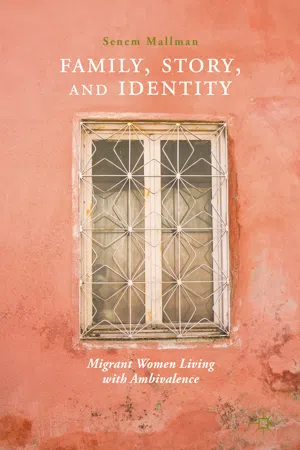
How do second-generation migrant women connect with their cultural heritage when ethnic ties have been weak or absent for most of their lives? Family, Story and Identity presents the life stories of twenty women of various ethnicities, analysis of published autobiographies, as well as autoethnographic accounts of the author's experiences, to show how stories connect adult children of immigrants with their cultural heritage. The collecting of stories comes in various forms and can include brief visits to ancestral homelands, documenting family histories and genealogies, and gathering stories, folktales, and recipes. Senem Mallman found that, as adults, many children of immigrants actively seek out family histories and stories in order to connect with their cultural heritage and with their parents, and to pass this knowledge on to their own children. She argues that seeking out stories enables the second-generation to find a place within their family narrative. This pursuit of stories leads them toward developing new perspectives about their culture, family and life in Australia, and new ways of living with their cultural ambivalence.
Senem MallmanFamily, Story, and Identityhttps://doi.org/10.1007/978-981-13-1915-0_1
Begin Abstract
1. Introduction
Senem Mallman1
(1)
La Trobe University, Melbourne, Australia
Senem Mallman
End Abstract
I want to begin by telling you how my mother’s story became a part of my own. When my mother was a teenager, in Adana, Turkey, her father decided that she needed to learn a trade. He removed her from school and sent her to sewing classes. My mother studied many crafts, knitting, crochet, embroidery, but her favourite was sewing. Her father bought her a sewing machine, which she used to make outfits and dresses for herself and for others. When she got married at the age of sixteen, she sewed her own engagement dress. It was a short, fitted dress made from white floral lace with silver embroidered trimmings. It was beautiful and unconventional.
In 1969, not long after they married, my parents migrated to Australia. They lived in the northern suburbs of Melbourne. My mother was employed as a machinist for Yakka, a work-wear clothing company. After many years, my parents purchased two industrial sewing machines, a straight stitching machine and a separate overlocker. They converted their garage into a sewing room, laying out carpet, bringing in old couches, a TV, bar-fridge, kettle, toaster, microwave, and dishes. My mother began to work from home, sewing for Australian clothing companies like Country Road and Witchery. For a while this was her work until most of the clothing companies went offshore. During this time, my parents struggled financially and decided to work as seasonal fruit pickers for income. She never sold her machines. Today she uses them to run a small local business doing alterations from home. For my mother, sewing was both a craft and a means of livelihood. She made creative dresses for herself, her children, and friends. Other times, she used her skill as a trade, to make a living.
I always took an interest in my mum’s sewing. When I wanted a particular outfit, I would go with my mum to Spotlight, an Australian retailer of fabrics, wool, and craft supplies, to find a pattern and choose a fabric. She would find all the necessary buttons, elastic bands, and zippers and we would return home with anticipation. At home, my mum and I would cut out the pattern while sitting on the floor in front of the television. Then we would go to the garage and I would watch her as she placed the patterns in their appropriate place on the folded fabric and skilfully cut out the shapes. While my mother made my clothes, I always remained by her side. In the mornings, I would make her a coffee and bring her a toasted cheese sandwich.
While she sewed, she would tell me stories about her memories of sewing and life in Turkey. During these times, she would talk about growing up in Turkey, her sewing lessons, and her love of singing. One story that remained engrained in my memory is about a time when she had climbed a tree and, thinking that she was alone, began to sing. My father’s aunty had passed by the tree and heard her singing. She went to my father’s mother and told her that my mother had grown up and had a beautiful singing voice. They told my father and the next day they went to see her. My father fell in love and asked for her hand in marriage. My mother would reminisce about her regrets and achievements, and about lost opportunities related to her singing voice, and remember how her schoolteacher wanted to encourage her singing but her father refused. She told me that after she was married, she had an opportunity to become famous but she was forbidden to by my father.
Many times my mother would tell me stories about her own mother. She told me that she thought about her mother every day. She admired her mother’s extraordinary intelligence and wisdom, and she channelled her mother’s hard work ethic in her everyday life. Her mother was a loving role model, strong and resilient. My mother’s stories of childhood, family, school, marriage, migration, work, and ageing are memories I cherish and learn from. These experiences of sewing with my mum were the contexts for her storytelling. My family heritage is now tied, through narrative, to my participation with her in the act of sewing, in the objects that were made, and in the memories connected to them. Her sentiments, her experiences, and her admonishments are all an important part of my own adult migrant identity.
I often think about my mother’s engagement dress and long to see and touch it, as one does with a family heirloom. My mother has kept her original suitcase from when she migrated. Inside, she has headscarves with hand crochet trimmings and doilies made by her mother and herself for her çeyiz (dowry). This suitcase has moved with her from house to house for over fourty-nine years and always remains on the top shelf of her bedroom closet. She brings it out every now and then to present its contents to her children and now her grandchildren. She tells stories about her mother and about her time creating the pieces that have remained folded away for so many years. Though I know it is not there, I still find myself imagining that one day her engagement dress will emerge from the suitcase, bright and white with its silver neckline. It does not. But the photo I have of her in her dress is enough (Image 1.1).
Image 1.1
My mother and father on their engagement day circa 1967
Not all children of immigrants have the opportunity to maintain significant ties to their parents’ homeland or their culture. Some have encountered a number of roadblocks in their quest to learn about their heritage. Many rely on stories. The gamut of stories heard while growing up become embedded in their everyday lives, manifesting as imagined experiences that motivate a calling to their cultural heritage in various shapes and forms. Stories can provide a foundation for future generations to learn about their predecessors. Such narratives can have a formative influence on the generational transmission of cultural heritage. Immigrant’s life narratives transmit to their children an idea of the hardships encountered, giving children the opportunity to re-imagine their lives in the context of what they come to know. Children of immigrants often do not understand the journey their parents undertook and cannot understand why this displacement has such a significant impact on them. A knowledge of past histories and narratives can better equip the children of immigrants to articulate their own experiences and identities in the context of their parents’ lives.
Migrants’ family stories are one of the driving forces behind the second generation’s motivation to connect with their cultural heritage and ancestry. Celia Falicov writes that families continuously reminisce about the past in ‘memory rituals’ and ‘daily family rituals’.1 These stories infuse the everyday lives of children of immigrants even if they are not necessarily attuned to their presence or aware of their significance. Falicov writes:
It is a mistake to think of this storytelling as merely a quaintly nostalgic or sentimental self-indulgence. Much of it serves to create a coherent narrative past and to make meaning out of inevitable transition into the present circumstances, as well as hopes for the future. Rather than feeling bored or tired about parents’ reminiscing, a good number of young people become attached to their parents’ land.2
This attachment—or calling, as suggested by Loretta Baldassar’s analogy of homing pigeons being ‘taught to return’—is ever-present in the lives of many children of immigrants.3 It is embedded in their daily lives and serves as the driving force behind motivations to explore their cultural origins and genealogical histories and can ‘preserve family coherence’ amongst the fragmentation and disconnection characteristic of immigrant families.4
Another powerful analogy is given in Noula Papayiannis’ research with second-generation Greek and Italian Canadian women. Papayiannis found that family stories are significant in that they provide the children of immigrants with ‘insights into the struggles and sacrifices of their parents’ and describes family stories as providing ‘helpful roadmaps for women in their own journeys toward a symbolic homeland’.5 Brad Ruting writes that the stories children of immigrants hear while growing up bring to life an awareness of living in the diaspora and the emotions of pain and separation and instil a sense of longing and curiosity.6 Merely hearing stories can construct a sense of ethnic identity. Without tangible links to their parents’ homeland and culture, stories are sometimes the only way children of immigrants are able to connect with their culture of origin.
Emotional ties to cultural heritage and ancestry can be reinforced through objects, photos, mementos, reflections, and conversations with others, to name a few. These intangible, emotional ties that children of immigrants develop have been defined by migration scholars as ‘indirect’7 or ‘emotional’8 ties to the homeland, or as ‘transnational behaviour and consciousness’.9 These are the ties that are explored in this book. Diane Wolf argues that second-generation migrants live a transnational life at an emotional level and engage in ‘emotional transnationalism’ even though they retain little or no direct ties to the homeland.10 Many of the interviewees in my research have few direct ties to their parents’ homeland, yet, as will be shown, they display deep emotional and symbolic ties to their family culture.
Stories of migration have shaped my understanding of some of the outcomes, encounters, experiences, and choices made by my parents. For children of immigrants, the life stories, folktales, and artefacts passed down from their parents can provide important connections or resources for the construction of a meaningful sense of identity. Physical objects are linked to stories, to the act of craft making, and to the memory of the people who made them. bell hooks’ maternal grandmother, Sarah Oldham (Baba), was a quilt maker: ‘To share the story of a given quilt was central to Baba’s creative self-expression, as family historian, storyteller, exhibiting the work of her hands.’ To her grandmother, ‘quilts were maps charting the course of our lives. They were history as life lived.’11 hooks likens quilt making to a tapestry of ‘visual history’ that became,
a text to be read and Baba would tell me the story of each dress and the girl who wore it. I could imagine then mama and her sisters, beautiful young girls, delighting in summer, wearing the much wanted, much beloved favourite dress.12
Handmade crafts remain and are passed down over the generations. While they may be a visual history, they also have memories connected to them that can only be related through stories told.13 Similarly, folktales and fragmented stories may be thought of as memory objects passed down through generations. Through the telling, they establish and maintain connections between the generations and the homeland.
Researching family history is another part of actively seeking out stories to learn about cultural heritage and ancestry. The women in this book collected genealogies, oral history, stories, and biographical documents wherever they could, archiving them for future reference and future generations. The collecting of stories itself became a part of their stories. Anne-Marie Kramer writes:
Genealogy allows belonging in time and connectedness across the generations, as well as belonging in new, or newly reconfigured places of significance. It therefore provides meaningfulness beyond the here and now, providing selves in the present with a geographical and/or temporal ‘place to stand’.14
Tracing genealogical kinship is important and personal for many people. It is like a homecoming. Paul Basu argues that travelling to the ancestral homeland allows the traveller to construct meaningful self-narratives from the ambiguities of their diasporic migrant histories.15 Searching for and visiting places associated with their ancestors is an opportunity for individuals to reconnect with a past from which they feel separated and to recover and constitute a sense of belonging to a particular place, culture, and family in the present.
Young children of immigrants are not always in a position to maintain close ties to their ancestral homeland. Their family history is often fragmented and incoherent and can be dispersed between different locations. At some point in their lives, as adults, many children of immigrants take the initiative to actively seek out family stories. Peggy Levitt argues that children of immigrants are directly or indirectly surrounded by references to the homeland ‘ideologically, materially and affectively, each day’.16 This constant reminder of heritage is the driving force behind the desire to learn about their family history. Seeking out stories can begin the process of healing old wounds caused by the tumults experienced in their youth. The process of ‘healing’ comes from constructing a ‘narrative map of the past’.17 They are comforted by a knowledge of family history and their place within the family narrative. The act of visiting homeland or collecting stories is the first step, and the outcome of this act is the creation of a meaningful self-narrative that connects their history with their present which, in turn, affects their future—they have a new outlook in their lives.
Scholars of migration and transnationalism have argued that transnational practices diminish over the generations. However, I agree with Peggy Levitt that, ‘it is far too early to sound the death knell for transnational practices among the children of immigrants’.18 Children of immigrants who are not engaged in identifiable transnational practices can find ways to connect with their culture of origin when transnational ties are weak or absent for most of their lives. Levitt advocates for a life-course perspective and suggests that ‘If we only examine the activities of the second-generation at a single point, we will miss significant ebbs and flows in involvement’.19 Similarly, Lynn McDonald writes that migration has a ‘profound influence on the ageing experience’.20 She maintains that in order to understand the effects of migration on individuals, a life-course perspective must be taken into consideration in conjunction with existing theories of understanding ageing.
At certain points in their lives, usually after a significant life-altering event, such as marriage, university, the death of a parent, or the birth of a child (or simply the curiosity that comes with age), adult children of immigrants seek to make sense of their lives in the context of their own past, their parents’ experiences, and, even in some cases, their ancestors.21 New experiences and stories are gathered and kept in their memories and become part of their life narrative. This very act of seeking out stories allows them to re-story their own life histories. Edward Bruner suggests that ‘narratives change, all stories are partial, all meanings incomplete’.22 This observation encourages a study of the changes in an individual’s life over the life cycle. It is especially apt for studying the second-generation experience because it not only addresses the temporal dimension of their lives but how the survival of particular problems or dominant cultural narratives can be reworked or re-storied to be understood in a different light.23
Michael White, a family therapist, who also studied anthropology, was particularly influenced by Edward Bruner. White developed the idea of people re-storying or re-interpreting their lives.24 Re-storying the dominant cultural narratives that have been a part of your life can radically shift your perception into a new and, ideally, more positive, alternative story. Using storytelling conventions, such as sequence, temporality, and plot, White and Epston developed ‘narrative therapy’. They encouraged clients to think of their lives and relationships as a story by mapping out their experiences as they would a story:
Stories are full of gaps which persons must fill in order for the story to be performed. These gaps recruit the lived experience and the imagination of persons. With every performance, persons are reauthoring their lives. The evolution of lives is akin to the process of reauthoring, the process of persons’ entering into stories, taking them over and making them their own.25
By reflecting back on their lives and explaining what these stories mean to them, people can begin to understand that meanings and perspectives can change. When experiences are re-storied, they are given new meaning, and when these stories are told, they shape the lives and relationships of all involved.26 This occurs for some second-generation migrants as they seek out alternative stories that contradict the dominant cultural story in which they have been immersed as children, generating new stories that change their perspectives of their history and future.
The dominant cultural story, as defined by Laurel Richardson, is the social and cultural narrative that exists within the everyday vernacular of mainstream society.27 However, it is not explicitly recognisable by the individual because they are so deeply embedded within these normative narratives. For the women in this book, the dominant cultural story in their lives has been the mainstream vernacular of Anglo-Australian society. When they were younger, the interviewees rejected parts of their family culture in order to identify with and fit into the status quo of Australian society. However, over time, they began to recognise that they were part of a different story, a ‘collective story’ that is the second-generation migrant experience. The collective story seeks to resist the dominant narratives and give ‘voice to those who are silenced or marginalized’.28 It shows the individual that they are part of a shared experience:
People who belong to a particular category can develop a ‘consciousness of kind’ and can galvanize other category members through the telling of the collective story. People do not even have to know each other for the social identification to take hold. By emotionally binding people together who have had the same experiences, whether in touch with each other or not, the collective story overcomes some of the isolation and alienation of contemporary life. It provides a sociological community, the linking of separate individuals into a shared consciousness.29
The collective story enables one to diverge from the dominant cultural story and provides new narratives that assist in the re-plotting or re-storying of a life: ‘we never cease to reinterpret the narrative identity that constitutes us, in the light of the narratives proposed to us by our culture’.30 Laurel Richardson argues that a recognition of the collective story brings with it ‘transformative possibilities’...
Table of contents
Cover
Front Matter
1. Introduction
2. Being on the Outside
3. Stories
4. The Prince
5. Changing Perspectives
6. The Newlyweds
7. People and Place
8. The Angel
9. Conclusion
Back Matter
Trusted by 375,005 students
Access to over 1.5 million titles for a fair monthly price.
Study more efficiently using our study tools.
Frequently asked questions
Yes, you can cancel anytime from the Subscription tab in your account settings on the Perlego website. Your subscription will stay active until the end of your current billing period. Learn how to cancel your subscription
No, books cannot be downloaded as external files, such as PDFs, for use outside of Perlego. However, you can download books within the Perlego app for offline reading on mobile or tablet. Learn how to download books offline
Perlego offers two plans: Essential and Complete
Essential is ideal for learners and professionals who enjoy exploring a wide range of subjects. Access the Essential Library with 800,000+ trusted titles and best-sellers across business, personal growth, and the humanities. Includes unlimited reading time and Standard Read Aloud voice.
Complete: Perfect for advanced learners and researchers needing full, unrestricted access. Unlock 1.5M+ books across hundreds of subjects, including academic and specialized titles. The Complete Plan also includes advanced features like Premium Read Aloud and Research Assistant.
Both plans are available with monthly, semester, or annual billing cycles.
We are an online textbook subscription service, where you can get access to an entire online library for less than the price of a single book per month. With over 1.5 million books across 990+ topics, we’ve got you covered! Learn about our mission
Look out for the read-aloud symbol on your next book to see if you can listen to it. The read-aloud tool reads text aloud for you, highlighting the text as it is being read. You can pause it, speed it up and slow it down. Learn more about Read Aloud
Yes! You can use the Perlego app on both iOS and Android devices to read anytime, anywhere — even offline. Perfect for commutes or when you’re on the go. Please note we cannot support devices running on iOS 13 and Android 7 or earlier. Learn more about using the app
Yes, you can access Family, Story, and Identity by Senem Mallman in PDF and/or ePUB format, as well as other popular books in Social Sciences & Cultural & Social Anthropology. We have over 1.5 million books available in our catalogue for you to explore.