- English
- ePUB (mobile friendly)
- Available on iOS & Android
eBook - ePub
About this book
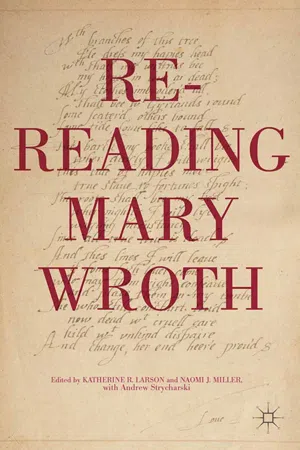
Approaching the writings of Mary Wroth through a fresh 21st-century lens, this volume accounts for and re-invents the literary scholarship of one of the first "canonized" women writers of the English Renaissance. Essays present different practices that emerge around "reading" Wroth, including editing, curating, and digital reproduction.
Information
P A R T I
Re-Examining Wroth: Authorship, Life, and Society
C H A P T E R O N E
Sleuthing in the Archives: The Life of Lady Mary Wroth
Margaret P. Hannay
How do we know what Lady Mary Wroth was really like? How can we know?1 What Judith Anderson says of early modern life writing is true of our own effort as well, that it “occupies a middle ground between history and art, chronicle and drama, objective truth and creative invention.”2 Life writing is by definition a narrative, and as such it partakes of literary conventions. Both biographies and autobiographies may be shaped, consciously or unconsciously, to fit the genre of romance, for example, or a conversion narrative, or martyrology.3 Lives can be shaped to make the subject a victim or a hero, and whether the arc of the biography is comic or tragic often depends on where it concludes, whether at a point of triumph or at the point of death, for in that sense the end of all lives is the same.
In constructing narrative the biographer and the biographical novelist face similar challenges, and the problems of the genre are most evident in life writing that is clearly fiction. Both the biographer and the novelist approach the life of their subject with the understanding that fact and truth are not necessarily synonymous; if we set up a scale with fact on one end and fiction on the other, then the “truth” about the subject often slides between these poles. Yet even in our postmodern era we are likely to admit the evidentiary value of the dates and locations of Wroth’s life—birth, marriage, the births and deaths of children, the deaths of parents and siblings and husband, and her own death. Can documents lie, even about such matters? Of course they can, but parish records normally seem to be quite accurate where they can be checked against other records. Next in evidentiary value may be economic records, such as account books and wills.4 Creativity in accounting is not unknown, but there seems little motivation for deceit by the Sidney agents recording Wroth’s dowry, for example.
Once we have collected all the available facts, we can say X occurs and then Y occurs, but then we reach the same problem that Philip Sidney says makes history akin to poetry, for the historian “must tell events whereof he can yield no cause; or, if he do, it must be poetically.”5 The evidence will often support conflicting interpretations. We might say that the biographer and the novelist thus perform similar narrative tasks, but they begin from different points, with the biographer providing material the novelist transmutes, as in Hilary Mantel’s splendid biographical novels Wolf Hall and Bring Up the Bodies, based on her friend Mary Robertson’s archival research on Thomas Cromwell.6 Important for Wroth in this regard is Naomi Miller’s forthcoming novel, The Tale-Teller.7 The historical novelist and the biographer might both visit places where the subject lived; learn about the religious, political, and philosophical context; and endeavor to avoid attributing modern ideas and customs to those who lived in a different era. Both may do considerable research on material culture—customs, clothing, food, architecture, and even the weather. Nevertheless, the novelist retains the freedom to invent details that cannot be discovered and to conflate minor characters, to change the order of events, and to shift locations; the best historical novelists alert readers to such artistic decisions.
Biographers tread a narrower path; events are presented when and where they occurred, insofar as that can be known. As Martin Stannard observes, “Writing a biography is like writing a novel in which the facts may not be invented, only the form.” The genre admits “no speculation without documentation.”8 When biographers fill in the gaps between verifiable facts, suggesting motivations and causality, those suppositions are signaled by hedge phrases: “she may have,” “possibly,” or, with somewhat more certainty, “probably.” The evidence will often support conflicting interpretations. In constructing narrative they are thus like novelists, yet biographers are tied to that data in a way that novelists are not. This is why Philip Sidney privileged the poet over the historian; the one creates a golden world, the other the brazen world in which we dwell. Perhaps the primary difference is in reconstructing consciousness; the novelist has a freer hand, imaginatively entering the subject’s mind. The biographer can never fully recapture Lady Mary Wroth’s nervous thoughts as she danced before Queen Elizabeth in an audition to become a maid of honor, or her despair as she wed a man she did not love, or her pleasure at the family’s laughter as they recognized melodramatic portraits of family and friends when she read aloud from her Urania. These thoughts may be developed in Naomi Miller’s novel, but appealing as such reconstructions may be, the biographer either leaves them to the novelist, or chooses to write a hybrid form.
The biographer is primarily a detective who begins by collecting evidence; “a biographer’s study is like the incident room of a major police investigation,” as Stannard observes of his own research.9 To find the thousands of bits of information to be assembled into a coherent narrative can take years in the archives, reading personal and official correspondence, wills, land grants and conveyances, court cases, acts of parliament, parish registers, account books, and genealogies. To write the first full-length biography of an early modern figure may mean searching for the most basic information (dates of birth and death, residence, marriages, children, grandchildren) by consulting all known primary documents and making informed guesses to track down additional sources. As Meg Bogin said years ago in her book on women troubadours, no one who has not worked in the field knows how dearly bought is a single fact.10 For example, Wroth died in the midst of the English civil wars, when records were in considerable disarray, and her death is not recorded in the parish records in any place where she had lived, including the Sidney family home of Penshurst, where several of her sisters and her nieces and nephews were buried. Wroth’s death was listed as 1651 or 1653 by William Chapman Waller in 1903, imprecise dating repeated in the old Dictionary of National Biography and subsequent accounts.11 A look at the Chancery document cited by Waller (TNA C10/110/89) shows why those two dates are given; there is a discrepancy in the huge document itself, which is based on court testimony, that is, various witnesses’ memory of events from nearly 20 years prior. To supply a more accurate date it took my eventual discovery of a reference in the Woodford Manorial Rolls in the Essex Record Office: Wroth died shortly (“nuper”) before April 3, 1651, when her daughter claimed Prouts, her mother’s property in Woodford Bridge (ERO MS D/DCw M23). Since it would take a few days after her mother’s death before Katherine could formally claim the property, we can probably assume that Wroth died in late March of 1651.12
Next to economic and legal documents in evidentiary value comes contemporary correspondence, particularly family correspondence. We have more information about Wroth’s childhood than that of almost any early modern writer from the more than three hundred surviving letters from Wroth’s father Robert Sidney, first Earl of Leicester, to her mother Barbara Gamage Sidney, Countess of Leicester, written during his long absences on the queen’s business; and from the long and vivid letters (1595–1602) of her father’s agent Rowland Whyte, who included family vignettes along with his political reports.13 As Noel Kinnamon, Michael Brennan, and I have been engaged in the long project of editing this voluminous correspondence we have discovered how unreliable some printed catalogues can be. In the eighteenth century, for example, Arthur Collins printed much of the Sidney correspondence, but he often condensed by leaving out things about the family, particularly women, and when he came to Whyte’s long letters, Collins had the habit of using bold swipes of heavy black ink on the originals to denote what he did not want transcribed. Sometimes he has completely obliterated the text, but sometimes we can see that the passage concerns family matters that he felt were too mundane to print—just exactly what the biographer wants to know. After family correspondence in evidentiary value come letters by those outside the family, like those delightful gossips John Chamberlain and Dudley Carleton, though they are sometimes misinformed. Veering even more toward fiction are dedications by poets hopeful of patronage; nevertheless, the terms of their praise may be instructive.
In a literary biography we can also study the writer’s own self- expression, but Wroth’s works may not tell us what we most want to know. Urania seems autobiographical, because the plot centers on members of two closely related families: the King and Queen of Naples and their children Amphilanthus, Urania, and Leonius, who shadow the Earl and Countess of Pembroke and their children William, Anne, and Philip Herbert; and the King and Queen of Morea and their children Pamphilia, Parselius, Rosindy, Philarchos, Philistella, and Bardariana, who shadow Wroth’s own family. As Gavin Alexander observes, Wroth’s “readers do seem . . . to concentrate on the woman behind the words.”14 Some events, like the deaths of Pamphilia’s siblings Parselius and Philistella, seem to allude to the deaths of Wroth’s own siblings, William and Philippa, and the obsessive repetition of tales of forced marriage and love for a cousin seems to glance at Wroth’s own arranged marriage and her love for her cousin William Herbert. Wroth’s writings are thus tantalizingly autobiographical, and yet they are completely unreliable as documentary sources, “as the biographical is simultaneously asserted and denied.”15 Details that seem as if they might be autobiographical, like Pamphilia’s black wedding dress, worn in honor of her brother’s recent death, employ a symbolic register and conflate family events.16 Wroth’s brother died some eight years after her marriage. Note also the account of her father’s embassy to France in the tale of Bellamira and Dettareus, which begins with family references and then careens into wild melodrama far from the prosaic events.17 Although forced marriage was prevalent in Wroth’s social circle, it was a literary convention in both comic and tragic modes, providing much of the plot not only of Wroth’s Urania and Love’s Victory but also of works such as Shakespeare’s A Midsummer Night’s Dream and Romeo and Juliet.
While collecting as much information as possible, the biographer must constantly evaluate the veracity of the data itself. Account books, wills, and land grants provide a different kind of truth than do letters, diary ent...
Table of contents
- Cover
- Title
- Introduction Re-Reading Mary Wroth: Networks of Knowing
- Part I Re-Examining Wroth: Authorship, Life, and Society
- Part II Re-Measuring Wroth: Form and Ritual
- Part III Re-Mediating Wroth: Editing and the Digital Humanities
- Part IV Re-Mixing Wroth: Beyond the Academy
- List of Contributors
- Index
Trusted by 375,005 students
Access to over 1.5 million titles for a fair monthly price.
Study more efficiently using our study tools.
Frequently asked questions
Yes, you can cancel anytime from the Subscription tab in your account settings on the Perlego website. Your subscription will stay active until the end of your current billing period. Learn how to cancel your subscription
No, books cannot be downloaded as external files, such as PDFs, for use outside of Perlego. However, you can download books within the Perlego app for offline reading on mobile or tablet. Learn how to download books offline
Perlego offers two plans: Essential and Complete
- Essential is ideal for learners and professionals who enjoy exploring a wide range of subjects. Access the Essential Library with 800,000+ trusted titles and best-sellers across business, personal growth, and the humanities. Includes unlimited reading time and Standard Read Aloud voice.
- Complete: Perfect for advanced learners and researchers needing full, unrestricted access. Unlock 1.5M+ books across hundreds of subjects, including academic and specialized titles. The Complete Plan also includes advanced features like Premium Read Aloud and Research Assistant.
We are an online textbook subscription service, where you can get access to an entire online library for less than the price of a single book per month. With over 1.5 million books across 990+ topics, we’ve got you covered! Learn about our mission
Look out for the read-aloud symbol on your next book to see if you can listen to it. The read-aloud tool reads text aloud for you, highlighting the text as it is being read. You can pause it, speed it up and slow it down. Learn more about Read Aloud
Yes! You can use the Perlego app on both iOS and Android devices to read anytime, anywhere — even offline. Perfect for commutes or when you’re on the go.
Please note we cannot support devices running on iOS 13 and Android 7 or earlier. Learn more about using the app
Please note we cannot support devices running on iOS 13 and Android 7 or earlier. Learn more about using the app
Yes, you can access Re-Reading Mary Wroth by K. Larson, N. Miller, K. Larson,N. Miller in PDF and/or ePUB format, as well as other popular books in Literature & European Literary Criticism. We have over 1.5 million books available in our catalogue for you to explore.