Despite pioneering studies, the term 'romance novel' itself has not been subjected to scrutiny. This book examines mass-market romance fiction in the U.K., Canada, and the U.S. through four categories: capitalism, war, heterosexuality, and white Protestantism and casts a fresh light on the genre.
eBook - ePub
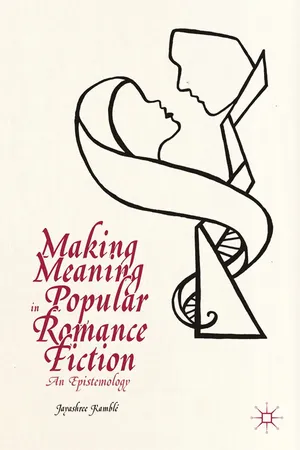
Making Meaning in Popular Romance Fiction
An Epistemology
- English
- ePUB (mobile friendly)
- Available on iOS & Android
eBook - ePub
About this book
Information
C H A P T E R 1
Capitalism: Money and Means in Romance Novels
Romance novels can function as the socially symbolic acts that provide access to the political unconscious by throwing into relief the dominant ideological movements of the last century —even as they often serve as exemplars of those ideologies. This chapter demonstrates this paradoxical state by highlighting the genre’s responsiveness to the most pressing economic imperatives facing its audience, especially after World War II. In particular, this analysis involves examining a trope that is often used in depicting the hero in romance novels in the second half of the twentieth century—that of the capitalist.
The successful businessman is one of the “masks” that the romance hero adopts when the genre is faced with new economic and social repercussions in its encounters with the growth of capitalism. (As Bakhtin notes, the hero of the novel, unlike the hero of the epic, is capable of wearing multiple masks. This is a necessity prompted by the fact that the novel embraces contemporaneity, which results in the content of the novel exceeding one protagonist; the excess must be absorbed by new masks (36).) While the romance hero has been scrutinized by critics like Snitow and Radway in terms of his place in the popular discourse on gender, his role in the economic worldview of the novels—his “mask” of the capitalist—has yet to be mapped fully. But numerous novels can testify to the extent to which the hero’s association with the profits of free enterprise has played an increasingly larger role in formulating the romantic plot over the century in which the genre has developed.
In the mask of the capitalist, the romance hero allows the faults as well as the attractions of capitalism to be represented by the corresponding off-putting or seductive traits of the lover. In staging the lover’s strategies and strengths in the courtship narrative, many novels use qualities such as cleverness and ruthlessness, characteristics borrowed heavily from the popular representations of CEOs and CFOs. The tack thus dramatizes in the love story a tale of big business and its impact on others. Casting the capitalist as romantic hero performs the function of personalizing the abstract economic force of the free market (almost the lone survivor of the wars between economic systems in the last 200 years).
The entwinement of courtship narrative with a narrative about capitalism has been a running theme in the novel since its inception. Raymond Williams touches on its impact in his assessment of British society as it is distilled in the works of Austen:
[Society] is an active complicated sharply speculative process: of inherited wealth and newly enclosing and engrossing estates; of fortunes from trade and colonial and military profit being converted into houses and property and social position; of settled and speculative marriages into estates and incomes. It is indeed that most difficult world to describe, in English social history: an acquisitive high bourgeois society at the point of its most evident interlocking with an agrarian capitalism that is itself mediated by inherited titles and the making of family names. (21)
The romanticizing of the male protagonists in this “long and complicated interaction of landed and trading capital” established a popular model for the romantic hero—one possessing a capitalist identity. The genre of twentieth-century popular romance retains both the economic mise-en-scène that originated in the late eighteenth century and the masculine ideal of the businessman, though this trope has evolved from one standing in for market capitalism to one representing multinational capitalism.
The preoccupation with men who own land, labor, and capital goods across national boundaries has become increasingly visible in most popular romance novels, from Harlequin Mills and Boon series titles, to single-title contemporary and historical romances published in the last four decades. It is unsurprising that the romance genre, a highly refined product of consumer capitalism, valorizes the system that produces it. The genre presents this economic system as the prerequisite for happiness by repeatedly endorsing a relationship between it (in the body of the hero) and the petite bourgeoisie and the proletariat (in the body of the heroine). It is undoubtedly ideological in respect to its fetishistic attraction to the bourgeois tale of courtship and love. But it does not solely validate corporate capitalism. The exposition and climax show the relationship to be combative and reveal fissures in the utopian capitalist universe. But Adorno, discussing television, suggests that such traits are in fact a classic feature of mass culture, allowing and defusing critiques of the system (Rosenberg et al. 479). It may be true that all cultural forms are embedded with a systemic failsafe mechanism that perpetuates some form of ideology. But it is, as Jameson suggests, the purpose of the Marxist critic to find the vein that contains the class conflict, the challenge to the ideological strategy (Political Unconscious 19–20). Romance fiction is rarely read in this light. Its identity as a mass-produced cultural form lends itself overwhelmingly to its indictment as a purely propagandist object. It is here that we must recall Marcuse’s distinction between the optimism of pure propaganda and the negating tendencies that lie in cultural forms that are not truly propagandist. Were the genre comfortably ensconced in the former category, postindustrial capitalism would be naturalized beyond questioning. But the discomfort that the affirmation of capitalism inspires spills out of the narrative, damaging its optimism and forcing the creation of the mask of the capitalist.
The Harlequin Mills and Boon Romance
Harlequin Mills and Boon novels provide a stylized image of the men who have controlled wealth over the last century.1 While they focus on the heroine’s ambivalence toward her sexual attraction for the hero and thus exonerate her of mercenary ambitions, the novels nevertheless employ wealth as a primary factor in the hero’s attractiveness. Moreover, the common plot device of revealing that the hero’s initially nefarious-seeming intentions were motivated by love works to garner approval of him and everything he represents. His brand of capitalism—ambitious, go-getting, swift, ruthless—becomes an inalienable part of his worth as a man, a husband, a social being. The novels ensure the approval of readers toward him through the implicit assertion that his lifestyle will always ensure a future devoid of financial hardship, but more importantly, will create space for an unending courtship even after the wedding. The Harlequin Mills and Boon hero’s independence from an earned wage is a marker that he is free to resume the role of suitor to his heroine at any time during the marriage without any financial risk to their life together.
Mills and Boon romance novels have been preoccupied with this economic backdrop, which assures a lifetime of a courtship-honeymoon, ever since it was first formulated in the fifties. But novels published in earlier decades under the firm’s romance fiction list were quite different in terms of the economic status of their protagonists. In the first half of the twentieth century, both Mills and Boon heroes and heroines were usually petit bourgeois, working clerical jobs or making a living as dentists, actors, doctors, or soldiers in the British army.2 These characters resembled the genre’s potential audience—white-collar workers with small disposable incomes. The novels played out a romantic development in the lives of the protagonists, one that did not typically cross class boundaries. Unlike the romance novels to come in the post-World War II years, the ones in the earlier period were not inclined to address class conflict, though they were deeply enmeshed in the reality of economic change and hardship that followed in the wake of World War I, especially for the working and professional classes. But the genre’s nascent stages dealt with a limited class perspective, appearing also to focus on a nationalist vision that seemed incompatible with overt discussions of class.3 Written during or after the British fervor inspired by World War I and within the existent economic universe (when British economic policies favored state regulation of industry and provided protection to small businesses), the novels seem disinclined to examine the weaknesses of the existent class structure and content to express just one class sensibility.
These novels differ from both the realist novel’s struggle to reconcile itself to the inevitable spread of imperial capital and the increasing loss of subjectivity it imposed on the common worker, as well as from the modernist novel’s attempt to distance itself from what it saw as the encroachment of commerce on the human spirit. In these early works, there is little engagement with the advent of a new phase of capitalism or its extant form. These narratives of a British working class or professional life deal with capitalism’s effects on the worker by divorcing them from their cause.4 But once economic policy moved away from state regulation to free trade after World War II and led to the collapse of less competitive firms and loss of jobs, Mills and Boon plots register dramatic changes. By mid-century, the fact of capitalism’s inevitable march is undeniable and the genre responds by reclaiming the structure of the courtship narrative to stage the reality of contemporary class struggle as acted out by the capitalist hero and petit-bourgeois heroine. Numerous Mills and Boon novels align the hero’s professional life and financial worth with corporate capitalism, emphasizing it further through the novel’s setting. In this new “formula,” the fantasy becomes one of financial security, which is guaranteed solely by an alliance with the intruding force of free market capitalism. In other words, the novels reenact the dialectical approach to a new form of capitalism that Jameson observes in Wuthering Heights.5 The genre’s decided interest in bourgeois money since the fifties confirms the all-pervasive impact of global capitalism and of the shift from Keynesian economics to the free market in Britain on its readers’ lives. The novels that had begun as romantic fantasy involving white-collar employees morph into the bourgeois fairy-tale in which the romantic relationship neutralizes the threat of the all-powerful capitalist.
Mills and Boon’s editorial guidelines began to emphasize the hero’s ascension as a corporate capitalist in the fifties and have been followed in innumerable novels since then. For instance, the Harlequin Mills and Boon website once described the ideal submission for a Modern Romance—an imprint under the main line—as “ . . . set in sophisticated, glamorous, international locations . . . [with a] focus on strong, wealthy, breathtakingly charismatic alpha-heroes” [emphasis added] (“Writing Guidelines”). Many of these novels focus almost exclusively on the ambitious businessman who has earned his riches and success. Descriptions of his world do not just provide a novelized version of Lifestyles of the Rich and Famous; they are repeatedly presented as the benefits of the hero’s devotion to corporate capitalism. A life of privilege as the dividend earned by capital makes its presence felt in nearly every chapter. Private jets, limousines, and multiple homes are indispensable elements in the Harlequin Mills and Boon series, and its “Continental hero” sub-genre also contains references to privately owned islands, planes, and yachts, not to mention well-tended gardens and Olympic-sized pools. There is frequent mention of housekeeping and grounds-keeping staff, security personnel, assistants, and personal physicians. All of this underscores the fact that the plots of romance novels not only function on the basis of those monetary advantages but are also inextricably tied to this economy. Rather than validating this system outright, however, the stories endorse it by making it the exclusive setting for their narrative of love, marriage, and happiness—other economic backgrounds or worldviews are rarely acknowledged as viable alternatives.
Nevertheless, the novels never dispense with class conflict. Though the romantic narrative is sustained through the bourgeois wealth that cushions the love affair, the novels contain reservations about the capitalist’s ethics, often as anxieties over his conduct in his sexual/romantic life. While the predilection for identifying the romance hero with the businessman begins shortly after World War II, the trope acquires a menacing component during the 1960s, one that has persisted into this millennium. In several Harlequin Mills and Boon novels published from then on, the hero is a successful industrialist, usually one who heads a conglomerate. In the instances where the hero has an aristocratic title, it has no real economic valence, occasionally functioning to give him a head start in carving out a position at the top of a capitalist economy. This hero has the Midas touch and in many instances is responsible for hostile takeovers of smaller, local businesses (or family properties), often entering the heroine’s life through such a business venture.6 She is typically the employee or daughter of the owner of the firm/property threatened by the hero and is placed in an antagonistic position to the new boss, frequently having to work for him or associate with him in some capacity. Their courtship involves the ruthless millionaire snubbing the heroine or overriding her conflicted feelings about his sexual advances by turns, thus exercising complete control over their interaction almost until the end of the novel. Eventually the narrative defuses the anxiety that the intrusion of this powerful figure has created in the heroine’s world through a symbolic solution: he declares his love, thus suggesting that she holds more power over him than he does over her. The plot arc appears to be a classic case of affirmative culture, with its defusing of any critical examination of corporatization.
When such plots were initially conceived, the corporate-head hero was in fact partly representative of the new British capitalism that was being fostered by the government at this time (and of the variant across the Atlantic). This plot line is visible in innumerable novels from the sixties on, including Charlotte Lamb’s Possession (1979).7 The heroine of this novel discovers that the family business is facing bankruptcy and suspects that successful business owner Dan Ryland is poised to take control of it. The only way the company can stay within the family is if Ryland gets something else in return for saving it, namely her. Her suspicions prove correct as Ryland coerces her into marriage. She vocally expresses her resentment of his insidious tactics throughout the narrative, while he dismisses each remonstrance as insignificant. The novel ends with his confession of love and douses the anxiety that he had incited through his style of conducting business.
There is a visible link between the ever-present anxiety in such novels and the shaping of Britain’s economic landscape by 10 Downing Street. The editors who played a significant role in directing Mills and Boon’s plots at this time were somewhat responsible for creating this link. According to Joseph McAleer, Mills and Boon’s editorial division began to encourage the above-mentioned economic disparity between hero and heroine (among other things) at the prompting of the editors of women’s magazines that purchased the serial rights for a novel (233). Editors like Winifred Johnson were credited with knowing what the readers wanted and exercised great influence on the genre from the forties on. Johnson herself was very conscious of political change in Britain, advising authors to adapt their works keeping new governments in mind.8 Novels that were modeled on those editorial directions sold well in the following decades because they were processing what Jameson would term their “social ground” (76). These Harlequin Mills and Boon romances voiced the fears of Britain’s economic decline (following the post-World War II boom), which culminated in the 1979 Thatcher government’s far from comforting solution to the crisis—promoting the free market. The latter led to the restructuring of British industry and significant levels of unemployment.9 The genre’s repeated focus on corporate takeovers (or some version thereof) evinces the results of Tory promotion of laissez-faire economics and later, the Thatcherite strategy to promote competition and force less cut-throat firms out of business. The subsequent loss of jobs and the assault on employees’ bargaining capacity is represented in these novels through the heroine’s precarious situation in the hero’s sphere of influence.
Numerous Harlequin Mills and Boon novels published during these decades thus dramatize the struggle to reconcile the demands of the bourgeoisie with the needs of the petite bourgeoisie and the working class in the romantic plot. These novels appease the fears they evoke by showing the salvation of the dominated once they—in this case, the heroines—accept the corporate marauder’s hidden benevolence. Thus, the conclusion of the romance—the betrothal, as Regis terms it—attempts to soothe the worry of the impact of the capitalist on the narrative’s original localized economy. At a time that trade unions are being broken, this union promises monetary stability for the heroine’s immediate family and often for the extended one, such as the workplace. It heralds the heroine’s move to financial security and happiness, and symbolizes the acceptance of the free market, which seems to be an inevitability anyway. It would be easy to label this narrative tendency as another example of the way mass culture creates false consciousness and encourages readers to accept bourgeois ideology. But the presence of hostile exchanges and anxiety in these novels and the relatively limited narrative space given to the “happy end” suggests that the Harlequin Mills and Boon series was voicing the conflicted British response to the gradual dismantling of the welfare state, the privileging of employer interests over those of employees, and the increasing bent toward privatization in the postwar years.
Critics like Snitow had noticed the implausibility of the Harlequin romance’s quick resolution to the conflict between the hero and heroine without fully comprehended its meaning: it is a symptom of the untenable nature of the populist unity Thatcherism attempted to create, aligning dominated classes with the dominant.10 While Stuart Hall points out that this policy exploited the problems of the Labour government’s emphasis on state control of industry and persuaded dominated classes to stand with the capitalist against “creeping collectivism” or socialism, popular forms like the Mills and Boon novels seem to have found it diffic...
Table of contents
- Cover
- Title
- Introduction: What Does It Mean to Say “Romance Novel”?
- 1 Capitalism: Money and Means in Romance Novels
- 2 War: Patriotism and the Damaged Romance Novel Hero
- 3 Heterosexuality: Negotiating Normative Romance Novel Desire
- 4 White Protestantism: Race and Religious Ethos in Romance Novels
- Conclusion: The Next Chapter for Romance Novels
- Notes
- Bibliography
- Index
Trusted by 375,005 students
Access to over 1.5 million titles for a fair monthly price.
Study more efficiently using our study tools.
Frequently asked questions
Yes, you can cancel anytime from the Subscription tab in your account settings on the Perlego website. Your subscription will stay active until the end of your current billing period. Learn how to cancel your subscription
No, books cannot be downloaded as external files, such as PDFs, for use outside of Perlego. However, you can download books within the Perlego app for offline reading on mobile or tablet. Learn how to download books offline
Perlego offers two plans: Essential and Complete
- Essential is ideal for learners and professionals who enjoy exploring a wide range of subjects. Access the Essential Library with 800,000+ trusted titles and best-sellers across business, personal growth, and the humanities. Includes unlimited reading time and Standard Read Aloud voice.
- Complete: Perfect for advanced learners and researchers needing full, unrestricted access. Unlock 1.5M+ books across hundreds of subjects, including academic and specialized titles. The Complete Plan also includes advanced features like Premium Read Aloud and Research Assistant.
We are an online textbook subscription service, where you can get access to an entire online library for less than the price of a single book per month. With over 1.5 million books across 990+ topics, we’ve got you covered! Learn about our mission
Look out for the read-aloud symbol on your next book to see if you can listen to it. The read-aloud tool reads text aloud for you, highlighting the text as it is being read. You can pause it, speed it up and slow it down. Learn more about Read Aloud
Yes! You can use the Perlego app on both iOS and Android devices to read anytime, anywhere — even offline. Perfect for commutes or when you’re on the go.
Please note we cannot support devices running on iOS 13 and Android 7 or earlier. Learn more about using the app
Please note we cannot support devices running on iOS 13 and Android 7 or earlier. Learn more about using the app
Yes, you can access Making Meaning in Popular Romance Fiction by Kenneth A. Loparo,Jayashree Kamblé in PDF and/or ePUB format, as well as other popular books in Literature & Literature General. We have over 1.5 million books available in our catalogue for you to explore.