- English
- ePUB (mobile friendly)
- Available on iOS & Android
eBook - ePub
About this book
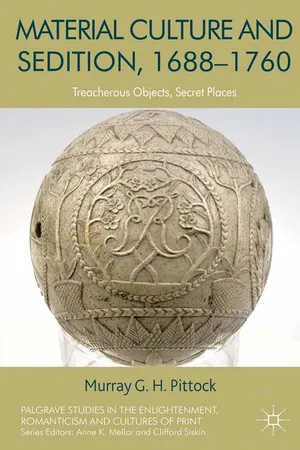
Material Culture and Sedition, 1688-1760 is a groundbreaking study of the ways in which material culture (and its associated designs, rituals and symbols) was used to avoid prosecution for treason and sedition in the British Isles. The fresh theoretical model it presents challenges existing accounts of the public sphere and consumer culture.
Information
1
Treacherous Objects: Towards a Theory of Jacobite Material Culture
‘What mighty Contests rise from trivial Things’
(Alexander Pope, Rape of the Lock)
Context
The study of Jacobitism has been operating on a steadily broadening base of scholarly inquiry since it began firmly to engage with conventional eighteenth-century historiography following the 1970 publication of the 1715–54 History of Parliament volume, and the role played by Eveline Cruickshanks in analysing the sympathies of Tory grandees and parliamentarians, later summarised in her Political Untouchables (1979) and placed in a wider context by Jonathan Clark’s English Society, 1660–1832 (1985; 2nd edn, 2000). Serious interrogation of the Jacobite world in a much deeper sense than that in which it had been previously understood has been advanced by studies as diverse as Howard Erskine-Hill’s The Social Milieu of Alexander Pope (1975), Paul Monod’s Jacobitism and the English People 1688–1788 (1989), my own Poetry and Jacobite Politics in Eighteenth-Century Britain and Ireland (1994; 2006), the late Breandan Ó Buachalla’s Aisling Ghéar (1996) and Daniel Szechi’s George Lockhart of Carnwath (2002). The history, literature and culture of Jacobitism, its role in national identities and internationally, have all been examined in much more detail than hitherto. In recent years, it has become increasingly clear that growing interest in the study of empire, diaspora, groups, networks and transcultural identities in the early modern period represents a fresh opportunity for scholars of the movement, as books such as Rebecca Wills’s The Jacobites and Russia (2002), Steve Murdoch’s Network North (2006) and Edward Corp’s books on the Jacobite courts in Italy and France have begun to make manifest.1
In the wider imperial world, the concept of ‘fratriotism’ – the adoption of the patriotism of other countries as a surrogate for one’s own – can be seen as suggestive of a lasting interest by many Jacobites at home and in diasporic groups in critiques of the British state and ‘imperial’ powers abroad. Just as with some among the radical generation of the period from 1790 to 1820, ‘imagining the King’s death’ became the basis among both Jacobite and radical networks and familes for a deeper and more endemic critique of imperial power, though such imaginations usually subsided into either nostalgic fantasy or the cultivation of alternative political oppositionalism, such as that of William Lyon Mackenzie, who led a revolt in Canada in the 1830s, or Joseph Hume the Greek patriot or Octavian Hume, co-founder of the Congress Party India.2
Both Jacobite and radical critiques of the British state often utilized the Roman republican rhetoric which, as Paul Monod has shown, was a key element in Jacobite ideological representation by the end of the 1730s (and, indeed, probably much earlier, as Katharine Gibson has suggested).3 The group of Jacobite exiles and ex-Jacobites who supported James Boswell on his Grand Tour in the 1760s and who on some occasions at least shared his interest in Corsican independence (a sympathy he presented in republican terms) form only one dimension of a multi-faceted phenomenon of networks, espionage rings, kinship bonds, cant, catchphrases, tokens, souvenir objects and voluntary associations, all of them evidence, in terms derived from Clifford Geertz, of a grouping of deep mental categories under the heading of social arrangements: in other words, a culture. To chart this kind of world we need a further new departure in Jacobite studies, one rooted not merely in a dynastic or national struggle but in the study of an inter- and transcultural phenomenon with elements of a language of symbol beyond text which simultaneously reflects, creates and memorializes text, a theoretical exploration which is relevant to accounts of other and related phenomena, such as 1790s radicalism. In other disciplines, following a long debate begun by Albert Mehrabian’s 1971 study, Silent Messages, it has been long accepted – though not always without challenge – that around at least 50 per cent of human communication is non-verbal. Yet historians have often relied on documents alone – not even private unrecorded speech – to assess ‘fact’ with apparently far greater confidence in their accuracy in recording what actually occurred. Of course, in recent years approaches have become more sophisticated, as the hidden omissions and condescensions of Rankean archival priorities have been better understood, and other methodologies, such as that of oral history, have themselves become more theorized through growing understanding of their mediation by processes such as composure and the social framing of memory.4 ‘History from below’ has also had a role to play in recovering the ‘fragments of forgotten conversations’ which landed previous generations in trouble with the authorities, as David Cressy and others have shown. The rising interest in the study of memory has potential to play an influential – though perhaps problematic – role, as Jacobite oppositional loci memoriae were both important to identify and of necessity unacknowledged; they had their character altered and inflected both towards and away from the shared framing of group identity. This was because they were simultaneously loci of both celebration and sanctuary, places to express a collectivity which it was yet always dangerous to communicate. In them, the ‘social dimensions of memory-sharing’ were inevitably compromised. Their ‘communicative memory’ was not merely cultural, and hence mediated: it was immediate, dangerous and treacherous, and its performances of the past hinted at a revolutionary futurity. Understanding the Jacobite world presents its own particular problems.5
Premises
The study of Jacobite culture, where communication – in all but a few privileged and/or private locations – was of necessity non-verbal or cant-inspired (see Chapters 3 and 4), requires both especial care and urgent attention to its complexities. This is the case both in the way that Jacobite material culture substitutes for conventional and articulated text and through the means by which it enshrines fragmentary text and uses it as a framework for shared memory.
There are two key areas for consideration in both these contexts. First is the acknowledgement of the enormous difficulties which faced Jacobite sympathizers in consigning their views openly to either print or speech because of the serious legal penalties attaching to so doing. As E. P. Thompson put it in 1975: ‘The press was muzzled, subject to prosecutions, and the thin surviving organs of opposition … wrote mainly in riddles. In few periods do the contemporary published sources give less away’. Thompson concluded that ‘the expression of people’s political sympathies was … often oblique, symbolic and too indefinite to incur prosecution’ (though there were apparently some daring balladeers who would ‘sing a ballad on a treasonable subject’ for money).6 But this leaves open the question of how communication, cultural solidarity and exchange were accomplished by the political opposition in such circumstances, which brings us to our second point of departure: the importance that objects, décor and material culture possessed with regard to communication in such a context, and the way in which this cuts across our now normative understanding of the nature of commerce, consumerism and show in the eighteenth century, while also providing fertile ground for an expansion of the study of memory. For if, as Nora argues, ‘space, gesture, image and object’ are indeed at the heart of the contrast between memory and history, and if both the ‘sacred context’ and the communication of the ‘incommunicable experience’ are core activities at memory sites, then the group activity and memorializations of oppositional and seditious groups are worthy of particular attention as both displaying to and perforce suppressing from a wider audience this kind of language of public celebration. This book will use the Jacobite world as its prime example and case-study of this; and in its postscript briefly considers the potential applicability of this case to the realm of subsequent politics.7
The Jacobite world is central to any study of the development of a culture of seditious memorialization conveyed through both code and object. Jacobitism was a major international political movement with both wealthy noble supporters and widespread popular appeal; it rose to prominence in the classic era for the development of the Habermasian public sphere; it contained nationalist elements and it made use of the development of consumer markets and the technological innovation and financial conduits which supported them. It also lasted for at least seventy-five years and produced a large European and North American diaspora. Jacobitism’s endurance, spread, depth and prolonged chronotope render it an ideal originary case-study for the memorializing and communication of politics beyond text, and its implications.
The most obvious thing about the Jacobite world , and one of the least acknowledged by those who demand traditional documentary trails of explicit primary archival material as the only acceptable routes to the exploration of its culture, is that it was a criminalized world. The major threats to Jacobite discourse, language, symbol, association, communication and display were the laws on treason and sedition. These could be very severe in their effects, not infrequently bearing the risk of a capital charge: they also varied across the three kingdoms of the British Isles, and were supported by a framework of legislation which imposed particular disabilities on Catholics, Scottish Episcopalians and English Nonjurors.
English laws on treason and sedition dominated proceedings against Jacobites, not least because of the extension of treason law – and with it the legal concept of misprision of treason – to Scotland by the 1709 Treason Act following the abolition of the Scottish Privy Council in 1708. In the years that followed, Scottish courts were so little trusted to deliver convictions against Jacobites that the treason trials of those involved in the Risings took place both under English treason law and in England under 25 Edward III. John Barrell famously argued in Imagining the King’s Death (2000) that this fourteenth-century statute was twisted in the 1790s to include acts of imagination which might seem to have a very indirect bearing on compassing the death of the sovereign, adhering to the Crown’s enemies and levying war, as the Act stipulated. Barrell’s research highlighted the extensibility of 25 Edward III in his chosen period (though, in fairness, scholars such as Roger Wells had noted ‘the imprecise extension of the definition of treason’ in the 1790s some time earlier): but the question is, is Barrell’s the only period in question? As the Stair Memorial Encyclopedia notes, ‘cases [of treason] up to the end of the eighteenth century … stretched the interpretation of the statute to barely acceptable bounds in an effort to fit the law to the modern behaviour it was designed to punish’.8 Stair’s allusion here is to a process extending ‘up to’ the end of the eighteenth century, not originating there. As James S. Donnelly, one of the leading scholars of Irish agrarian discontent, notes with regard to Waterford in his work on the Whiteboys of the early 1760s, ‘seven Whiteboys were hanged, five of them under … 25 Edward III, even though in burning a house they were far from levying war against the king’.9
There is plenty of evidence that the extensibility of treason legislation was not a development which began in the 1790s. The treason law of 25 Edward III (extended to Ireland in 1495 by Sir Edward Poynings’s Drogheda parliament, which sought to enshrine Henry VII’s suzerainty over the country) already had a long history of the extension of its original terms behind it. These dated back to the Peasants’ Revolt of 1381 and the 1378 Statute of Gloucester’s introduction of the concept of scandalum magnatum, slander and false report against the great nobles of the realm, which later came readily to be linked to speech tending to subvert the Crown. As 25 Edward III and its associated legislation became both the ‘principal means of enforcing not only new religious policies in England and Wales, but also self-consciously “imperial” policies’ in Ireland, the Act’s interpretation began increasingly to extend its remit to the policing of language (particularly so under Henry VIII). Given the limited resources of the enforcement of conformity in the hands of the early modern state, the emphasis on linguistic transgression was probably the route of least resistance. The conveniently baggy legal definition of ‘compasser ou ymaginer’ no doubt facilitated some of these changes. Equally, its vagueness may have helped to enable a long debate as to whether speech alone could be treasonable, one not solved even by countervailing rulings like the 1627 Hugh Pyne case, because of the habit successive administrations had of tinkering with the legislation in order to afford further protection to their more controversial acts or policies.
This was most marked under Henry VIII, whose 1535 Treason Act (26 Henry VIII c.13) ‘made dangerous all kinds of speech’ and rendered it treasonous to challenge either the king’s title or his religion. Alan Orr sees the ‘conflation of treason with the lesser offense of praemunire’ (support for either a foreign authority or one in opposition to the authority of the monarch) in the Tudor period as key to a process which synergized ecclesiastical and political disloyalty as alike verging on the category of treason. Even though Edward VI repealed the 1535 Act, the anti-heresy proceedings of Mary and Elizabeth’s virtual reintroduction of her father’s legislation by 13 Elizabeth I c.1 (1571) set up a potent nexus where speech against the monarch’s religion might be linked to speech against their title and thus to an implicit intention tending to their deposition which would lead to the offender’s being liable – as several Catholic clergy found – to a treason charge and a shameful death. ‘Seditious words’ might be no more than Catholic ones, and although sedition in and of itself might not be treason, it was closely allied to it. Suggestions that Charles I or Charles II were Catholics were themselves regarded as coming under this legislation, and were treated little differently from expressions of the view that Henry VIII was a heretic in an earlier age: the religious beliefs of the monarch were not a matter for debate, and to conjecture concerning them could itself be seditious.10
The statutory presence of a category of seditious libel from 1606 helped to intensify this process. Sedition became liable to be reinterpreted as high treason, a slippage accelerated if not created by the association of seditious publishing with the Parliamentary cause and hence armed rebellion against the Crown. The 1661 Sedition Act (13 Car 2 st 1 c1)(likewise as with 25 Edward III extended to Scotland shortly after the Union), rendered it treason to imprison, restrain or wound the king and marked out compassing, imagining, inventing and devising such procedures as also actionable. The inclusion of tumultuous petitioning in this list served to...
Table of contents
- Cover
- Title
- 1 Treacherous Objects: Towards a Theory of Jacobite Material Culture
- 2 Décor, Decoration and Design
- 3 Sedition, Symbols, Colours, Cant and Codes
- 4 Associations and Antiquarians
- 5 Propaganda: Medals, Weapons, Glass, Ceramics and Relics
- Postscript: The Making of Memory
- Appendix: Index of Symbols, Cant and Code
- Notes
- Bibliography
- Index
Trusted by 375,005 students
Access to over 1.5 million titles for a fair monthly price.
Study more efficiently using our study tools.
Frequently asked questions
Yes, you can cancel anytime from the Subscription tab in your account settings on the Perlego website. Your subscription will stay active until the end of your current billing period. Learn how to cancel your subscription
No, books cannot be downloaded as external files, such as PDFs, for use outside of Perlego. However, you can download books within the Perlego app for offline reading on mobile or tablet. Learn how to download books offline
Perlego offers two plans: Essential and Complete
- Essential is ideal for learners and professionals who enjoy exploring a wide range of subjects. Access the Essential Library with 800,000+ trusted titles and best-sellers across business, personal growth, and the humanities. Includes unlimited reading time and Standard Read Aloud voice.
- Complete: Perfect for advanced learners and researchers needing full, unrestricted access. Unlock 1.5M+ books across hundreds of subjects, including academic and specialized titles. The Complete Plan also includes advanced features like Premium Read Aloud and Research Assistant.
We are an online textbook subscription service, where you can get access to an entire online library for less than the price of a single book per month. With over 1.5 million books across 990+ topics, we’ve got you covered! Learn about our mission
Look out for the read-aloud symbol on your next book to see if you can listen to it. The read-aloud tool reads text aloud for you, highlighting the text as it is being read. You can pause it, speed it up and slow it down. Learn more about Read Aloud
Yes! You can use the Perlego app on both iOS and Android devices to read anytime, anywhere — even offline. Perfect for commutes or when you’re on the go.
Please note we cannot support devices running on iOS 13 and Android 7 or earlier. Learn more about using the app
Please note we cannot support devices running on iOS 13 and Android 7 or earlier. Learn more about using the app
Yes, you can access Material Culture and Sedition, 1688-1760 by M. Pittock in PDF and/or ePUB format, as well as other popular books in Literature & European Literary Criticism. We have over 1.5 million books available in our catalogue for you to explore.