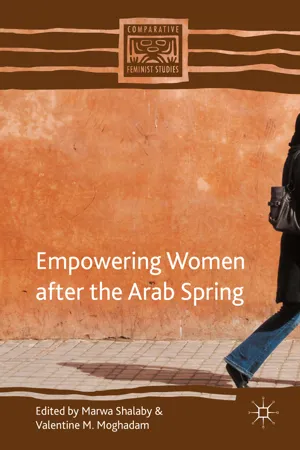
This book sheds light on some of the most critical issues impeding the advancement of women's rights post Arab Spring, such as patriarchy, barriers to women's agency in the legal and socioeconomic realms, women's access to the decision-making process, citizenship rights, and the impact of conflict on women's status. It offers a distinct perspective that takes into account the diversity of the Arab world and presents a theoretical framework on the study of women's empowerment amid the transformations that have shaped the social and political fabrics of Arab societies. Empowering Women after the Arab Spring represents cutting-edge research from a variety of academic disciplines — anthropology, political science, and sociology — and presents comparative analyses from places including the United Arab Emirates, Syria, Egypt, and Tunisia. This volume offers one of the first systematic efforts to combine qualitative and quantitative research to draw a more accurate picture of the realities of Middle Eastern women.
eBook - ePub
Empowering Women after the Arab Spring
- English
- ePUB (mobile friendly)
- Available on iOS & Android
eBook - ePub
Empowering Women after the Arab Spring
About this book
Information
Print ISBN
9781137567925
Subtopic
Middle Eastern Politics© The Author(s) 2016
Marwa Shalaby and Valentine M. Moghadam (eds.)Empowering Women after the Arab SpringComparative Feminist Studies10.1057/978-1-137-55747-6_11. Introduction: Deconstructing Women’s Empowerment in the Middle East and North Africa
Marwa Shalaby1
(1)
Rice University, Houston, TX, USA
Keywords
MENAEmpowermentArab SpringWomenAgencyPatriarchyWhat is empowerment? How is it measured and quantified? What are the basic pillars of empowerment? Is empowerment a static concept, or does it constantly vary and transform across time and different contexts? How can empowerment be studied amid societal and political transformation? Is it time to abandon the long-standing cultural paradigm applied to the study of gender and usher in a new era of feminist studies—one with a deeper and more nuanced understanding of women’s issues across the MENA region?
Since the onset of the Arab Spring, images of women at the forefront of the mass demonstrations and protests have significantly raised hopes that Arab women were finally breaking their silence, defying the status quo, and fighting for their own rights. Women across the Middle East and North Africa (MENA) region were not only forcing their way into the public sphere, but also shattering long-standing cultural stereotypes about their roles in society—not only in Egypt, Tunisia, and Libya but also in Bahrain, Syria, and Yemen—while defying brutal practices by persistent authoritarian regimes. Women played a crucial role in these popular uprisings by calling for dignity, bread, and social justice. They believed that gender equality and women’s rights were inseparable from popular demands for dignity and justice. However, the collapse of democratic aspirations throughout the MENA region—exacerbated by the weakening of state structures in many parts of the region and the rise of ethnic and religious conflict—negatively impacted the advancement of women’s rights, especially in post-revolution political systems.
Despite the fact that several Arab countries have taken considerable strides to improve women’s status since the onset of the Arab Spring, achieving gender parity is far from complete. Positive developments in several Arab states—such as Tunisia’s 50 percent constitutional quota for women, the repeal of the rape marriage law in Morocco, the guarantee of 25 percent of seats for women in Egypt’s municipal elections, and the introduction of the “zippered list” electoral mechanism in Libya—are just the beginning. Women across the region still face innumerable challenges, from honor killings, domestic violence, unjust personal and family laws, citizenship laws, and sexual harassment to discrimination in the workplace, the gender wage gap, occupational sex segregation, and unequal access to political and leadership positions.
Both academics and policy practitioners have come to the conclusion that there is an urgent need to initiate a comprehensive, gender-focused reform process based on a deeper understanding of the cultural peculiarities of the region, while paying special attention to the societal and structural challenges facing Arab women during and after transitions. Furthermore, it is becoming increasingly clear that change in regard to women’s rights must be initiated from within Arab societies; efforts over the past few decades to promulgate a hegemonic Western feminist agenda inattentive to regional cultural peculiarities and the diversity of priorities have proved futile in improving the social status of Arab women. As Sabbagh once eloquently stated, “Arab women carry many burdens, the worst being the popular stereotypes that serve to establish the positional superiority of western women and constitute a worse injustice against Arab women than the patriarchal oppression they must face in their own countries” (Sabbagh 1996).
The collection of essays in this book aims to present a comprehensive, interdisciplinary view of the opportunities as well as the challenges currently facing women in the MENA region, especially post–Arab Spring. As maintained by Cavadar and Yasar (2014), “a better understanding of Middle Eastern women requires analytical tools used in a comparative, contextualized, and interdisciplinary fashion instead of an exclusive focus on the methods that give attention only to outcomes” (p. 34). To achieve this goal, the analyses presented in this book shed light on some of the most critical issues impeding the advancement of women’s rights, such as patriarchy and Islam, barriers to women’s agency in the legal and socioeconomic realms, women’s access to the decision-making process, citizenship rights, and the impact of conflict on women’s status across the region. Finally, this edited volume strives to propose tangible policy prescriptions and insights based on the findings of the authors’ research to advance women’s rights at this critical point in the region’s history.
Reconceptualizing Women’s Empowerment Amid Political and Societal Transition in the Arab World
By and large, interest in gender issues in general—and women’s empowerment in particular—has gained momentum over the past few decades. The UN decade for women (1975–1985), the 1995 Beijing Fourth World Conference on Women, and the resulting Platform for Action (United Nations 1995), which emphasized women’s empowerment as the cornerstone of equality, development, and peace, paved the way for a new era of feminist scholarship. Empowerment has become a very powerful term that is extensively used across disciplines and among different academic and policy circles. Moreover, the past decade has witnessed the mainstreaming of the concept across different public and policy realms. However, various scholars and policy practitioners have critiqued the mainstreaming of “empowerment,” as they believe it distorts the original purpose and strength of the concept (i.e., the transformative power of empowerment to alter gender relations) by confining the term to the fields of development and economic growth (Batliwala 2007).
Ironically, despite the popularity of the term, as of yet, there is no universally accepted definition for empowerment. While various debates over the meaning of empowerment carry on (Beteta 2006; Drydyk 2013), many consider its ambiguity an advantage that gives scholars and policy practitioners the ability to “work it out in actions terms” (Batliwala 1994). Attempts to measure empowerment have also encountered challenges from both theoretical and practical standpoints (Batliwala and Pittman 2010; Pillarisetti and McGillivray 1998). Due to the multifaceted nature of empowerment, academics and policy researchers adopt different approaches to test its generalizability and effectiveness across different settings and cultures. While some scholars focus on the dichotomy of top-down versus grassroots/participatory approaches to the process of empowerment, others focus on the process from a developmental (i.e., collective) standpoint (USAID 2012) with little or no interest in understanding the mechanisms of empowerment on the individual level and its emphasis on the ideas of “agency,” “control,” and “choice.” Nonetheless, despite the obvious limitations of the developmental approach to the study of female empowerment (Porter 2013), the recognition of gender equality and female empowerment as critical prerequisites for achieving sustainable development and prosperity has undeniably transformed both policy research and practice.
Being the main pillar of “empowerment,” feminist studies have also witnessed the shift from a narrow focus on the notion of “power” that simply conceptualizes empowerment as the end goal, to a more nuanced approach that takes into consideration the context and barriers to women’s exercise of power (Rowlands 1998). Accordingly, empowerment is conceptualized as a tool to achieve desirable outcomes and specific goals. Its strength lies in its transformative ability to affect power relations in societies—most importantly, gender relations and the resilient patriarchal structures they produce. Consequently, many studies have emerged paying more attention to this dimension of individual versus collective empowerment. In this respect, Moser’s work offers an excellent example; she defines empowerment as “the ability to determine the choices in life and to influence the direction of change, through the ability to gain control over crucial material and non-material resources” (Moser 1993, 74–75).
There is a wide variation in how scholars conceptualize empowerment based on the approach they employ in their work. These variations have profound theoretical implications as well as empirical ones. Whereas empowerment was defined in 30 different ways over the past few decades (Alkire and Ibrahim 2007), Kabeer’s theoretical framework continues to be one of the most cited sources on the topic. In her seminal work, she defines empowerment as “a process of change during which those who have been denied the ability to make choices acquire such an ability” (Kabeer 1999, 437).
According to Kabeer’s definition, empowerment is deemed as a multistage process that revolves around the individual’s capacity to make choices, regardless of the nature or the context of the choices. Kabeer identifies three main elements necessary for the exercise of choice: resources, agency, and achievements. The resources element is external to the individual’s capabilities or control, and it entails the availability of necessary (pre-) conditions for survival that are social, economic, and institutional in nature. Agency, in contrast, is an internal process that depends on the ability of the individual to uncover his own preferences and objectives. Finally, achievement is deemed to be the final outcome of this process of change that mainly depends on the availability of resources and agency. As a result of this view, empowerment is depicted as both a process and an outcome (Papart et al. 2002).
Alternatively, Moghadam and Senftova define empowerment from a developmental standpoint as “a multi-dimensional process of civil, political, social, economic, and cultural participation and rights” (Moghadam and Senftova 2005). In this view, empowerment is a multidimensional process rather than a holistic, multistage process. The strength of this approach lies in the fact that it allows for the measurement and evaluation of women’s empowerment across different contexts and settings, using a number of uniform measures. The study presents 44 different indicators that measure seven main domains of empowerment: sociodemographic, bodily integrity and health, literacy and educational attainment, economic participation and rights, political participation and rights, and cultural participation and rights. 1 However, given the scarcity of data, especially in developing countries, combined with the difficulty of capturing changes in cultural and social norms often complicates the systematic study and application of this conceptualization of empowerment.
More recently, Haghighat defines empowerment from a sociocultural perspective, with a special focus on the MENA region. She argues, “Women’s empowerment cannot simply be defined in terms of being able to perform specific activities or benefitting from propitious outcomes. It results from a process whereby women can freely analyze, develop, and voice their needs and interests without being predefined or unwillingly imposed by religion, government, or social norms and where their influence and control extends beyond women’s familial/kinship circles” (Haghighat 2013, 274). According to this conceptualization, the process of women’s empowerment in the MENA region goes well beyond the narrow developmental and individualistic approaches. For that reason, efforts to improve the status of women in the region should pay special attention to the influence of family and kin relationships on limiting women’s ability to exercise power and make personal choices in their societies.
Notwithstanding the difficulties associated with defining and measuring the notion of empowerment across disciplines and contexts, the task gets even more daunting under the present situation in the MENA: a time of political and social transformation and uncertainty. The surge of violence and radicalism across the region continues to pose a real challenge to the promotion of women’s rights, and further, the ongoing volatility of the political and social structures of many Arab countries ra...
Table of contents
- Cover
- Frontmatter
- 1. Introduction: Deconstructing Women’s Empowerment in the Middle East and North Africa
- 1. Islamic Law and Gender Equality
- 2. Agency and Women’s Empowerment
- 3. Challenge and Progress Post Arab-Spring
- Backmatter
Trusted by 375,005 students
Access to over 1.5 million titles for a fair monthly price.
Study more efficiently using our study tools.
Frequently asked questions
Yes, you can cancel anytime from the Subscription tab in your account settings on the Perlego website. Your subscription will stay active until the end of your current billing period. Learn how to cancel your subscription
No, books cannot be downloaded as external files, such as PDFs, for use outside of Perlego. However, you can download books within the Perlego app for offline reading on mobile or tablet. Learn how to download books offline
Perlego offers two plans: Essential and Complete
- Essential is ideal for learners and professionals who enjoy exploring a wide range of subjects. Access the Essential Library with 800,000+ trusted titles and best-sellers across business, personal growth, and the humanities. Includes unlimited reading time and Standard Read Aloud voice.
- Complete: Perfect for advanced learners and researchers needing full, unrestricted access. Unlock 1.5M+ books across hundreds of subjects, including academic and specialized titles. The Complete Plan also includes advanced features like Premium Read Aloud and Research Assistant.
We are an online textbook subscription service, where you can get access to an entire online library for less than the price of a single book per month. With over 1.5 million books across 990+ topics, we’ve got you covered! Learn about our mission
Look out for the read-aloud symbol on your next book to see if you can listen to it. The read-aloud tool reads text aloud for you, highlighting the text as it is being read. You can pause it, speed it up and slow it down. Learn more about Read Aloud
Yes! You can use the Perlego app on both iOS and Android devices to read anytime, anywhere — even offline. Perfect for commutes or when you’re on the go.
Please note we cannot support devices running on iOS 13 and Android 7 or earlier. Learn more about using the app
Please note we cannot support devices running on iOS 13 and Android 7 or earlier. Learn more about using the app
Yes, you can access Empowering Women after the Arab Spring by Marwa Shalaby, Valentine M. Moghadam, Marwa Shalaby,Valentine M. Moghadam in PDF and/or ePUB format. We have over 1.5 million books available in our catalogue for you to explore.