- English
- ePUB (mobile friendly)
- Available on iOS & Android
eBook - ePub
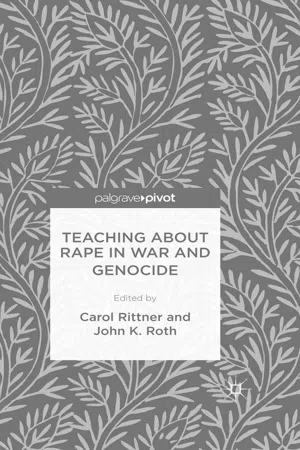
Teaching About Rape in War and Genocide
About this book
This edited volume is both a guide for educators and a resource for everyone who wants to strengthen resistance against a major atrocity that besieges human development. Its contributors explore a crucial question: how to teach about rape in war and genocide?
Information
1
Why Teach?
Carol Rittner, Ernesto Verdeja, Elisa von Joeden-Forgey, Hugo Slim, Maria Eriksson Baaz, Maria Stern, and Henry C. Theriault
Abstract: The importance of teaching about rape in war and genocide is intensified because that atrocity has become a strategy used intentionally by combatants to harm individuals and destroy communities. These utterly destructive atrocities cannot be curbed or prevented unless people are educated about them. Teaching about rape in war and genocide definitely needs to be done, but it cannot be done well apart from critical reflection about aims and assumptions, prospects and pitfalls. What hopes and expectations motivate teachers to enter this rugged terrain? Can teaching about rape in war and genocide help to curb or eliminate such atrocities? Questions such as these govern the reflections and suggestions about teaching in this chapter.
Keywords: assumptions; education; pitfalls; rape as strategy
Rittner, Carol, and John K. Roth, eds. Teaching about Rape in War and Genocide. Basingstoke: Palgrave Macmillan, 2016. DOI: 10.1057/9781137499165.0005.
Why teach about rape as a weapon of war and genocide? This book’s basic answer is that such education is crucial because no atrocity is more destructive of human dignity. Inflicted primarily on women and girls but on men and boys too, rape in war and genocide compounds the mayhem, suffering, murder, and death that mass violence inflicts on individuals, groups, and humanity as a whole by violating the most personal, intimate, and vulnerable parts of our embodied lives and spirits.
That response, however, arguably raises more questions than it answers. For example, is the aim of such teaching to prevent the use of rape and other kinds of sexualized violence in war and genocide? If so, the effort seems futile and wasted, for we only need to read the daily newspaper, watch the evening news, or browse the internet to see that such work, no matter how well-intentioned, has not achieved its goal. Furthermore, can one teach about war and genocide without paying attention to rape? Why not focus on other dimensions of war and genocide—propaganda and hate speech; the destruction of homes and villages; the motivations of perpetrators and bystanders; mayhem, torture, and murder; the survivors? Why teach about a topic that may arouse prurient interests? And who wants to face the fact that human beings—all of us, men and women alike—have the capacity to inflict such violence? Who wants to confront the ethical questions one inevitably must ask about rape in war and genocide?
These tough questions must be confronted. If they are not, too much will be lost. So this chapter addresses the question, “Why teach?”—not just why teach in general, but why teach specifically about rape as a weapon in war and genocide? In addition to emphasizing that teaching about rape in war and genocide definitely needs to be done, the discussion that follows also stresses that sound teaching in this area requires keen awareness and ongoing assessment of the hopes and dangers that accompany entry into that rugged terrain. Furthermore, this chapter shows that the question “Why teach?” is scarcely separable from the question “How to teach?” Indeed, responses to the latter help to explain why teaching about rape in war and genocide is so important.
Attitudes
Carol Rittner
For centuries, war, genocide, and rape have been linked in a deadly dance.1 But during the twentieth and twenty-first centuries, rape and other sexualized violence in armed conflict have become an integral part of war and genocide, a strategy used intentionally by combatants to harm individuals and to destroy communities.2 If these facts are not sufficient to mandate teaching about rape in war and genocide, one scarcely can imagine any other considerations that could do so. Why teach about rape in war and genocide? The most direct response is simply: because these utterly destructive atrocities happen, and they cannot be curbed or prevented unless people are educated about them. If this judgment makes sense, then the question “Why teach?” urgently prompts inquiry about the best way to do so, which entails reckoning with attitudes and dispositions.
For too long, little was said about sexualized atrocities in war and genocide because women were silenced by cultural taboos and unwarranted shame. Rape became “war’s dirty secret.”3 When attention was drawn to it, some scholars expressed skepticism, arguing that such atrocities were so fraught and controversial that accurate study and teaching about them were unlikely to happen.4 Others, however, disagreed.5 Their persuasion prevailed to such an extent that sexualized violence in armed conflict, including the use of rape as a weapon of war and genocide, is now discussed much more openly in college and university classrooms, among peacekeepers and humanitarian workers, in the military and non-governmental organizations.
Sexualized violence in armed conflict is of such concern that Ban Ki-moon, the United Nations Secretary-General, has appointed a Special Representative to focus on it, and the UN Security Council has passed resolutions to condemn it. Criminal tribunals to prosecute perpetrators have been established, and celebrities and public officials convene global summits to protest and resist these crimes.6 Typically, those discussions, special representatives, resolutions, tribunals, and global summits have focused on women and girls as victims of sexualized violence and on men and boys as perpetrators of it. That emphasis rightly reflects the fact that rape in war and genocide is usually inflicted on women and girls by men. The focus, however, is expanding, appropriately, because men and boys also are victims of such violence.
Sexualized assaults against men and boys as well as women and girls take place for many of the same reasons: to humiliate, torture, destroy, and silence individuals and communities. Males and females are abused in different but similar ways: brutally and sadistically, with rifles, bottles, sticks, poles, machetes, and knives. Men and boys are castrated and sterilized. Sometimes they are forced to rape their mothers and sisters, their fathers and brothers. “There are certain things you just don’t believe can happen to a man,” said one survivor. “Everybody has heard women’s stories. But nobody has heard men’s [stories].”7
Often, men and boys are reluctant to speak about the sexualized atrocities inflicted upon them because of attitudes about gender roles and what it means in some societies to be a man. Men are expected to protect themselves and their families, including their women; they are not expected to be victims of sexualized violence. In some societies, negative religious and cultural attitudes toward gays, bisexual, and transgender men and boys also inhibit open discussion about males as victims of conflict-related sexualized violence. And in some societies in which homosexual intercourse—regardless of consent—is punished harshly, male rape victims experience the worst possible humiliation: “Their women say to them, ‘Are you a man or a woman?’”8
How, then, can one teach about this difficult yet demanding topic? The challenges are many, but in teaching about sexualized violence in armed conflict, including rape as a weapon of war and genocide, one can helpfully incorporate the following practices:

And finally, one should,
Although some scholars and teachers remain concerned that attention paid to male victims of rape in war and genocide will detract from the fundamental need to stress what happens to women and girls in those circumstances, teachers should emphasize that “compassion is not a finite resource” and “concern for ... men and boys, need not signify the lessening of concern for women and girls.”9
Beginnings
Ernesto Verdeja
In courses on comparative genocide, justice and reconciliation, and peace studies, I have taught about sexualized violence in war and genocide for more than a decade. Persistent challenges include how to introduce that difficult and emotional topic and set the stage for meaningful discussion about it. Here are some of the key points that my teaching has taught me.
First, teaching about rape in war and genocide differs from other kinds of teaching. Obvious though that point may be, its importance should not be underestimated, for the horror of such atrocity requires significant sensitivity on the part of the instructor, whose attitude, tone, and teaching style set the general tenor of class discussion. It is not enough to master the details, the scholarly literature, or the variety of relevant explanatory models. Students are often unsure how to make...
Table of contents
- Cover
- Title
- Introduction: Tackling Overlooked Issues
- 1 Why Teach?
- 2 Who Should Teach and Learn?
- 3 What Needs to Be Taught?
- 4 How Should One Teach?
- 5 When and Where?
- Conclusion: Time Will Tell
- Selected Bibliography
- Index
Trusted by 375,005 students
Access to over 1.5 million titles for a fair monthly price.
Study more efficiently using our study tools.
Frequently asked questions
Yes, you can cancel anytime from the Subscription tab in your account settings on the Perlego website. Your subscription will stay active until the end of your current billing period. Learn how to cancel your subscription
No, books cannot be downloaded as external files, such as PDFs, for use outside of Perlego. However, you can download books within the Perlego app for offline reading on mobile or tablet. Learn how to download books offline
Perlego offers two plans: Essential and Complete
- Essential is ideal for learners and professionals who enjoy exploring a wide range of subjects. Access the Essential Library with 800,000+ trusted titles and best-sellers across business, personal growth, and the humanities. Includes unlimited reading time and Standard Read Aloud voice.
- Complete: Perfect for advanced learners and researchers needing full, unrestricted access. Unlock 1.5M+ books across hundreds of subjects, including academic and specialized titles. The Complete Plan also includes advanced features like Premium Read Aloud and Research Assistant.
We are an online textbook subscription service, where you can get access to an entire online library for less than the price of a single book per month. With over 1.5 million books across 990+ topics, we’ve got you covered! Learn about our mission
Look out for the read-aloud symbol on your next book to see if you can listen to it. The read-aloud tool reads text aloud for you, highlighting the text as it is being read. You can pause it, speed it up and slow it down. Learn more about Read Aloud
Yes! You can use the Perlego app on both iOS and Android devices to read anytime, anywhere — even offline. Perfect for commutes or when you’re on the go.
Please note we cannot support devices running on iOS 13 and Android 7 or earlier. Learn more about using the app
Please note we cannot support devices running on iOS 13 and Android 7 or earlier. Learn more about using the app
Yes, you can access Teaching About Rape in War and Genocide by J. Roth, C. Rittner, J. Roth,C. Rittner in PDF and/or ePUB format, as well as other popular books in Politics & International Relations & Teacher Training. We have over 1.5 million books available in our catalogue for you to explore.