This book explores the luxury industry and how it has undoubtedly been one of the fastest-growing sectors since the 1970s, and one in which Europe has managed to strengthen its competitiveness in the world market. While many aspects of globalization remain abstract and intangible, the luxury industry has created markets where previously there were none, by educating Japanese about the history of French handbags, Chinese about the finest wines, and setting global standards for an elite, inspirationallifestyle. In this edited volume, a wide range of scholars comes together to analyze the history of the business and the innovations in management and marketing that have emerged from it. Invaluable for scholars, industry figures, and dilettantes alike, it will define the field of study for years to come.
eBook - ePub
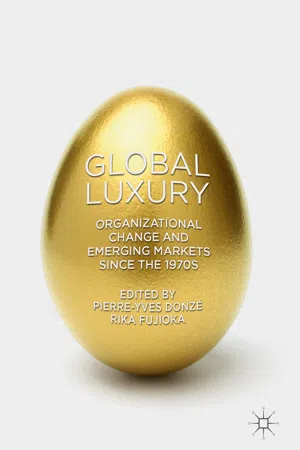
Global Luxury
Organizational Change and Emerging Markets since the 1970s
- English
- ePUB (mobile friendly)
- Available on iOS & Android
eBook - ePub
Global Luxury
Organizational Change and Emerging Markets since the 1970s
About this book
Information
© The Author(s) 2018
Pierre-Yves Donzé and Rika Fujioka (eds.)Global Luxuryhttps://doi.org/10.1007/978-981-10-5236-1_11. Introduction
Pierre-Yves Donzé1 and Rika Fujioka2
(1)
Graduate School of Economics, Osaka University, Toyonaka, Osaka, Japan
(2)
Faculty of Business and Commerce, Kansai University, Suita, Osaka, Japan
Pierre-Yves Donzé (Corresponding author)
Rika Fujioka
The luxury goods industry has undoubtedly been one of the fastest-growing sectors since the 1970s, and one in which Europe has managed to strengthen its competitiveness within the world market. According to the consulting firm Bain & Company, global sales in the luxury industry (including fashion, jewellery, watches, and cosmetics) shot up from 73 billion euros in 1994 to 253 billion euros in 2015 (Bain & Company 2015).
The second characteristic of this industry is that luxury business is based on relatively new firms, although they hold and manage brands with a history going back to the nineteenth century and even earlier for few of them. In 2013, most of the top 25 largest luxury groups (see Table 1.1) were indeed founded during the 1980s and the 1990s, or are older firms whose growth was based principally on the acquisition of other brands and companies since the 1980s. Hence, one can argue that the luxury business is a new industry, if one considers its organizational structure and largest actors. Yet the contemporary success of luxury goods throughout the world results essentially from their brand identity, which emphasizes both their timeless nature and their embodiment of heritage , craftsmanship, and history. Overcoming the contradiction between the modern organization of luxury companies and the traditional image of their product is one of the key challenges faced by this industry (Donzé and Wubs 2017).
Table 1.1
Top 25 largest luxury groups of the world, 2013
Rank | Company name | Most important brands | Country (headquarters) | Year of foundation | FY13 luxury goods sales (US$mil.) | FY13 total revenue (US$mil.) | FY13 net profit margin (%) |
|---|---|---|---|---|---|---|---|
1 | LVMH Moët Hennessy-Louis Vuitton SA | Louis Vuitton, Fendi, Bulgari, Loro Piana, Emilio Pucci, Acqua di Parma, Donna Karan, Loewe, Marc Jacobs, TAG Heuer, Benefit Cosmetics | France | 1987 | 21,761 | 38,717 | 13.5 |
2 | Compagnie Financiere Richemont SA | Cartier, Van Cleef & Arpels, Montblanc, Jaeger-LeCoultre, Vacheron Constantin, IWC, Piaget, Chloé | Switzerland | 1988 | 13,429 | 14,275 | 19.4 |
3 | The Estée Lauder Companies Inc. | Estée Lauder, M.A.C., Aramis, Clinique, Aveda, Jo Malone | United States | 1946 | 10,969 | 10,969 | 11.0 |
4 | Chow Tai Fook Jewellery Group Ltd. | Chow Tai Fook | Hong Kong | 1929 | 9979 | 9979 | 9.6 |
5 | Luxottica Group SpA | Ray-Ban, Oakley, Vogue Eyewear, Persol, Oliver Peoples | Italy | 1961 | 9713 | 9713 | 7.5 |
6 | The Swatch Group Ltd. | Breguet, Harry Winston, Blancpain, Longines, Omega, Rado, Swatch | Switzerland | 1983 | 8822 | 9128 | 22.8 |
7 | Kering SA | Gucci, Bottega Veneta, Saint Laurent, Balenciaga, Brioni, Sergio Rossi, Pomellato, Girard-Perregaux | France | 1992 | 8594 | 12,948 | 0.4 |
8 | L’Oréal Luxe | Lancôme, Biotherm, Helena Rubinstein, Urban Decay, Kiehl’s | France | 1909 | 7791 | 7791 | 14.7 |
9 | Ralph Lauren Co. | Ralph Lauren, Polo Ralph Lauren, Purple Label, Blue Label, Black Label, RLX Ralph Lauren | United States | 1967 | 7450 | 7450 | 10.4 |
10 | PVH Corp. | Calvin Klein, Tommy Hilfiger | United States | 1881 | 6200 | 8186 | 1.8 |
11 | Shiseido Co. Ltd. | SHISEIDO, clé de peau BEAUTÉ, bareMinerals, NARS, ISSEY MIYAKE, ELIXIR, Benefique | Japan | 1872 | 5404 | 7659 | 3.8 |
12 | Rolex SA | Rolex, Tudor | Switzerland | 1905 | 5398 | 5398 | n/a |
13 | Hermès International SCA | Hermès, John Lobb | France | 1837 | 4975 | 4975 | 21.3 |
14 | Coach , Inc. | Coach | United States | 1941 | 4806 | 4806 | 16.3 |
15 | Prada Group | Prada, Church’s, Car Shoe | Italy | 1913 | 4776 | 4776 | 17.8 |
16 | Lao Feng Xiang Co., Ltd. | Lao Feng Xiang | China | 1848 | 4175 | 5329 | 2.7 |
17 | Tiffany & Co. | Tiffany & Co., Tiffany | United States | 1837 | 4031 | 4031 | 4.5 |
18 | Burberry Group plc | Burberry, Burberry Brit, Burberry London, Burberry Prorsum | United Kingdom | 1856 | 3704 | 3704 | 14.3 |
19 | Michael Kors Holdings Limited | Michael Kors, MICHAEL Michael Kors | UK | 1981 | 3311 | 3311 | 20.0 |
20 | Hugo Boss AG | BOSS, HUGO, BOSS Green, BOSS Orange | Germany | 1924 | 3231 | 3231 | 13.7 |
21 | Coty Inc. | Lancaster, Calvin Klein fragrance; Licensed fragrance brands: Marc Jacobs, Chloé | United States | 1904 | 3186 | 4552 | −1.4 |
22 | Swarovski Crystal Business | Swarovski | Austria | 1895 | 3095 | 3894 | n/a |
23 | Giorgio Armani SpA | Giorgio Armani, Emporio Armani, Armani, A/X Armani Exchange | Italy | 1975 | 2904 | 2904 | 1.1 |
24 | Chow Sang Sang Holdings International Ltd. | Chow Sang Sang | Hong Kong | 1948 | 2571 | 3242 | 4.9 |
25 | Luk Fook Holdings (International) Ltd. | Luk Fook | Hong Kong | 1991 | 2420 | 2477 | 9.7 |
Finally, another major characteristic of the luxury business is its high profitability. In 2013, companies such as Swatch Group , Hermès and Michael Kors had a net profit margin of 20% or more, while nine other enterprises of the top 25 had figure between 10% and 20%. Only one (Coty Inc.) was in deficit that year (see Table 1.1). Consequently, these companies attract the attention of investors and present usually a long-term growth largely superior of other blue chips in worldwide stock exchanges. Such a profitability results from the new management strategy implemented in the 1970s and 1980s which aimed at creating more economic value through building brands and controlling distribution .
1 Understanding the Dynamics of the Luxury Industry
The luxury industry has not always been the big business which it is today. Therefore, it is important to understand the dynamics of this sector in order to have a proper view over the conditions of its historical evolution, the way it was transformed into a fast-growing activity, and the reasons for its present-day success. Scholars in history, business history and management have focused on various aspects and issues of the luxury industry (Donzé and Fujioka 2017). Academic works can be roughly classified into two major fields, each of which adopts a different focus on “luxury”, making it to integrate these two perspectives.
Firstly, there are researches published by management scholars, notably in marketing (e.g. Okonkwo 2007; Chevalier and Mazzalovo 2008; Chevalier and Xiao 2009; Kapferer and Bastien 2009; Tungate 2009; Berghaus et al. 2014). Most of these works provide useful knowledge on luxury companies. They focus on luxury brands and analyze how these brands are built and managed, and h...
Table of contents
- Cover
- Frontmatter
- 1. Introduction
- 1. Organizational Change
- 2. Markets
- 3. New Strategies
- Backmatter
Trusted by 375,005 students
Access to over 1.5 million titles for a fair monthly price.
Study more efficiently using our study tools.
Frequently asked questions
Yes, you can cancel anytime from the Subscription tab in your account settings on the Perlego website. Your subscription will stay active until the end of your current billing period. Learn how to cancel your subscription
No, books cannot be downloaded as external files, such as PDFs, for use outside of Perlego. However, you can download books within the Perlego app for offline reading on mobile or tablet. Learn how to download books offline
Perlego offers two plans: Essential and Complete
- Essential is ideal for learners and professionals who enjoy exploring a wide range of subjects. Access the Essential Library with 800,000+ trusted titles and best-sellers across business, personal growth, and the humanities. Includes unlimited reading time and Standard Read Aloud voice.
- Complete: Perfect for advanced learners and researchers needing full, unrestricted access. Unlock 1.5M+ books across hundreds of subjects, including academic and specialized titles. The Complete Plan also includes advanced features like Premium Read Aloud and Research Assistant.
We are an online textbook subscription service, where you can get access to an entire online library for less than the price of a single book per month. With over 1.5 million books across 990+ topics, we’ve got you covered! Learn about our mission
Look out for the read-aloud symbol on your next book to see if you can listen to it. The read-aloud tool reads text aloud for you, highlighting the text as it is being read. You can pause it, speed it up and slow it down. Learn more about Read Aloud
Yes! You can use the Perlego app on both iOS and Android devices to read anytime, anywhere — even offline. Perfect for commutes or when you’re on the go.
Please note we cannot support devices running on iOS 13 and Android 7 or earlier. Learn more about using the app
Please note we cannot support devices running on iOS 13 and Android 7 or earlier. Learn more about using the app
Yes, you can access Global Luxury by Pierre-Yves Donzé, Rika Fujioka, Pierre-Yves Donzé,Rika Fujioka in PDF and/or ePUB format, as well as other popular books in Business & Business General. We have over 1.5 million books available in our catalogue for you to explore.