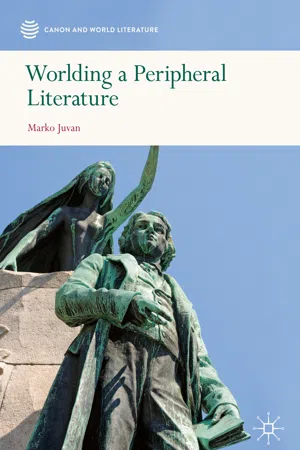
Bringing together the analyses of the literary world-system, translation studies, and the research of European cultural nationalism, this book contests the view that texts can be attributed global importance irrespective of their origin, language, and position in the international book market. Focusing on Slovenian literature, almost unknown to world literature studies, this book addresses world literature's canonical function in the nineteenth-century process of establishing European letters as national literatures. Aware of their dependence on imperial powers, (semi)peripheral national movements sought international recognition through, among other things, the newly invented figure of the national poet. Writers central to dependent national communities were canonized to represent their respective cultures to the norm-giving Other – the emerging world literary canon and its aesthetic ideology. Hence, national literatures asserted their linguo-cultural individuality through the process of worlding; that is, by their positioning in the international literary world informed by the supposed universality of the aesthetic.
- English
- ePUB (mobile friendly)
- Available on iOS & Android
eBook - ePub
Worlding a Peripheral Literature
About this book
Information
© The Author(s) 2019
M. JuvanWorlding a Peripheral LiteratureCanon and World Literaturehttps://doi.org/10.1007/978-981-32-9405-9_11. Introduction
Marko Juvan1
(1)
Research Center of the Slovenian Academy of Sciences and Arts, Ljubljana, Slovenia
Keywords
Literary world-systemGlobalizationDialogueHegemonyNationalizationWorldingIn his private notes, written during the fascist repression of the Slovenian minority in Italy, the Slovenian writer Vladimir Bartol (1903–1967), who was compelled to leave his native Trieste and flee across the Italian border to Ljubljana in his youth, boldly considered his novel Alamut (1938) a potential global hit (see Košuta 1988: 554, 1991). In fact, the text gives the impression that it was conceived to become an international bestseller, in precisely the style that Rebecca Walkowitz defines as “born translated” (Walkowitz 2015: 3–4). It uses an easily translatable style, draws on Orientalist historical knowledge, sets the story in exotic eleventh-century Iran, displays erudition, clings to successful genre patterns, creates suspense, and addresses big issues of totalitarianism, dictatorship, terrorism, and conspiracy theory. In the very year of its first publication in Slovenian, Bartol tried to offer his novel to the global cultural market. He submitted a screenplay about Alamut Castle directly to the Hollywood film metropolis, but MGM studios rejected it. Fifty years later, Alamut nevertheless began to gain worldwide popularity. It has been translated into almost twenty languages, including English (Bartol 2004). In 2007, the plot and idea of Bartol’s Orientalist novel even inspired the popular series of video games Assassin’s Creed, and the Slovenian newspaper Delo reported on 22 February 2013, that the French film director and scriptwriter Guillaume Martinez was enthusiastically planning to screen Alamut and make an international hit out of it. Alamut’s success story remains unfinished; it still has not been adapted for film. As a matter of fact, Bartol’s entrance into global literary traffic occurred due to a favorable, although contingent, historical situation and thanks to a global metropolis. In 1988, when Alamut was first translated into French, its story and setting coincided with the topicality of Islamic fundamentalism after Khomeini’s revolution in Iran. Needless to say, the global obsession with Islamic radicalism, terrorism, and suicide bombers continues to hold sway after 9/11, Al Qaeda, and ISIS—whatever poses a permanent threat to Western-style democracies and the world-system is suitable for the topicality of Bartol’s novel.
The case of Alamut shows that peripheral authors, even those subjected to repression of their native language (their primary instrument), may have a sense of the world literary space and a desire to take a position in this space. Moreover, when writing intertextually and drawing on transcultural resources, peripheral authors from small literatures and expressing themselves in minor languages appear to have a better chance at establishing themselves internationally, however troublesome and delayed their entrance to the world literary traffic might be. However, such cases are rare, and even rarer is international canonization of peripheral authors. Probably hardly any player of the game Assassin’s Creed has ever heard of Bartol, and it would be difficult to find a globally prominent literary critic or scholar that would mention Bartol among the top fifty world writers of the twentieth century. Alamut is quite popular across the world, but its author is a far cry from being an international celebrity. This paradox leads to the problem of the author function and the canon. The power of the author function seems to vary according to the historically changeable position of a particular writer in the world-systems of languages and literatures. How and to what degree do authors partake in the world literary space if they come from a peripheral (minor, weaker, dependent ) literary system? Compared to authors of major literatures, what are their chances of becoming recognized, world-famous, awarded, and included in the international literary canon?
While everybody knows Assassin’s Creed without having the slightest idea of Bartol as a peripheral writer, everybody is familiar with the name of Goethe without knowing how he sought to overcome the peripherality of German letters vis-à-vis the European West. Johann Wolfgang von Goethe, the internationally recognized promoter of the idea of world literature (his quotes recur as a topos in every narrative on the history of the concept), originally referred to the term Weltliteratur in order to lend a touch of cosmopolitan universality to his writing and establish his position as a “classical national author” (Goethe 1963: 239–244) in the German lands and Europe alike. In other words, the idea of world literature was instrumental not only in rectifying Goethe’s intercultural intertextuality and his social networking in the international respublica litterarum but also in his self-canonizing efforts to become a German classic. He aimed to assume the role of a nation-founding author whose classical universality would simultaneously transcend nationalist parochialism and represent the authority central to European literary life. Evidently, he wanted to help German letters—which he held as backward in comparison to renowned Western literatures—achieve international recognition on the purportedly universal basis of humanism and the aesthetic mode of cultural consumption. Such ambitions that surfaced in the context of the nineteenth-century European national movements seem to be at odds with Goethe’s canonical position in world literature today and with the current centrality of Germany in the European core of the world-system. Hence, Goethe’s enormous lifetime success and posthumous canonicity obliterated the particularly semi-peripheral and nationalist subtext of the presumed universality implied in his influential notion of world literature.
In comparison with existing narratives on world literature featuring Goethe, I would instead call attention to his role in the nineteenth-century nexus of national and world literatures. As I corroborate in this book, Goethe exemplifies the authorial function of a nation-representing author from a (semi-)periphery whose canonicity establishes a symbolic link between national and world literatures as interdependent entities. Having explored the asymmetrical relations between a peripheral literary field and the world literary system, I go on to show how a marginal perspective on the original Goethean nexus of national and world literatures influenced the emergence and development of one of the internationally least studied East-Central European peripheries: Slovenian literature.1
The central figure of my theorizing on the nexus of national and world literature in peripheral Romanticism is the Slovenian national poet France Prešeren (1800–1849).2 He was born as the third of eight children to a respected Upper Carniolan peasant family. His mother was literate, knew German, and intended Prešeren for the priesthood. At school in Ljubljana (1812–1813), his talent was spotted and encouraged by his enlightened and Francophile teacher Valentin Vodnik (1758–1819), celebrated as the author of the first Slovenian printed volume of secular poetry (1806). While finishing his studies at the University of Vienna, he dropped his clerical ambitions and enrolled as a law student, providing for himself by various means such as scholarships or work as a private tutor to the future poet Anastasius Grün and others. He received a doctorate in law in 1828. While in Vienna, he presented his early poetry in 1825 to the renowned Slavic philologist Jernej (Bartholomäus) Kopitar, who advised patience and a more polished reworking of his texts. After obtaining his degree, Prešeren returned to the Carniolan town of Ljubljana, where he planned to practice law. After his jurisprudential qualification exam (1832), several applications for his law practice were unsuccessful because of his bohemian lifestyle, which raised the suspicion of him being a Freigeist. Ultimately, in 1846, he was allowed to practice in the provincial town of Kranj, where he worked until his death.
Prešeren’s life was marked by a series of platonic relations or flirtations with mostly much younger women. The most notable was Julija Primic, the German-speaking daughter of a wealthy Ljubljana merchant family, whom he poetically idealized as a Petrarchan “Laura” (1833–1836). In the 1830s, he reconnected with the philologist Matija Čop (1797–1835) and oth...
Table of contents
- Cover
- Front Matter
- 1. Introduction
- 2. The Canonicity of World Literature and National Poets
- 3. Perspectivizing World Literature (in Translation)
- 4. The Birth of National Literature from the Spirit of the Classical Canon
- 5. World Literature in Carniola
- 6. A Compromise “World Text”
- 7. Worlding the National Poet in the World-System of Translation
- Back Matter
Trusted by 375,005 students
Access to over 1.5 million titles for a fair monthly price.
Study more efficiently using our study tools.
Frequently asked questions
Yes, you can cancel anytime from the Subscription tab in your account settings on the Perlego website. Your subscription will stay active until the end of your current billing period. Learn how to cancel your subscription
No, books cannot be downloaded as external files, such as PDFs, for use outside of Perlego. However, you can download books within the Perlego app for offline reading on mobile or tablet. Learn how to download books offline
Perlego offers two plans: Essential and Complete
- Essential is ideal for learners and professionals who enjoy exploring a wide range of subjects. Access the Essential Library with 800,000+ trusted titles and best-sellers across business, personal growth, and the humanities. Includes unlimited reading time and Standard Read Aloud voice.
- Complete: Perfect for advanced learners and researchers needing full, unrestricted access. Unlock 1.5M+ books across hundreds of subjects, including academic and specialized titles. The Complete Plan also includes advanced features like Premium Read Aloud and Research Assistant.
We are an online textbook subscription service, where you can get access to an entire online library for less than the price of a single book per month. With over 1.5 million books across 990+ topics, we’ve got you covered! Learn about our mission
Look out for the read-aloud symbol on your next book to see if you can listen to it. The read-aloud tool reads text aloud for you, highlighting the text as it is being read. You can pause it, speed it up and slow it down. Learn more about Read Aloud
Yes! You can use the Perlego app on both iOS and Android devices to read anytime, anywhere — even offline. Perfect for commutes or when you’re on the go.
Please note we cannot support devices running on iOS 13 and Android 7 or earlier. Learn more about using the app
Please note we cannot support devices running on iOS 13 and Android 7 or earlier. Learn more about using the app
Yes, you can access Worlding a Peripheral Literature by Marko Juvan in PDF and/or ePUB format, as well as other popular books in Literature & Languages. We have over 1.5 million books available in our catalogue for you to explore.