
- English
- ePUB (mobile friendly)
- Available on iOS & Android
eBook - ePub
About this book
The Lost Leaders presents the personal stories of women who achieved success in corporate leadership, but have chosen to abandon their careers, providing a fascinating glimpse of the culture that exists in the contemporary corporation.
Information
P A R T 1
Accidental Careers
In the 1950s, William H. Whyte, Jr. wrote “The Organization Man,” and provided us with a description of the stereotypical businessman of that era.1 He is a man, of course, and conforms to a strict conservative code, assimilating easily into the office culture of the time. He will be loyal to one company his entire career and his loyalty will earn him job security and a gold watch, not to mention a nice pension plan, upon retirement.2 The workplace was still dominated by these organization men when the Lost Leaders first began entering it in the late 1970s. By the 1990s, when they began to leave, the environment had changed dramatically; there is now little loyalty on the part of either the company or the employee. But the men still looked pretty much the same, and they still had no problem assimilating into cultures that were created by the organization men that came before them.
But what of the “organization woman?” Based on the Lost Leaders in this book, I offer this composite for the organization woman of the 1990s: Although she didn’t grow up expecting to have a lofty title and earn a six-figure salary, she finds herself in a beautifully appointed corner office with a large staff reporting to her. She is highly educated, having earned an MBA at night while building her career. She is married with two children and is constantly challenged both by the logistics of a young family and the emotional energy it takes to hold down an executive position and raise children at the same time.
When I first met each Lost Leader, I asked her to tell me the story of her career. I grew up at roughly the same time, so I knew that we didn’t set our sights on the “C-suite” as children. Somewhere during our childhood, when we learned that girls grew up to be wives, mothers, and sometimes teachers, the women’s movement happened. We weren’t quite old enough to participate in the movement, but it changed our lives and the lives of all women. Now we could have it all, or so we were told. These new options led the women in this book to become business professionals and eventually executives. None of them, and I’d venture few of this era, had this as her childhood dream.
In the next five chapters (chapters 1–5), the women describe how their paths led into business, how they became the executives whose careers took the turns that led them to be Lost Leaders. They also introduce us to the companies where they built their careers and to some of the “characters” that play significant roles in their stories. These stories give you a sense of who they are and what they might have contributed to the success of American businesses, if they had been given the opportunity and were not lost so early in their careers. Although some of the women stayed in business until they were in their fifties, their careers had been stalled much earlier by the obstacles they faced. Not all of those obstacles are the result of them being female in male-dominated workplaces. In some cases they chose not participate in the business practices and treatment of employees that they felt were not proper or ethical. Was their view of business ethics skewed by their being female? Possibly. Are there male executives who also objected? Certainly. The stories the women tell will reveal some of the culture and practices that led to ethical breaches that contributed to the crises in such companies as Lehman Brothers and Goldman Sachs. They are well worth listening to, as businesses try to rebuild their reputations. The women also tell of lingering sexism that haunted their careers.
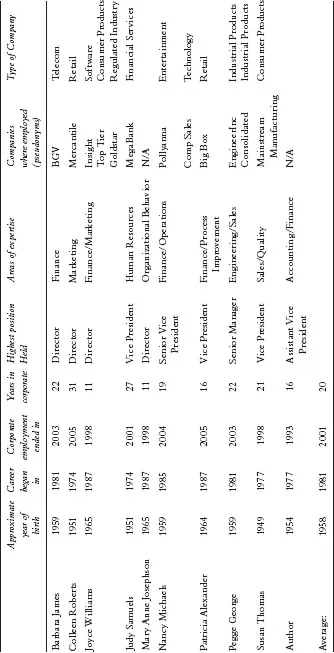
Table P.1 may be useful as a reference to the Lost Leaders, their employers and their bosses, all of whom are given pseudonyms to protect their identities.
Table P.1 Lost Leaders background information
C H A P T E R O N E
Colleen Roberts
Colleen is a strong woman, raised by a long line of strong women. Nearly six feet tall, she is slim and attractive, with short blond hair and a distinctive Southern drawl. When I met with her at her tastefully decorated home in an historic district, she served me iced tea and cookies using napkins that had been her mother’s. If I had not come to interview her about her career, I would have assumed she was a Southern belle, not a hard-driving executive.
Colleen grew up in a small town in the South with conservative values, but the women around her taught her that she could be anything she wanted to be. This was highly unusual for the 1950s. Her strength was an advantage at times in her career, but in her last job it created problems with the men in leadership. She feels they were threatened by women in positions of authority. They thwarted her efforts to help their business grow. Eventually, this situation became untenable for both Colleen and the men in charge, and she joined the ranks of the Lost Leaders. Here she tells us a little about herself and the company that she left just a few days before I met her:
I was born in 1951, the youngest of three children. I grew up in the Deep South. The fortunate part of my upbringing is that I had a mother who was my role model, smartest woman I’ve ever known. She was a writer. She taught school, but her heart was in writing. She actually chose, after World War II, when everybody was having babies and staying home, my mother chose to go back to work. She did not want to stay home. It was a small town and she was a few blocks away; she never missed any of my piano concerts or any of that. It was obviously simpler times back then, the town was only 5,000 people; we could bicycle down the street and everybody knew us. We had nannies, black nannies that cooked and cleaned and took care of us.
My sister and I grew up thinking that was the way women are supposed to be, you are supposed to have your own life and find your own way, because my mother was very happy doing it. I was also influenced by my grandmother on my father’s side. She lived in my hometown and she was also a schoolteacher. She was from a family of seven children. Six were girls and all six of those women went to college and all six of them taught school. When you got in a room with them, when they all got together on holidays, it was a little overwhelming, because these women were strong. My grandfather cooked the Christmas dinner every year; my grandmother didn’t know how to cook. So I grew up in this environment of these women that were absolutely fabulous. I can remember as a child sitting around the card table with these old women. Loud, was it loud in there! They would stay up till one, two o’clock in the morning playing cards with us kids.
I was just fortunate to grow up around a lot of confident women that showed me at a very early age that your life is what you make it to be. Whatever you want to be, you are strong and you can do it. A great example was a conversation I had with my Mom when I was in the seventh grade. It was 1963. We always laughed about it later. It was when my brother graduated from high school and had been accepted at a major university. We were having dinner, talking about his going to college. My sister pipes up and says she wants to be a schoolteacher like my grandmother and great aunts. My mom looked at me and said, “What do you want to be?” I was 12, and I said, “I want to be Alex’s secretary.” I hadn’t thought much about college and, at 12, I adored my brother. Wherever he was going, I wanted to go. So I said, “I’ll work for Alex and I’ll be his secretary.” My mother looked at me across the table and she said, “You’ll be what?” I said, “I’ll work for Alex.” She said, “Has it ever occurred to you that you could be a lawyer just like him? You could work in the same office with him, but you could be a lawyer.” I will never forget that conversation. I said, “Okay, fine, I’ll be a lawyer.”
In college I got interested in market research, so I majored in marketing and went to work in advertising. After I graduated, I found a small agency and formed a good relationship with one of the senior account people and he took me under his wing. I never felt hindered by the male environment or the male executives there, because they were all brilliant, and I so respected what they were teaching me.
I met a gentleman who was with a large company and he got transferred to another city. We dated long distance for about a year and a half, then I moved to be with him and we got married. Then, like every big company executive, he got lured away by another corporation and we moved again. I was the dutiful wife and I didn’t regret it. It was okay because I was in my early thirties and I felt like my career was really doing fine. For example, I got a chance to work with a creative team out of New York, and I actually did the advertising for the “Easy Bake” oven. I had one as a child, and I couldn’t believe it; it was a thrill.
Eventually I got a job in a 60-year-old firm, one of the oldest advertising agencies in the Northeast. The four executives were stuffy old men. That was the first time I hit that environment. Here I was, young, in my thirties, so full of everything, just trying to build a résumé. I hit that agency, and I said, “I’m just going to have to teach them, because they’re not doing it the way I was trained and I know what I’m doing is right.” Needless to say, it was a rocky road at first. But in the third year I became the first female vice president in the history of that company, at the age of 35. But it was tough; it was hard. I felt so good that I was finally there. That’s what I felt like in my mid-thirties. I had arrived.
Well, lo and behold, my husband decides he hates the city we were in and his new job. I didn’t want to leave. I was making good money, loving my job. But we moved. That was about 20 years ago, around the mid-eighties. It took me quite a while to find a position that paid anything comparable to what I was making, due to a completely different job market in the Southeast. I ended up at a start-up agency that offered tremendous growth potential. For the next five years, I traveled almost three weeks a month. I loved it at first, but, after five years, I went to them and asked to be taken off the road. I was literally collapsing from all the travel. They said no, so I quit. Within two years they lost every piece of business that I had brought in and two years after that, the agency closed down. They lost it all.
This company certainly suffered by losing Colleen as a leader. She then went to work for a growing private company with a regional presence that I will call Mercantile, a pseudonym for this franchised retail operation. She stayed at Mercantile for the nine years prior to our interviews. During this time she also became divorced from the man that she had followed through all of his career moves.
The first six years at Mercantile were absolutely insane, crazy. I was working 70- and 80-hour weeks because I was building an internal advertising agency. It was such a great experience. When I joined that company, there was nothing in the way of advertising and marketing. They had no brand identity, they had no image, they had no PR, they had nothing. I was part of building all of it. But the environment at that company was very different from anything I’d ever seen. It was privately owned by a father and son, Mike Sr. and Mike Jr., who built it from scratch.
A couple years before I was hired, they hired a CFO. His name was Tim, and Mike’s brother had been named Tim. That Tim, the oldest of Mike Sr.’s children, was killed by a drunk driver when he was 19. So here comes young Tim into the company. He ingratiated himself to Mike Sr., the owner. Mike Sr. calls him Timmy, which is the nickname he had for his son. Timmy can do no wrong; he is promoted in six years and is the first person to become of vice president in that company. He was the only person who had a title except Mike Sr. who was chairman and Mike Jr. who was president and CEO.
Well, I think Tim is the dumbest man in the world. I never got along with him, ever. He’s the only person in my entire career who I ever looked at and said, “You are so full of shit. You don’t know what you’re talking about,” in front of six people. Later on I apologized to him and said, “That was very unprofessional,” but I was so angry, because he constantly made comments in meetings I was chairing. I knew he didn’t know what he was talking about; he was just trying to impress Mike Sr.
Tim and Steve, who was marketing director, have no vision for the company. They know they want 200 stores. They consider that their vision, but that’s just a goal. When I would sit in meetings with them and try to talk to them about what we need in customer service, why we need to train our store owners, the things that we need to do to make us a better business down the road—not a larger business, but a better business—they didn’t want to hear it. I think it was partially because it was coming from a woman, and I think the second part of it is that Tim, being an accountant, could never justify the money for these programs. And I kept saying, “You’ve got to look outside the window. You’ve got to open that window, because we have a lot of competition now.” The competitive environment had changed and I spent two years talking to them about the changes that I felt we needed. I tried to get them to let me solicit customer feedback. They don’t want customer feedback.
Three years ago, Tim was promoted again, this time to executive vice president. I’m certain they gave him ownership in the company. At the same time they promoted the marketing director, Steve, who was hired six months after me, to vice president of marketing. The two of them were to lead this team into the future. I was overlooked.
Colleen’s career success was significant, but her credentials were not enough to overcome an environment where the men seemed resistant to the opinions of a strong, outspoken woman. This appears to have come as something of a surprise to her, possibly because of the way she was raised, but also because of her earlier success and her positive experiences with men in the advertising business. Perhaps those were the outliers, or perhaps it was just poor leadership at Mercantile. Either way, she is now among the Lost Leaders, selling real estate in the small town where she grew up.
Like Colleen, many of the Lost Leaders had positive experiences with male mentors during their careers. Their success probably would not have occurred without them. This might have been part of why these women lasted as long as they did, and why some of them were caught off guard when they hit the now infamous “glass ceiling” or had a run-in with what they call the “old boy network.”
A few of the other Lost Leaders share Colleen’s experience of being a “trailing spouse.” As more women have moved up into executive ranks, couples struggle to balance the needs of two powerful careers. Barbara and Pegge, who will be introduced later, found their own careers stalled because they were not willing to accept transfers that would disrupt their families. Women continue to be more likely to be the ones who sacrifice caree...
Table of contents
- Cover
- Title
- Introduction
- Part 1 Accidental Careers
- Part 2 Corporate America
- Part 3 Hopes for the Future
- Notes
- Bibliography
- General Index
- Index to the Lost Leaders’ Stories
Trusted by 375,005 students
Access to over 1.5 million titles for a fair monthly price.
Study more efficiently using our study tools.
Frequently asked questions
Yes, you can cancel anytime from the Subscription tab in your account settings on the Perlego website. Your subscription will stay active until the end of your current billing period. Learn how to cancel your subscription
No, books cannot be downloaded as external files, such as PDFs, for use outside of Perlego. However, you can download books within the Perlego app for offline reading on mobile or tablet. Learn how to download books offline
Perlego offers two plans: Essential and Complete
- Essential is ideal for learners and professionals who enjoy exploring a wide range of subjects. Access the Essential Library with 800,000+ trusted titles and best-sellers across business, personal growth, and the humanities. Includes unlimited reading time and Standard Read Aloud voice.
- Complete: Perfect for advanced learners and researchers needing full, unrestricted access. Unlock 1.5M+ books across hundreds of subjects, including academic and specialized titles. The Complete Plan also includes advanced features like Premium Read Aloud and Research Assistant.
We are an online textbook subscription service, where you can get access to an entire online library for less than the price of a single book per month. With over 1.5 million books across 990+ topics, we’ve got you covered! Learn about our mission
Look out for the read-aloud symbol on your next book to see if you can listen to it. The read-aloud tool reads text aloud for you, highlighting the text as it is being read. You can pause it, speed it up and slow it down. Learn more about Read Aloud
Yes! You can use the Perlego app on both iOS and Android devices to read anytime, anywhere — even offline. Perfect for commutes or when you’re on the go.
Please note we cannot support devices running on iOS 13 and Android 7 or earlier. Learn more about using the app
Please note we cannot support devices running on iOS 13 and Android 7 or earlier. Learn more about using the app
Yes, you can access The Lost Leaders by R. Heppner in PDF and/or ePUB format, as well as other popular books in Social Sciences & Business Ethics. We have over 1.5 million books available in our catalogue for you to explore.