eBook - ePub
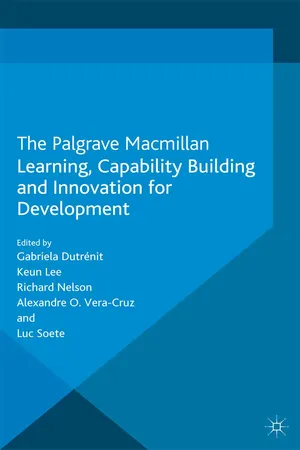
Learning, Capability Building and Innovation for Development
- English
- ePUB (mobile friendly)
- Available on iOS & Android
eBook - ePub
Learning, Capability Building and Innovation for Development
About this book
Today, a large number of scholars studying development understand this process as involving learning and capability building. Capability building is an active, not a passive, process. It requires a purposeful effort from the learner's side, with support and commitment on allocation of time and resources toward learning activities. This process implies the possibility of failure as well as success, as we also learn from failures. A global cast of academics and policy makers examines economic development as a process of learning and technological accumulation, showing how economic development is a process involving creative destruction. While markets and market competition play major roles in structuring the development process, non-market institutions and government policies matter.
Information
1
Introduction
Today, a large number of scholars studying the development of countries below technological and economic frontiers understand the process as involving active learning, capability building and innovation, in the sense of introducing new ways of doing things in the local environment and sometimes even at an international level, with all the risks of failure as well as the promise of great progress associated with innovation. Jorge Katz was among the first scholars of economic development to espouse this point of view (Katz, 1976, 1984, 1986 and 1987). When he began to do so over 40 years ago, he was a lonely voice in the wilderness. Nowadays this view of economic development is widely, if far from universally, accepted. The authors of this book dedicate it to Jorge, in recognition of the fact that we are following an intellectual trail that he blazed.
This approach to economic development as a process of learning and building technological capabilities emerged from analysing the determinants of economic development using Schumpeterian lenses and an appreciative theorizing methodology, as put forward by Nelson and Winter (1982). While focused on what is happening in the economy, the perspective is interdisciplinary. The main building blocks of this approach are highlighted below.
First, capability building is an active, not a passive, process. It does not simply involve almost automatic learning by doing or practices, but requires a purposeful effort on the learner’s part, supported by committed allocation of time and resources towards learning activities. This process implies the possibility of failure as well as success, as we learn from failures too. Due to the uncertainty associated with research activities, innovation is risky as well as potentially productive and profitable. Empirical evidence recollected and systematized since the 1970s has shown that technological change in developing countries cannot only be associated with a technology transfer process of “off the shelf” packages; firms in these countries are not passive recipients of technology. On the contrary, there are learning and domestic efforts (i.e. there is indigenous technological knowledge generation); the technology transfer processes include internal efforts to adapt, assimilate and change the technological packages, and there are other domestic generation processes that emerge even from the mere copying of foreign designs. Hence, the processes of building up technological capabilities combine domestic efforts of knowledge generation with knowledge coming from external sources (Katz, 1976, 1984, 1986 and 1987; Dahlman and Westphal, 1982; Bell, 1984; Dahlman, Ross-Larson and Westphal, 1987, among many others). This resulting innovation can range from small improvements that are new just for the firm, to major innovations that are new at an international level (Freeman, 1974). These innovations contribute to the enrichment of the firms’ knowledge bases and performance.
Second, an essential part of the learning process goes on within individual firms, or other organizations that provide goods and services (such as hospitals and schools in the sectors where they operate). The experience of a more successful catching up economy, like South Korea, shows that, although they were weak initially, private firms have emerged eventually as the carriers of innovation activities and, thus, economic growth. For example, the share of private research and development (R&D) activities has eventually surpassed that of public R&D, and the share of corporate inventors in patent filings has grown to surpass that of individual inventors (Lee and Kim, 2010). A considerable amount of research has been done in recent years on firms’ learning in the economic development process.
Third, firms must be understood as operating within a system of innovations or a network of agents, including their customers and suppliers, and other organizations such as public laboratories, research institutes, institutions that train the workers, municipalities and a variety of other organizations that in one form or another are related to the creation and dissemination of technological knowledge in the society. They operate in an environment where a variety of government policies and programmes influence what they can do and what can drive them to success. This perspective on the activities and institutions involved in the economic development process is much more inclusive than that considered in other treatments of economic development. What is going on in the economy is seen as intimately connected with what is going on in politics, and in society more broadly.
The evidence gathered in the last decades has made it clear that the structure of linkages between agents matters in order to explain development processes. What appears as innovation at the aggregate level is, in fact, the result of an interactive process that involves many actors at the micro level (Kim, 1997; Arocena and Sutz, 2000; Cimoli, 2000; Cassiolato et al., 2003). This brings about the notion of a system of innovation, which recognizes the complexity of many market relationships between the actors, their embedding in broader social and institutional structures, the elements of cooperation and trust that often are essential if markets are to work well, and the role of non-market institutions in the innovation process in many sectors. The national systems of innovation bring to the forefront the central role of the state as a coordinating agent (Freeman, 1987; Lundvall, 1992; Nelson, 1993). This role is particularly important to solve coordination problems that arise due to the fact that innovation observed at the macro level depends on the behaviour of individual actors and the institutions that govern their interactions. All kinds of synergies and externalities appear dynamically as the country advances the building of the national system of innovation. But, for this building process, each country has to rely on its own set of institutions and coordination mechanisms for its own specific public/private actors.
Fourth, economic development is a process involving creative destruction. The economies suffer recurring cycles of creation and destruction of productive capacities and technological capabilities that prevent the consolidation of perpetually stable and cumulative processes of development of productive forces. In this context many firms, new ones as well as old ones, go out of business, as others successfully put into practice the new ways of doing things. Old industries and institutions decline as new ones advance in a process involving pain as well as benefit. Creative destruction implies the emergence of new sectors, markets, clusters and other forms of multi-agent structures; innovation affects economic growth and development by triggering a structural change (Schumpeter, 1934, 1939; Kuznets, 1971, 1973; Saviotti and Pyka, 2004).
Fifth, while markets and market competition play major roles in structuring the development process, major roles are also played by non-market institutions (universities and public research systems, scientific and technical societies, among others) and by a wide variety of government policies and programmes. As many institutions tend not to operate on market logic, we should avoid thinking about interactions and behaviours of the innovation systems solely in terms of price and market linkages.
A single, universal description of the development process of a society is too simplistic to help us understand the complexity of the issues that need to be examined when development is seen as a process of learning and technological accumulation. Countries do not pass through a series of “stages” identical to those spanned years before by today’s developed countries. Economies have their own rules of development of their productive forces, in which the structure of production, technological capabilities and organizational and institutional frameworks evolve in quite idiosyncratic ways. As the network of agents is country and time specific, it gives rise to different styles of development. It is observed that some late-comer countries could make a bold entry not into existing but into emerging industries by taking advantage of a new techno-economic paradigm or a new generation of technologies, and thereby create their own “path” which is different from that of the forerunners (Lee and Lim, 2001). This path-creating strategy is consistent with the idea of leapfrogging (Perez and Soete, 1988) in that some late-comers may be able to leapfrog older vintages of technology, bypass heavy investments in previous technology systems and jump on new technologies to take over the market from the incumbent firms or countries.
It has taken many years for this perspective on economic development to take hold. In recent years, the number of scholars who see the process of economic development in this way has increased substantially and an association of such scholars, and Globelics (Global Network for the Economics of Learning, Innovation, and Competence Building Systems),1 is now thriving, for instance.
The original idea of this book was to honour one of the leaders of innovation studies in catch up and development processes (Jorge Katz). That was the seed that inspired a group of recognized experts from different parts of the world, excited by this endeavour, to join together in reflecting on innovation, technological capability accumulation and catching up.
This book contributes to understanding key issues of the processes of learning, technological capability building and innovation in countries below the technological frontier, including the role of innovation policy; the connection between innovation, productivity and competitiveness; macro– micro interactions for innovation activities; and other topics related to catching up processes, including technological regimes, natural resources and the role of under-radar innovations. The contributions include the historical evolution of different approaches, definitions of key concepts and evidence from different countries. As a whole, the book provides a comprehensive approach to the foundations of the theory and the problems that many countries, particularly in Latin America, have faced when trying to move forward in these processes. Also presented are chapters describing successful Asian countries.
The first three chapters focus more on the contributions made by Jorge Katz to this way of thinking about economic development. The rest of the chapters deal with different aspects of this approach.
The chapter by Gabriela Dutrénit describes the evolution of Jorge Katz’s career, including his intellectual influences, and explores the impact of his publications on the determinants of technological efforts and the generation of domestic technological capabilities through citations of his main publications. This analysis clarifies the broad impact that his work has had on scholars and international institutions from all over the world. The citations analysed in this chapter show the increase of the impact of his publications over time in different languages and from authors coming from different regions, and a broad mix of documents quoting his work, including theses and reports from international institutions. Even though his work has had an impact on different regions, his impact has been greatest on Latin American academia.
Alexandre Vera-Cruz and Arturo Torres-Vargas aim at discussing and highlighting some of Katz’s contributions for the understanding of learning and technological capability building in developing countries. According to the authors, Katz seeks a deeper understanding of technological change by focusing on a “real firm”; this approach not only had an impact on the advance of academic knowledge but also enhanced the cognitive power of the analysis to help managers and policy makers in designing and implementing policy instruments from a realistic perspective. His framework takes account micro as well as sectorial and macro facts, which are seen as interdependent phenomena. Katz’s works introduced to the analysis of technological change, learning and accumulation of capabilities a set of elements that produced a major renovation of the existing ideas. The authors argue that Katz’s main contributions emerge from his dissatisfaction with and break from the neoclassical school, and his gradual adherence in practice to the evolutionary approach. In that process, Katz introduced new concepts and also developed a rigorous empirical analysis that allowed the building up of a solid appreciative theory, as it was called by Nelson and Winter (1982), which is still an obligatory reference for anyone who wants to understand these processes, particularly in developing countries.
José Cassiolato, Helena Lastres and Flávio Peixoto build a bridge between the Latin American structuralist approach and the innovation systems perspective. They argue that Katz has substantially shown the negative effects of the “market fundamentalism” policy framework on the production structures, learning and capacity building of Latin American firms. He has also demonstrated that the macroeconomic environment harmed the firms’ strategies and government policies for industrial and technological development. Katz exposed the limitations to innovation and development that Latin American countries have faced by revealing that micro strategies and learning are not only correlated and dependent upon a conflicting macroeconomic environment and policy regime, but can be annulled by them. In this sense, he distanced himself from the more traditional works on capability accumulation, innovation and learning, concentrating only on micro learning, that have emanated from the Northern hemisphere in the last 30 years.
The chapter by Morris Teubal focuses on a different dimension of innovation and technological change, the role of innovation policy. He emphasizes that innovation policy is a field of knowledge (in contrast to being a mere “application” of positive knowledge about the real world), which includes as key issues the role of strategic priorities, the increasing importance of policy targeting of new higher-level organizations, and a better integration of narrowly defined innovation policy with other innovation system components, particularly the science, technology and higher education infrastructure. This chapter discusses some central features of the emerging systems evolutionary perspective on innovation policy, particularly in relation to developing countries. In doing so, Teubal draws on a set of conceptual underpinnings of innovation policy in this context, such as the growing emphasis on the importance of “capabilities” for development, the limits of productivity increases in existing sectors to sustain economic growth, and the inevitable structural changes beyond a certain point.
Howard Pack’s chapter highlights that the micro examination of the behaviour of individual firms through case study research provides a rich source of evidence on the details of the transfer/absorption process, and gives clues to the type of microeconomic detail that contributes to deeper understanding of this process. This facilitates the identification of public and private policies that might be pursued to enhance productivity. However, the author stresses that econometric and case studies are complementary, to provide a broader picture of the processes. Drawing on this argument, he analyses the implications of the case study literature for econometric studies, which largely employ censuses of manufacturing or more frequent industrial survey data to explore the modes of technology transfer for individual firms and the demand for technology and its productivity.
Gustavo Crespi argues that the studies carried out during the 1970s and 1980s in Latin America constituted the first attempts to measure firm-level productivity and innovation in Latin America and contributed to putting the framework in place to start systematically collecting information about productivity and innovation in the region. Drawing on these roots and on several studies that have investigated the links between innovation and productivity at the firm level, and based on large data sets that have been accumulated, Crespi explores the fundamentals of productivity growth at the industry and plant level in Latin America, through the particular lens of the “Chilean experiment”.
Bernardo Kosacoff’s chapter focuses on the case of Argentina and analyses the performance of industrial activities and the development of dynamic competitive advantages in this particular context. He draws on arguments that long-term growth is explained to a great extent by the capacity of economies to incorporate, generate and diffuse knowledge and technologies – in other words, in the development of local capacities to close the productivity gaps that separate the country from the most advanced nations – but also that a consistent macroeconomic framework is required to sustain fiscal and external funding equilibria, which are necessary conditions for development.
Mario Cimoli and Gabriel Porcile’s chapter draws on Katz’s insights on macro–micro interrelations. This author studied the evolution of firms and industries under different macro conditions and institutional frameworks in Latin America; this allowed him to identify different patterns of micro– macro interactions (Katz, 1982 and 2001; Cimoli and Katz, 2003). This chapter presents a theoretical model that discusses the implications for technological learning of recent trends towards the appreciation of the real exchange rate and increasing volatility in commodity prices. The authors stress the negative impacts on productivity growth of instability in Gross Domestic Product (GDP) growth, and argue that the consequences of what appear to be short-term macro shocks are significant over the long run on micro–macro interactions in which learning, structural change and growth co-evolve.
The chapter by Valeria Arza explores the links between the macroeconomic environment and microeconomic decisions. Based on the idea that technological behaviour in developing countries is to some extent idiosyncratic to the characteristics of their National System of Innovation (NSI), and, therefore, that there are few parallels between firms’ behaviour in developing and in developed countries, her chapter explores empirically the relation between macroeconomic uncertainty and firms’ investment in R&D and in machinery, by putting together contributions from psychology, sociology and economics.
Rajah Rasiah’s chapter also focuses on the argument of macro–micro interrelations to explore catching up processes in Korea and Taiwan. He makes a case that careful coordination between the macro institutions, the meso organizations and the micro firms was important in the movement of Samsung and Taiwan Semiconductor Manufacturing Corporation to the technology frontier in semiconductor production. He argues that successful technological catch up in Korea and Taiwan was driven by strategic government support; inflow of foreign stocks of knowledge through licensing acquisitions and knowledge diffusion through brain gain and circulation; connectivity to buyer–supplier chains; and macro, meso and micro coordination to insulate the movement of high-tech firms to the technology frontier. Effective coordination between the macro instruments, meso organizations and micro firms ensured the progression of Samsung Semiconductor and Taiwan Semiconductor Manufacturing Corporation to the technology frontier.
Keun Lee highlights that scholars who follow Schumpeterian economics have emphasized the importance of acquiring “indigenous” technological capabilities that have become and will continue to be of considerable importance for countries attempting to catch up. His chapter develops knowledge access and learning as the most important factor for a successful catch up in technology, and examines the relationship between the knowledge regimes of sectors and the possibility of catch up. He argues that traditional developme...
Table of contents
- Cover
- Title Page
- Copyright
- Contents
- List of Figures and Tables
- Preface and Acknowledgements
- Notes on Contributors
- 1. Introduction
- 2. The Generation of Domestic Technological Capabilities: Measuring the Impact of the Contributions of Jorge Katz
- 3. The Latin American Structuralist School and the Innovation Systems Perspective: Jorge Katz, Learning and Micro and Macro Connections
- 4. The Significance of Jorge Katz’s Work for the Understanding of Learning and Technological Capability Building in Developing Countries
- 5. “Old” and “New” Approaches to Innovation Policy: A Systems Evolutionary Perspective 1
- 6. Industrial Productivity in Developing Nations
- 7. Productivity and Firm Heterogeneity in Chile
- 8. Developing Competing Capabilities in the Argentinean Industry (1958–2008)
- 9. Micro–Macro Interactions in Technological Learning and Growth
- 10. The Social Dimension of Behaviour: Macroeconomic Uncertainty and Firms’ Investment in R&D and in Machinery in Argentina
- 11. Macro, Meso and Micro Coordination and Technological Progress: Catch Up Experiences of Samsung and Taiwan Semiconductor Manufacturing Corporation
- 12. Knowledge Regimes and Technological Catch Up
- 13. Catching Up in the 21st Century: Globalization, Knowledge and Capabilities in Latin America, a Case for Natural Resource Based Activities
- 14. Past Innovation Trajectories in Latin America and Current Innovation Trajectories in the Asian Driver Economies
- Index
Trusted by 375,005 students
Access to over 1.5 million titles for a fair monthly price.
Study more efficiently using our study tools.
Frequently asked questions
Yes, you can cancel anytime from the Subscription tab in your account settings on the Perlego website. Your subscription will stay active until the end of your current billing period. Learn how to cancel your subscription
No, books cannot be downloaded as external files, such as PDFs, for use outside of Perlego. However, you can download books within the Perlego app for offline reading on mobile or tablet. Learn how to download books offline
Perlego offers two plans: Essential and Complete
- Essential is ideal for learners and professionals who enjoy exploring a wide range of subjects. Access the Essential Library with 800,000+ trusted titles and best-sellers across business, personal growth, and the humanities. Includes unlimited reading time and Standard Read Aloud voice.
- Complete: Perfect for advanced learners and researchers needing full, unrestricted access. Unlock 1.5M+ books across hundreds of subjects, including academic and specialized titles. The Complete Plan also includes advanced features like Premium Read Aloud and Research Assistant.
We are an online textbook subscription service, where you can get access to an entire online library for less than the price of a single book per month. With over 1.5 million books across 990+ topics, we’ve got you covered! Learn about our mission
Look out for the read-aloud symbol on your next book to see if you can listen to it. The read-aloud tool reads text aloud for you, highlighting the text as it is being read. You can pause it, speed it up and slow it down. Learn more about Read Aloud
Yes! You can use the Perlego app on both iOS and Android devices to read anytime, anywhere — even offline. Perfect for commutes or when you’re on the go.
Please note we cannot support devices running on iOS 13 and Android 7 or earlier. Learn more about using the app
Please note we cannot support devices running on iOS 13 and Android 7 or earlier. Learn more about using the app
Yes, you can access Learning, Capability Building and Innovation for Development by G. Dutrénit, K. Lee, R. Nelson, L. Soete, A. Vera-Cruz, G. Dutrénit,K. Lee,R. Nelson,L. Soete,A. Vera-Cruz in PDF and/or ePUB format, as well as other popular books in Social Sciences & International Relations. We have over 1.5 million books available in our catalogue for you to explore.