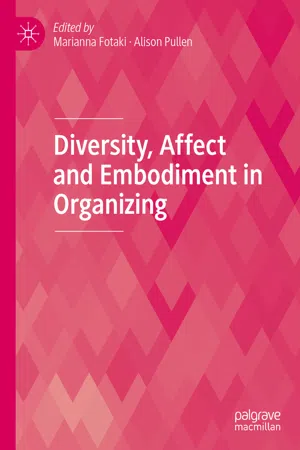
Bringing together research from critical diversity studies and organization theory, this edited collection challenges unspoken norms and patterns of discrimination in organizational bodies. The authors problematize the management of diversity by focusing on the differentiations between racialized, aged, gendered and sexed bodies. By taking a fresh approach and placing the body at the forefront of power relations, this thought-provoking book seeks to challenge the homogenizing and oppressive dimensions of organizational governance, structure and culture that deny bodily difference. An insightful read for scholars of HRM, diversity management and organization, Diversity, Affect and Embodiment in Organizing encourages an active approach to tackling discrimination and recognizes the diversity of embodied lives.
eBook - ePub
Diversity, Affect and Embodiment in Organizing
- English
- ePUB (mobile friendly)
- Available on iOS & Android
eBook - ePub
Diversity, Affect and Embodiment in Organizing
About this book
Information
© The Author(s) 2019
Marianna Fotaki and Alison Pullen (eds.)Diversity, Affect and Embodiment in Organizinghttps://doi.org/10.1007/978-3-319-98917-4_11. Introducing Affective Embodiment and Diversity
Marianna Fotaki1 and Alison Pullen2
(1)
Warwick Business School, University of Warwick, Coventry, UK
(2)
Macquarie University, Sydney, NSW, Australia
The Diverse Goals of Diversity in Organizations
The discourse of diversity has gained popularity in globalizing organizations. It is seen as a means to improving companies’ performance by addressing the issue of talent shortages and by aligning the organization more closely with an increasingly heterogeneous customer base (Hunt et al., 2015). A related concept of inclusion is concerned with ensuring employee involvement and integration of diversity procedures in organizational structures (Roberson 2006). However, according to critical scholars, the pragmatic focus on ‘the management of diversity’ may diffuse the emancipatory imperative implicit in ‘the discourse of equity’ (Humphries and Grice 1995, p. 17). This is also borne out by the evidence. Despite women entering the professions and managerial positions in roughly the same proportions as men in the UK and other developed countries over the last decades, and despite women entrepreneurs flourishing in developing countries, overall, the pre-existing gender inequalities remain: in some cases, there is reversal to old patterns while new inequalities intersecting with class, age, race, ethnicity, and sexuality have also emerged. The progress in developed Western countries has been far too slow with gender pay gap still a reality for almost every single country and sector around the world and the under-representation of women in positions of influence in business, government, and academia. For instance, research by the American Association of University Women shows that women typically earn about 90 per cent of what men are paid until they are about 35 years old and after that median earnings for women are typically 75–80 per cent of what men are paid (AAUW 2016). At every level of academic achievement, women’s median earnings are less than men’s earnings, and in some cases, the gender pay gap is larger at higher levels of education in the USA. The evidence from across Europe shows that norms and customs often mean that skilled, female employees are not paid as much as their male counterparts within almost any occupation (Boll et al. 2016).
Simultaneously, there has been a powerful backlash against women’s empowerment taking the form of anti-gender and postfeminist discourses (McRobbie 2009; Adamson 2017). Antigenderism is a coherent ideological construction consciously and effectively used by right-wing and religious fundamentalists worldwide (Korolczuk and Graff 2017) and is often promoted through the creation of anxieties related to gender relations, sexuality, and reproduction. In some parts of Europe (e.g. Hungary and Poland) and elsewhere, feminism and feminists, as well as gender theory and gender mainstreaming in institutions, are seen to be destroying the nation and undermining the concept of family (Dhaliwal and Yuval-Davis 2014; Kuhar and Paternotte 2017). Postfeminism, on the other hand, focuses on the issues of individual choice and discourses of female freedom as if equality (McRobbie 2009) has been achieved for all women and men, and as if disempowerment that different groups of people continue to experience is not an issue of established power structures but a matter of individual preferences (Gill and Scharf 2011; Lewis et al. 2017; Rottenberg 2017).
These discourses go hand-in-hand with the establishing of neoliberalism as the dominant paradigm and the sole viable narrative that late capitalism deploys to justify the growth of inequality and dispossession via austerity in the developed countries (Daskalaki and Fotaki 2017) and by enclosures and driving away entire populations from their lands in the developing world (Sassen 2014). Tracing a trajectory from ‘liberal’ to ‘neoliberal’ feminism in development, Wilson (2015) argues that approaches to gender which are currently being promoted within neoliberal development frameworks, while often characterized as ‘instrumentalizing’ gender equality, in fact rely upon, extend, and deepen gendered inequalities in order to sustain and strengthen processes of global capital accumulation. This is, for instance, achieved by informalizing labour (Moghadam 2005) and privatizing care (Gideon 2006) that affects women disproportionately leading to their de facto disempowerment; however, the practice of neoliberalism draws upon, incorporates, and reinforces these existing patriarchal relationships of power and selectively re-emphasizes patriarchal social norms whenever it is needed by, for instance, cutting on the role of the state that feminists have attempted to build and by creating a fertile ground for exploiting insecurities that are so created (Cornwall et al. 2008). There is thus a symbiotic relationship between the resurgent neoconservatism and neoliberalism that the authors identify.
The dominant approaches to equal opportunities in the workplace representing the liberal, free market conception of employment fails to address the root causes of discrimination, while at the same time condemning women to competing on men’s terms at work. Feminist economists have demonstrated that gender inequality in the marketplace concerning pay differentials and career advancement could not be explained away in terms of individual choices by women without accounting for the ignorance and prejudice of employers (Kabeer 2012). As Kabeer (2012, p. 12) summarizes it: ‘while individuals and groups make choices and exercise agency they do so within the limits imposed by the structural distribution of rules, norms, assets and identities between different in their society’ and that ‘inequality is structured into market forces by discriminatory practices inherited from the past as well as by the bargaining power exercised in the present by powerful market actors pursuing their own self-interest’.
Historical patterns reflecting men’s social power underlie the persistent undervaluation of women at work and why women do not get the same opportunities for career progression and pay as men do. Cultural assumptions stereotyping women as less willing or able to perform in high-powered positions are then used to justify and normalize this discrimination. This suggests that gender stereotypes are ideological and prescriptive, and their influence is unlikely to diminish simply with the passage of time or with accumulating evidence of women’s capabilities (Benschop and Brouns 2003; Charles 2008).
This also highlights the limitations of legislative measures that are necessary but not sufficient to bring about radical change. Power is not restricted to formal policy and assumptions of female and minoritized others’ inferiority are often unspoken. As Fotaki and Harding (2018, p. 35) argue: ‘women are associated with the traits that are seen as being ‘out of place’ in organizations, a version of sanitized masculinity continues to be the prevalent norm’. Focusing on institutional diversity policies in British higher education aiming to counteract this phenomenon Sara Ahmed (2012) indicated that the existence of such policies is institutionalized in a way that protects and preserves the status quo in organizations rather than adequately recognizing diversity, allowing the institution to ignore its entrenched problems. The management research also shows that even in organizations that adopt meritocratic policies, managers tend to favour a male over an equally qualified female employee and award him a larger monetary reward (Castilla and Bendar 2010) perhaps because they no longer see the necessity to address the exiting inequalities or for the fear of discriminating against men. Other researchers evaluating the effectiveness of diversity policies found that efforts to establish responsibility for diversity lead to the broadest increases in managerial diversity as opposed to moderating managerial bias through diversity training and diversity evaluations and addressing social isolation through mentoring and networking that showed modest effects by comparison (Kalev et al. 2006).
Why Embodiment and Affect Matters for Understanding Diversity?
There also exists critical research on the management of diversity in organizations. This work brings into focus the forms of discrimination that occur in relation to different types of sexed, shaped, racialized, sexualized, and abled bodies (Acker 2006; H...
Table of contents
- Cover
- Front Matter
- 1. Introducing Affective Embodiment and Diversity
- Part I. Theoretical Developments: Affect, Bodies and Diversity
- Part II. Empirical Studies of Diversity and Affective Embodiment
- Part III. Critical Political Approaches on Affective Embodiment
- Back Matter
Trusted by 375,005 students
Access to over 1.5 million titles for a fair monthly price.
Study more efficiently using our study tools.
Frequently asked questions
Yes, you can cancel anytime from the Subscription tab in your account settings on the Perlego website. Your subscription will stay active until the end of your current billing period. Learn how to cancel your subscription
No, books cannot be downloaded as external files, such as PDFs, for use outside of Perlego. However, you can download books within the Perlego app for offline reading on mobile or tablet. Learn how to download books offline
Perlego offers two plans: Essential and Complete
- Essential is ideal for learners and professionals who enjoy exploring a wide range of subjects. Access the Essential Library with 800,000+ trusted titles and best-sellers across business, personal growth, and the humanities. Includes unlimited reading time and Standard Read Aloud voice.
- Complete: Perfect for advanced learners and researchers needing full, unrestricted access. Unlock 1.5M+ books across hundreds of subjects, including academic and specialized titles. The Complete Plan also includes advanced features like Premium Read Aloud and Research Assistant.
We are an online textbook subscription service, where you can get access to an entire online library for less than the price of a single book per month. With over 1.5 million books across 990+ topics, we’ve got you covered! Learn about our mission
Look out for the read-aloud symbol on your next book to see if you can listen to it. The read-aloud tool reads text aloud for you, highlighting the text as it is being read. You can pause it, speed it up and slow it down. Learn more about Read Aloud
Yes! You can use the Perlego app on both iOS and Android devices to read anytime, anywhere — even offline. Perfect for commutes or when you’re on the go.
Please note we cannot support devices running on iOS 13 and Android 7 or earlier. Learn more about using the app
Please note we cannot support devices running on iOS 13 and Android 7 or earlier. Learn more about using the app
Yes, you can access Diversity, Affect and Embodiment in Organizing by Marianna Fotaki, Alison Pullen, Marianna Fotaki,Alison Pullen in PDF and/or ePUB format, as well as other popular books in Business & Human Resource Management. We have over 1.5 million books available in our catalogue for you to explore.