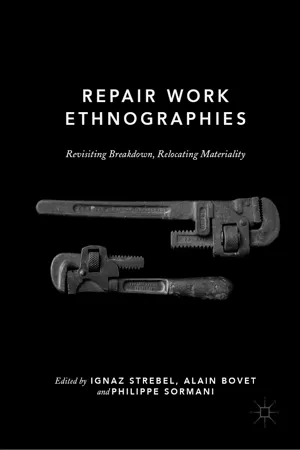
eBook - ePub
Repair Work Ethnographies
Revisiting Breakdown, Relocating Materiality
- English
- ePUB (mobile friendly)
- Available on iOS & Android
eBook - ePub
Repair Work Ethnographies
Revisiting Breakdown, Relocating Materiality
About this book
This pioneering book homes in on repair as an everyday practice. Bringing together exemplary ethnographies of repair work around the world, it examines the politics of repair, its work settings and intricate networks, in and across a wide range of situations, lay and professional. The book evidences the topical relevance of situated inquiry into breakdown, repair, and maintenance for engaging with the contemporary world more broadly. Airplanes and artworks, bicycles and buildings, cars and computers, medical devices and mobile phones, as virtually any commodity, infrastructure or technical artifact, have in common their occasional breakdown, if not inbuilt obsolescence. Hence the point and purpose of closely examining how and when they are fixed.
Information
© The Author(s) 2019
Ignaz Strebel, Alain Bovet and Philippe Sormani (eds.)Repair Work Ethnographieshttps://doi.org/10.1007/978-981-13-2110-8_11. Introduction: When Things Break Down
Philippe Sormani1, 2 , Alain Bovet3, 4 and Ignaz Strebel4
(1)
STS Lab, University of Lausanne, Lausanne, Switzerland
(2)
CEMS-IMM, EHESS, Paris, France
(3)
HEG—Haute école de gestion Arc, University of Applied Sciences and Arts Western Switzerland, Neuchâtel, Switzerland
(4)
Institute of Geography and Sustainability, University of Lausanne, Lausanne, Switzerland
Airplanes and artwork, bicycles and buildings, cars and computers, photocopiers and printers, the list could be indefinitely extended and reassembled. Yet, what all its items have in common, as with virtually any commodity, infrastructure or technical artifact, is their occasional breakdown, if not inbuilt obsolescence. To problems of the latter kind, sustainable development in and beyond product design, a renewed emphasis on care and craft, as well as various ‘do it yourself’ initiatives, have become key responses—in short, a genuine Kultur der Reparatur (Heckl 2013). Upon closer inspection, this “culture of repair” may, of course, not prove as reliable, revolutionary or self-reliant as its confident promotion and first impression suggest. Neither does it seem exempt from artisanal nostalgia, a gendered division of labor, or otherwise conservative politics . Despite or precisely because of these resonances, a renewed engagement with repair and maintenance fuels many ecological alternatives to current frames of innovation , dominant modes of production, consumption, and circulation, as well as recent efforts to rethink our “broken world” more broadly (cf. Jackson 2014). Drawing upon a multifaceted collection of repair work ethnographies, this book homes in on repair work as an everyday practice of distinctive interest to Science and Technology Studies (STS) . The book examines its politics , work settings, and networks in and across a wide range of situations, lay and professional, involving a plethora of objects, big and small, and that in the most contrasting circumstances, up north and down south. In so doing, the book fills an important gap in the literature of STS , whilst making a critical contribution to relocating the field’s materialist outlook (for a related move, see Jarzabkowski and Pinch 2013). The remainder of this introduction is made of three sections. In the first section, the stated gap in the STS literature—the “still-neglected situation” (Quéré 1998) of repair work—and the heuristic interest of considering material disruptions will be briefly considered. In the second section, we shall briefly reconsider how this heuristic potential has been exploited in some ‘classic’ ethnographies of repair work. The final section outlines how the present collection makes a difference in the current field of STS , if not social inquiry , more broadly.
Investigating Material Disruption and Repair Work in Situ
Bringing together a wide range of case studies, this book holds together in terms of one leitmotif, the leitmotif encapsulated in the book’s title: Repair Work Ethnographies: Revisiting Breakdown, Relocating Materiality . The book’s pivotal move, then, is to bring to bear the ethnographic study of repair work as an everyday practice in situ on the key conceptual and theoretical discussions on “materiality ,” “objectual practice,” and “non-human agency ” in latter-day STS (e.g., Knorr Cetina 2001; Latour 2000, 2005; Pinch and Swedberg 2008; Quéré 2015; Sayes 2013; Schmidgen 2012). Repair work provides an empirical locus of strategic interest, insofar as its situated practice discloses the primary concerns of participants involved, what happens to be material to them—if only to have a kitchen sink unclogged, your computer debugged, or any other everyday item repaired right away. In turn, recent discussions on “materiality ” in STS have remained surprisingly aloof from such everyday concerns (e.g., Barad 2003), not least of which their concrete articulation in situ and actual ordering ‘in real time,’ as entailed by any ordinary course of repair work (for a related argument, see Ingold 2007). To stick to the prime example, Actor-Network Theory (ANT) remains an ambivalent case in point. On the one hand, it has continuously emphasized the “variable ontology” of its cast of characters (e.g., Callon 1990; Law 2009). On the other, it has tended to frame its empirical investigations in terms of theoretical definitions a priori (regarding “social order” to begin with, Latour 2005) , instead of investigating the framing exercise and its local contingency, as part of its empirical domain in particular situations (if only to avoid the “ontological monism” of a one-frame-fits-all approach, cf. Collin 2011). 1 Consequently,
[W]hat ANT [arguably] fails to do is to study closely the interaction or the lived relationship between human beings and material objects. The empirical work is by and large lacking the detail and precision of the more traditional social studies of technology and many of the textual productions and interpretations are those of the sociologist rather than the actors. It is noticeable that there are very few accounts of the perceptual or tactile interaction between humans and objects in the network, few detailed field observations, photographs or use of video to study the process of the network that would allow the material objects to have a presence in the accounts. What are found in the published studies, are textual forms that are produced sometimes by the human participants – engineers’ reports, publicity statements, transcripts of discussions, summatory diagrams – but often by the sociologist. These can be excitingly irreverent, entertainingly laden with irony and wit and full of interesting conceptual moves – but these textual devices keep the sociologist in control of the play of interpretations and keep the reader at a safe distance from the lived workings of the network. (Dant 2005: 81)
Therefore, the book at hand focuses on the everyday practice of repair work as its core phenomenon. The book’s contributions make explicit the technical expertise and practical reasoning, lay and professional, displayed in actual courses of repair work, as well as the entangled background of material conditions, procedural knowledge, and social circumstances that such work may disclose in situ and in vivo. The “lived workings of the network” thus are to be examined as they take shape in and across particular situations of repair work. How do these situations actually unfold? How far are they extended? What kind of actors, materials, and technologies do they involve, if not co-constitute? Is their extension discussed? And how does the “status of the object” (Pels et al. 2002) under repair get re-examined, renegotiated and/or re-established? These are some of the key questions that the book and its unique collection of repair work ethnographies will address. Setting aside their specificities for now, it is worthwhile to point out their common strategy—the empirical focus on material disruptions of everyday routines—and intellectual origins of that methodological strategy and its heuristic potential. 2
Indeed, a number of philosophers and social scientists have shown the insight that can be gained from material disruption. As Martin Heidegger suggested via his phenomenological allegory of the ‘broken hammer,’ it is only when an object fails to lend itself to its common use that it becomes a concern, that we start thinking about it, regretting the lack of its “‘readiness-to-hand’ as its normative identity” (Lynch et al. 1983: 224). What is more, the “context of equipment is ‘lit up’ and ‘the world announces itself’ when something is unready-to-hand” (Heidegger 1962: 105; in Dant 2005: 88) . Material disruption, then, not only problematizes a broken instrument, tool, or object but also the social situation that its ordinary use configures—in short, its “world of everyday life” (Schutz 1973). A close idea runs through pragmatist philosophy and John Dewey ’s theory of inquiry in particular. For pragmatist philosophy, characteristically, it is the unanticipated interruption of established routines that renders indeterminate, if not doubtful, a hitherto unquestioned situation. In turn, this indetermination and doubtfulness may lead participants to start inquiring the situation, grasp its changed character, and thereby reestablish their agency . Indeed, Dewey defines inquiry as an oriented, transformative process:
Inquiry is the controlled or directed transformation of an indeterminate situation into one that is so determinate in its constituent distinctions and relations as to convert the elements of the original situation into a unified whole. (Dewey 1991a: 108)
Two implied ideas are worth pulling out. First, as Dewey explains, the original situation presents itself as an indeterminate or “open” one, insofar as it is not clear how its components hang together as various aspects of that same situation. To return to our first example: does the clogged kitchen sink have something to do with our eating habits? Second, the original situation, if indeterminate, is not to be considered problematic per se. Indeed, for Dewey, the problematization of the s...
Table of contents
- Cover
- Front Matter
- 1. Introduction: When Things Break Down
- Part I. Settings
- Part II. Networks
- Part III. Politics
- Part IV. Afterword
- Back Matter
Trusted by 375,005 students
Access to over 1.5 million titles for a fair monthly price.
Study more efficiently using our study tools.
Frequently asked questions
Yes, you can cancel anytime from the Subscription tab in your account settings on the Perlego website. Your subscription will stay active until the end of your current billing period. Learn how to cancel your subscription
No, books cannot be downloaded as external files, such as PDFs, for use outside of Perlego. However, you can download books within the Perlego app for offline reading on mobile or tablet. Learn how to download books offline
Perlego offers two plans: Essential and Complete
- Essential is ideal for learners and professionals who enjoy exploring a wide range of subjects. Access the Essential Library with 800,000+ trusted titles and best-sellers across business, personal growth, and the humanities. Includes unlimited reading time and Standard Read Aloud voice.
- Complete: Perfect for advanced learners and researchers needing full, unrestricted access. Unlock 1.5M+ books across hundreds of subjects, including academic and specialized titles. The Complete Plan also includes advanced features like Premium Read Aloud and Research Assistant.
We are an online textbook subscription service, where you can get access to an entire online library for less than the price of a single book per month. With over 1.5 million books across 990+ topics, we’ve got you covered! Learn about our mission
Look out for the read-aloud symbol on your next book to see if you can listen to it. The read-aloud tool reads text aloud for you, highlighting the text as it is being read. You can pause it, speed it up and slow it down. Learn more about Read Aloud
Yes! You can use the Perlego app on both iOS and Android devices to read anytime, anywhere — even offline. Perfect for commutes or when you’re on the go.
Please note we cannot support devices running on iOS 13 and Android 7 or earlier. Learn more about using the app
Please note we cannot support devices running on iOS 13 and Android 7 or earlier. Learn more about using the app
Yes, you can access Repair Work Ethnographies by Ignaz Strebel, Alain Bovet, Philippe Sormani, Ignaz Strebel,Alain Bovet,Philippe Sormani in PDF and/or ePUB format, as well as other popular books in Social Sciences & Cultural & Social Anthropology. We have over 1.5 million books available in our catalogue for you to explore.