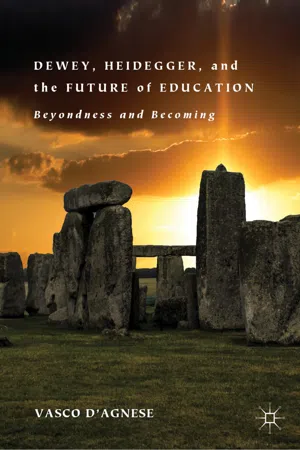
Drawing on insights into the philosophies of Dewey and Heidegger, this book moves forward the greater philosophical discourse surrounding education. It illuminates deep affinities between the corresponding traditions of Dewey and Heidegger, broadly labeled hermeneutics and pragmatism, and in doing so reveals the potential of the Dewey-Heidegger comparison for the future of education. To accomplish this task, Vasco d'Agnese explores the Deweyan and Heideggerian understanding of existence and experience. Both thinkers believed that humans are vulnerable from the very beginning, delivered to an uncanny and uncertain condition. On the other hand, such an uncanniness and dependency, rather than flowing in nihilistic defeat of educational purposes, puts radical responsibility on the side of the subject. It is, then, educationally promising. The book explains that for both Dewey and Heidegger, being a subject means being-with-others while transcending and advancing one's boundaries, thus challenging the managerial framework of education that currently dominates educational institutions throughout the world.
- English
- ePUB (mobile friendly)
- Available on iOS & Android
eBook - ePub
About this book
Information
Topic
EducationSubtopic
Education Theory & Practice© The Author(s) 2019
Vasco d'AgneseDewey, Heidegger, and the Future of Educationhttps://doi.org/10.1007/978-3-030-19482-6_11. Introduction
Vasco d’Agnese1
(1)
University of Campania Luigi Vanvitelli, Caserta, Italy
Vasco d’Agnese
Even when written by a single author, a book is never a solitary effort. Underpinning every book is a wide expanse, a universe of shared experience wherein the book, sinking its roots, finds its nourishment and grows. I believe it is important to acknowledge such a concrete, bodily space, which acts as both a magma surrounding one’s attempt and a rational framework guiding one’s construction. This is the space of conversations and waiting, study and dialogue; it is the space of hearing and responding, of patience and excitement, imagination and painstaking work. It is the growing terrain where challenging feelings, compelling questions, exciting thoughts and sensations difficult to pin down chase and find each other, sometimes producing ideas worth developing and sharing, sometimes not. However, this is also the space where one finds and experiences one’s limits, inadequacy and failures—in a sense, a book is also the result and the exposition of such limits, failures and inadequacy.
The space where a book develops is a space we both inhabit and produce, create and undergo. Of course, such a space is made up of one’s own work, intentions and choices. However, when writing a book, we must also acknowledge that outside of any rhetoric, it is the book itself that compels us to respond. Paradoxically, one is thrown into the book one writes.
This is so because one may decide which article to read, which passage is worth analyzing and which not; moreover, the conversations one has with family, friends, and colleagues are also the result of one’s choices. However, we will never know in advance which ideas we will find in the articles read, nor will we be able to predict which feelings, emotions, questions and thoughts will arise while in conversation with friends, colleagues or family. Stated differently, even when pursuing a deliberate endeavor, the ways we are affected by others and the world are outside of our intentions and choices. As a result, we must acknowledge that our feelings, projects, desires and even thoughts are not at our disposal because they are deeply affected by the unpredictable encounters we experience through living. In other words, there is a radical undergoing that affects even one’s conscious thinking and choices.
It is exactly this process of being affected in unpredictable ways that pushes us forward. Of course, this is not to deny one’s agency, which would be senseless. Rather, the point is to position one’s agency where it belongs, namely between two diverse kinds of uncertainty and unpredictability: the uncertainty of our connectedness, of our being-affected-by, which lies behind us, and the unpredictability of the universe of experience we open up through our actions and thinking, which lies beyond us. In a sense, as I wish to make clear throughout the book, we are projected into the future exactly because we are exposed and affected in unpredictable ways. Thus, when thinking about our existential condition, we experience ourselves as, at the very same time, behind and beyond our own understanding and comprehension. I think that an important part of both educational and philosophical work lies in acknowledging what is, at the very same time, behind and beyond that kind of alleged self-mastery that a significant part of educational discourse still assumes as its grounding and ultimate terrain. In this sense, preserving the very unpredictability of one’s and others’ connectedness and beyondness is at the core of our educational and philosophical work.
The book I present, then, attempts to pin down, along different guidelines, the work I have done over the last five years. Central to this book are, of course, Dewey and Heidegger. Throughout the interlaced study of their writings, I found myself reading Dewey with a Heideggerian lens, as it were, and, conversely, reading Heidegger with a Deweyan lens. Such an approach, I believe, has allowed me to reveal something that would have remained hidden or underestimated when considering each thinker in his own right.
Jorge Luis Borges, the Argentinian writer, once wrote that any great novelist creates her own predecessors. This is true for the force, the power, if you wish, of any great novelist lies exactly in forces us to read previous novelists in her own light, thus highlighting aspects of the predecessors’ work that, otherwise, could have remained hidden or underestimated. Otherwise stated, the imaginative power of any great novelist reach out into the past as well as into the future. In this case, in a very concrete sense, it is the present that illuminates the past, imbuing that past with new and diverse features. Accordingly, I hope that the analyses of Deweyan and Heideggerian oeuvres will illuminate one another, thus revealing new and unseen features of both oeuvres. Moreover, in interweaving Dewey’s and Heidegger’s thought, it is my hope that the sense of beyondness, interrelatedness and being-with-others emerging from such an interlaced reading may help us build and tend to something not already contained in what is here and now, thus welcoming what is other than ourselves and fundamentally uncertain and unpredictable—which, as I wish to argue, is one of the central aims of education.
Specifically, I wish to argue that both Dewey and Heidegger conceived of the human condition and human existence as fundamentally uncertain and uncanny: human beings are jeopardized and delivered over from the very beginning, and this condition continues throughout one’s entire life. We will come to see that for both Heidegger and Dewey, we are, on the one hand, thrown into the world, delivered to an uncanny and uncertain condition—in Dewey’s words, we “cannot escape the problem of how to engage in life” (Dewey 1922, p. 81). For Dewey, as well as for Heidegger, we are always-already vulnerable and exposed because “experience is primarily a process of undergoing a process of standing something; of suffering and passion, of affection, in the literal sense of these words” (Dewey 1917, p. 10). In Heidegger’s words, “Dasein stands primordially together with itself in uncanniness” (Heidegger 1996/1927, p. 264). However, such an undergoing, such an uncanniness, is also the condition by which we can “overreach ourselves” (Heidegger 1992/1929–1930, p. 165), fulfilling the “broadening of the self” (Dewey 1913, p. 89) that is education. This fulfillment is possible because for Dewey, undergoing “is never mere passivity” and experience is always “a matter of simultaneous doings and sufferings” (Dewey 1917, p. 10). In Dewey’s understanding, the subject is always pushed out into the future, enlarging and emancipating its experience, thereby deepening and intensifying its quality. For Heidegger, a similar dynamic comes to define uncanniness and Dasein’s condition, which is embedded with projecting and transcendence, namely, the ways in which “Dasein chooses itself” (Heidegger 1992/1928, p. 190). Such a choice, in turn, “is the summons of the self to its potentiality-of-being-a-self, and thus calls Dasein forth to its possibilities” (Heidegger 1996/1927, p. 253). Thus, both Dewey and Heidegger—although differently—highlight the subject’s exposure and vulnerability while also framing this condition as essential to the “potentiality-of-being-a-self”/“broadening of the self” to occur.
However, my attempt is not an analysis of Dewey and Heidegger per se. My reading of the two thinker...
Table of contents
- Cover
- Front Matter
- 1. Introduction
- 2. Interweaving Dewey and Heidegger: Theoretical Background and Educational Bearings
- 3. Challenging Plato’s Theoretical Gaze: Undergoing and Ineffable
- 4. The Essential Uncertainty of Thinking: Subject and Education in John Dewey
- 5. Heideggerian Philosophy as an Educational Endeavor
- 6. Imagination, Art, and Radical Possibility in Dewey
- 7. Creative Questioning, Being-With and Transcending in Heidegger
- Back Matter
Trusted by 375,005 students
Access to over 1.5 million titles for a fair monthly price.
Study more efficiently using our study tools.
Frequently asked questions
Yes, you can cancel anytime from the Subscription tab in your account settings on the Perlego website. Your subscription will stay active until the end of your current billing period. Learn how to cancel your subscription
No, books cannot be downloaded as external files, such as PDFs, for use outside of Perlego. However, you can download books within the Perlego app for offline reading on mobile or tablet. Learn how to download books offline
Perlego offers two plans: Essential and Complete
- Essential is ideal for learners and professionals who enjoy exploring a wide range of subjects. Access the Essential Library with 800,000+ trusted titles and best-sellers across business, personal growth, and the humanities. Includes unlimited reading time and Standard Read Aloud voice.
- Complete: Perfect for advanced learners and researchers needing full, unrestricted access. Unlock 1.5M+ books across hundreds of subjects, including academic and specialized titles. The Complete Plan also includes advanced features like Premium Read Aloud and Research Assistant.
We are an online textbook subscription service, where you can get access to an entire online library for less than the price of a single book per month. With over 1.5 million books across 990+ topics, we’ve got you covered! Learn about our mission
Look out for the read-aloud symbol on your next book to see if you can listen to it. The read-aloud tool reads text aloud for you, highlighting the text as it is being read. You can pause it, speed it up and slow it down. Learn more about Read Aloud
Yes! You can use the Perlego app on both iOS and Android devices to read anytime, anywhere — even offline. Perfect for commutes or when you’re on the go.
Please note we cannot support devices running on iOS 13 and Android 7 or earlier. Learn more about using the app
Please note we cannot support devices running on iOS 13 and Android 7 or earlier. Learn more about using the app
Yes, you can access Dewey, Heidegger, and the Future of Education by Vasco d'Agnese in PDF and/or ePUB format, as well as other popular books in Education & Education Theory & Practice. We have over 1.5 million books available in our catalogue for you to explore.