- English
- ePUB (mobile friendly)
- Available on iOS & Android
eBook - ePub
About this book
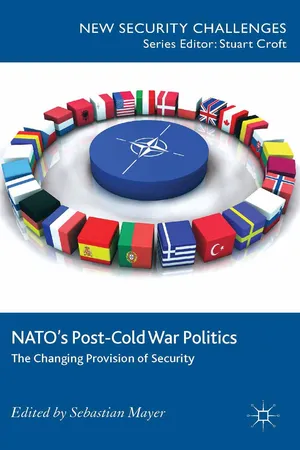
This collection is the first book-length study of NATO's bureaucracy and decision-making after the Cold War and its analytical framework of 'internationalization' draws largely on neo-institutionalist insights.
Information
1
Introduction: NATO as an Organization and Bureaucracy
Like other international organizations (IOs), the North Atlantic Treaty Organization (NATO) has become more complex since 1990. In the concise accounts that follow, this collection examines NATO’s bureaucracy and decision-making after the end of the Cold War, identifies changes therein, and evaluates their implications for the pursuit of external security and accompanying shifts in the locus of governance – alterations implying a transformation in national security politics. The book exposes the new functions and administrative capacities NATO has developed since 1990 and describes underlying processes. It is concerned with their implications for the provision of security, and it also develops initial arguments about the causes of this institutional change. The contributors address questions such as the following:
1) How did NATO as an organization and civil service change in the post-bipolar environment? Which administrative elements have evolved within the Alliance since 1990 – from scratch or as an evolution out of existing institutional schemes – in order to cope with new functions that the pact has taken on? And how have consensus-building, decision-shaping, and decision-making changed since?
2) How can the power relationship between NATO’s international administration and members be characterized, as reflected in the Alliance’s structures? Has NATO norm-shaping abilities or a security identity of its own, and did its institutional autonomy increase? Is NATO’s military integration at present more constraining for its members than before 1990? Are there accompanying losses in national autonomy?
3) Why did NATO’s overall bureaucratic structure and administrative units change the way they did after the Cold War? What are the driving forces behind this institutional change? How can specific institutional developments be explained? Perhaps as results of external shocks, deliberate rational action, norm-driven behaviour, path-dependent logic, or a mixture of them?
The emphasis of this volume lies on the first two sets of questions, although most chapters also provide hunches on how questions from the third could be answered. So far, there is no study systematically exploring NATO’s civil service and decision-making processes after 1990, and the main objective of the book is to fill this void. Contributors from a wide range of backgrounds – historians, theoretically interested scholars, policy experts, and practitioners – give important insights on the ways NATO provides security after the Cold War. Authors discuss the new challenges the Alliance now faces; they examine the changing rules, operational roles, and practices of a number of administrative bodies such as the Military Committee; they investigate the nature of NATO’s relationships with third-party actors, including non-governmental organizations; and they also examine the emergence of informal cooperation within and beyond the Alliance.
This introduction to the collection presents a number of concepts, interpretive frames, and theories that help to describe and explain specific features of institutional change of international (security) organizations. Traditional accounts (neorealism and the older functionalist regime theory) with their high levels of abstraction have difficulties to grasp bureaucratic features and IO’s internal dynamics. Conceptual insights for the majority of chapters – those dealing with NATO’s internal structures – are particularly taken from concepts more recently applied to the discipline of International Relations (IR), chiefly bureaucratic politics and principal–agent (PA) models, which are covered in more detail. While all authors address the heuristic framework of ‘internationalization’ which is introduced in the next section, some of the subsequent chapters remain rather descriptive. Yet, several authors reach levels of generalization high enough so as to allow for applying their findings to a range of other situations. The conclusion of this collection assesses both these theoretical arguments and empirical findings. A number of probabilistic theoretical claims on the internationalization of external security politics through NATO – as well as on its limits – can then be generated, and pathways to further research formulated.
The remainder of this introduction is structured as follows. The next section brings in the heuristic concept of internationalization, the common analytical theme running through all subsequent chapters. Next, the formation, persistence, and change of alliances are presented from a neorealist perspective. The following section provides alternative views based on regime theory and security governance which have a greater significance for the theme of this collection. The subsequent two sections pay particular attention to the more recent neo-institutionalist scholarships from which the internationalization framework particularly draws, and they specify several of its conceptual elements: one that introduces bureaucratic politics perspectives on international organizations, followed by a discussion on delegation, institutional autonomy, and agency in IOs. The penultimate section briefly looks at NATO as an organization and bureaucracy during and after the Cold War while the final gives an overview of the book.
Internationalization: A framework for analysis
The concept of ‘internationalization’ is suggested as an analytical framework for this volume. I define internationalization as a process by which national procedures of planning, decision-making, or implementation of a policy area are linked with – or shift to – international organizations and thus enhance their significance (Mayer 2009: 41–56; Mayer and Weinlich 2007: 43–46). Purely national decision-making lies at one ideal-typical end of the internationalization spectrum – with a supranational structure wherein member states have irrecoverably transferred authority to international actors with their pursuant autonomy from member-state control (equally ideal typical) at the other end. As all authors in the ensuing chapters clearly testify, NATO is far from developing into a suchlike supranational organization. Beneath a supranational governance structure, however, different levels of internationalization can be identified. Internationalization is therefore not an all-or-nothing proposition but always a matter of degree.
Internationalization unfolds through an increasing relevance of international actors (such as NATO’s secretariat) which are more remote from member-state control than national delegates. Indications are quantitative and qualitative increases in the tasks, competences, and resources of an IO’s consensus-shaping, decision-making, and implementing bodies as authoritative actors along the phases of the policy cycle. If these bodies are given new or more tasks in any of these phases, or receive more material resources such as funds, staff, or administrative capacities, it is inferred that their significance for the generation of security increases. But internationalization is also fostered – although to a lower degree – by way of an increased contact-density among national representatives at the international level.
The overarching question connected with the concept of internationalization is whether the institutionalization of new functions, mechanisms, and operational roles within the Alliance since 1990 has changed the way security is provided for among IO member states: through fragmented responsibilities in which transgovernmental and transnational contacts and pressure to reach consensus may alter underlying national preferences; by thicker institutional structures of rules and common practices potentially constraining national decisionmaking; or by schemes with the potential to subject national capabilities for autonomous action to institutional and physical constraints, for instance, through the integration of national capabilities. The internationalization framework broadly subscribes to a neo-institutionalist research agenda for which the central question is no longer merely whether international institutions matter in the first place, but increasingly how and under what conditions they make a difference.
The collection has two primary objectives. The first is stock-taking: the book provides a state-of-the-art description of the changed post-bipolar alliance as a bureaucracy and its decision-making processes for practitioners, bureaucratic politics scholars, and others interested in how NATO functions. The second, more specific objective, addresses the implications of these changes for the provision of security and elucidates its drivers. This aim is particularly worthy of note for those scholars of IR, comparative politics, and law engaged with the question of whether and to what extent the classical Western nation-states have changed over the past decades in response to pressures like globalization or liberalization (Hurrelmann et al. 2007; Leibfried and Zürn 2005). There are related literatures on the transformation of security politics after the Cold War, particularly on privatization and internationalization (cf. Avant 2005; Fischer-Lescano and Mayer 2013; Krahmann 2010; Weinlich 2011; Wulf 2005).
This book starts from the premise that bureaucratic developments need to be put in perspective by relating them to informal cooperation (through networks or impermanent ad hoc groupings) which escapes, or stands in opposition to, formal rules. This helps providing a less distorted picture of how the Alliance functions and how the power balance between its civil service and capitals can be adequately characterized. Studies taking a sociological viewpoint on IOs tend to neglect the interaction between micro-level phenomena and their external environment which may have a significant impact on internal change, however (Downs 1967: ch. II). There is generally the danger that bureaucratic politics scholars overestimate IO’s internal dynamics and supranational independence (as, conversely, is the case with scholars emphasizing state power). The disregard of power structures and state preferences leads to a misrepresentation of the overall picture of transformation of security politics. If we discover, for instance, that NATO’s institutional autonomy has significantly risen but its formal multilateral procedures and accompanying constraints are increasingly bypassed by its members, then this rise in institutional autonomy evidently gains no traction.
NATO as an international administration is an enormously under-researched area. This stands in stark contrast to the abundance of enquiries on bureaucratic arrangements and processes within the EU’s Common Foreign and Security Policy (CFSP) or the United Nations (UN), let alone purely civilian IOs such as the World Trade Organization (WTO) or the International Monetary Fund (IMF).1 What is more, the few book-length studies of NATO’s internal institutional structures, dynamics, or leadership roles are much dated (Jordan 1967, 1987; Jordan with Bloom 1979; Mouritzen 1990). The shortage has three main reasons: (1) NATO’s strict secrecy rules and the lack of transparency to an extent obstruct studies on its internal institutional dynamics in the first place; (2) there is no substantial funding, the existence of research networks, or academic structures which could significantly facilitate such work; and (3) scholars studying the Alliance predominantly perceive it merely as a tool for member states with no potential for IO autonomy.
This state-centric ontology is unduly narrow but not entirely unwarranted. As all authors in this volume demonstrate, NATO remains a largely government-dominated decision structure, and its civilian and military management exhibit only little institutional autonomy – the degree of independence from interference allowing for some purposive action. Inis Claude once succinctly made the point that ‘an international organization is most clearly an actor when it is most distinctly an “it”, an entity distinguishable from its member states’ (Claude 1984: 13). NATO’s administrative elements were designed as (and still chiefly are) supporting bodies, to a high degree constrained and dominated by member states. They do contain a substantial degree of governmental, rather than non-governmental representation. Major decisions are taken through the deeply embedded and sovereignty-sensitive customary practice of the consensus ‘rule’. And NATO operations ultimately cannot be deployed unless the larger members acquiesce in providing required capabilities.
Yet, although (the powerful) NATO members may be the principal, they are by no means the only significant actors. Owed to the sparse research on NATO as an IO in its own right, its independent role may have been underestimated in the past. After all, day-to-day business is left to NATO’s international bureaucracy, and it acts as an implementing agency for member states’ policies. This function is already important in its own right, and additional tasks in the execution of policies are seen as feeding the process of internationalization. What is more, the implementation of policy decisions often opens channels for political activity for bureaucratic actors (Joachim, Reinalda, and Verbeek 2008). Due to the functional expansion of the security agenda which now comprises multilayered dimensions and involves more operational tasks in the non-Article 5 spectrum such as peacekeeping or peace enforcement, NATO as an IO with its institutional resources appears to be much in need. Also, in an extensively enlarged alliance, there are additional veto players, and the more heterogeneous preferences of individual members can be less easily accommodated. It is not implausible to argue that governments have therefore suffered a relative loss of influence within the Alliance and that the role of NATO’s international bureaucracy to establish cohesion and facilitate rapid consensus-building and decision-making has increased accordingly.
It is unlikely that more research on the Alliance as an organization will uncover the International Staff as an autonomous, runaway supranational body or its post-Cold War Secretaries General as frequently slacking agents. Yet, it might well be that preceding scholarship has underestimated NATO’s potential to initiate or shape decisions and hence structure collective outcomes – but likewise to obstruct institutional change imposed from outside. It is crucial to note that an IO’s ideal-typical roles – instrument, arena, and independent actor – should not be seen as mutually exclusive. Often, IOs play several roles and their corresponding leeway varies according to issue area and external systemic constraints (Snidal 1990). The subsequent chapters in this volume explore these roles and structural changes.
Has the member state’s Westphalian sovereignty, the absence of a role for external actors in domestic structures, receded in the wake of internationalization? Eventually, this question is open to empirical scrutiny. Many authors in this volume answer it in the affirmative, and their insights challenge the widespread notion that states are the only significant actors in the pursuit of external security. They hence acknowledge that institutions do make a difference and thus lean towards the neo-institutionalist paradigm. Others remain wedded to a more state-centric foundational reality about the nature of IOs and are more cautious with regard to an alleged institutional autonomy, norm-shaping abilities, or a constraining potential of the alliance.
Formation, persistence, and change of alliances: The neorealist baseline
The formation of alliances is one of the most striking phenomena in international relations. An alliance can broadly be characterized as a ‘formal agreement that pledges states to co-operate in using their military resources against a specific state or states and usually obligates one or more of the signatories to use force, or to consider (unilaterally or in consultation with allies) the use of force in specified circumstances’ (Osgood 1968: 17). International security organizations (ISOs) are alliances inasmuch as they are made up primarily of states as their component entities which collaborate to pursue collective goals in the field of security. They are formal in character – based on multilateral ...
Table of contents
- Cover
- Title Page
- Copyright
- Contents
- List of Tables and Figures
- Acknowledgements
- Notes on Contributors
- List of Abbreviations and Acronyms
- 1. Introduction: NATO as an Organization and Bureaucracy
- Part I: The Origins of NATO and Its Bureaucratic Development during the Cold War
- Part II: Changing Security Challenges and NATO’s New Identity
- Part III: NATO’s Post-Cold War Bureaucracy, Consensus-Building, and Decision-Making
- Part IV: NATO’s Relations with Third-Party Actors
- Part V: External Power Structures and Global Security
- Timeline: NATO’s Bureaucratic-Institutional Development since 1949
- Index
Trusted by 375,005 students
Access to over 1.5 million titles for a fair monthly price.
Study more efficiently using our study tools.
Frequently asked questions
Yes, you can cancel anytime from the Subscription tab in your account settings on the Perlego website. Your subscription will stay active until the end of your current billing period. Learn how to cancel your subscription
No, books cannot be downloaded as external files, such as PDFs, for use outside of Perlego. However, you can download books within the Perlego app for offline reading on mobile or tablet. Learn how to download books offline
Perlego offers two plans: Essential and Complete
- Essential is ideal for learners and professionals who enjoy exploring a wide range of subjects. Access the Essential Library with 800,000+ trusted titles and best-sellers across business, personal growth, and the humanities. Includes unlimited reading time and Standard Read Aloud voice.
- Complete: Perfect for advanced learners and researchers needing full, unrestricted access. Unlock 1.5M+ books across hundreds of subjects, including academic and specialized titles. The Complete Plan also includes advanced features like Premium Read Aloud and Research Assistant.
We are an online textbook subscription service, where you can get access to an entire online library for less than the price of a single book per month. With over 1.5 million books across 990+ topics, we’ve got you covered! Learn about our mission
Look out for the read-aloud symbol on your next book to see if you can listen to it. The read-aloud tool reads text aloud for you, highlighting the text as it is being read. You can pause it, speed it up and slow it down. Learn more about Read Aloud
Yes! You can use the Perlego app on both iOS and Android devices to read anytime, anywhere — even offline. Perfect for commutes or when you’re on the go.
Please note we cannot support devices running on iOS 13 and Android 7 or earlier. Learn more about using the app
Please note we cannot support devices running on iOS 13 and Android 7 or earlier. Learn more about using the app
Yes, you can access NATO’s Post-Cold War Politics by S. Mayer in PDF and/or ePUB format, as well as other popular books in Politics & International Relations & International Relations. We have over 1.5 million books available in our catalogue for you to explore.