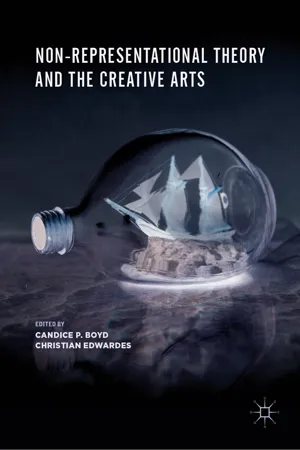
This book presents distinct perspectives from both geographically-oriented creative practices and geographers working with arts-based processes. In doing so, it fills a significant gap in the already sizeable body of non-representational discourse by bringing together images and reflections on performances, art practice, theatre, dance, and sound production alongside theoretical contributions and examples of creative writing. It considers how contemporary art making is being shaped by spatial enquiry and how geographical research has been influenced by artistic practice. It provides a clear and concise overview of the principles of non-representational theory for researchers and practitioners in the creative arts and, across its four sections, demonstrates the potential for non-representational theory to bring cultural geography and contemporary art closer than ever before.
eBook - ePub
Non-Representational Theory and the Creative Arts
- English
- ePUB (mobile friendly)
- Available on iOS & Android
eBook - ePub
Non-Representational Theory and the Creative Arts
About this book
Information
© The Author(s) 2019
Candice P. Boyd and Christian Edwardes (eds.)Non-Representational Theory and the Creative Artshttps://doi.org/10.1007/978-981-13-5749-7_11. Creative Practice and the Non-Representational
Candice P. Boyd1 and Christian Edwardes2
(1)
School of Geography, University of Melbourne, Parkville, VIC, Australia
(2)
Arts University Bournemouth, Poole, UK
Foremost, this book is about the experimental forces that guide creative practice —forces of which we are aware but also those that we are not. This book is also about space —the ways in which it is created, co-constructed, vital , emergent , transient , and contingent . What it serves to highlight is a breadth and depth of creative practice which struggles and celebrates the things of this world that are fleeting , ephemeral , not-quite-subjective , diffused , distributed , and difficult to grasp. It is about the ways in which artists and geographers have turned to a mode of creative praxis which is situated yet uncertain in order to extend the limits of artistic and geographical knowledge , and it is about the ways in which geographers and artists have mutually informed and inspired one another to create work which locates itself at the ‘bleeding’ edge of the art–geography nexus. As editors, it is our sincere hope that this book prompts a rethinking of the relationship between geography and art—for what they share and what they offer one another as disciplines, and for the potential they each hold for constructive and creative collaboration . In what follows by way of an introduction, we provide an overview of the historical dialogue between art and geography , their shared theoretical underpinnings in relation to creative practice , and the recent turn to the non-representational —a movement in practice and thought which has brought these two disciplines closer than ever before.
An Introduction to Non-Representational Theory: The Geography of What Happens
Non-representational theories in geography first emerged in the early 1980s in response to a disciplinary need to ‘take practices seriously’ (Thrift, 2008, p. 21). It was not until the mid-1990s at the University of Bristol, however, that its tenets were elaborated in a first wave of scholarship that was largely theoretical (Anderson & Harrison, 2010). Over the following decades cultural geographers began to develop distinct methodological approaches, sparking the interest of cognate disciplines including anthropology, performance studies, and the creative arts whose work shared similar philosophical antecedents. This second wave of activity culminated in the publication of the first book on non-representational methodologies in 2015 (Vannini, 2015).
Thrift (2008) describes non-representational theory as the geography of what happens. It is interested in the ways in which life ‘takes place’ through movement , intensities , and encounters (Lorimer, 2005). In doing so, it rejects substance-based understandings of the world, in favour of process-relational philosophies , by positing that the world is always in movement. Forces and entities continually come in and out of relation in ways that are contingent , messy, and unpredictable but, at the same time, full of potential . Non-representational theory is an attempt to embrace life’s messiness without the need to contain or reduce it to a set of social constructions and, therefore, follows in the tradition of vitalist thinkers such as Alfred North Whitehead, Gilles Deleuze, Brian Massumi, and Bruno Latour. It similarly employs the ethological notion of the pre-individual field from which the world ‘unfolds’ from moment to moment within a broader stream of activity (Thrift, 2008).
Central to process-based understandings of the world is the need to produce knowledges that escape ‘a consciousness-centred core of self-reference’ and instead call attention to the pre-cognitive and affective dimensions of practice (Thrift, 2008, p. 5). There is more to the world than what we can consciously know or represent in language, a phenomenon that practitioners in the creative arts have articulated as ‘carnal knowledge’ (Barrett & Bolt, 2013). Carnal, bodily, or visceral knowledges are produced by intervening in the world through creative and material acts of ‘making sense ’, an approach to knowledge production which non-representational theory and the creative arts share. Apart from being highly contingent , such approaches are resolutely experimental as they seek to ‘reveal’ the world’s precarity (Dewsbury, 2010). What this means for the artist practitioner is the retreat of the (cognitively-driven) intentional act as the means of providing a totalising explanation or interpretation of their work. Instead, attention is turned to the configurations of bodies and things that ‘enable and extend’ an artist’s conscious awareness.
As Dewsbury (2010) argues, non-representational theory is an ontology of sense and sense only comes about as a ‘bodily sense’ (p. 147). Thus, the ability to apprehend the non-representational is only made possible by a sensing body in relation . Forces and intensities act on bodies but are also produced through bodies , transmitted by bodies, and transformed by them (Lorimer, 2008). It is this capacity of the body to affect and be affected which enables its conceptualisation as an expressive force in the world (Cadman, 2009). The implication for the ‘doing’ of non-representational research is that we must ‘…get embroiled in the site and allow ourselves to be infected by the effort, investment, and craze of the particular practice or experience being investigated’ (Dewsbury, 2010, p. 326). This means cultivating a certain sensuous disposition to the body as part of a wider ecology of things, which has led cultural geographers to experiment with sensory research methods and for artists to explore the potential of site- and event-based practices and performances (Boyd, 2017; Edwardes, 2015).
Lastly, non-representational theory is spatially inflected and it is in its formulations of space that it makes a potent contribution to thinking and practice in the creative arts . Space, in this sense , is not a ‘container’, but a set of manifold relations that are socially produced out of diverse material and affective conditions or situations (Crouch, 2010). Space is conceived, perceived, and lived (Lefebvre, 1991). Such formulations have a strong affinity with Soja’s (1996) notion of third space as a ‘limitless composition of lifeworlds that are radically open and openly radicalizable … disorderly, unruly, constantly evolving, unfixed, never presentable in permanent constructions’ (p. 70). It is ...
Table of contents
- Cover
- Front Matter
- 1. Creative Practice and the Non-Representational
- Part I. Situated Practices in Art, Craft and Design
- Part II. Artistic Engagements with Geography
- Part III. Geographers Exploring Artistic Practice
- Part IV. Sound, Music, and Creative Mobilities
- Back Matter
Trusted by 375,005 students
Access to over 1.5 million titles for a fair monthly price.
Study more efficiently using our study tools.
Frequently asked questions
Yes, you can cancel anytime from the Subscription tab in your account settings on the Perlego website. Your subscription will stay active until the end of your current billing period. Learn how to cancel your subscription
No, books cannot be downloaded as external files, such as PDFs, for use outside of Perlego. However, you can download books within the Perlego app for offline reading on mobile or tablet. Learn how to download books offline
Perlego offers two plans: Essential and Complete
- Essential is ideal for learners and professionals who enjoy exploring a wide range of subjects. Access the Essential Library with 800,000+ trusted titles and best-sellers across business, personal growth, and the humanities. Includes unlimited reading time and Standard Read Aloud voice.
- Complete: Perfect for advanced learners and researchers needing full, unrestricted access. Unlock 1.5M+ books across hundreds of subjects, including academic and specialized titles. The Complete Plan also includes advanced features like Premium Read Aloud and Research Assistant.
We are an online textbook subscription service, where you can get access to an entire online library for less than the price of a single book per month. With over 1.5 million books across 990+ topics, we’ve got you covered! Learn about our mission
Look out for the read-aloud symbol on your next book to see if you can listen to it. The read-aloud tool reads text aloud for you, highlighting the text as it is being read. You can pause it, speed it up and slow it down. Learn more about Read Aloud
Yes! You can use the Perlego app on both iOS and Android devices to read anytime, anywhere — even offline. Perfect for commutes or when you’re on the go.
Please note we cannot support devices running on iOS 13 and Android 7 or earlier. Learn more about using the app
Please note we cannot support devices running on iOS 13 and Android 7 or earlier. Learn more about using the app
Yes, you can access Non-Representational Theory and the Creative Arts by Candice P. Boyd, Christian Edwardes, Candice P. Boyd,Christian Edwardes in PDF and/or ePUB format, as well as other popular books in Social Sciences & Art General. We have over 1.5 million books available in our catalogue for you to explore.