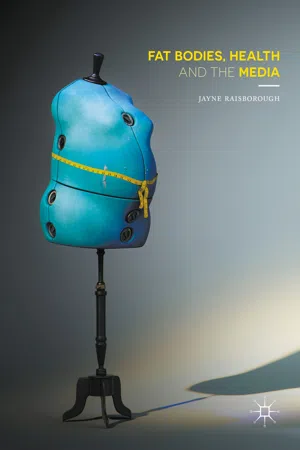
In this book, Jayne Raisborough explores interpretations of fat bodies from Palaeolithic Europe to Poverty Porn TV to argue that fat's materiality makes it ripe for stigmatising associations. However, especially in a social context that presents health as a matter of choice, fat also emerges as an ideal redemptive substance to be pummelled and starved into submission. This book presents a 'fat sensibility' to demonstrate how fat is helping us all become responsibilised healthy-citizens. It asks just what self are we being asked to diet ourselves into?
- English
- ePUB (mobile friendly)
- Available on iOS & Android
eBook - ePub
Fat Bodies, Health and the Media
About this book
Our televisions bulge with weight-loss shows, as the news warn of the obesity epidemic. Fat is such a villain that larger people are stigmatized and we all are seduced by life-changing claims of a multi-billion pound diet industry. Yet, when we question if our bathroom scales can really tell us about our health, we start to ask just why and how fat holds such fascination.
Information
© The Editor(s) (if applicable) and The Author(s) 2016
Jayne RaisboroughFat Bodies, Health and the Media10.1057/978-1-137-28887-5_11. Introduction: Fat, the Media, and a Fat Sensibility
Jayne Raisborough1
(1)
School of Applied Social Science, University of Brighton, Brighton, UK
Thirty-stone Sharon avoids looking in the mirror. She can’t leave her house for fear of people commenting on her weight. At only 40 years of age, she realizes that her life is just wasting away and that her own self-confessed greed and laziness is the cause. Her self-esteem is at rock bottom. With the threat of heart disease hanging over her, she needs to do something and she can’t do it alone. Luckily, help is on hand in the form of a fitness expert. With tough love, a grueling exercise regime and punishing diet, he’ll give this woman her waist and life back again. He’ll believe in her so she can start believing in herself.
If this sounds familiar it is because stories like this wind their way through weight-loss television shows found in many parts of the world. In the UK, shows such as Supersize vs Superskinny, Secret Eaters, and Embarrassing Fat Bodies join the re-runs of You Are What You Eat to compete with satellite broadcasts such as America’s Obese: A Year to Save my Life and New Zealand’s Down Size Me. It is not just the UK that is treated to such a menu of weight-loss shows: The Biggest Loser, the most lucrative format of this genre, has been sold and aired in over 25 countries, with China being the latest to host the show. The global success of The Biggest Loser has encouraged a multitude of new television weight-loss formats, as this journalist’s report of American television indicates:
The CW’s ‘Shedding for the Wedding’ features overweight couples competing in weight-loss challenges to earn elements of their dream wedding. Oxygen’s ‘Dance Your A** Off’ scores plus-sized participants on their dance abilities and pounds lost. Lifetime’s ‘DietTribe’ tracked the weight-loss progress of five real women over four months of intense diet and exercise. The Style Network has ‘Ruby’, a series that follows its morbidly obese namesake star on her journey to regain her health. There’s also MTV’s ‘I Used to Be Fat’, Discovery’s ‘One Big Happy Family’ and A&E’s ‘Heavy’.Two more weight-related series premiere this week: Lifetime’s ‘Love Handles’, featuring overweight couples working to heal their relationships as they shed pounds… (Cohen 2011).
Of course, weight is also making the news. Take, for example, recent newspaper headlines; as the Bangkok Post reports on the speed of weight gain in the Thai population, Malta Today shares the latest World Health Organization research that identifies Malta as hosting the most obese population in the European Union. The UK’s Guardian offers a sober warning that obesity rates could be far worse than predicted, with dire consequences for the National Health Service. Similarly The Australian tells its readers to ‘Forget smoking—Obesity is our biggest health menace’. Their neighbours at the The New Zealand Herald claim that the number of obese citizens has quadrupled since the 1980s and demand to know just who will pay for the care of these people, while across an expanse of water, Canada’s The Globe and Mail and the US’s New York Times remind their readers that obesity as a disease now affects increasing numbers of teenagers and young children. It may seem that just as the news provides us with worrying statistics of widening girths, spiralling health costs, and dire future predictions, television shows are not only helping people like Sharon get their lives back, but are also educating audiences about healthier lifestyles and motivating them. There seems that there is little to worry about—perhaps television shows are reflecting a real societal risk and, through entertainment, are mobilizing us all back to health. We’d better watch more telly!
Concerns start, however, when we consider that even a cursory glance at television schedules and news headlines suggest that our bathroom scales can tell us all we ever need know about our health. Our concerns may deepen when we hear claims that the range and scale of the obesity ‘epidemic’ have been over-exaggerated (Blaine 2007). It is, as Gard and Wright (2005) argue, one thing to recognize what may be a trend in weight increase but is quite another to suggest that there is agreement over the severity and extent of that trend. Indeed, they add that there are a number of problems in assuming that medical science is the only or is an unproblematic way of apprehending obesity. Not only are there deep concerns within the medical profession about possible iatrogenic and stigmatizing impacts of the obesity epidemic (Monaghan 2013), but there is also little clear-cut epidemiological evidence linking overweight with illness and death (Holland et al. 2011), or that which connects weight loss with health gain (Throsby 2008), or evidence to suggest anti-obesity measures actually work (Warin et al. 2015). Things become more muddied when we look at increasing evidence of the so-called ‘healthy obese’—larger individuals who have comparable metabolic health to ‘normally’ (or rather normatively) weighted persons. Along this line of thinking, we can also add that there is growing support for the idea that obesity may well have health-enhancing properties for the elderly (Murphy 2014). There seems ample support then for sociologist Lee Monaghan’s claim that the ‘actual extent of risks and deaths assumed to be due to fatness is scientifically indeterminable and, like any currency, subject to potentially massive inflation’ (2005: 304). For many scholars this ‘inflation’ is due in no small part to a creeping conflation between ‘overweight’ and ‘obesity’ and the inaccuracy of the most ubiquitous measurement of the obesity epidemic—the body mass index (BMI) (Moffat 2010; Murphy 2014). We’ll return to the BMI in Chap. 3.
Yet, if we accept, as even some of the most ardent sceptics of the idea of an ‘obesity epidemic’ do, that there is an intensity of correlations between certain illnesses/diseases and weight at extreme weight ranges (Monaghan 2013; Wray and Deery 2008), we may be alarmed to realize that the people most likely to encounter the risks are also those most unfavourably situated at the intersections of socially stratifying power relations (van Amsterdam 2013; Warin et al. 2015). We may feel very uneasy when we acknowledge the sociological point that poverty, deprivation, and social inequalities drawn along the lines of social class, gender, and ethnicity, amongst others, are major drivers of ill health (Jovanovic 2014). We may even start to wonder why our societies are not more fully supporting solutions to illnesses and disease that are geared towards social justice and redistribution as opposed to solely behaviour or lifestyle change—the very solutions we see dramatized in the weight-loss television show. In this light, we may start to be suspicious of the weight-loss show.
We may also start to feel uneasy about ‘epidemic claims’ once we consider too the vested interests that the global pharmaceutical, insurance, and diet industries have in the obesity epidemic, despite, for example, increasing evidence demonstrating the ineffectiveness of dieting for weight reduction—no matter how miraculous the diet may claim to be (de Ridder et al. 2014). We could feel a little troubled when we remember that fat makes for big business and not just for the enterprising few exploiting the market gap in oversized clothes, toilet seats, and caskets; food companies have quickly realized increased profitability in products that can boast their health-enhancement qualities alongside their low or no fat content (Oliver 2006). The economic crisis is not slowing down this industry; indeed, some are looking to weight-loss products to boost flagging sales elsewhere. Take, for example, Amway in Thailand who hope to counter slowing sales of their food supplements with a new weight-loss product that will take its place on a market worth some 10 billion bhat, with 8 % growth (Jitpleecheep 2015). For those of you looking to invest state-side: The U.S. Weight Loss Market: 2015 Status Report & Forecast by Marketdata Enterprise Inc. observes a flattening of the diet drink market but tags medical weight-loss programmes and their meal replacements as future money-spinners.
Yet, there is more we can still say: if we pan out from the specifics of fat, we might reflect too on the ways that market rationalities are redefining health from a state free from illness to a site of individual responsibility (Parker 2014): it is now up to each of us to navigate a sea of health risks and our success is increasingly read from the body. It is no exaggeration to state that the body, in our neoliberal contexts, serves as a moral canvas—the look, tone, shape, and stance of the body speaks not only of a person’s health, but of their worth and, as this book will argue, of personhood itself. Once these wider, contextual issues are considered, when, in other words, the relationship between fat and health is regarded with more curiosity or suspicion, then it is possible and necessary to ask why transformative stories like Sharon’s, which privilege a weight/health relationship and individualized, privatized, lifestyle solutions, are increasingly filling our television screens.
Why the Media Matters: Health Literacies and Stigma
Scholars who are critical of the over-simplification of weight/health have been concerned with media representations of fat and obesity for some time. By and large, they have focused their attention on the news coverage of the obesity epidemic because fact-based alarmist claims (‘fat bomb’ statistics, for example) have become commonplace in this genre (discussed here in Chap. 3). This scholarship argues that the media plays an important role in the construction and circulation of health literacies. I am using this term to refer specifically to the way we understand health and, in this case, ‘read’ it from our bodies and from the bodies of others (see Murray’s (2008) discussion of lipo-literacies). These literacies are significant because not only do they inform our subjective experiences of our bodies and health and give us a way of understanding the bodies and health status of others, but they also inform and are informed by wider societal ideals around personhood and citizenship. As this book will demonstrate, health literacies tend to sweep up other, wider, sometimes seemingly unrelated social anxieties about, for example, classed, racialized Others, about welfare, about dependency and the imagined threats these pose for prevailing notions of progression, modernization and civilization (see Chap. 7). Health literacies are then always more than diagnostic tools or neutral, discrete ways of knowing—they are always and already imbricated in broader political contexts and thus in power relations.
Health literacies circulate at personal, interpersonal, and societal (structural) levels and are able through this circulation to shape common sense and policy (e.g. Barry et al. (2009) have demonstrated that our beliefs about obesity affect our support for various public policies and state interventions). Health literacies are also related to expressions of lipophobia (Gracia-Arnaiz 2013), weightism (Ata and Thompson 2010), and fatism (Maturo 2014). These terms capture the degrees and extent of stigma and weight discrimination encountered by larger people in all spheres of life from intimate interpersonal relationships in the physical and online world to more formal experiences with institutions, organizations, and services (De Brún et al. 2014; Farhat et al. 2015). Taking employment as an example, Flint and Snook’s (2014) literature review suggests that larger people can face less favourable treatment in job interviews; suffer more workplace stress; are more likely to be allocated the ‘worse’ jobs; work longer hours; and in some cases earn less money than employees considered to be of ‘normal weight’. The authors suggest ...
Table of contents
- Cover
- Frontmatter
- 1. Introduction: Fat, the Media, and a Fat Sensibility
- 1. Dramatis Personae: Introducing Fat, Health and Mass Media
- 2. Fat Hits the Small Screen
- Backmatter
Trusted by 375,005 students
Access to over 1.5 million titles for a fair monthly price.
Study more efficiently using our study tools.
Frequently asked questions
Yes, you can cancel anytime from the Subscription tab in your account settings on the Perlego website. Your subscription will stay active until the end of your current billing period. Learn how to cancel your subscription
No, books cannot be downloaded as external files, such as PDFs, for use outside of Perlego. However, you can download books within the Perlego app for offline reading on mobile or tablet. Learn how to download books offline
Perlego offers two plans: Essential and Complete
- Essential is ideal for learners and professionals who enjoy exploring a wide range of subjects. Access the Essential Library with 800,000+ trusted titles and best-sellers across business, personal growth, and the humanities. Includes unlimited reading time and Standard Read Aloud voice.
- Complete: Perfect for advanced learners and researchers needing full, unrestricted access. Unlock 1.5M+ books across hundreds of subjects, including academic and specialized titles. The Complete Plan also includes advanced features like Premium Read Aloud and Research Assistant.
We are an online textbook subscription service, where you can get access to an entire online library for less than the price of a single book per month. With over 1.5 million books across 990+ topics, we’ve got you covered! Learn about our mission
Look out for the read-aloud symbol on your next book to see if you can listen to it. The read-aloud tool reads text aloud for you, highlighting the text as it is being read. You can pause it, speed it up and slow it down. Learn more about Read Aloud
Yes! You can use the Perlego app on both iOS and Android devices to read anytime, anywhere — even offline. Perfect for commutes or when you’re on the go.
Please note we cannot support devices running on iOS 13 and Android 7 or earlier. Learn more about using the app
Please note we cannot support devices running on iOS 13 and Android 7 or earlier. Learn more about using the app
Yes, you can access Fat Bodies, Health and the Media by Jayne Raisborough in PDF and/or ePUB format, as well as other popular books in Social Sciences & Gender Studies. We have over 1.5 million books available in our catalogue for you to explore.