This book investigates the use of duress as a defence in international criminal law, specifically in cases of child soldiers. The prosecution of children for international crimes often only focuses on whether children can and should be prosecuted under international law. However, it is rarely considered what would happen to these children at the trial stage. This work offers a nuanced approach towards international prosecution and considers how children could be implicated and defended in international courts. This study will be of interest to academics and practitioners working in international criminal law, transitional justice and children's rights.
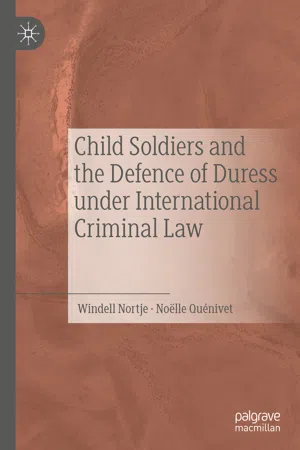
eBook - ePub
Child Soldiers and the Defence of Duress under International Criminal Law
- English
- ePUB (mobile friendly)
- Available on iOS & Android
eBook - ePub
Child Soldiers and the Defence of Duress under International Criminal Law
About this book
Information
© The Author(s) 2020
Windell Nortje and Noëlle QuénivetChild Soldiers and the Defence of Duress under International Criminal Lawhttps://doi.org/10.1007/978-3-030-20663-5_11. Introduction
Windell Nortje1 and Noëlle Quénivet2
(1)
Faculty of Law, University of the Western Cape, Cape Town, South Africa
(2)
Bristol Law School, University of the West of England, Bristol, UK
It is common cause that children should be shielded from participating in armed conflicts. The reality, however, is that children, defined as persons under the age of 18 years old,1 actively engage in conflicts across the world and are involved in duties, such as fighting,2 portering,3 gathering information,4 caretaking,5 cooking,6 looting,7 acting as bodyguards or military guards,8 manning checkpoints,9 providing medical care10 and abducting and training other children.11 Consequently, as some children take a direct part in the hostilities12 they are likely to commit international crimes.13 Indeed, child soldiers commit some of the most egregious crimes under international law since they are often used by armed groups at the frontline of armed conflicts.14 However, they are usually not prosecuted for such crimes and are rehabilitated once they have been disarmed and demobilised.15 While some child soldiers are rehabilitated when they are still children, many child soldiers are not demobilised and become adult soldiers because often they cannot escape from the armed group or simply decide to stay with the group.16 Many of these children even become military commanders, such as Dominic Ongwen. In the past few years Ongwen has become the face of a former child soldier turned commander17: abducted at a young age and forced to commit horrendous crimes he moved up the ranks of the Lord’s Resistance Army headed by the infamous Joseph Kony,18 and is now facing prosecution before the International Criminal Court (ICC), though for crimes committed as an adult. Another ‘poster boy’ of this terrible conflict that engulfed northern Uganda for almost 30 years is Thomas Kwoyelo who suffered the same fate as Ongwen as a child but, unlike him, is now being prosecuted on the national level before the High Court of Uganda. It must however be pointed out that whilst they might both be the face of these former child soldiers, they are prosecuted for crimes committed as adults and not as children. Yet, both symbolise the fate of hundreds of thousands of children around the world and have caught the Western world’s imagination.19 Such attitude is partially due to the fact that they epitomise the cross-breed of victims and perpetrators and challenge a number of binary models. Firstly, they blur the established moral norm that divides those caught in an armed conflict between, on the one hand, victims who are innocent and pure and, on the other, perpetrators who are guilty and evil.20 Secondly, international criminal law (and any criminal law for that matter) is based on this victim-perpetrator dichotomy21 as ‘international courts are meant to deliver messages about the values and norms, which are assumed to characterize humanity’22: much of their life story shows that they are both. The victim-perpetrator narrative is an immense disruptive power that, it is argued, the International Criminal Court has recognised.23 Thirdly, they shatter the binary model of adults-bad and children-good that dominates modern legal discourse.24 Child soldiers struggle to fit into this idealised vision of childhood as a ‘period of play and innocent experimentation’.25 Although ‘[c]hild soldiers carry the burden of simultaneously being recipients and perpetrators of violence’26 they are quintessentially viewed as ‘innocent’, ‘pure’ victims.27 Yet, ‘while the perception of young people as victims of forced conscription and unscrupulous warlords might be correct for many of the very young children, the quantitatively more significant number of older child and youth combatants often do not fit this picture.’28 Indeed, the prosecutions of Ongwen and Kwoyelo irremediably challenge this Western liberal idea that child soldiers should be viewed as victims only. This book provides numerous examples of children having committed crimes, thus supporting a more nuanced and complex understanding of the role that children play in armed conflicts.
Whilst the concept of a child soldier might conjure up in the general public’s mind archetypal pictures of very young boys holding AK47s, it is used in law and social sciences to cover a much wider set of individuals, including girls and children who are not fighting. Indeed, although there is no legally binding definition neither in treaty nor in customary law, soft law instruments, such as the 1997 Cape Town Principles, state that child soldiers are ‘[a]ny person under 18 years of age who is part of any kind of regular or irregular armed force or armed group in any capacity, including but not limited to cooks, porters, messengers and anyone accompanying such groups, other than family members. It includes girls recruited for sexual purposes and forced marriage. It does not, therefore, only refer to a child who is carrying or has carried arms.’ The 2007 Paris Principles heavily draw upon this definition too.29 In addition, Graça Machel30 who penned the...
Table of contents
- Cover
- Front Matter
- 1. Introduction
- 2. Duress as a Defence Under International Criminal Law
- 3. The Application of the Requirements of Duress to Child Soldiers
- 4. Limits of, and Exclusions from, the Defence of Duress
- 5. Duress as an Excuse Defence for International Crimes
- 6. Conclusion
- Back Matter
Trusted by 375,005 students
Access to over 1.5 million titles for a fair monthly price.
Study more efficiently using our study tools.
Frequently asked questions
Yes, you can cancel anytime from the Subscription tab in your account settings on the Perlego website. Your subscription will stay active until the end of your current billing period. Learn how to cancel your subscription
No, books cannot be downloaded as external files, such as PDFs, for use outside of Perlego. However, you can download books within the Perlego app for offline reading on mobile or tablet. Learn how to download books offline
Perlego offers two plans: Essential and Complete
- Essential is ideal for learners and professionals who enjoy exploring a wide range of subjects. Access the Essential Library with 800,000+ trusted titles and best-sellers across business, personal growth, and the humanities. Includes unlimited reading time and Standard Read Aloud voice.
- Complete: Perfect for advanced learners and researchers needing full, unrestricted access. Unlock 1.5M+ books across hundreds of subjects, including academic and specialized titles. The Complete Plan also includes advanced features like Premium Read Aloud and Research Assistant.
We are an online textbook subscription service, where you can get access to an entire online library for less than the price of a single book per month. With over 1.5 million books across 990+ topics, we’ve got you covered! Learn about our mission
Look out for the read-aloud symbol on your next book to see if you can listen to it. The read-aloud tool reads text aloud for you, highlighting the text as it is being read. You can pause it, speed it up and slow it down. Learn more about Read Aloud
Yes! You can use the Perlego app on both iOS and Android devices to read anytime, anywhere — even offline. Perfect for commutes or when you’re on the go.
Please note we cannot support devices running on iOS 13 and Android 7 or earlier. Learn more about using the app
Please note we cannot support devices running on iOS 13 and Android 7 or earlier. Learn more about using the app
Yes, you can access Child Soldiers and the Defence of Duress under International Criminal Law by Windell Nortje,Noëlle Quénivet in PDF and/or ePUB format, as well as other popular books in Politics & International Relations & Criminal Law. We have over 1.5 million books available in our catalogue for you to explore.