- English
- ePUB (mobile friendly)
- Available on iOS & Android
eBook - ePub
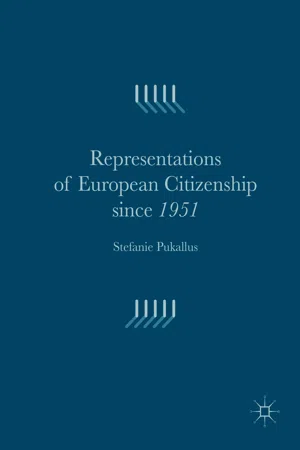
Representations of European Citizenship since 1951
About this book
This book is a study of the multiple meanings of European citizenship, which has been represented and publicly communicated by the European Commission in five distinctive ways – Homo Oeconomicus (1951-1972), A People's Europe (1973-1992), Europe of Transparency (1993-2004), Europe of Agorai (2005-2009) and Europe of Rights (2010-2014). The public communication of these five distinct representations of European citizenship reveal how the European Commission conceived of and attempted to facilitate the development of a Civil Europe. Ultimately this history, which is based upon an analysis of public communication policy papers and interviews with senior European Commission officials past and present, tells a story about changing identities and about who we as Europeans might actually be and what kind of Europe we might actually belong to.
Information
© The Author(s) 2016
Stefanie PukallusRepresentations of European Citizenship since 195110.1057/978-1-137-51147-8_11. A Civil Europe
Stefanie Pukallus1
(1)
University of Sheffield, Sheffield, UK
1 The European Commission and the Stimulation of a European Civil Consciousness
The European Commission (henceforth Commission) has been a continuing driving force for European integration. 1 It has been characterised as having two main characteristics: first, it is independent in that it has to treat the opinions of the member states with parity and respect. In short, ‘it must be impartially politically and indifferent as to nationality’. 2 Second, and importantly for the civil narrative described in this book, the Commission ‘must also be European, meaning that it must discern the common interest clearly and accurately and promote it energetically. In this sense it must be partisan and protagonistic’. 3 According to Haas 4 ‘(…) Monnet was reported to consider the Commission as ‘the repository of the European General Will’. As the ‘motor of the Community’, 5 it envisaged ‘politics [as] the art of the possible’. 6 What this meant was that the Commission provided the dynamism necessary to bring European integration forward—in fact, Hallstein argued that ‘no feature of the Community is as spectacular, as thrilling as its progressiveness’. 7 In short, the Commission interpreted its competences in the Treaties widely and was therefore able to define the scope and depth of European integration in distinct policy areas. From the start, the Commission’s vision of what European integration was to become included European civil integration and concomitantly, European policy areas extended beyond economic and political policies to include specifically civil policies. In other words, the Commission (and before that the High Authority 8 ) has shown a persistent interest in fostering European civil integration since the 1950s. By European civil integration I mean the Commission’s ambitions and subsequent efforts to stimulate greater European civil unity and solidarity through a range of civil initiatives in the cultural and educational fields such as the building of European schools, University programmes and collaborations, the production of European films and documentaries as well as the organisation of art and music festivals; civil-spatial policy which included the use of symbols, statues and the organisation of European exhibitions; and social policy where the Community attempted to create a European social security system, developed housing projects and provided funding for further education and training. Importantly, public communication was a policy in its own right 9 but also supported the raising awareness efforts of the other civil initiatives and, so it was hoped, the stimulation of a European civil consciousness.
Indeed, already in the first generation of European civil servants—‘enlightened and purposeful politicians’ 10 —there was a group of influential officials who firmly believed in the value of, the potential for and the necessity of European civil integration. The members of this group included René Mayer, Max Kohnstamm, Michel Gaudet, Pierre Uri, Jacques-René Rabier, François Fontaine, all of whom worked closely with one of the main protagonists of European integration, Jean Monnet, who was the driving force behind the High Authority’s early civil initiatives. Indeed Monnet, his collaborators (as well as their successors, which included, notably, Walter Hallstein 11 and Jean Rey 12 but also Sicco Mansholt, 13 Robert Marjolin) 14 showed a steadfast conviction and political perseverance, not to say political courage, 15 in their attempts to pursue a persistent civil aim: the stimulation of a European civil consciousness favourably disposed towards the Community’s federal ambitions. 16 Specifically, such a civil consciousness referred to the Commission’s view of an ideal European public perceived of in terms of its own universalising solidarity which extended beyond a specific nationally based political or economic milieu. This was a European public perceived of as a ‘solidary sphere’ which would ‘[unite] individuals dispersed by class, race, religion, ethnicity’ 17 and sustain civil society in the working out of its own identity and boundaries.
What the following chapters will show is that the early European civil servants naturally encouraged the development of civil institutions. It was as if they instinctively understood their value and the necessity to build them. And whilst they did not use a specifically modern and sociological vocabulary when it came to articulating European civil society and its institutions, their vision corresponded to the way the sociologist Jeffrey Alexander understood the history and development of modern civil society. As Alexander argued, ‘Civil society is not merely an institutional realm. It is also a realm of structured, socially established consciousness, a network of understandings creating structures of feeling that permeate social life (…)’ 18 and, as I will show, early European officials emphasised the need for the emergence of a European civil consciousness. In this sense, Alexander provides a useful vocabulary able to capture what the early European officials were doing in terms of facilitating a Civil Europe. Indeed, Alexander’s terminology can, without anachronism, help us to reveal and name early European civil aims and efforts. And whilst Alexander wrote about the development and nature of civil society in North America, he admitted that ‘there is no principled reason (…) why the concept of civil society cannot be applied to the supranational plane’. 19 In other words, the concept ‘civil society’ can be used independently from a national setting because it is a value-concept much in the same way that Weber understood the nation: both belong to what Weber 20 called the ‘sphere of values’. Understood as a value-concept, European civil society would be based on common European values such as the ‘principles of freedom, of human dignity, of a constant and unremitting search for peace’ 21 rather than being geographically, linguistically or ethnically fixed. Subsequently, civil solidarity would arise through the sharing of these common values by the members of civil society. As such, the solidarising ‘we’ of civil society can be Europeanised, and this was what the European Commission intended to stimulate, as can be illustrated by Hallstein’s claim that ‘solidarity is not only a matter of political convenience, it is part of our political conviction’, 22 and such solidarity or European civil ‘unity (…) is not something that can be imposed from above’. 23 In other words, ‘Europe’s unity, which cannot be a technocratic achievement or the result of a plethora of regulations, will be brought about by the freely expressed will of its people’. 24 Correspondingly, the emergence of a European civil society and its attendant institutions could only be stimulated by the Community, but not imposed. Thus, as Alexander argued, civil society was best understood ‘as a solidary sphere, in which a certain kind of universalizing community comes to be culturally defined and to some degree institutionally enforced’. 25 The defining feature of any civil society is civil solidarity which, in turn, is ‘exhibited and sustained by public opinion, deep cultural codes, distinctive organizations—legal, journalistic and associational—and such historically specific interactional practices as civility, criticism, and mutual respect’. 26 Civil society as a concept is analytically distinct (although in reality the distinction is not always clear-cut) from the so-called non-civil spheres. The non-civil spheres include the political sphere (the state), education, ...
Table of contents
- Cover
- Frontmatter
- 1. A Civil Europe
- 2. Homo Oeconomicus (1951–1972)
- 3. ‘A People’s Europe’ (1973–1992)
- 4. ‘Europe of Transparency’ (1993–2004)
- 5. Europe of Agorai (2005–2009)
- 6. Europe of Rights (2010–2014)
- 7. Summary
- Backmatter
Trusted by 375,005 students
Access to over 1.5 million titles for a fair monthly price.
Study more efficiently using our study tools.
Frequently asked questions
Yes, you can cancel anytime from the Subscription tab in your account settings on the Perlego website. Your subscription will stay active until the end of your current billing period. Learn how to cancel your subscription
No, books cannot be downloaded as external files, such as PDFs, for use outside of Perlego. However, you can download books within the Perlego app for offline reading on mobile or tablet. Learn how to download books offline
Perlego offers two plans: Essential and Complete
- Essential is ideal for learners and professionals who enjoy exploring a wide range of subjects. Access the Essential Library with 800,000+ trusted titles and best-sellers across business, personal growth, and the humanities. Includes unlimited reading time and Standard Read Aloud voice.
- Complete: Perfect for advanced learners and researchers needing full, unrestricted access. Unlock 1.5M+ books across hundreds of subjects, including academic and specialized titles. The Complete Plan also includes advanced features like Premium Read Aloud and Research Assistant.
We are an online textbook subscription service, where you can get access to an entire online library for less than the price of a single book per month. With over 1.5 million books across 990+ topics, we’ve got you covered! Learn about our mission
Look out for the read-aloud symbol on your next book to see if you can listen to it. The read-aloud tool reads text aloud for you, highlighting the text as it is being read. You can pause it, speed it up and slow it down. Learn more about Read Aloud
Yes! You can use the Perlego app on both iOS and Android devices to read anytime, anywhere — even offline. Perfect for commutes or when you’re on the go.
Please note we cannot support devices running on iOS 13 and Android 7 or earlier. Learn more about using the app
Please note we cannot support devices running on iOS 13 and Android 7 or earlier. Learn more about using the app
Yes, you can access Representations of European Citizenship since 1951 by Stefanie Pukallus in PDF and/or ePUB format, as well as other popular books in Politics & International Relations & European Politics. We have over 1.5 million books available in our catalogue for you to explore.