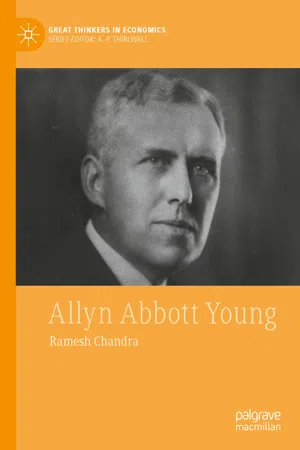
Allyn Young: Preliminary Remarks
The 1990s have seen a revival of interest in Young with the publication of his first authoritative biography by Charles Blitch (1995). His work, which was largely scattered in obscure journals, newspapers and encyclopaedias, was collected, and a bibliography consisting of about 100 entries was compiled by Perry Mehrling and Roger Sandilands (1999). His monetary thought was pieced together by David Laidler (1993, 1998) and Mehrling (1996, 1997). Some of Young’s earlier papers were collected by himself in a volume Economic Problems: New and Old (Young 1927). It had been thought that Young published very little, but with the compilation of a bibliography of a hundred items, it became obvious that his work was quite substantial. However, he has largely remained a forgotten figure in the history of economics with some early references emerging about his paper on increasing returns and economic progress (Young 1928) in the writings of the post-WWII development economists such as Paul Rosenstein-Rodan (1943, 1961), Ragnar Nurkse (1953) and Lauchlin Currie (1974). Later, new trade theorists and new growth theorists made him the starting point of their own theories (see Krugman 1993; Romer 1986, 1989; Murphy et al. 1989).
Blitch (
1995)
portrays Young as a central figure in the development of American economics. Mehrling and Sandilands (
1999, p. xi)
suggest that modern interest in Young is more due to his economic thought than due to his contribution to the economics profession:
His fingerprints are everywhere: co-author of a best-selling textbook Outlines of Economics (Ely et al. 1908, 1916, 1923, 1930) and of two others besides (Riley 1925; Reed 1925), patient builder of professional infrastructure as head of the Stanford economics department (1906–1910) and Secretary of the fledgling American Economic Association (1914–1920); devoted public servant, most notably as the chief economist and statistician of the American Commission to Negotiate the Peace at Paris; inspiring teacher of a generation of economists, most notably Frank Knight and Edward Chamberlin but including also Holbrook Working, Lauchlin Currie, James Angell, Arthur Marget, and Nicholas Kaldor.
Modern interest in Young stems less, however, from his contributions to the economics profession, than from his contribution to economic thought. Young’s 1928 presidential address … has never lacked fans … and the recent flurry of interest in theories of endogenous growth … has brought Young’s thinking on growth to the attention of a much broader audience… Only recently with the work of Laidler (1993, 1998) and Mehrling (1996, 1997), has Young begun to come into focus as a figure of fundamental importance in the field of monetary economics, and this side of Young, it is fair to say, is still much less well known than the side concerned with economic growth.
Young was a deep and original thinker. He appeared to resemble an iceberg; what he wrote was just a small part of what he carried inside his mind. Even his writings testified to the same iceberg phenomenon, for what was visible on the surface was just a small part of the full range of his implications. His style was simple; his writings to the unguarded reader appeared commonplace. But they carried a depth uncommon among his contemporaries. Young was a first-rate critic and commented on many of his contemporaries and past economists. He also carried on a lively correspondence with his contemporaries such as John M. Keynes, Joseph A. Schumpeter, Wesley C. Mitchell, Thomas S. Adams, Irving Fisher, Richard T. Ely, Frank W. Taussig and Frank H. Knight. He also wrote on a large variety of subjects such as the nature, scope and method of economics, value theory, distribution theory, rent, wages, interest and profits, Marxism and socialism, increasing returns, imperfect competition, monopoly, concentration of economic power, and applied problems such as railway pricing, farm relief and index numbers. He also made his mark as an original and inspiring graduate teacher. From his writings, comments, teachings, criticisms and correspondence, it would appear that he not only had a very wide range but also uncommon insight. Often he appeared a step ahead of many of the authors he commented on.
Young is best known for his seminal paper on increasing returns and economic progress published just before his untimely death.1 In this paper, for the first time, he spelt out the disequilibrium paradigm in contrast to the equilibrium paradigm of the neoclassical theory—both of the partial equilibrium type (Marshall 1890) and of the general equilibrium variety (Walras 1874; Pareto 1906). He had made a deep study of the neoclassical theory and had come to the conclusion that there was nothing much in it worth saying which could not be said in a few pages. In a letter to Knight (dated 6 October 1928), in response to Knight’s comments on the Presidential address shortly before his death, he stated that he wanted to depart from the equilibrium method in favour of increasing returns. He further maintained that equilibrium rate of change afforded just as appropriate a hunting ground for pure theory as conditions of static equilibrium did.
Although Young was opposed to the partial equilibrium method and its one-thing-at-a-time theorising, he resented the general equilibrium method even more. In his opinion, the partial equilibrium method was eminently suited to dealing with practical problems and was easy to understand especially for beginners. The general equilibrium method, on the other hand, was highly abstract and gave nothing concrete except a truism. Young did not like highly abstract methods that had little bearing on the practical problems of economic life.
Young had mastered the whole of the literature in economics. He was not beholden to a single school or a single way of thinking. He drew his ideas and views from several schools of thought for he believed that each school had its strong points. In his opinion economic truth was not the monopoly of a single method or school. While the historical method gave wisdom, the abstract method of the English political economy supplied us with the instruments to solve communal problems. Any economic doctrine which had existed for long had some truth in it. Rival theorists were generally both right except when denouncing each other. Moreover, different methods were to be treated as complements in the pursuit of knowledge. For example, if deduction and induction are used separately, they would only give us partial results. One was incomplete without the other. Both had to complement to arrive at a fuller picture.
He regarded the distinction between theoretical and applied economics as largely artificial. According to him, theory was useless unless it was capable of dealing with practical problems. He was deeply influenced by English political economy as it dealt with practical national concerns of the time.2 Moreover, it had an instrumental value in supplying a method to deal with any problem and come to a reasoned conclusion. These economists took their data from real life. Their premises were based on commonplace facts and observations, and it was only superficially that they appeared abstract and deductive.
Himself a competent mathematician and statistician, Young was excited by the new developments in mathematics and statistics and their use in economics. But Young regarded a perfectly abstract economics as impracticable. For him a system built on variables defined only by their mathematical attributes was not economics. The results obtained from the use of mathematics and statistics in economics had to be integrated into the existing fabric of knowledge. Averages and aggregates and their interrelationships by themselves provided a weak basis of inductive inference unless supported by other knowledge. Since statisticians were uncovering new facts every day, to use them the theorists would have to make room for new abstractions and conceptions. Theorists and statisticians, therefore, needed to work together to bridge the gap between themselves.
For Young the field of economics was wide open. No doctrine or economic proposition was to be treated as final. Each was to be ruthlessly examined in the light of new facts, observations and information. Economic truth was not something marked in stone and fossilised forever. Young had an evolutionary perspective on economics. What was true in a particular stage of history was not necessarily true in another. His thinking also evolved overtime. Initially, he was fascinated by the equilibrium economics of Antoine Cournot, Alfred Marshall, Léon Walras, Vilfredo Pareto and William Jevons. But later he wanted to abandon equilibrium economic...