eBook - ePub
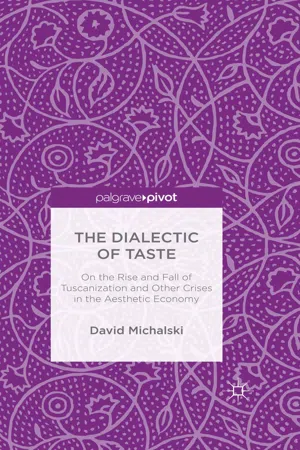
The Dialectic of Taste
On the Rise and Fall of Tuscanization and other Crises in the Aesthetic Economy
- English
- ePUB (mobile friendly)
- Available on iOS & Android
eBook - ePub
The Dialectic of Taste
On the Rise and Fall of Tuscanization and other Crises in the Aesthetic Economy
About this book
The Dialectic of Taste examines the aesthetic economy in the context of economic crises. It explains how a new concern for aesthetics, seen in artisan markets, was born out of the ashes of McDonaldization to become a potent force today, capable of both regulating social identity and sparking social change.
Information
1
Introduction: What’s at Stake in Taste
Abstract: This opening chapter examines the consequences of the aestheticization of everyday life, by historicizing the role taste plays in the social mediation of value. It engages the literature on the social impact of the aesthetic dimension by placing counterpositions from Kantian aesthetics, the sociology of culture, critical theory, postmodern theory, and cultural studies in relation to changes in the political economy. Across this discourse, it focuses on a central line of concern emanating from a dialectic between beauty and alienation, one that raises the importance of aesthetic judgment in the determination of social forms, just as taste is enlisted to resolve an economy in crisis.
Keywords: aesthetics; critical theory; cultural studies; prosumption; sociology of taste; value
Michalski, David. The Dialectic of Taste: On the Rise and Fall of Tuscanization and Other Crises in the Aesthetic Economy. New York: Palgrave Macmillan, 2015. DOI: 10.1057/9781137544285.0002.
Sense which is subservient to crude needs has only restricted meaning. For the starving man the human form of food does not exist, but only its abstract character as food . . . Thus, the objectification of the human essence, both theoretically and practically, is necessary in order to humanize man’s senses, and also to create the human senses corresponding to all the wealth of human and natural being. (Karl Marx1)
In philosophy, and in some rarefied segments of society, taste and the conception of the beautiful were once thought to be connected. Taste was a means to discern beauty. In the Critique of Judgment, Immanuel Kant held that an object or representation that induces a free meeting between the imagination and understanding is beautiful.2 And he held that the recognition of the beautiful is what validates the ability of the subject to engage in the form of contemplation and judgment he called taste, a judgment that Kant insisted must be made free from interests and positions of servitude. The ability to recognize the beautiful in this manner was extremely important to Kant’s conception of modernity. Like the ability to deduce and apply the categorical imperative outlined in the Critique of Practical Reason (2000) the application of free aesthetic judgment validated and grounded his proposition of a universal subject. The sovereignty of taste established the ability to sense beauty as a foundation of the human condition, and in doing so, it authenticated social and public collectivities that form around shared sensuous experience.3 For Kant, this was the purpose of taste. It comprised its, so-called, purposive purposelessness.4 The judgment of taste was held to be enacted without coercion or interest, and with this framing, Kant valorized the aesthetic judgment as an authoritative way of knowing, and positioned it at the center of the Enlightenment with the task of mediating conflicts between science and moral thought.5 In this book, I show how taste has been enlisted to mediate crises affecting our own political economy, and in this way, I show how taste, once again, is being called upon to determine the beautiful.
Since the nineteenth century, sociologists have issued two important and interrelated critiques of Kantian aesthetics. The first disputes the notion that aesthetic judgment can be independent or disinterested. In lieu of sovereign aesthetic contemplation, sociologists from Thorstein Veblen (1919) to Pierre Bourdieu (1984) have shown how the interplay between social beings and social structures influences judgments of taste. The Kantian conception of the beautiful, in light of such critiques, is recast either as an aftereffect of social dispositions nurtured within positions of power or privilege, or as a strategic proclamation devised to serve, consciously or unconsciously, as a means of self, group, or class aggrandizement. In the tradition of Veblen and Bourdieu, taste is understood as both the product and the instrument of status relations.6 Taste, these sociologists concluded, was not in the service of the beautiful, but in service to social status.
This argument has been expanded in subsequent years by contributions from feminist theorists, critical race theorists, and other cultural sociologists who have shown that the concept of the beautiful is shaped by multiple, differential, and intersecting structures. By tracking these structures in their fieldwork, and bringing to light the differences between subjective standpoints, these critics issue a second substantial critique against Kantian aesthetics: in light of difference, it is impossible to speak of taste as universally held faculty of judgment. In place of a universal enlightened subject, networks of specialized communication produce both multiple aesthetic systems and fragmented subjects, each capable of producing conceptions of the beautiful in relation to localized and situational intentions.
Postmodern critiques of Kantian aesthetics posit a similar relativism. Without supporting the social scientists’ emphasis on structures or functional relations, writers such as Baudrillard and Clarke have argued that beauty has gone the way of truth, serving only to veil the play of interests responsible for assertions of taste. Any claim that taste is engaged in the sovereign pursuit of the beautiful, from the postmodern perspective, is just an alibi for the underlying irrational inclinations to which taste bows: those born of pleasure, political games or some chaotic string of signifiers or another (Gottdiener 2000).
The culmination of these critiques signaled the dismantlement of the proto-political character of the aesthetic set forth by Kant (Danto 1998). Taste, rendered as the aftereffect of social forces, is unable to develop a conception of beauty compelling enough to temper the excesses of politics, religion, or science. While sociologists continue to emphasize the role taste plays in the organization of social groups, taste today is primarily understood as an instrument that regulates both consumption and identities, rather than a means to detect and cultivate collective conceptions of the good life, and in doing so, ground social action.7
In this book, I will not be arguing for a return to Kantian aesthetics. Not only are such arguments obstructively ensnared in an Idealism that separates them from the circumstances of social life, they are, as sociologists remind us, often mired in a conservative politics, which benefits from the imagined isolation of the aesthetic dimension from the forces of history. Nor will I be making a plea to reconstruct a transcendental, historical subject. Instead, I will show how both taste and the subjectivities that deploy it are constructed through the mediation of the beautiful in relation to the world. That is, I will show that any concept of beauty capable of intervening in the course of social life gains its power through its connections to that life, rather than in spite of those connections. The aesthetic way of knowing, configured by Kant as the telos of the revolutionary project of the Enlightenment, is not strengthened by attempts to quarantine it from the charged fields of social power, from the rhythms or noise of cultural difference, or from changes in the political economy. Rather, the aesthetic dimension’s ability to influence social change is empowered by its engagement with historical conditions. As such, the various social critiques of Kantian aesthetics, including the charge that it represents a dream of freedom enabled by the conceit of privilege, or that it constructs a fleeting and fragmented Subject from the confluence of social forces, help to illustrate how the character of taste has developed over time and in relation to society. It is as a social faculty, one that necessarily takes shape within, and in reaction to concrete situations, that taste becomes capable of mediating its social conditions and relations.
The goal of this project is to show how taste performs as an engine of history, in a political economy where aesthetics and taste are everywhere also conscripted to serve as instruments of social regulation, as tools for shaping identities, as sources of signs and symbols marking affiliations and differences. I will show how the experiences of today have come to demand that taste fulfill two interrelated but contradictory roles. It is asked to serve as a vehicle to move products, circulate capital, and extract profit, just as it is called upon to realize its Enlightenment promise to develop and evaluate conceptions of the Beautiful, with and against, our practical sensory experience. The Dialectic of Taste aims to illustrate the movements and consequences of these countervailing forces, which marshal aesthetic feelings and aesthetic ways of knowing for their own ends.
The understanding of aesthetic feeling has long been the goal of art historians. In their attempt to assess the value and meaning of art, they couple a tradition of formal analysis with an attention to the materiality of objects to approximate the capacity of art to express and evoke, in a sensuous form, the texture of an era, and an insight into the constraints and opportunities posed by the environment in which a work of art is created. Understanding these feelings is the key to discovering what makes some objects of taste rise to a matter of public concern and general interest. For the art historian, art is held not only to record the concrete conditions of humanity, but also to organize that humanity as an image, one from which we can gauge and critique existent social relations (Fieldler[1957], Stimson[2014]). Despite undergoing the same critiques mounted against Kantian aesthetics, art history has continued to make its examination of the art’s impact on the social world a central focus of the discipline. Scholars, such as Shapiro, Baxandall, and Clark conceived of the aesthetic dimension as an authoritative way of knowing, one that is both shaped and capable of shaping social and cultural history. True works of art, art historians insist, are a special class of objects that provide an authentic and historically rooted vision of the world, as it truly is, or as it ought to be.
I share this contention. And in this book, I argue further that the social authority, which art historians find in art, can be claimed by the objects of taste that populate our contemporary consumer society, to the degree that such objects sufficiently provoke aesthetic contemplation and judgment, and in so doing, work to humanize the senses. This view has antecedents in Benjamin (1999), Buck-Morss (1989), Marchand (1985), and Haug (1987), all of whom saw, in their own ways, commodities or advertisements as the vehicles of socially produced wish images. That is, beyond their role in economic or symbolic exchange (whether configured by Bourdieu (1984) or Baudrillard [1993]), I argue, current political and economic conditions have made commodities the vehicles of socially produced anticipatory narratives or promises, issued today against the intolerable conditions of their denial.
In making this argument, that aesthetically oriented commodities carry the burden of art to represent a vision of-the-world, and for-the-world, I realize I am cutting against the grain of a scholarly divide that has been constructed between critical aesthetics and the sociology and cultural studies of consumption. In this divide, critical aesthetic theory is held to assert that art represents a privileged category of objects, one that is, in part, distinguished from popular culture and kitsch by its autonomy from moral, political, or economic norms. Following Kant’s insistence that the truth content of art derives from its disinterestedness, it holds that the intelligence of art has been irreversible disempowered by art’s relation to the market and the ideologies that accompany economic processes. In turn, much of the work in the sociology and cultural studies of consumption is held to dispute art’s special claim to provide a uniquely sovereign and authoritative way of knowing. These fields assert, instead, that popular culture, commercial representations, and kitsch can all yield their own subjective and contingent truths, truths that find their relevancy in the way their audiences receive and manipulate them.8
A similar scholarly divide has taken shape in the world of art theory around the question of political art: can art that overtly deals with politics draw on the power of aesthetics, as conceived by Kant, as a means to mediate politics? Or, instead, is such art ideological, and hence no longer capable of evoking or conveying aesthetic feelings and an aesthetic way of knowing? My answer to these questions is congruent with my answer to the question about the aesthetic potential of the commodity form. The commodity is capable of conveying and evoking aesthetic feelings and ways of knowing, but, as I will show, it does so in opposition, and in reaction to the economic role of the commodity. In other words, it is the autonomous aesthetic aspect of the art work, or the commodity, that provides its critical function.9
While the link between these two approaches to cultural theory, critical aesthetic theory, and the study of consumer culture is often framed as an opposition that must be transcended,10 my strategy in The Dialectic of Taste is to preserve the core contradiction that is developed in this scholarly divide: the contest between the sovereignty of taste and the consumers’ manipulation by productive forces. Doing so illustrates how the struggle over value, interred in the commodity form, comes to sharpen the authority and autonomy of taste. I argue that changes in our political economy have created an intensifying contradiction between the aesthetic value of a commodity and the values it produces through social or economic exchange, and that this contradiction has pushed the question about the aesthetic promise of commodities to the center of social history.11
When Horkheimer and Adorno (1972) contended that the culture industry set the values of an unfettered entrepreneurial system against the revolutionary potential of culture, their purpose was to warn us that the vestiges of taste (as a critical and humanizing faculty) were becoming increasingly instrumentalized by the bourgeoning mass society. They argued that changes in the political economy were destroying the proto-political claims of art. In place of a progressive conception of art, where the work of the artist can lead to greater freedoms and self-awareness, they recorded the eme...
Table of contents
- Cover
- Title
- 1 Introduction: What’s at Stake in Taste
- 2 The Aesthetic Economy
- 3 Abstract Taste and the Crisis of Value
- 4 The Allegory of Tuscany
- 5 Taste as a Social Mediation of Value
- 6 The Allegory of the Commodity Form
- References
- Index
Trusted by 375,005 students
Access to over 1.5 million titles for a fair monthly price.
Study more efficiently using our study tools.
Frequently asked questions
Yes, you can cancel anytime from the Subscription tab in your account settings on the Perlego website. Your subscription will stay active until the end of your current billing period. Learn how to cancel your subscription
No, books cannot be downloaded as external files, such as PDFs, for use outside of Perlego. However, you can download books within the Perlego app for offline reading on mobile or tablet. Learn how to download books offline
We are an online textbook subscription service, where you can get access to an entire online library for less than the price of a single book per month. With over 1.5 million books across 990+ topics, we’ve got you covered! Learn about our mission
Look out for the read-aloud symbol on your next book to see if you can listen to it. The read-aloud tool reads text aloud for you, highlighting the text as it is being read. You can pause it, speed it up and slow it down. Learn more about Read Aloud
Yes! You can use the Perlego app on both iOS and Android devices to read anytime, anywhere — even offline. Perfect for commutes or when you’re on the go.
Please note we cannot support devices running on iOS 13 and Android 7 or earlier. Learn more about using the app
Please note we cannot support devices running on iOS 13 and Android 7 or earlier. Learn more about using the app
Yes, you can access The Dialectic of Taste by David Michalski in PDF and/or ePUB format, as well as other popular books in Social Sciences & Cultural & Social Anthropology. We have over 1.5 million books available in our catalogue for you to explore.