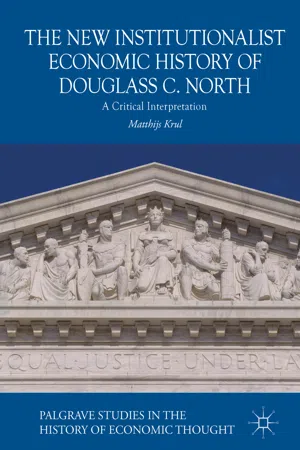
This book offers a comprehensive assessment of Douglass North's contribution to economics and the social sciences by examining the origins and structure of his New Institutionalist Economic History (NIEH). Informed by contemporary debates in the philosophy of economics, Krul describes the evolution of North's theory from mainstream economics to an increasingly heterodox form of New Institutionalism. He also examines what North's original aims were in developing the NIEH research programme and how well it has achieved these aims. By exploring major themes in North's NIEH, with an emphasis on the final stage of his theory, Krul sheds new light on the strengths and weaknesses of North's work. He also discusses the implications of this critical interpretation for the New Institutionalism in economics and other fields of social science.
eBook - ePub
The New Institutionalist Economic History of Douglass C. North
A Critical Interpretation
- English
- ePUB (mobile friendly)
- Available on iOS & Android
eBook - ePub
The New Institutionalist Economic History of Douglass C. North
A Critical Interpretation
About this book
Information
© The Author(s) 2018
Matthijs KrulThe New Institutionalist Economic History of Douglass C. NorthPalgrave Studies in the History of Economic Thoughthttps://doi.org/10.1007/978-3-319-94084-7_11. Introduction: Douglass North’s NIEH in Context
Matthijs Krul1
(1)
Max Planck Institute for Social Anthropology, Berlin, Germany
Matthijs Krul
Introduction
The concept of the institution has conquered much of the social sciences. Reference to institutions as an explanatory variable, often the primary one, is practically ubiquitous in the social scientific heartlands such as contemporary sociology and political science, and it has even reached the outlying settlements of economic anthropology and ancient history. In short, as the preferred explanatory device in areas that combine economic analysis with a historical dimension, institutions rule (Burki and Perry 1998; Rodrik, Subramanian, and Trebbi 2004). While this turn across a range of disciplines undoubtedly has multiple origins, with dynamics particular to the individual disciplines themselves being one important component, there is little doubt that a major driver of this interest has been the rising popularity of the New Institutionalist Economics (NIE).1
This term, coined by NIE pioneer Oliver Williamson (Williamson 1975), has been defined by adherence to two slogans: that “institutions matter” and that “the determinants of institutions are susceptible to analysis by the tools of economic theory” (Matthews 1986). In a more recent consideration of how the NIE has developed since its original coinage, Williamson has emphasized that it is the latter of the two that distinguishes the NIE from the older traditions in institutionalist economics (Williamson 2000: 595). No doubt the prestige of what is perceived as the mainstream of economics in the social sciences at large has thereby helped NIE ideas and concepts achieve a widespread distribution in a way that previous institutionalist traditions did not. In various disciplines the approach has given rise to new research programs inspired by the tools of NIE theory, sometimes distinguished by the use of the ‘new’ label: for example, the New Economic Sociology (Granovetter 1985; Nee 2008; Richter 2015). It has also converged with public choice theory in political science, owing to mutual inspiration (Buchanan and Tullock 1962; Olson 1965; Mueller 2003; Ostrom and Ostrom 2004).
The result of this ‘neoinstitutionalist turn’ has been the creation of an interdisciplinary field in economic thought dedicated to the analysis of institutions.2 As Elinor Ostrom has formulated it, in its broadest sense, it brings together public choice theory, NIE , and game theory into a single framework that “draws inspiration and methods from the other social sciences as well as biology to provide a general framework for the analysis of humanly designed institutions at multiple levels and their consequences” (Ostrom 2007: 240).3 Where public choice theory is concerned with the incentive structure of individuals in political institutions and organizations and game theory with the analysis of strategic action by individuals under conditions of imperfect information, the NIE provides an economic theory framework to answer the question why institutions arise in the first place (Ostrom 2007: 242–243). The central concern of the NIE is to explain the existence of institutions and private organizations in terms of market failure , in other words as the result of limitations of (and on) private contracting. Fundamental concepts of the NIE are transaction costs, which are all costs associated with the process of exchange other than the price of the good in question, and property rights, which are the political and legal constraints on ownership and exchange.
The rise of the NIE in economic thought owes much to the influence of Douglass C. North and his New Institutionalist Economic History (NIEH), the subject of this book.4 His work is often recognized as one of the main bodies of literature that has contributed to the renewed popularity of institutional analysis, and has done much to refound such analysis on new theoretical foundations.5 But North’s work is neither typical of the neoclassical paradigm nor of the NIE school as such. Where many NIE authors have confined their work to the analysis of firms and market structure in modern capitalist societies, North has—arguably more than any other author—taken the larger framework of the neoinstitutionalist turn to its furthest extent. In so doing, he has made two great contributions to the New Institutionialism: by providing a theoretical foundation for the interdisciplinary project as a whole and by testing the very boundaries of its capabilities to explain.
From his origins in quantitative economic history, North became a prominent advocate of New Institutionalist analysis in every domain of sociohistorical explanation, not limited to the study of modern market societies alone. With North, the NIE has acquired for the first time a systematically historical dimension. He developed his NIEH in a series of stages, each taking him further away from the boundaries of conventional economic analysis and each time extending the scope of his theorizing considerably wider. It is illustrative of North’s ambition to fulfill the promise of the neoinstitutionalist turn in economic thought to its fullest extent that the subtitle of his final book, Violence and Social Orders, is nothing less than “a conceptual framework for interpreting recorded human history” (North, Wallis, and Weingast 2009). The present book is a study of his work in the context of this larger institutionalist research agenda. It examines how North came to set this agenda, how he developed his approach in response to it, and how ongoing theoretical problems each time led him to reformulate his NIEH in a new direction. It also examines systematically the problems with his NIEH and assesses to what extent North actually succeeded in the aims he set for himself.
Capturing the essence of North’s NIEH is less easy than it may seem. Quite likely because of the frequently changing ways he attempted to cohere his many varied insights, he never spent much time on defining his approach as a ‘school’. Commentators on his work have therefore tended to focus on different aspects of it as the breakthrough element, depending on their own particular concerns and uses of his theory. A consensus view can nonetheless be distilled. Firstly, North shared with the NIE in general a qualified rejection of the neoclassical tradition, in particular because of its ahistoricity and its inability to explain persistent inefficiencies. Secondly, and this is the qualification, the desire to complement (or, in more ambitious cases like North’s, supplant) the neoclassical approach to institutions and their historical development was not to come at the expense of the foundations of economics: price theory and the operation of individual choice within constraints. North, however, went further than almost all other NIE authors in elaborating these constraints. His increasingly strident criticisms of rational choice economics combined with his insistence on historical explanation (path dependence) and the importance of market failures and inefficient institutions to shape his NIEH into something quite different from even neoclassical-adjacent approaches, like those of Oliver Williamson and others.
The central focus of North’s NIEH is the study of the formation and change of institutions. The purpose of this explanation is to account for how economies have varied in economic performance over time. In the course of doing so, it also has to study how and why most of economic history has been characterized not by neoclassically efficient markets, but by every possible form of market failure and by wildly differing political economic arrangements, property rights, and allocation systems. In the most fully formed expression of his ideas, North distinguished between these institutional arrangements and the larger ‘environment’ within which they appear, which consists of a deeper layer of beliefs and ideologies, deep-seated noneconomic logics, and political orders. North’s NIEH in its final form is therefore a theory of the interaction between beliefs, institutions, political orders, and economic outcomes.
But this theory has always maintained the economic core of price theory and choice theory: the first three variables in this qualitative model act as constraints on individual action, and this constrained action leads to economic performance (usually rather poor performance, at that) via the operation of markets or quasi-markets. The meanings of efficiency, welfare (Pareto optimality), and rationality are much changed in North’s work in comparison even with other NIE theories, let alone neoclassical models.6 But simultaneously, his NIEH is dedicated throughout to the preservation of what one might call the microfoundations of the modern discipline of economics.7 His longtime collaborator John Joseph Wallis sums up his attitude well: “North long emphasised the importance of history and of neoclassical economics. He criticised both disciplines for their complacency about the adequacy of the current conceptual and methodological consensus on how history or economics should be done. He always operated within a framework of individuals who act intentionally (neoclassical economics matters) and who perceive the world through cognitive lenses that are part inherited from their culture and part derived from their own experience (history matters)” (Wallis 2015).
As I will argue in this book, this Janus-faced attitude to and within the discipline of economics has its origin in a particular place: his confrontation with Karl Polanyi, standing in for the many criticisms of economics from outside the field. In addressing “the challenge of Karl Polanyi” (North 1977), he was forced to consider the question: If neoclassical economics has only a very limited range of applicability, how can institutional change in history be explained without giving up on economic orthodoxy altogethe...
Table of contents
- Cover
- Front Matter
- 1. Introduction: Douglass North’s NIEH in Context
- 2. North’s NIEH in Historical Overview
- 3. Markets, the Social Contract, and the ‘Smithian Result’
- 4. Players of the Game: Rationality, Choice, and Indeterminacy
- 5. North’s Theory of Cultural Evolution
- 6. North’s NIEH as Global History
- 7. Revisiting Polanyi’s Challenge: North and the Limits of the New Institutionalism
- 8. Conclusion: The Future of the Neoinstitutionalist Turn
- Back Matter
Trusted by 375,005 students
Access to over 1.5 million titles for a fair monthly price.
Study more efficiently using our study tools.
Frequently asked questions
Yes, you can cancel anytime from the Subscription tab in your account settings on the Perlego website. Your subscription will stay active until the end of your current billing period. Learn how to cancel your subscription
No, books cannot be downloaded as external files, such as PDFs, for use outside of Perlego. However, you can download books within the Perlego app for offline reading on mobile or tablet. Learn how to download books offline
Perlego offers two plans: Essential and Complete
- Essential is ideal for learners and professionals who enjoy exploring a wide range of subjects. Access the Essential Library with 800,000+ trusted titles and best-sellers across business, personal growth, and the humanities. Includes unlimited reading time and Standard Read Aloud voice.
- Complete: Perfect for advanced learners and researchers needing full, unrestricted access. Unlock 1.5M+ books across hundreds of subjects, including academic and specialized titles. The Complete Plan also includes advanced features like Premium Read Aloud and Research Assistant.
We are an online textbook subscription service, where you can get access to an entire online library for less than the price of a single book per month. With over 1.5 million books across 990+ topics, we’ve got you covered! Learn about our mission
Look out for the read-aloud symbol on your next book to see if you can listen to it. The read-aloud tool reads text aloud for you, highlighting the text as it is being read. You can pause it, speed it up and slow it down. Learn more about Read Aloud
Yes! You can use the Perlego app on both iOS and Android devices to read anytime, anywhere — even offline. Perfect for commutes or when you’re on the go.
Please note we cannot support devices running on iOS 13 and Android 7 or earlier. Learn more about using the app
Please note we cannot support devices running on iOS 13 and Android 7 or earlier. Learn more about using the app
Yes, you can access The New Institutionalist Economic History of Douglass C. North by Matthijs Krul in PDF and/or ePUB format, as well as other popular books in Economics & Economic History. We have over 1.5 million books available in our catalogue for you to explore.