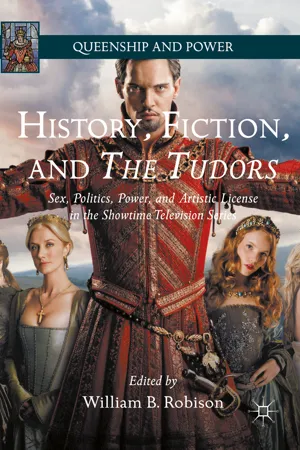
This is the first book-length study of the award-winning historical drama The Tudors. In this volume twenty distinguished scholars separate documented history, plausible invention, and outright fantasy in a lively series of scholarly, but accessible and engaging essays. The contributors explore topics including Henry VIII, Catherine of Aragon, Anne Boleyn, his other wives and family, gender and sex, kingship, the court, religion, and entertainments.
eBook - ePub
History, Fiction, and The Tudors
Sex, Politics, Power, and Artistic License in the Showtime Television Series
- English
- ePUB (mobile friendly)
- Available on iOS & Android
eBook - ePub
History, Fiction, and The Tudors
Sex, Politics, Power, and Artistic License in the Showtime Television Series
About this book
Information
© The Author(s) 2016
William B. Robison (ed.)History, Fiction, and The TudorsQueenship and Power10.1057/978-1-137-43883-6_11. Introduction
William B. Robison1
(1)
Department of History and Political Science, Southeastern Louisiana University, Hammond, LA, USA
“You think you know a story, but you only know how it ends. To get to the heart of the story, you have to go back to the beginning.” Thus does a voiceover by Jonathan Rhys Meyers as Henry VIII introduce each of the thirty-eight episodes of Showtime’s The Tudors. His statement is one with which historians can only agree. Regrettably, its apparent promise of concern for historical accuracy is one on which four seasons and thirty-five hours of the hugely popular cable television series largely fail to deliver. More revealing of what is to come is that the first episode starts not in 1509, the real beginning of Henry’s reign, but c. 1518 with the well-staged but fictitious assassination of Henry’s nonexistent uncle, followed in rapid succession by the king being “inconsolable,” angrily calling for war with France, and gleefully having sex with Bessie Blount, all within a few minutes both on-screen and in the storyline. From there the anachronisms, time compression, distortions, and outright inventions multiply, mingling with occasional moments of historicity and culminating with Henry agreeing with Thomas More and Thomas Wolsey’s proposal to create something that sounds like the League of Nations. 1
This initial episode reveals a fundamental identity crisis that pervades the entire series. Is it supposed to be a serious historical drama, a clever deconstruction of traditional history, an artsy exercise in sociopolitical criticism, a period soap opera, or the world’s longest piece of soft-core pornography? Is its target audience well-read history buffs, the hip intelligentsia, the demographic drawn to “chick flicks,” or fans who like some semblance of a plot with their gratuitous sex and violence? That one can perhaps answer “all of the above” to both questions does not really clarify matters. Creator and writer Michael Hirst’s response to criticism of the series has been similarly ambivalent. On one hand, he has said that his goal was entertainment rather than historical accuracy, which is fair enough—he is in the entertainment business. On the other hand, it is clear that he wants to be taken seriously in commenting about history even if not for recounting it literally. For example, he has said that his goal was to challenge the traditional views of Henry and the English Reformation. Further, he admits that there was too much emphasis on sex in the first two seasons, but that did not prevent his creating a bevy of fictitious sexual encounters in the third and fourth. Beyond that, he has made the all-too-frequent mistake of assuming that he can “improve” an already exciting story. 2
Nevertheless, The Tudors is a genuine cultural phenomenon, one that historians of early modern England can hardly afford to ignore. It is by far the longest filmic event ever to deal with the Tudor dynasty. Filmed in Ireland for the Showtime premium cable television channel in the USA, it also appeared on BBC2 in the UK, CBC Television in Canada, and TV3 in Ireland, is now in syndication on other networks, is being distributed by Sony Pictures Television International, has been released through various digital outlets, and is available all over the world on DVD and Blu-ray, both as individual seasons and in a boxed set. It has won forty-one television awards and been nominated for sixty-five more, many of its stars have become international celebrities, it has its own rather sophisticated website, where one can buy a variety of series-related merchandise, and it has spawned fan sites, fan clubs, and fan fiction, as well as keeping Tudor blogs abuzz with commentary. Although the show has drawn fire from some television critics, others have had a largely positive reaction, while viewers have made it one of the highest rated programs in Showtime’s history. 3
The popular appeal of The Tudors poses both a dilemma and an opportunity to historians. Many have reacted with amusement, dismay, hostility, and/or cynical resignation to its extremely casual relationship with historicity. But despite its many inaccuracies, the plot lines are often dramatic and engaging, the actors are generally good, the production values are high, and the series does certain things well, for example, its depiction of court pageantry and sport. All this makes the story seem plausible, gives it an “authentic” look, and renders it as likely to mold popular opinion about Henry and his era in the twenty-first century as Alexander Korda’s The Private Life of Henry VIII (1933) did in the twentieth century. Historians cannot afford simply to disdain and dismiss the show; rather, they have a responsibility to engage constructively the inaccuracies in The Tudors (and other films) unless history is to concede the field to fiction. 4
However, historians can also take advantage of the popularity of The Tudors. In terms of scholarship, it provides abundant material for students of the emerging field of “Tudorism,” which Marcus Bull and Tatiana String describe as “the post-Tudor mobilization of any and all representations, images, associations, artefacts, spaces, and cultural scripts that either have or are supposed to have their roots in the Tudor era.” The Tudors already has been the subject of scholarly articles and presentations at professional conferences, in many of which contributors to this volume have participated. Moreover, historical films like The Tudors can serve a practical purpose, for discussing them in the classroom and the public forum—as well as scholarly publications—can encourage interest in real history, stimulate critical thinking, and reinforce memory. With proper guidance, students and others can be remarkably adept at comparing films with works of history and ferreting out errors. The extraordinary popularity of The Tudors makes it particularly useful in this regard. Therefore, rather than merely bemoaning its manifold flaws, it behooves historians to expose its errors while exploiting its Tudorist appeal. 5
English filmmaker Michael Hirst is no stranger to the Tudor period or to controversy about his history-based projects, having written the screenplays for Shekhar Kapur’s feature films Elizabeth (1998) and Elizabeth: The Golden Age (2007). Most of the directors for The Tudors—Jon Amiel, Ciaran Donnelly, Brian Kirk, Alison Maclean, Colm McCarthy, Charles McDougall, Jeremy Podeswa, Steve Shill, Dearbhla Walsh—have worked in both film and television, and some have collaborated with Hirst and/or worked on other historically themed shows, as have cinematographer Ousama Rawi, editors Lisa Grootenboer and Wendy Hallam Martin, score composer Trevor Morris, and costume designer Joan Bergin. 6
The star of The Tudors, Jonathan Rhys Meyers, is an odd choice to play Henry VIII, to whom he bears absolutely no physical resemblance and whose colossal ambition, conflicting impulses, gargantuan appetites, and outsized emotions he often struggles to convey. On-screen more than anyone except the king is Henry Cavill as Charles Brandon and, after him, Anthony Brophy as imperial ambassador Eustace Chapuys, both decidedly ahistorical but nonetheless engaging. Several characters who were major players in the political and religious struggles of the 1530s and 1540s and who thus should appear in all four seasons arrive late or depart without explanation: Henry Czerny, a lightweight amalgamation of the 2nd and 3rd Dukes of Norfolk, the latter of whom should have a major role throughout Henry’s reign but vanishes at the end of Season One; Hans Matheson, who portrays Archbishop Thomas Cranmer with insufficient gravitas in Season Two and then is gone; Simon Ward, a rather one-dimensional Catholic fanatic as Stephen Gardiner, who does not show up until Season Three; and Alan Van Sprang, a remarkably unpleasant Francis Bryan who mysteriously appears at the beginning of Season Three and disappears at the end.
Seasons One and Two are distinctly better than Three and Four, in part because Maria Doyle Kennedy and Natalie Dormer’s strong performances as Henry’s longest-lasting and most interesting wives, Catherine of Aragon and Anne Boleyn. Neither Anita Briem or Annabelle Wallis, Jane Seymour in Seasons Two and Three, respectively, measures up; Joss Stone is able but miscast as the supposedly ugly Anne of Cleves; Tamzin Merchant’s adolescent appearance and behavior as Catherine Howard make her frequent nude scenes seem like child pornography; and Joely Richardson, though very good, has a fairly limited role as Catherine Parr. The first two seasons also feature stronger supporting actors, notably Sam Neill as the most fully realized on-screen Wolsey ever; Jeremy Northam, who emerges from the shadow of Paul Scofield (A Man for All Seasons) as Thomas More; Nick Dunning, splendidly slimy as Thomas Boleyn; and James Frain as a more complex Thomas Cromwell than the paper villain usually seen on film. The major characters in Seasons Three and Four are less compelling, for example, Max Brown and Andrew McNair as Edward and Thomas Seymour, respectively; Emma Hamilton as Anne Stanhope; Rod Hallett as Richard Rich; Frank McCusker as Risley (Thomas Wriothesley); Torrance Coombs as Thomas Culpeper; and David O’Hara as the Earl of Surrey. A notable exception is Sarah Bolger, who plays Princess Mary with considerable subtlety as she evolves from a sad, neglected teenaged girl into the bitter young woman who later burned nearly 300 heretics.
Season One’s main attraction is the breakup of Henry’s first marriage to Catherine of Aragon and perpetually hot pursuit of Anne Boleyn, whose family urge her to replace her sister Mary in the king’s bed but who refuses to yield, even if in a dream sequence she urges him, “Seduce me.” Other story lines include Wolsey’s efforts to obtain a divorce for the king and the papal crown for himself; a failed plot by the Duke of Buckingham (Steve Waddington) to seize the throne; the birth of the royal bastard Henry Fitzroy (Zak Jenciragic) to Elizabeth Blount (Ruta Gedmintas), his ennoblement as Duke of Richmond, and eventual death; alternating plans for war against and alliances with Francis I of France (Emmanuel Leconte) and Emperor Charles V (Sebastian Armesto), including marriage proposals for Princess Mary and much pageantry; completely invented marriages by Henry’s sister Margaret (Gabrielle Anwar) to the king of Portugal and then Brandon; Henry’s pamphlet war with Martin Luther; More’s estrangement from the king and nascent persecution of Lutherans; Cromwell’s premature arrival; royal temper tantrums; and lots of sex; all culminating with Wolsey’s fictitious suicide.
Marital politics continue to dominate Season Two, with Henry getting his divorce and marrying Anne, who gives him a daughter Elizabeth but no son, encourages his affair with Madge Shelton (Laura Jane Laughlin) to forestall other rivals but is gradually supplanted by Jane Seymour anyway, and is arrested and convicted on charges of adultery trumped up by Cromwell. Also, Henry breaks with a Roman Catholic Church anachronistically led by Pope Paul III (Peter O’Toole); Cranmer rises to prominence as Anne encourages religious reform; the Boleyns secretly try to poison Bishop John Fisher (Bosco Hogan), whose cook Richard Rouse (Gary Murphy) is boiled alive for the offense; More and Fisher are executed for refusing to take the Oath of Allegiance to Henry; Catherine is exiled from court, separated from Princess Mary, and stoically declines and expires; Mary is declared illegitimate and forced to serve her younger sister, later declared a bastard herself; Anne dies after a dramatic speech from the scaffold; and Henry gluttonously devours a swan, which is clearly a symbol for his deceased second bride.
It is the triangle of Henry, Catherine, and Anne that gives the first two seasons dramatic tension, and once both women die, the series loses energy. Season Three (eight episodes instead of the usual ten) introduces a new Jane Seymour, who reconciles Henry with his daughters, unsuccessfully appeals for mercy to the rebels in the Pilgrimage of Grace, and dies after giving birth to Prince Edward, which leads to a bizarre episode in which the king goes into seclusion (and apparently mad) with only his fool Will Somers (David Bradley) for company. Meanwhile, Brandon savagely suppresses the Pilgrimage of Grace (a role that in reality belonged to Norfolk), and Henry has a fling with the fictitious Lady Ursula Misseldon (Charlotte Salt), who also sleeps with Bryan when he is not having sex with Anne Stanhope or on the continent trying to assassinate Reginald Pole (Mark Hildreth). Cromwell, with the assistance of artist Hans Holbein (Peter Gaynor), engineers the king’s marriage to Anne of Cleves, the failure of which leads Cromwell to the scaffold and Henry to the bed of the nymphet Catherine Howard. Princess Mary has a brief flirtation with Philip of Bavaria (Collin O’Donoghue), but his Protestantism and rapid departure put a sad end to that.
Season Four witnesses Henry’s marriage to the incredibly silly Catherine Howard, whose past affair with Francis Dereham (Allen Leech) and current one with Thomas Culpeper lead to divorce and beheading for her, heartbreak for the presumably aging king (who does not look older), and an unexpected royal marriage for Catherine Parr, the wife of Lord Latimer (Michael Elwyn) and the unofficial fiancé (pending her husband’s death) of Thomas Seymour. It also includes the king’s highly improbable bedding of the recently rejected Anne of Cleves. The Seymours’ feud over politics and social status with Surrey and over religion with Gardiner, who relentlessly pursues Protestants, including Anne Askew (Emma Stansfield) and the queen. Seeking to recover his youth on the battlefield, Henry successfully besieges Boulogne at an enormous cost in lives and money, and Brandon has an affair with the imaginary Brigitte Rousselot (Selma Brook). Gardiner’s intrigues against Catherine and plot to put Mary on the throne get him imprisoned in the Tower, while Surrey’s ambition for the crown leads to his execution. While Holbein paints Henry’s famous portrait, the ghosts of the king’s first three wives appear in succession and berate him for his poor treatment of them and their children. Henry sends his family away, and the series ends with him examining his new portrait and then turning to leave the room. His death is not shown.
Unfortunately, while The Tudors is visually appealing and features some good performances, no amount of beauty or good acting can rescue it from Hirst having drastically rewritten history without any real justification for doing so. One expects a certain amount of invented dialogue and “stage business” in even the most accurate of historical dramas, but such things as amalgamating Henry’s two sisters into one, having Margaret marry and murder the King of Portugal (she did neither) and then wed Brandon (whom her missing sister Mary married) mangles history to no apparent dramatic purpose. The plethora of similar inaccuracies throughout the series belies Hirst’s claim that it was “85 % accurate.”However, Hirst does enjoy some support among scholars. Ramona Wray seeks to explain the many historical inaccuracies in The Tudors not as anomaly or error but as indicative of “a process now recognized as a characteristic of quality television—a ‘complex seeing.’” In other words, it is rife with clever inside jokes. Wray’s observation might make sense with a film like Shakespeare in Love, which consistently engages in clever self-mockery, but it gives Hirst more credit than his record—with Elizabeth, Elizabeth: The Golden Age, and The Tudors—seems to deserve. However, Wray is not alone. Jerome de Groot also sees it as an extended example of postmodern playfulness.
Still, a major element of The Tudors’ appeal is not so much intellectual subtlety but lots of good-looking men and women, brightly (if inaccurately) costumed and frequently naked, with the more or less constant prospect during moments of non-erotic activity that they will be naked again soon. As Ginia Bellafante observed in her New York Times review of Season Two, “If The Tudors fails to live up to the great long-form dramas cable television has produced, it is not simply because it refuses the visceral messiness of a Rome or a Deadwood… but more significantly because it radically reduces the era’s thematic conflicts to simplistic struggles over personal and erotic power.” Or as Tim Dowling noted in The Guardian in 2009, “Almost everyone in The Tudors is young, thin and beautiful. Not only is this a little unlikely, it can also make it hard to tell them apart.”
All that said, the goal of this volume is not merely to do a “hatchet job” on The Tudors but to assess it as a work of art, as a representation of history, as a reflection of modern and perhaps postmodern concerns, and as a potential tool for teach...
Table of contents
- Cover
- Frontmatter
- 1. Introduction
- 2. Henry VIII in The Tudors: Romantic Renaissance Warrior or Soap Opera Playboy?
- 3. Catherine of Aragon in The Tudors: Dark Hair, Devotion, and Dignity in Despair
- 4. The Tudors, Natalie Dormer, and Our “Default” Anne Boleyn
- 5. The Last Four Queens of Henry VIII in The Tudors
- 6. The Significance of the King’s Children in The Tudors
- 7. The King’s Sister(s), Mistresses, Bastard(s), and “Uncle” in The Tudors
- 8. The King’s In-Laws in The Tudors
- 9. The King’s Friends in The Tudors
- 10. Postmodern and Conservative: The King’s Ministers in The Tudors
- 11. A Cardboard Crown: Kingship in The Tudors
- 12. The Tudors and the Tudor Court: Know Your Symptom
- 13. “The Dyer’s Hands Are Always Stained”: Religion and the Clergy in The Tudors
- 14. Fact, Fiction, and Fantasy: Conspiracy and Rebellion in The Tudors
- 15. Crime, Punishment, and Violence in The Tudors
- 16. Humanism and Humanitarianism in The Tudors
- 17. All That Glitters is (Fool’s) Gold: Depictions of Court Entertainment in The Tudors
- 18. Holbein and the Artistic Mise-en-Scène of The Tudors
- 19. Fashionable Fiction: The Significance of Costumes in The Tudors
- 20. Putting Women in Their Place: Gender, Sex, and Rape in The Tudors
- 21. Incomplete Prescription: Maladies and Medicine in The Tudors
- Backmatter
Trusted by 375,005 students
Access to over 1.5 million titles for a fair monthly price.
Study more efficiently using our study tools.
Frequently asked questions
Yes, you can cancel anytime from the Subscription tab in your account settings on the Perlego website. Your subscription will stay active until the end of your current billing period. Learn how to cancel your subscription
No, books cannot be downloaded as external files, such as PDFs, for use outside of Perlego. However, you can download books within the Perlego app for offline reading on mobile or tablet. Learn how to download books offline
Perlego offers two plans: Essential and Complete
- Essential is ideal for learners and professionals who enjoy exploring a wide range of subjects. Access the Essential Library with 800,000+ trusted titles and best-sellers across business, personal growth, and the humanities. Includes unlimited reading time and Standard Read Aloud voice.
- Complete: Perfect for advanced learners and researchers needing full, unrestricted access. Unlock 1.5M+ books across hundreds of subjects, including academic and specialized titles. The Complete Plan also includes advanced features like Premium Read Aloud and Research Assistant.
We are an online textbook subscription service, where you can get access to an entire online library for less than the price of a single book per month. With over 1.5 million books across 990+ topics, we’ve got you covered! Learn about our mission
Look out for the read-aloud symbol on your next book to see if you can listen to it. The read-aloud tool reads text aloud for you, highlighting the text as it is being read. You can pause it, speed it up and slow it down. Learn more about Read Aloud
Yes! You can use the Perlego app on both iOS and Android devices to read anytime, anywhere — even offline. Perfect for commutes or when you’re on the go.
Please note we cannot support devices running on iOS 13 and Android 7 or earlier. Learn more about using the app
Please note we cannot support devices running on iOS 13 and Android 7 or earlier. Learn more about using the app
Yes, you can access History, Fiction, and The Tudors by William B. Robison in PDF and/or ePUB format, as well as other popular books in History & Film & Video. We have over 1.5 million books available in our catalogue for you to explore.