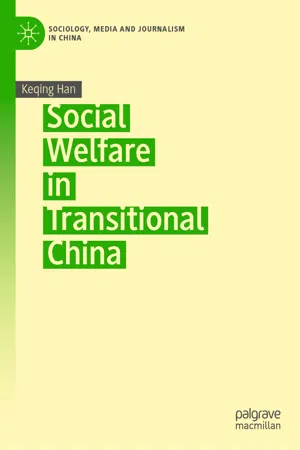
At a time of significant transformations in Chinese society, this book addresses the key issue of social welfare and the reform of the welfare system in 21st century China. Considering both the theory and policy making across a variety of welfare issues which directly impact on the country's economic development, it examines the development of civil society, changes in social stratification and in social class structure. It notably considers the key questions of welfare in both urban and rural settings, for different population groups such as children, the elderly and the disabled, addressing topical issues of housing, education, public health, poverty and the restructuring of related welfare policy system to tackle China's key issues. It also considers the impact of migrant workers in China and their social integration, including within the welfare system. Providing a unique insight into how economic globalization and financial crisis affects Chinese social welfare policies, thisbook is a key read for scholars worldwide interested in social transformation in Chinese society at a time of significant social and economic transition.
- English
- ePUB (mobile friendly)
- Available on iOS & Android
eBook - ePub
Social Welfare in Transitional China
About this book
Information
© China Renmin University Press 2020
K. HanSocial Welfare in Transitional ChinaSociology, Media and Journalism in Chinahttps://doi.org/10.1007/978-981-32-9660-2_11. Introduction
Keywords
Social welfareWelfare stateBeveridge ReportReconstruction1.1 Definitions of Social Welfare and Origins of Welfare States
1.1.1 Definitions of Social Welfare
“Social Welfare” generally refers to a kind of interest distribution mechanism, and a gauge for measuring the level of happiness of all citizens. However, the scholars from different states or regions have varied definitions of social welfare. And the researchers, though coming from the same social background, may interpret this issue from diverse perspectives.
According to the US scholar Robert L. Barker, social welfare is “a nation’s system of programs, benefits, and services that help people meet those social, economic, educational, and health needs that are fundamental to the maintenance of society”. 1
In the Encyclopedia of Social Work, which was published by the US National Association of Social Workers in 1999, social welfare is explained as “an extensive and inaccurate phase, mostly defined as an ‘organized activity’, ‘government intervention’, policy or project that intends to respond to the social problems that are being aware of or improve the conditions of the disadvantaged groups…However, social welfare may be better understood as an idea about a fair society that creates job opportunities and helps people achieve their life value, provides social members with security to a reasonable degree, keeps them from financial strain and violence, and facilitates the establishment of a fair and personal value-based assessment system; so such society shall be economically productive and stable. Such idea is based on an assumption that human society, through organized governance, is able to produce and provide what social welfare requires and morally obliged to fulfill such idea because it is feasible”. 2
The Japanese Social Security Review Conference, which was held in 1950, came up with a report on Suggestions for Japan’s Social Security System which states that “social welfare is an undertaking that is designed to provide necessary guidance on livelihood and reintegration into society, as well as life protection to the handicapped, children and others that are entitled to governmental bailout, so as to enable them to lead a life on their own”. Besides, according to Article 3 in the Law on the Social Undertakings of Japan, “all social welfare activities shall abide by the principles for helping and cultivating the people that have to regain means of subsistence without hurting their will for a self-reliance life”. In other word, social welfare, which involves “all kinds of activities that benefit those in need of assistance and protection”, 3 is the same with social welfare undertaking.
In 1991, China published the Encyclopedia of China that covers 74 volumes dedicated to separate disciplines. The volume of Sociology defines “social welfare” as “a system that is designed to improve the quality of life of all citizens, particularly those in difficulty. This system shall, by means of allocating funds and rendering services, ensure basic living standard of all social members and upgrade their life as much as possible. Social welfare, in a narrow sense, indicates the services and measures for helping certain social members that lead a difficult life due to old age, sickness or incapacity resulting from physical or psychological defect; in a broad sense, it refers to all types of services and measures for improving both material and spiritual life of all members of society”. 4
Overall, social welfare could be defined in both broad sense and narrow sense. From the perspective of objects or beneficiaries, the broad-sense social welfare takes care of all social members, while the narrow-sense social welfare focuses on the impoverished or special groups. With respect to welfare content, the generally defined social welfare contains both financial security and social services, while the narrowly defined social welfare is only about financial security or somewhat social assistance. The social welfare in this book is generally defined, i.e., it is a system designed to satisfy people’s needs and improve their living standard by means of fiscal allocation, physical distribution and social services. Strictly speaking, social insurance is not covered in social welfare, yet a general social welfare is a comprehensive system that embraces social assistance, social insurance and social services.
1.1.2 Origins of Welfare States
After the World War II, all industrialized countries, while improving their society security system, began to pay more attention to building a social welfare system. The UK and other western European countries successively declared to develop themselves into a welfare state, and an all-round welfare system that cares about their citizens “from cradle to tomb”. Other countries, though not following the same path, kept enacting legislation on social welfare. Japan, for example, stipulated the famous “six laws on social welfare”, 5 which have laid legal basis for building and developing a sound social welfare system in the country.
The knowledge of welfare state is usually deemed as stemming from the UK. In 1941, Sir William Beveridge, head of the then Social Insurance and Allied Services Committee, was entrusted by the UK government to draw up a post-war social security plan. At the end of 1942, Sir Beveridge delivered the famous report titled Social Insurance and Allied Services, usually known as the “Beveridge Report”, which sets out to annihilate five evils, i.e., “Want, Disease, Ignorance, Squalor and Idleness”. Sir Beveridge presented 23 reform proposals to fulfill these targets, particularly standardizing social insurance premium and social security administration, and ultimately build a caring-for-all social insurance system. 6 The Beveridge Report is of epoch-making significance for creating the basic framework for a post-war welfare state. It reflects on the UK’s previous welfare schemes, and stands firm to the principle that welfare is for common good rather than the interest of certain groups, and the cause of social welfare calls for joint endeavor of both government and individuals. In contrast to the previous efforts, the Beveridge Report is rated as a prime example for the studies on social welfare, since it envisions a complete welfare system, involving both people’s needs in every aspect—its foremost concern—and corresponding measures. Around the end of the World War II, the UK government, on the basis of the Beveridge Report, introduced a series of social welfare laws: Family Allowance Law (1945), National Insurance Law (1946), National Health Service Law (1946), Industrial Injury Law (1946) and National Relief Law (1948). The above five laws are so extensive that they take every aspect of social welfare into account; they are considered as an epitome of the UK’s achievements in social welfare in the past 300 years. These laws entered into effect as of July 5, 1948 when the precedents went invalid automatically, marking that the UK officially turned into a welfare state and opened a new page in its history.
Since the 1970s, the UK has been reforming its welfare system, thus altering the continuous growth momentum of the welfare expenditure that had lasted for almost half a century, and generating a “non-welfare” development trend. The reform strictly controlled the UK’s welfare expenditure, e.g., some expenses were frozen, some were deferred, and some welfare products were “privatized” and subject to market operation. Such reform came under heavy criticism. It was even accused of deteriorating social inequality, since the previous policies were caring more about the poor, while the new ones catered to the rich. 7
In the world at large, other developed western countries have joined the UK in the rank of welfare states, particularly those in the northwestern Europe like Sweden which are long hailed as “window of the welfare state” for their high-spend and extensive welfare policies. These societies have seen the policies for higher-level and more reasonable welfare treatment become irreversible, despite of some economic and social problems therefrom, because it is human instinct to seek happiness and benefit, and continuous economic growth makes their dream attainable. Therefore, when taking measures to control expansion of welfare expenditure, all governments shall seize the opportunity of development, foster reasonable growth of welfare and mitigate the possible adverse effect, in an aim to build a social welfare system that benefit all citizens.
1.2 Basic Functions of Social Welfare
There is no doubt that the establishment and improvement of social welfare system is the prominent feature of the modern market economy, and also important means for a state to intervene with economy and correct market malfunction. Nowadays, social welfare plays an essential role in resolving social problems, safeguarding social stability and improving people’s living standard. To be specific, social welfare could be interpreted through its economic, political and social functions.
1.2.1 Economic Functions
First, social welfare is a form of income distribution. By taking part in social income distribution, social welfare is able to ease the negative impact from income disparity and ensure basic livelihood of all citizens. Second, social welfare is of great significance in resource allocation. Through exerting influence on prioritization and input scale of financial appropriation, social welfare will alter velocity of capital accumulation. Last, social welfare has enormous impact upon macroeconomy, which manifests in the following three a...
Table of contents
- Cover
- Front Matter
- Part I. Central Concepts
- Part II. China’s Welfare System
- Back Matter
Trusted by 375,005 students
Access to over 1.5 million titles for a fair monthly price.
Study more efficiently using our study tools.
Frequently asked questions
Yes, you can cancel anytime from the Subscription tab in your account settings on the Perlego website. Your subscription will stay active until the end of your current billing period. Learn how to cancel your subscription
No, books cannot be downloaded as external files, such as PDFs, for use outside of Perlego. However, you can download books within the Perlego app for offline reading on mobile or tablet. Learn how to download books offline
Perlego offers two plans: Essential and Complete
- Essential is ideal for learners and professionals who enjoy exploring a wide range of subjects. Access the Essential Library with 800,000+ trusted titles and best-sellers across business, personal growth, and the humanities. Includes unlimited reading time and Standard Read Aloud voice.
- Complete: Perfect for advanced learners and researchers needing full, unrestricted access. Unlock 1.5M+ books across hundreds of subjects, including academic and specialized titles. The Complete Plan also includes advanced features like Premium Read Aloud and Research Assistant.
We are an online textbook subscription service, where you can get access to an entire online library for less than the price of a single book per month. With over 1.5 million books across 990+ topics, we’ve got you covered! Learn about our mission
Look out for the read-aloud symbol on your next book to see if you can listen to it. The read-aloud tool reads text aloud for you, highlighting the text as it is being read. You can pause it, speed it up and slow it down. Learn more about Read Aloud
Yes! You can use the Perlego app on both iOS and Android devices to read anytime, anywhere — even offline. Perfect for commutes or when you’re on the go.
Please note we cannot support devices running on iOS 13 and Android 7 or earlier. Learn more about using the app
Please note we cannot support devices running on iOS 13 and Android 7 or earlier. Learn more about using the app
Yes, you can access Social Welfare in Transitional China by Keqing Han in PDF and/or ePUB format, as well as other popular books in Politics & International Relations & Education Theory & Practice. We have over 1.5 million books available in our catalogue for you to explore.