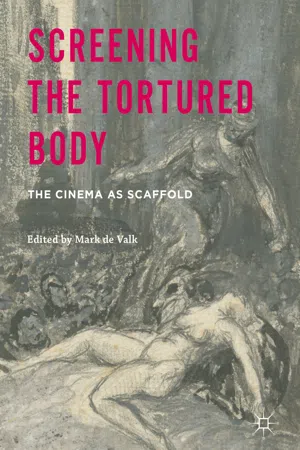
Inspired by Michel Foucault's examination of state subjugation and control, this book considers post-structuralist notions of the 'political technology of the body' and 'the spectacle of the scaffold' as a means to analyse cinematic representations of politically-motivated persecution and bodily repression. Through a critique of sovereign power and its application of punishment 'for transgressions against the state', the collected works, herein, assess the polticised-body via a range of cinematic perspectives. Imagery, character construction and narrative devices are examined in their account of hegemonic-sanctioned torture and suppression as a means to a political outcome. Screening The Tortured Body: The Cinema as Scaffold elicits philosophical and cultural accounts of the 'restrained' body to deliberate on a range of politicised films and filmmakers whose narratives and mise-en-scène techniques critique corporeal subjugation by authoritarian factions.
- English
- ePUB (mobile friendly)
- Available on iOS & Android
eBook - ePub
About this book
Information
Subtopic
Film & Video© The Author(s) 2016
Mark de Valk (ed.)Screening the Tortured Body10.1057/978-1-137-39918-2_11. Introduction
Mark de Valk1
(1)
Faculty of Arts, The University of Winchester, Winchester, UK
Screening the Tortured Body: The Cinema as Scaffold is a collection of essays examining a range of cinematic texts inspired by Michel Foucault’s deliberation on state subjugation, control and punishment of the subject. In assessing the role of the sovereign on the screen, these theses consider post-structuralist notions pertaining to the ‘political technology of the body’ and ‘the spectacle of the scaffold’ as a means to analyse cinematic representations of politically motivated persecution, state bodily repression and the topographies/spaces where they are meted out. These state practices of authoritarian subjugation are historically accounted for by Foucault, and the study of their ‘depiction’ (on-screen) is apropos to be examined per current-day sovereign repressive measures employed to control and punish the ‘polticised’ individual who commits ‘transgressions against the state.’ Developing this point, Deleuze contends that,
Through a critique of sovereign power (i.e. state, military and corporate factions, the ‘military industrial complex’) and its application of punishment ‘for transgressions against authority,’ the collected works assess the polticised-body via a range of cinematic texts, directorial perspectives, cinematographic imagery, dramatic character construction and narrative and documentary devices that contain an account of hegemonic-sanctioned torture and suppression as a means to a political outcome. The collection engages with philosophical and cultural filmic accounts of the ‘restrained’ body to deliberate on a range of politicised themes and directors whose narratives and mise-en-scène techniques critique corporeal subjugation by autocratic government bureaucracies and militarised factions. The authors examine and critique a cross-section of dramatic and documentary films that can be read as texts and social comment on sovereign dominance and control over, and upon, the polticised-body (politic). Here, via an analysis of cinema’s engagement with social justice and human rights contexts, the director’s frame is deliberated as challenge to state-sanctioned torture, subjugation and observation as a means to a jurisdictive consequence; in practice, investigation of cinematic accounts on the screen that both ‘re-imagine’ sovereign propagated narratives and as contestation to the public’s ‘acceptance’ per its reception of those narratives.Foucault located the ‘disciplinary societies’ in the eighteenth and nineteenth centuries; they reach their height at the outset of the twentieth. They initiate the organization of vast spaces of enclosure. The individual never ceases passing from one closed environment to another, each having its own laws…Foucault has brilliantly analysed the ideal project of these environments of enclosure…to concentrate; to distribute in space; to order in time; to compose a productive force within the dimension of space-time whose effect will be greater than the sum of its component forces. But what Foucault recognised as well was the transience of this model: it succeeded that of the ‘societies of sovereignty’, the goal and functions of which were something quite different (to tax rather than to organize production, to rule on death rather than to administer life…These are the ‘societies of control’, which are in the process of replacing disciplinary societies. “Control” is the name Burroughs proposes as a term for the new monster, one that Foucault recognizes as our immediate future. Paul Virilio also is continually analysing the ultra-rapid forms of free-floating control that replaced the old disciplines operating in the time frame of a closed system.1
The aim is to examine, interpret and re-interpret cinema’s relationship between the (oppressed) body and the exertion of power by the sovereign. According to Elizabeth Grosz, psychoanalysts and philosophers such as Freud, Lacan, Deleuze and Foucault focused on the mind at the expense of the body and did not ‘explicitly develop a theory of the body.’ As Grosz argues, ‘At most, conceptions of corporeality are presumed by them, or they refer to the body without making it the centre of focus.’2 As such, this collection posits the body as a centre of focus; the compilation examines the effect of the sovereign’s reign over and control of the body. It will do this by considering how cinema challenges the state’s proclivity to create a ‘constituency for torture.’ Building on a range of cultural theorists’ notions exploring the ‘disappeared body,’ the essays explore how the cinema-screen can be read as a modern-day ‘public scaffold’; that is, how the sovereign affects a ‘spectacle of punishment’ to seek ‘revenge upon the body…for transgressions against the state.’ These essays look at how the body translates to the political, the subjugation of the body by the ‘sovereign’ and the reclamation of the ‘disappeared body’; here as a means of theorising on the ability to ‘re-inscribe’ the corporeal body to negate abuse and control as exercised by the state.
I want to suggest that cinema’s consideration of the ‘politicised body’ will function as query and affirmation of how it visually and thematically represents the body through its depiction of how the sovereign controls it, how it marks it, trains it, tortures it. By focusing on Foucault’s notion of the scaffold, where the body is ritually laid bare to the force of the sovereign, the ‘inscriptive’ surface of the body can be ‘refigured or re-mapped’ to reclaim the power of the body from the sovereign, as Grosz argues. Indeed, cinema’s calling attention to authoritarian state practices of bodily repression allows for a reclaiming of power from the patriarchal sovereign.
Part I of the collection, State Evisceration/Tortured Flesh, considers the cinematic ramifications of how ‘bodily flesh’ is fetishised in all its ‘defilement,’ in all its ‘dirt [and] disorder,’ as Douglas suggests.3 Here, the state is considered vampire and purveyor of porn (Kerner Chap. 3, Bacon Chap. 5), where the screen frames nightmares of ‘uncleanness’ and primitive rituals of authoritarian control and ‘infection’ of bodily fluids; the cinema as scaffold demarcating the ‘image and spectator’ as ‘transformative’ via ‘mucous [and] viscous…fluid tissue’ as Patricia MacCormack (Chap. 2) advocates in Tortured Spectators: Massacred and Mucosal. Other essays in Part I consider Foucault and Agamben Aldana Reyes (Chap. 4) with regard to the state’s ‘retributive vigilantism’ and a range of horror-porn texts examine the containment of bodily ‘contagion.’ These notions link to the part’s final essay where the tortured vampiric-state manifests its bodily retribution through ‘imperial identification’ via military colonisation of the ‘captured enemy’ body (Wallenbrock, Chap. 6). Here, government complicity is narrativised as cinematic depictions of torture ‘legitimisation.’
Part II’s The Subjugated Body-Politic as Spectacle assesses a series of cinematic docu-narratives that locate the state’s focused use of politicised torture or politicised elimination of the subject as exhibition, the individual (body-politic) under in-terror-gation, whether confined within a private space (Hayward’s Chap. 7) or obliterated in the public square (de Valk’s Chap. 8), where observed subjugation on the screen as resistance and challenge to ‘the rhetoric implemented to maintain totalitarian governance’ as Susan Hayward suggests. As Foucault notes, ‘revenge of the state is visited upon the body in retribution for sins against the sovereign.’ The narrative and documentary films explored consider the screen as bearing witness to historically placed stories (Turim, Chap. 9) and documented subject experiences of repression and state-condoned (including gendered, DiGiovanni’s Chap. 10) torture where the filmmakers critique, question and contest the power of sovereign interests that intersect to ‘project’ the image of a controlled and punished subject to itself as a means to break the political will of the body-politic. Agamben’s ‘state of exception’ and Foucault’s spectacle of the punished body are historically accounted for via the cinema-screen’s arguable function as representative of a return to the ‘pre-Enlightenment public execution scaffold.’ But it is now a public space/forum that has turned its critical lens onto state-projected nightmares of the subjugated body-politic allowing viewers to experience these politicised events through a reclaimed ‘collective reception.’ Crudely speaking, the screen as return of the public execution set within the public square (cinema space); execution not as demise, but as a device for justice and the holding to account of ‘ideological systems that seek total domination’ (Hayward).
Finally in Part III, Framing Spectator Reception of State Retribution, the authors consider a range of film texts examining documented and dramatised characters who have been tortured in recent conflicts, whether external of, or internal to, the state and how they have been received/perceived by the director and the audience/public. Julia Lesage, in Chap. 11, considers how documentary films examine military-sanctioned torture involving ‘external’ (foreign’) subjects and how they, on-screen, provide ‘information about the subject, indicate ways of dealing with the issues, invite an emotional response and invoke an ethical stance.’ The matter of an ‘internal’ (‘domestic’) subject reception is considered in O’Sullivan’s Enemy of the State, Chap. 14, per the documented case of a current (politicised) prisoner; here, a view from the filmmaker’s point-of-view. Fagan’s Chap. 13 examines spectatorship reception of repression and subjugation paradoxes on-screen; for example, in DePalma’s Redcated the audience reads opening titles, declaring the film to be ‘entirely fiction’ while ‘inspired by an incident widely reported to have occurred in Iraq,’ yet simultaneously an attempt to ‘visually document imagined events.’ Dramatic characterisations of female embodiment/gender, per the ‘carrying out’ of the state’s oppressive will, are explored via protagonist construction, and the director’s role in Zero Dark Thirty; here, the received ‘image’ of women as propagated by the state’s participation/insertion into script and directorial outcomes (Anderson Chap. 12 and Olkowksi Chap. 15).
In her essay, Julia Lesage asks us to reflect on how the universality of the cinema-screen’s exploration and depiction of the ‘state-tortured body’ is exemplified:
The task of representing a large-scale event of historical importance does us a service. They [filmmakers] offer a path to mastery over a complex topic, even if it is only a provisional mastery that becomes more nuanced and revised the more we consider other facts and other voices on the subject. In this instance, because there is so much information about the issue of torture, far more than any one person can remember or easily draw upon, [cinema] offer[s] a structure for organizing that knowledge, setting out main ideas that can shape further exploration or be modified as the viewer reads more about the subject on his/her own. In this way, the films are a valuable tool for any concerned viewer, especially activists, since the films place an emphasis on understanding and also draw attention to how we understand. That is, the films indicate how information about torture is repressed, mediated and filtered before it ever gets to the public eye.
Footnotes
1
Deleuze, Gilles, L’Autre Journal, no. 1, May 1990.
2
Grosz, Elizabeth, Volatile Bodies: Toward A Corporeal Feminism, Indian University Press, 1994, p. ix.
3
Douglas, Mary, Purity and Danger, Routledge, 2007, pp. 1–2.
State Evisceration/Tortured Flesh
© The Author(s) 2016
Mark de Valk (ed.)Screening the Tortured Body10.1057/978-1-137-39918-2_22. Tortured Spectators: Massacred and Mucosal
Patricia MacCormack1
(1)
Anglia Ruskin University, Cambridge, UK
In his work on cine...
Table of contents
- Cover
- Frontmatter
- 1. Introduction
- 1. State Evisceration/Tortured Flesh
- 2. The Subjugated Body-Politic as Spectacle
- 3. Framing Spectator Reception of State Retribution
- Backmatter
Trusted by 375,005 students
Access to over 1.5 million titles for a fair monthly price.
Study more efficiently using our study tools.
Frequently asked questions
Yes, you can cancel anytime from the Subscription tab in your account settings on the Perlego website. Your subscription will stay active until the end of your current billing period. Learn how to cancel your subscription
No, books cannot be downloaded as external files, such as PDFs, for use outside of Perlego. However, you can download books within the Perlego app for offline reading on mobile or tablet. Learn how to download books offline
Perlego offers two plans: Essential and Complete
- Essential is ideal for learners and professionals who enjoy exploring a wide range of subjects. Access the Essential Library with 800,000+ trusted titles and best-sellers across business, personal growth, and the humanities. Includes unlimited reading time and Standard Read Aloud voice.
- Complete: Perfect for advanced learners and researchers needing full, unrestricted access. Unlock 1.5M+ books across hundreds of subjects, including academic and specialized titles. The Complete Plan also includes advanced features like Premium Read Aloud and Research Assistant.
We are an online textbook subscription service, where you can get access to an entire online library for less than the price of a single book per month. With over 1.5 million books across 990+ topics, we’ve got you covered! Learn about our mission
Look out for the read-aloud symbol on your next book to see if you can listen to it. The read-aloud tool reads text aloud for you, highlighting the text as it is being read. You can pause it, speed it up and slow it down. Learn more about Read Aloud
Yes! You can use the Perlego app on both iOS and Android devices to read anytime, anywhere — even offline. Perfect for commutes or when you’re on the go.
Please note we cannot support devices running on iOS 13 and Android 7 or earlier. Learn more about using the app
Please note we cannot support devices running on iOS 13 and Android 7 or earlier. Learn more about using the app
Yes, you can access Screening the Tortured Body by Mark de Valk in PDF and/or ePUB format, as well as other popular books in Media & Performing Arts & Film & Video. We have over 1.5 million books available in our catalogue for you to explore.