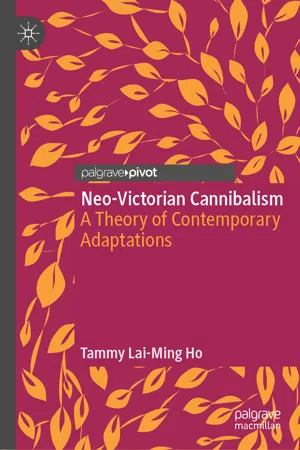
This Pivot examines a body of contemporary neo-Victorian novels whose uneasy relationship with the past can be theorised in terms of aggressive eating, including cannibalism. Not only is the imagery of eating repeatedly used by critics to comprehend neo-Victorian literature, the theme of cannibalism itself also appears overtly or implicitly in a number of the novels and their Victorian prototypes, thereby mirroring the cannibalistic relationship between the contemporary and the Victorian. Tammy Lai-Ming Ho argues that aggressive eating or cannibalism can be seen as a pathological and defining characteristic of neo-Victorian fiction, demonstrating how cannibalism provides a framework for understanding the genre's origin, its conflicted, ambivalent and violent relationship with its Victorian predecessors and the grotesque and gothic effects that it generates in its fiction.
- English
- ePUB (mobile friendly)
- Available on iOS & Android
eBook - ePub
About this book
Information
© The Author(s) 2019
Tammy Lai-Ming HoNeo-Victorian Cannibalismhttps://doi.org/10.1007/978-3-030-02559-5_11. Introduction: Neo-Victorian Cannibalism
Tammy Lai-Ming Ho1
(1)
Hong Kong Baptist University, Kowloon Tong, Hong Kong
Tammy Lai-Ming Ho
Abstract
This book investigates how different neo-Victorian novels negotiate the conflicting desires of communion and identity-formation. The neo-Victorian texts chosen include earlier works in the genre and relatively recent ones and are written by writers of different nationalities. Some of the texts have received ample academic attention while others have been less examined. The chapters in the book are divided in order to focus on thematic pairings of Victorian and contemporary texts (and authors-as-texts). The pairings demonstrate the cannibalism of a specific element of the Victorian, for example, author, text and feature of its history, by the neo-Victorian as well as illustrating and elucidating the cannibalistic nature of the genre.
Keywords
AdaptationCharlotte BrontëCannibalismCharles DickensNeo-VictorianVictorianSome books are to be tasted, others to be swallowed, and some few are to be chewed and digested. —Francis Bacon (1597)
This book is about a body of contemporary neo-Victorian novels whose ambivalent relationship with the past can be theorised in terms of aggressive eating, even cannibalism . Although cannibalism does not appear as a theme in all neo-Victorian novels, it is pervasive in neo-Victorian writing, whether fictional or critical, in its extended sense of aggressive appropriation of pre-existing texts. Not only is the imagery of eating repeatedly used by critics to comprehend neo-Victorian literature, the theme of cannibalism itself also appears overtly or implicitly in a number of the novels and their Victorian prototypes. I argue that aggressive eating or cannibalism , then, can be seen as a pathological and defining characteristic of neo-Victorian fiction. It provides a framework for understanding the genre’s origin, its conflicted and violent relationship with its Victorian predecessors, and the grotesque and gothic effects it generates in the fiction. Some novelists and critics have touched upon the relationship between cannibalism and neo-Victorian literature, indicating that the connection has not gone entirely unnoticed. However, there is as yet no substantial study of the topic. This book aims to discuss how the idea of aggressive eating or cannibalism might be used to analyse and theorise the relationship between the contemporary and the Victorian .1
The contemporary’s cannibalism of the Victorian has two motivations: to commune with the Victorian model on the one hand and to create a new identity through the absorption of elements of the very same model on the other. In some ways, this seems paradoxical and irreconcilable and creates a kind of dilemma for the neo-Victorian novelists. I believe that these contemporary writers have aesthetic and artistic aspirations and therefore ‘the very existence of a past creates the necessity for difference—not for the audience, not sub specie aeternitatis, but for the writer and artist himself’ (Bate 1971: 31). If the neo-Victorian writer imitates the Victorian too closely (total communion), he or she risks their work becoming little more than pastiche. If the novelist embraces the contemporary too closely, the work could lose all semblance of the Victorian and no longer fit the genre comfortably. The stronger the contemporary writers’ instinctual desire and anxiety to establish a difference from their predecessors (while at the same time imitating them), the more vigorous and aggressive their approach in appropriating or ‘misreading’ (to use Bloom’s term) the Victorian elements would be. It is the opposing directions that contribute to the ambiguity of the neo-Victorian genre’s relationship with its Victorian model, a relationship I describe as ‘aggressive ambivalence’. Neo-Victorian novels demonstrate a desire to emulate the literary accomplishments of their Victorian forebears but this desire is tainted with a distrust and disgust of the era and its authors (and possibly a certain level of self-disgust). The neo-Victorian embraces Victorian fiction by consuming its literary styles, plots and techniques (communion), while aggressively criticising Victorian ideologies through contemporary theoretical paradigms and by seeking to undermine the success of Victorian authors and their works (identity-formation). In both their search for communion and identity-formation, they are aggressive, simultaneously pushing away and enthusiastically embracing their ancestors’ influence. Cannibalism provides an apt metaphor to explain this aggressive ambivalence, itself an ambivalent and violent practice; one takes in as well as destroys its food. More fundamentally, cannibalism also provides a theoretical basis for both the neo-Victorian’s desire to commune with the Victorian and the conflicting need to form a self-identity.
Although I believe the neo-Victorian genre as a whole can be characterised as aggressively ambivalent towards the Victorian, it is important to note that individual novels embody this ambivalence to different extents and intensities. Each demonstrates its own pattern of negotiation and struggle between the two coexisting motivations of cannibalism—communion and identity-formation. The treatment of the Victorian sources in the texts can thus range from respectful and affectionate to highly dismissive and aggressive and far and wide in between. In some cases, this negotiation may even demonstrate itself in overt references to cannibalism /vampirism or in self- or sub-conscious descriptions of the cannibalistic nature of the writer’s own work.
In this book, I will investigate how different neo-Victorian novels negotiate the conflicting desires of communion and identity-formation, and will explore themes of cannibalism within the texts. The neo-Victorian texts chosen include earlier works in the genre and relatively recent ones and are written by writers of different nationalities. Some of the texts have received ample academic attention while others have been examined less. The chapters are divided in order to focus on thematic pairings of Victorian and contemporary texts (and authors-as-texts). The pairings demonstrate the cannibalism of a specific element of the Victorian , for example, author, text and feature of its history, by the neo-Victorian as well as illustrating and elucidating the cannibalistic nature of the genre . The selection of texts, then, apart from reflecting my own taste and cannibalism of the Victorian , also points to the extent to which cannibalism is evident in the genre as a whole.
The theme of cannibalism is manifested in various ways in neo-Victorian works, thereby mirroring the highly aggressive relationship between the contemporary and the Victorian and highlighting the range of subjects and subgenres associated with neo-Victorian fiction. Each chapter in the book hinges on one type of ‘cannibal ’ through which the discussion of the theory of neo-Victorian cannibalism is elucidated. Chapter 2, ‘Contesting (Post-)colonialism: Jane Eyre , Wide Sargasso Sea and Three Neo-Victorian Rejoinders’, establishes the important connection between two recent literary responses to Victorian literature, namely, the wider neo-Victorian project and a more specific subset of it, which reconsiders the nineteenth century from a postcolonial perspective. These two are yoked together and manifested in Jean Rhys ’ Wide Sargasso Sea (1966), the foundational neo-Victorian text. I argue that, apart from incorporating canonical nineteenth-century celebrities and texts, contemporary writers also appropriate ideas about Victorian empire. That Rhys’ Wide Sargasso Sea is the foundational postcolonial neo-Victorian text prompts the reading of its pre-text, Charlotte Brontë’s Jane Eyre (1847), as a foundational colonial Victorian work. I tease out the cannibalistic, Caribbean and (post-)colonial elements in Jane Eyre and Wide Sargasso Sea. I then read a group of Anglo-American neo-Victorian novels which return to both Brontë’s and Rhys’ models. In particular, I focus on how they reorient the narrative focus away from the empowered Creole Antoinette (a reworked version of Bertha Mason) in Wide Sargasso Sea back to the British characters of Jane Eyre. I consider this shift of narrative attention away from Antoinette/Bertha as a problematic commentary on (and possible rejection of) the corrective postcolonial agenda found in neo-Victorian novels such as Wide Sargasso Sea.
Chapter 3, ‘Dickens the Cannibal Canni...
Table of contents
- Cover
- Front Matter
- 1. Introduction: Neo-Victorian Cannibalism
- 2. Contesting (Post-)colonialism: Jane Eyre, Wide Sargasso Sea and Three Neo-Victorian Rejoinders
- 3. Dickens: The Cannibal Cannibalised
- 4. Stoker and Neo-Draculas
- 5. Coda: Victorian Memes
- Back Matter
Trusted by 375,005 students
Access to over 1.5 million titles for a fair monthly price.
Study more efficiently using our study tools.
Frequently asked questions
Yes, you can cancel anytime from the Subscription tab in your account settings on the Perlego website. Your subscription will stay active until the end of your current billing period. Learn how to cancel your subscription
No, books cannot be downloaded as external files, such as PDFs, for use outside of Perlego. However, you can download books within the Perlego app for offline reading on mobile or tablet. Learn how to download books offline
Perlego offers two plans: Essential and Complete
- Essential is ideal for learners and professionals who enjoy exploring a wide range of subjects. Access the Essential Library with 800,000+ trusted titles and best-sellers across business, personal growth, and the humanities. Includes unlimited reading time and Standard Read Aloud voice.
- Complete: Perfect for advanced learners and researchers needing full, unrestricted access. Unlock 1.5M+ books across hundreds of subjects, including academic and specialized titles. The Complete Plan also includes advanced features like Premium Read Aloud and Research Assistant.
We are an online textbook subscription service, where you can get access to an entire online library for less than the price of a single book per month. With over 1.5 million books across 990+ topics, we’ve got you covered! Learn about our mission
Look out for the read-aloud symbol on your next book to see if you can listen to it. The read-aloud tool reads text aloud for you, highlighting the text as it is being read. You can pause it, speed it up and slow it down. Learn more about Read Aloud
Yes! You can use the Perlego app on both iOS and Android devices to read anytime, anywhere — even offline. Perfect for commutes or when you’re on the go.
Please note we cannot support devices running on iOS 13 and Android 7 or earlier. Learn more about using the app
Please note we cannot support devices running on iOS 13 and Android 7 or earlier. Learn more about using the app
Yes, you can access Neo-Victorian Cannibalism by Tammy Lai-Ming Ho in PDF and/or ePUB format, as well as other popular books in Literature & Literature General. We have over 1.5 million books available in our catalogue for you to explore.