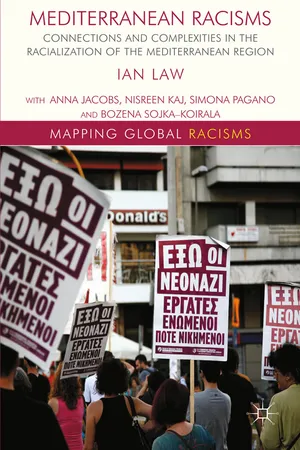
eBook - ePub
Mediterranean Racisms
Connections and Complexities in the Racialization of the Mediterranean Region
- English
- ePUB (mobile friendly)
- Available on iOS & Android
eBook - ePub
Mediterranean Racisms
Connections and Complexities in the Racialization of the Mediterranean Region
About this book
This is the first book to provide an analysis of racism in the Mediterranean region. Ian Law reassesses contemporary processes of racialization, employing theoretical tools including polyracism, racial Arabization and racial Nawarization and drawing on new evidence on racism in North Africa, Lebanon, Cyprus, Greece and the Roma campland in Italy.
Information
1
Racial Mediterraneanization: Origins and Development
Introduction
The Mediterranean region is the birthplace of some of the oldest, most deeply rooted cultures and civilizations on our planet (Egyptian, Greek, Roman and Islamicate), and also of three of the most influential global religions: Christianity, Islam and Judaism. In the context of the interactions and connections between these civilizations and religions a diversity of racisms emerged, facilitating the mis/recognition of difference, the development of hierarchies and strategies of domination which also found expression in science, art, literature and aesthetics. In the pantheon of racial discourse, people in this region have themselves been artificially aggregated, misrepresented and hierarchically fixed as the ‘Mediterranean race’ (Sergi 1901). This chapter introduces the Mediterranean region and identifies the origins and development of racism here. It also explores these relations and provides a historical context-setting account for the subsequent examination of contemporary racisms in the region, which are the subject of later chapters.
In David Abulafia’s (2011) magisterial account of the history of the people of the Mediterranean he confirms that this was ‘probably the most vigorous place of interaction between different societies on the face of this planet’, with both easy contact between societies and the development of distinctive cultures and states. This chapter explores both these interactions and the specificities in the development of processes of racialization. In tracing the threads of the process of racial Mediterraneanization, whereby regimes and societies across this region produced complex systems of racial hierarchies, racialized norms and values and patterns of domination and exclusion, this chapter seeks to outline some selected key contours across the vast history of this region. Racial Mediterraneanization can be counter-posed to accounts of racial Europeanization (Goldberg 2008) and is the specific process of the generation of interconnected forms of racial discourse across racial states in this region. It seeks to provide a contextual account which establishes some new dimensions in the story of the emergence of racial rule and it proposes a new conceptual framing of ‘polyracism’, which seeks to incorporate and foreground the multiple dynamics at work here. Multiple racisms, varieties of modernity,1 multiple peoples and multiple empires have created the contemporary Mediterranean region, and unitary, simplistic models of historical development and change are not applicable to this complex context. The planet is constituted by a set of ‘overlapping, multiple, intersected modernities’ (Ong 1999), which encompass states with racism (Goldberg 2005, 2008). Philip Abrams (1982, p.16) emphasizes that historical sociology should not be concerned with specifying ‘grand schemes of evolutionary development’, rather, it should be concerned with the ‘continuous process of construction’ and this book is primarily concerned with examining threads and chains of meaning, continuities and relationalities and the implications and weight of racial histories on the present.
This book is a challenge to the regional vocabulary of critical race theory, as with the post-colonial theoretical project which seeks to achieve ‘the de-colonisation of the West’s theory of the non-West’ (Scott 1999, p.12), because it seeks to interrogate and concentrate upon the nature and extent of crossovers, contaminations and relations between racial ideologies, politics and representations in the geopolitical space of the Mediterranean. Positioning this account across the intersections of both the Occident and the Orient, and of the global North and the global South acknowledges the contested nature of geographical space, the ideological construction of regions such as Europe and the complexity of medieval, colonial and post-racial, post-secular encounters. The critical appropriation of the history of a multiple Mediterranean requires the ‘deconstruction of being and becoming Europe’ as Iain Chambers (2008, pp.9–10) argues, echoing a voice from the African shore of the Mediterranean: Jacques Derrida. In assessing the ‘liquid materiality’ of this region, this chapter provides a new frame through which the construction of European racialization and its connections and relations to historical processes of racialization in North Africa, the Mediterranean rim of Western Asia and elsewhere can be examined. This position has also been elucidated by Edward Said (1994, 1997), who, in interrogating Occidental reactions to Islam, advocates that we focus our attention on the entanglements and interweaving of histories and cultures and also their instability, frequent change and mutability.2
A key focus here, facilitated by a ‘Mediterranean focus’ is deconstructing European narratives of exclusivity and superiority. The hybridity of European culture, its borrowing, adapting and transforming ideas and influences from other regions and complex interconnections with other regions, peoples and places also applies to the construction of racial ideologies, hierarchies and exclusions. The supreme arrogance that racism is a purely European invention is challenged in this book, linking to arguments set out in Red Racisms (Law 2012). Mediterranean Racisms develops this regional mapping of historical and contemporary global racialization through connecting African, Middle Eastern and Mediterranean island contexts with European conceptions of race and hierarchy. Of crucial importance here is that, as Chouki El Hamel (2013, p.103) confirms, ‘Mediterranean peoples preceded Western Europeans and Americans by many centuries in ideas of racially classified societies’.
Polyracism and proto-racism
The concept of polyracism is used here in the context of a new theory denoting the historical development of multiple origins of racism in different regions and forms, as opposed to the monoracism arguments positing a linear development of Western racisms from the classical world onwards and outwards. Arguments for discounting and ignoring an analysis of non-Western racisms, because they are seen as of lesser importance or because they have been more weakly elaborated and implemented (Frederickson 2001, Eliav-Feldon, Isaac and Zeigler 2009), are very much open to challenge. Firstly, these arguments do not attempt to claim that a variety of early regional racisms do not exist, so where they have been well demonstrated and documented, this starting point is not in contention. Secondly, constructing a hierarchy of ‘importance’ is highly suspect, trampling over the perceptions and experiences of racialized groups in those contexts and positing their situations as unworthy of critical assessment. Thirdly, the significance of interconnections, interactions and crossings between systems of thought and in the operation of racialized regimes and empires further problematise a refusal to understand the complexity of the process of racialization across the planet, offering to render only an incomplete and incoherent account. David Goldberg’s (2009) methodological emphasis on the significance of investigating the interconnections between racism in one place with racisms elsewhere illustrates the value of relational analysis, which opens up new avenues for study which a comparative methodology cannot. The choice of a Mediterranean focus in this book derives from an analytical endeavour to foreground these interconnections.
There is a set of fundamental debates about the origins of racism in the world and an emerging literature which is engaging in the basic task of tracing the social and cultural archives of both race-thinking and the associated history of ideas, together with the development of racialized systems, regimes and empires (Hall 2011, Eliav-Feldon, Isaac and Zeigler 2009, Spickard 2005, Smaje 2003, Chakrabarty 2003).
These debates revolve around a set of fundamental questions. Firstly, the nature of pre-modern racisms is in question: did race and racism, again as both discursive constructions and as core logics in the operation of states and regimes, exist prior to the development of Western modernity? If so, then what is their significance? Secondly, if we can establish the existence of these pre-modern processes, where do we trace them to? Europe, the Greco-Roman world of classical antiquity, North Africa, China, India or elsewhere? Thirdly, how did trans-regional processes of interaction and interconnection operate across these sites, and what were the relational mechanisms at work here?
Great stress has rightly been placed on the significance of Western modernity as the engine of global racialization and its systems of colonization, plantation slavery, industrial capitalism and nationalism, with all their dehumanizing and civilizing logics. But, this story has often been told with the forgetting and exclusion of the role that both multiple pre-modernities and ‘multiple modernities’ (Eisenstadt 2003) – better conceptualized as varieties of modernity (Schmidt 2000) – have played in this complex interconnected process (also see Scott 1999). The incorporation of these other contexts requires a revised foundational understanding and theoretical framework for understanding and explaining the racialization of the planet. This book seeks to contribute to this intellectual agenda, challenging the Eurocentrism in contemporary debates through an examination of the pre-modern interconnections and threads of ideas, practices and representations across the Mediterranean in relation to race, racism and slavery that underlie the formation of racialized regimes in Southern Europe, the Middle East and North Africa. In examining the history of the Mediterranean region, the interactions of peoples and the development of racialized discourse, this section will begin by examining selected issues and evidence from Africa and the era of classical antiquity (eighth century BCE to fifth century AD), pre-Islamic Arabia (sixth century BCE to sixth century AD) and the rise and role of the Islamic Caliphate from the seventh century AD, the formation of Latin Christian Europe from the eighth century AD, the rise of the Ottoman empire and other medieval and early modern evidence. This Ottoman moment, for Abulafia (2011), distinguishes the end of the Third Mediterranean (600–1350) period and the beginning of the Fourth Mediterranean (1350–1830) period. This last period was marked by increasing domination by the Atlantic powers prior to the opening of the Suez canal in 1869, which facilitated both a major expansion in world trade and further European colonization of Africa.
The spurious, but intense, debate over whether ancient Egyptians were ‘black’ (Dubois 2003), with its associated claiming of Egyptian civilization as either black African or as an ‘untainted’ part of the origins of Europe, via ancient Greece, constructs essentialized accounts based on racial dualism and the construction of exclusive white and black social and cultural worlds. The Egypt of the Pharaohs was fundamentally African but it was also marked out by its complex differentiation of African peoples and cultures. Dynastic Egyptians strove to differentiate and distinguish themselves from others, especially ‘Negroid’ black Africans, often through caricature. The evidence from genetic anthropology found in DNA studies indicates that all modern humans share a common female ancestor who lived in Africa about 140,000 years ago, and all men share a common male ancestor who lived in Africa about 60,000 years ago and these ancestors are part of a growing body of fossil and DNA evidence indicating that modern humans arose in sub-Saharan Africa and began migrating, starting about 65,000 years ago, to populate first southern Asia, China, Java and, later, Europe (Human Genome Project 2010). The inability to scientifically sustain valid racial categories and racial boundaries between peoples indicates that ancient Egypt can be claimed as neither ‘black’ nor ‘white’, but only as encompassing a range of physical and physiognomic human differentiation. Representations of blackness and other racial categories in the artefacts of Egyptian civilization do, however, indicate that the social and cultural misrecognition of this type of difference, or in other words the formulation of discourse about race, was first established here through the creation of divisions of ‘Ethiopian people’. All over Egypt in temple and tomb art, including that of Tutankhamun, representations of the exaggerated physical characteristics of barbaric black Nubians, red-brown finely featured Egyptians and others can be found. The complexity of these representations was evident in the inclusion of physically differentiated Libyans, Syrians and Shashu Bedouins, among others (van Wyk Smith 2010). Linkages of these representations to forms of racial differentiation in contemporary Egypt and other countries in Northern Africa and the Mediterranean rim of Western Asia will be explored in the next section and in Chapter 2.
Tracking and tracing the genealogy of Western images of Africa and Africans and the 2000-year-old discourse of race is a task that has been addressed by Malvern van Wyk Smith (2010). He has recently confirmed that the origins of this discourse are rooted in Africa, specifically in late new-kingdom Egypt (sixteenth century BCE to eleventh century BCE), as its ruling elites sought to distance Egyptian civilization from its African origins. Kushite Nubians, founders of Napata and Meroe who, in the eighth century BCE, provided the black rulers of the Twenty-fifth Dynasty in Egypt, adopted and adapted to such dynastic discriminations in order to differentiate their own ‘superior’ Meroitic civilization from the world of ‘other Ethiopians’. In due course, Archaic Greeks, who began to arrive in the Nile Delta in the seventh century BCE, internalized these distinctions in terms of Homer’s identification of ‘two Ethiopias’, an Eastern and a Western, to create a racialized (and racist) discourse of ‘worthy’ and ‘savage Ethiopians’. As van Wyk Smith argues, such conceptions would inspire virtually all subsequent Roman and early medieval thinking about Africa and Africans, and become foundational in European thought. For example, he argues that the gross misrepresentations of ‘Negroid facial features’ that have been linked to the most explicit phases of European racism were not a product of Mediterranean Europe but arose first as Nubian and Egyptian creations (2011, p.57).
This intervention by van Wyk Smith, firmly grounded in extensive research, and inspired by Basil Davidson’s Old Africa Rediscovered (1959) and Black Mother (1961, revised 1968) among others, makes a number of key challenges to contemporary debates that have far-reaching implications for the understanding of the racialization of the planet. Firstly, confirmation of the African origins of Egypt and clarification of the ways in which racial invention of hierarchies of African peoples dovetailed with the regional domination of Dynastic Egypt indicates the importance of recognizing the far-reaching significance of pre-modern discourses of race and racism and their influence and impact in shaping the racial hierarchies of Western modernity, colonialism, slavery and empire. Indeed the Egyptian sense of being racially ‘special’ was not only based on their relation to blackness and Africans but also to ‘Asians’.3 Racism did not begin with the development of mercantile capitalism and this in itself is a fundamental challenge to many contemporary accounts of global racialization. The rich archives of race-thinking, including classical sources, science, traveller’s tales, art and literature, flourished through movement of peoples and ideas and interconnections between societies across and around the Mediterranean.
The shaping of Greco-Roman racist discourse is now well documented. Delacampagne (1983, 1990) argues that the naturalized superiority of Hellenic culture in relation to both external ‘barbarians’ and naturalized internal divisions between propertied Greek adult males and women and slaves both involved the derivation of the cultural characteristics of a group from its biological characteristics. In addition, Aristotle discussed the nature of both the Hellenic race and other peoples, and there was strong evidence of colour symbolism in ancient Greek and Roman cultures, with whiteness being associated with positive values and blackness with death and the underworld (Snowden 1970). Benjamin Isaac (2004) identifies three key elements operating here, including environmental determinism, the belief in the heritability of acquired characteristics and the belief in the importance of lineage, citing, for example, Hippocrates’ Airs, Waters and Places from the fifth century BC and Aristotles’ Politics from the fourth century BC.
Proto-racism is not a lesser or weaker racism, but a racism based on pre-modern concepts which operates as a conceptual mechanism to ‘rationalise stereotypes and prejudices’. Isaac claims that this has its origins in fifth-century Greece and ignores earlier evidence such as that used by Smith (2010). Isaac (2004) identifies key discursive linkages between the character of entire peoples being determined by geography, with hierarchies determined by blood ties or lineage (autochthony) and also identifies assumptions that mixed descent would corrupt human qualities and argues that eugenics originated in the writings of Plato and Aristotle where it was seen as necessary for the upper class to maintain racial superiority. This work was drawn upon in the popularization of eugenics in the nineteenth and twentieth centuries. Classification of peoples according to external physical features and derivation of characters and destiny from these, physiognomics, was shown to be highly popular. For example, Pliny the Elder provided an account of ‘monstrous races’ in the first century AD (Jahoda 1999, pp.3–4). Comparison of foreign people to animals and other forms of xenophobia and ethnic hatred are identified as becoming more hostile and aggressive in the context of imperialist and expansionist moments. Strong anti-Oriental attitudes emerged in accounts of Persians and here Isaac identifies a direct determinate link between imperialism and the inferiorization of Asiatics.
Far from being irrational and nonsensical, then, these ideas were seen in many cases as a core element in the specification, delineation and political construction of these civilizations and societies. As discussed in Red Racisms (Law 2012), early distinguishing of the separate ancestries of people from the ‘centre’ in Chinese kingdoms in the Zhou Dynasty (Zhōucháo) (1045–256 BC) and barbarian peoples in the borderlands and peripheries of the region (yídí), confirmed by Confucius, led to the crystallization of the notion of the Chinese people as a race in the Han Dynasty (206 BC–220 AD). The Sino-centric view of a superior central state and associated civilization and culture provided a hierarchical world view within which core concepts of racial difference led to a logic of incorporation and assimilation of those other ‘barbarian peoples’ on the part of the Chinese civilization state (Law 2012). The parallel formation of perceptions of race across two civilizations who had virtually no contact during this period of antiquity indicates the formation of multiple origins for racial hierarchies. Sino-Hellenic comparative work (Shankman and Durant 2002) also confirms this process across many other dimensions of cultural and cosmological concepts, elements and ideas which further indicate support for the thesis of multiple origins or polyracism.
Proto-racism is also identified in Roman views of subject peoples, the idea of collective natural slavery was intertwined with patterns of conquest, subjugation and governance. This linking of proto-racism and imperialist ideology is exemplified in the work of Tacitus in presenting Roman views on Germans (Isaac 2004, p.515). Also, in the Roman empire, anti-Judaism became established. For example, there were anti-Jewish pogroms and riots in Alexandria at the time of Emperor Caligula and both Roman and Greek states refused to grant Jews citizenship rights (Laquer 2006, p.41). By the fifth century, Jews had spread throughout the Roman empire. They subsequently became the object of demonization and hostility driven by the Christian church, blamed for the death of Jesus Christ, and were subject to mass violence by the Crusaders across Europe and mass expulsions from English territories 1288–90, and notably in Spain, Portugal, Bohemia and Italy in the late Middle Ages (Poliakov 1975). By 1500 a well-established Jewish presence had disappeared from large areas of Western Europe (Edwards 1994). Religious anti-Judaism developed with a range of stereotypes, hostility and discrimination that later transformed into secular anti-Semitism, which vilified Jewishness in the context of modernity and emerging nationalisms and highlighted ideas of racial difference (Bauman 1989).
Major religions in the Mediterranean region provided a centrally important framework for the development of ideas of racial differentiation and racial hierarchy. By the seventh century, categorizing human beings by skin colour was established in Jewish, Christian and Muslim canonical texts, particularly in the context of seeing Noah’s sons as representing the three human skin colours of the world’s population. In examining the discursive construction of blac...
Table of contents
- Cover
- Title Page
- Copyright
- Contents
- Preface
- Acknowledgements
- About the Authors
- 1. Racial Mediterraneanization: Origins and Development
- 2. Contemporary Racisms in the Mediterranean Region
- 3. The Mediterranean Roma
- 4. The Mediterranean Expulsion Machine
- Postface: Theorizing Polyracism
- Notes
- References
- Index
Trusted by 375,005 students
Access to over 1.5 million titles for a fair monthly price.
Study more efficiently using our study tools.
Frequently asked questions
Yes, you can cancel anytime from the Subscription tab in your account settings on the Perlego website. Your subscription will stay active until the end of your current billing period. Learn how to cancel your subscription
No, books cannot be downloaded as external files, such as PDFs, for use outside of Perlego. However, you can download books within the Perlego app for offline reading on mobile or tablet. Learn how to download books offline
Perlego offers two plans: Essential and Complete
- Essential is ideal for learners and professionals who enjoy exploring a wide range of subjects. Access the Essential Library with 800,000+ trusted titles and best-sellers across business, personal growth, and the humanities. Includes unlimited reading time and Standard Read Aloud voice.
- Complete: Perfect for advanced learners and researchers needing full, unrestricted access. Unlock 1.5M+ books across hundreds of subjects, including academic and specialized titles. The Complete Plan also includes advanced features like Premium Read Aloud and Research Assistant.
We are an online textbook subscription service, where you can get access to an entire online library for less than the price of a single book per month. With over 1.5 million books across 990+ topics, we’ve got you covered! Learn about our mission
Look out for the read-aloud symbol on your next book to see if you can listen to it. The read-aloud tool reads text aloud for you, highlighting the text as it is being read. You can pause it, speed it up and slow it down. Learn more about Read Aloud
Yes! You can use the Perlego app on both iOS and Android devices to read anytime, anywhere — even offline. Perfect for commutes or when you’re on the go.
Please note we cannot support devices running on iOS 13 and Android 7 or earlier. Learn more about using the app
Please note we cannot support devices running on iOS 13 and Android 7 or earlier. Learn more about using the app
Yes, you can access Mediterranean Racisms by I. Law in PDF and/or ePUB format, as well as other popular books in Social Sciences & Politics. We have over 1.5 million books available in our catalogue for you to explore.