This book explores the rise of the aesthetic category of addiction in the nineteenth century, a century that saw the development of an established medical sense of drug addiction. Drugs and the Addiction Aesthetic in Nineteenth-Century Literature focuses especially on formal invention—on the uses of literary patterns for intensified, exploratory engagement with unattained possibility—resulting from literary intersections with addiction discourse. Early chapters consider how Romantics such as Thomas De Quincey created, with regard to drug habit, an idea of habitual craving that related to self-experimenting science and literary exploration; later chapters look at Victorians who drew from similar understandings while devising narratives of repetitive investigation. The authors considered include De Quincey, Percy Shelley, Alfred Tennyson, Christina Rossetti, Charles Dickens, Robert Louis Stevenson, and Marie Corelli.
- English
- ePUB (mobile friendly)
- Available on iOS & Android
eBook - ePub
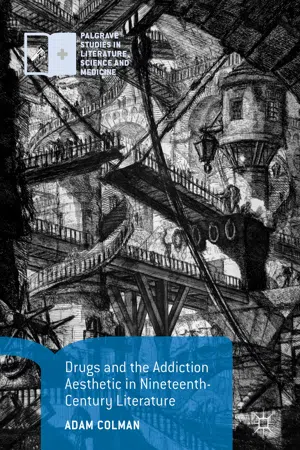
Drugs and the Addiction Aesthetic in Nineteenth-Century Literature
About this book
Information
© The Author(s) 2019
A. ColmanDrugs and the Addiction Aesthetic in Nineteenth-Century LiteraturePalgrave Studies in Literature, Science and Medicinehttps://doi.org/10.1007/978-3-030-01590-9_11. Introduction
Adam Colman1
(1)
Department of English, University of Massachusetts Amherst, Amherst, MA, USA
This is the story behind the good sort of addiction. To be clear: that good sort is not the medical condition of substance dependence, which is perilous and so often devastating. Instead, by “good sort of addiction,” I refer to a sense of addiction frequently used in pop-culture criticism. We find it in descriptions of videogames, in essays on music, and in reviews of television programs. Kirsten Acuna’s review of Breaking Bad, for example, uses the language of drug use in praise of a television show (in this case a show about a methamphetamine-dealer named Walt). “If you’re binge-watching,” Acuna writes, “‘Breaking Bad’ becomes as addictive as the blue meth Walt’s buyers can’t go without.”
Acuna is quite specific about the nature of Breaking Bad’s good sort of addictiveness. She argues that the show’s habit-forming property comes from its strategy of promising new information in each installment: “The final 12–15 minutes of nearly every episode,” she writes, “usually has a huge plot turn.” Acuna’s use of the word “addictive” here conveys a sober inclination toward acquisition of more and more knowledge, a sustained consideration of promised novelty and difference, and an orientation toward constantly intimated potential. Substance dependence, as described by the fourth edition of the Diagnostic and Statistical Manual of Medical Disorders (DSM), also compels ongoing pursuit of more and more through “a pattern of repeated self-administration” (176), but it overrides will and narrows the range of possibilities pursued. It can drive one to consume repeatedly a substance “despite knowledge of having a persistent or recurrent physical or psychological problem that is likely to have been caused or exacerbated by the substance” (DSM-IV 181). The positive sense of addiction used by Acuna—that of an aesthetic experience merely like substance dependence due in large part to its similarly repetitive nature—combines the propulsion of desire with a widened range of exploration. Such an experience belongs to what I call the addiction aesthetic, an aesthetic category characterized by a particular modality, or orientation toward possibility. The addiction aesthetic’s modality, this book argues, is one of intensely repetitive investigation of the possible.
It is hard to imagine aesthetic experience of any kind that does not involve some combination of repetition and a sense of the possible, yet this book particularly examines the intensified, exploratory version of such experience in terms of addiction for two reasons. First, addiction-related terminology continues to appear in descriptions of this sort of aesthetic experience and, second, durable versions of such aesthetic experience emerged with regard to nineteenth-century ideas about habit-forming intoxicants. For a clearer idea of that emergence, consider the difference between Beethoven and Bach, as well as the difference in their receptions. Alex Ross, in a New Yorker piece on Beethoven, describes the nineteenth-century composer’s work as “addictive” in order to distinguish it from that of earlier composers such as Bach, whose music uses comparatively steadier repetitions and variations. Beethoven, Ross observes, brings more elaboration, greater scale, more obsessiveness—in short, more—to the musical tradition represented by Bach, and the result is addictive. Ross writes:
Here, a twenty-first-century writer uses the language of addiction to describe a Romantic composer—to describe the greater intensity of that nineteenth-century composer’s repetitive pursuit of something more than the music of his predecessors.1 Ross also quotes E.T.A. Hoffmann’s praise of Beethoven as a composer whose music involves “infinite yearning” (Hoffmann 98), using language further suggestive of addictiveness, especially given that Hoffmann’s own nineteenth-century aesthetic ideals have been linked to his alcohol habit.2More than anything, it was the mesmerizing intricacy of Beethoven’s constructions—his way of building large structures from the obsessive development of curt motifs—that made the repertory culture of classical music possible. This is not to say that Beethoven’s predecessors, giants on the order of Bach, Haydn, and Mozart, fail to reward repeated listening with their cerebral games of variation. In the case of Beethoven, though, the process becomes addictive [emphasis added], irresistible. No composer labors so hard to stave off boredom, to occupy the mind of one who might be hearing or playing a particular piece for the tenth or the hundredth time.
Beethoven is said to have declared, “Music is like wine, inflaming men’s minds to new achievements, and I am the Bacchus serving it out to them, even unto intoxication” (Schindler 276). Such music resembled an intoxicant because it provided a pathway toward “new achievements”—toward novelty, toward possibility. Contemporaries including Hoffmann and later writers identified a corresponding, addictive, “infinite yearning” in this aesthetic experience. At a time when addiction discourse was on the rise in Europe (in conjunction with broader post-Enlightenment discussions of desirous habit) many saw aesthetic potential that matched addictive craving and intoxication; the quote from Alex Ross exemplifies the continued presence of that aesthetic sensibility.3 Thus “the addiction aesthetic” still proves useful as a label for this category of experience.
Again, the addiction aesthetic’s ongoing processions toward novelty, as we see in Acuna’s review, are exploratory rather than strictly, oppressively ravenous. Breaking Bad’s addictive allure sustains thoughtful curiosity about “huge plot turns,” an investigatory attitude toward always-developing and always-promised change. Rather than producing drab compulsion, routine merges with its opposite for a figuratively addicted audience’s delighted contemplation. Breaking Bad’s addictive form—its episodically plot-driven tantalization—establishes the rhythms of routine engagement with the non-routine, structuring the aesthetic experience by which an audience might explore strangeness through intensified yet basically sober habit (the formal logic suggests something akin to that of Beethoven’s music as described by Ross). In this book, I do not rule out the possibility that such art deemed addictive may be experienced through the same neural processes as drug addiction, but nor do I devote much attention to the negative sense of addiction applied, for instance, to songs—“earworms”—that get stuck in one’s head, override will, and work in manners closer to the medically understood version of addiction associated with substance dependence. The scope of this book will mostly remain limited to the origins of the aesthetic category founded upon a positive sense of addictive repetition, a sense different from—though clearly related to—the compulsions of the medical condition.4
This book focuses primarily on Britain in the nineteenth century, when addiction became more firmly understood as a medical condition and so became available as an aesthetic concept. The Society for the Study of Addiction and the leading medical journal it produces, Addiction, both trace back to Britain in the nineteenth century. Specifically, they trace back to 1884, when the society was founded as the Society for the Study and Cure of Inebriety, and when it first published its Proceedings. The terminology should not mislead anyone: from the start, the society was focused on drug habit as a disease rather than strictly a moral failing. “Only medical practitioners could have full membership… This medical focus was reflected in the society’s adherence to the disease concept of inebriety with its concomitant implication that inebriates should be treated in a hospital or asylum” (Blocker, Fahey, and Tyrell 564). And while 1884 is later than the publication of texts examined within the earlier chapters of this book, the sense of habitual intoxication as a disease of craving (and not a moral failing) emerged long before. That sense was demonstrably accessed and articulated influentially by earlier writers, from Coleridge to Dickens.
Across the nineteenth century, the rise of professional medicine and medical journals continually supported an increase in medicalized discussion of addiction. “Habitual use, what we would now call addiction, caused less concern,” notes Virginia Berridge, than other risks of drug use early on in the century (Demons 26), but the problems of habitual use were at least registered. Contradicting a tradition that had viewed habitual intoxication as a moral flaw and following the eighteenth-century work of Benjamin Rush and Thomas Trotter, intemperance became increasingly described as disease in a variety of medical publications.5 Words like “alcoholism” and the noun “addict,” now among standard terms for describing substance dependence, emerged later in the nineteenth century, even if terms like “intemperance” or “inebriate” were commonly used to denote the same phenomena.6 In any case, Thomas Trotter had already described those who were “addicted to the habit” of alcohol consumption by the early nineteenth century (36). Addiction may not, again, have been the universally preferred term for drug and alcohol habit, and fears about opium habituation were not strong enough to regulate the substance in any real way in Britain prior to the 1868 Pharmacy Act, yet Romantic-era writers described what has since often been called addiction.
Addiction was becoming more widely medically recognized as intensely potent habits in general became part of so many different aspects of British life, often those linked to exploratory pursuit or consumption. As Meredith Conti notes, addiction became medically registered once there was “impetus to define, conceptualize and treat addiction” (113). By the start of the nineteenth century, that impetus had arrived as heightened consumerism, colonialism, and global commerce depended upon substances known by those like Trotter and Rush to be habit-forming—substances such as rum, tobacco, and opium.7 Enlightenment thinkers including David Hume and Edmund Burke had also, in the eighteenth century, advocated custom and habits as mechanisms for society’s stability at a time when social habits were increasingly sustained by habit-forming activities in coffee-houses and taverns. This habitual social commerce involved pursuit of more than just consumption, such as knowledge of what was happening in one’s world, or knowledge through which one might profit. And as the nineteenth century developed, habit would become further linked to exploration. The scientific method—by which habitually repetitive experiment drives ceaselessly toward some knowledge yet to be had—attained greater cultural significance as the figure of the professional scientist gained prominence. Key people in nineteenth-century science, moreover, self-experimented with intoxication and at times developed troubling toxic habits themselves, making their intensely repetitive investigations seem all the more evidently addictive, as I will discuss. Romantic and Victorian writers thus had an expanse of meaning to draw from when they considered drug and alcohol habit, and that sense of variety accompanied their representations of addictive consumption that had broadly exploratory rami...
Table of contents
- Cover
- Front Matter
- 1. Introduction
- 2. Shelley, Alcohol, and the “world we make”: Habit’s Patterns in The Cenci
- 3. The Labyrinths of De Quincey’s Confessions of an English Opium-Eater
- 4. From Lotos-Eaters to Lotus-Eaters: Tennyson’s And Rossetti’s Mediated Addiction
- 5. Bleak House’s Addictive Detective-Work
- 6. Optative Movement and Drink in Dr Jekyll and Mr Hyde
- 7. Epilogue: Generic Variety in Marie Corelli’s Wormwood and Beyond
- Back Matter
Trusted by 375,005 students
Access to over 1.5 million titles for a fair monthly price.
Study more efficiently using our study tools.
Frequently asked questions
Yes, you can cancel anytime from the Subscription tab in your account settings on the Perlego website. Your subscription will stay active until the end of your current billing period. Learn how to cancel your subscription
No, books cannot be downloaded as external files, such as PDFs, for use outside of Perlego. However, you can download books within the Perlego app for offline reading on mobile or tablet. Learn how to download books offline
Perlego offers two plans: Essential and Complete
- Essential is ideal for learners and professionals who enjoy exploring a wide range of subjects. Access the Essential Library with 800,000+ trusted titles and best-sellers across business, personal growth, and the humanities. Includes unlimited reading time and Standard Read Aloud voice.
- Complete: Perfect for advanced learners and researchers needing full, unrestricted access. Unlock 1.5M+ books across hundreds of subjects, including academic and specialized titles. The Complete Plan also includes advanced features like Premium Read Aloud and Research Assistant.
We are an online textbook subscription service, where you can get access to an entire online library for less than the price of a single book per month. With over 1.5 million books across 990+ topics, we’ve got you covered! Learn about our mission
Look out for the read-aloud symbol on your next book to see if you can listen to it. The read-aloud tool reads text aloud for you, highlighting the text as it is being read. You can pause it, speed it up and slow it down. Learn more about Read Aloud
Yes! You can use the Perlego app on both iOS and Android devices to read anytime, anywhere — even offline. Perfect for commutes or when you’re on the go.
Please note we cannot support devices running on iOS 13 and Android 7 or earlier. Learn more about using the app
Please note we cannot support devices running on iOS 13 and Android 7 or earlier. Learn more about using the app
Yes, you can access Drugs and the Addiction Aesthetic in Nineteenth-Century Literature by Adam Colman in PDF and/or ePUB format, as well as other popular books in Literature & British History. We have over 1.5 million books available in our catalogue for you to explore.