What is it that police and policing actually do? What are the effects? How are these effects mediated and experienced by different people at different times and in different contexts? This volume draws attention to the centrality of police and policing to the project of governance and the experience of being human in the contemporary world.
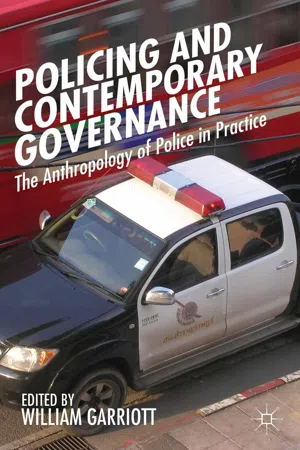
eBook - ePub
Policing and Contemporary Governance
The Anthropology of Police in Practice
- English
- ePUB (mobile friendly)
- Available on iOS & Android
eBook - ePub
About this book
Information
Topic
Scienze socialiSubtopic
PoliticaPart I
Policing the Everyday
1
Invading the Favela: Echoes of Police Practices among Brazil’s Urban Poor
This chapter examines the effect of police practices on the lives of the residents of a poor neighborhood (favela) in Rio de Janeiro, Brazil. Scholars examining police practices in Brazil have generally focused on more extreme forms of policing, particularly on the high rates of civilians killed by the police (Caldeira, Chapter 4). But it is also important to examine more mundane forms of policing and show how policing shapes everyday experiences. As Comaroff and Martin note, when the analytic focus is shifted from the police to policing, it becomes possible to see how policing reverberates through daily lives, diffusing into social and institutional order (Comaroff, Foreword; Martin, Chapter 6).
An ethnographic analysis of interactions between the police and favela residents, and a focus on the pragmatics of policing, allows for a more accurate critical understanding of how police practices impact the lives of the urban poor. Prior studies of policing in Brazil have often seen violence in favelas as either the consequence of the state’s failure to control its own agents, or it is, paradoxically enough as Teresa Caldeira argues, exactly a product of that failure: poor urban residents, in this view, demand harsh policing exactly because the state is seen as unable to otherwise monopolize violence. Another common argument views police violence not as a failure of the state but, instead, as exactly how the state manages the social chasms induced by neoliberalism. In this view, police violence effectively separates the islands of the wealthy from those of the poor, imprisoning the urban poor in virtual carceral spaces (Wacquant 2008).
Paying attention to mundane policing, and remaining aware of how policing “exceeds the work of the police per se” (Comaroff, Foreword), significantly challenges both of these arguments. Police attempts to criminalize favelas are incomplete and unsuccessful: they mostly fail to contain crime within favelas, do not succeed in redefining local practices as crime, and do not naturalize the power of the state. Yet policing has a deep impact upon the everyday lives of residents of the favela, an impact that echoes through the favela’s spaces and social practices even after the police have departed. But while the criminalization of the favela is inherently incomplete, police practices nevertheless contribute to a process I term “policification.”
The echoes of this process of policification have effects far deeper and more complex than simply encouraging the poor to demand violence against themselves or “prisonizing” them in carceral islands of poverty. Instead, the experience of being policed, as Martin (Chapter 6) argues, carries with it an ontological specificity that saturates how favela residents, especially young men, experience themselves and their neighborhood. In particular, it re-shapes everyday social practices and taken-for-granted experiences, producing new forms of social alterity while “abnormalizing” everyday life. Far from normalizing the state’s power, or functioning to uphold social order and naturalize social inequalities, the police actively disorganized daily life.
I first began to think about how policing shapes the everyday lives of Rio’s poor while I was conducting field work in the favela of Caxambu in the northern part of Rio.1 One afternoon I was talking with Zeca and Nêgo, two men who lived in the neighborhood. Nêgo, a dark-skinned man in his early twenties, worked at a tendinha (small store), located just down the street from where I lived.2 As we were talking, we sat on metal folding chairs on the sidewalk opposite Nêgo’s store, in the scant shade provided by a low concrete wall. We knew that the police were in the morro (the hillside, the locally-preferred term for favela) because earlier a group of teenagers, some of whom were drug dealers, had walked past us on their way down the hill. Nêgo asked one of the young men where he was going. “To the beach,” he replied. “After all, os homi tão na área” (the men are in the area). When two police cars drove by, we could see the barrels of their automatic rifles sticking out of the windows of their cars. They drove by slowly, staring at the three of us, and our conversation momentarily ground to a halt as Nêgo and Zeca stared back. After a moment it continued:
Zeca: So he’s asking you what … what is a favela? What does favela mean?
Nêgo: For me a favela is discrimination. When you go down below, if you live up here, you’re already being discriminated. Even more so if you’re dark-skinned and such (sendo da cor escuro e tal), then you’re discriminated even more. You feel … even the police if they come here, if they come here and see us here, they won’t treat us like they treat people below. They’ll treat us differently. Humiliating people for no reason, just because they’re sitting here.
Ben: Is that because people live here, or because of the color of their skin (por causa da cor)?
Nêgo: Of course, because of their color, their color (É claro, por causa da cor, da cor). The two things. We’re discriminated. People like us who live in a poor community, like Caxambu, or other communities, we’re really discriminated against. Not everyone who lives in a morro (the favela) is a traficante (a drug dealer).
Nêgo’s reaction to the police has led me to ask how can examining the ways that favela residents experience policing produce a more nuanced understanding of the structures of power which shape the lives of many poor Brazilians? Sally Engle Merry argues that the “criminalization of everyday life—the redefining of customary practices as crimes—takes shape on a rhetorical terrain” (Merry 1998, 15). But in the case of poor neighborhoods in Brazil—as perhaps in many other settings, as Egon Bittner (2005) classically argued—the primary function of the police is not necessarily criminal law enforcement. Instead, police practices draw upon and re-shape fears, anxieties and understandings of race, gender and other forms of difference.
Rather than describing this process as criminalization, it would be perhaps more accurate (though less elegant) to call it “policification.”3 The question, then, is to examine how the police alter the rhetorical terrain of everyday life, and how this process of policification echoes through the lives of favela residents long after the police have left the neighborhood. How do the police build upon, and alter, experiences of race and social difference? How, in the dusty corner bars and muddy narrow alleys of Rio’s favelas, does policing take place, and how do those who are the target of militarized policing understand this experience?
Everyday Policing and Strategies of Abnormalization
When I first began conducting research on how violence and structures of marginalization shape everyday life in poor neighborhoods in Rio de Janeiro, I had little intention of studying policing. This was not because I was unaware of the deep patterns of police violence in Rio’s poor neighborhoods. I had conducted extensive research on police and death-squad violence in urban Brazil (Penglase 1994). I also knew that antagonism between the police and poor Cariocas (residents of Rio) was equally deeply entrenched, going back at least to the early twentieth century (Bretas 1997; Holloway 1993; Carvalho 1997).
But as several contributors to this volume note, policing often so suffuses everyday experiences that it often structures the conditions of inquiry themselves (Martin, Chapter 6; Jaurgeui, Chapter 5). In my case, my prior experience with both studying the police and having been policed myself as I conducted research in Rio’s favelas led me to make two assumptions about my ethnographic research. First, I assumed that the more extreme forms of police violence have had the largest impact on the daily lives of poor Brazilians. Police homicides had been extensively studied. I also thought that studying such encounters ethnographically would not only be logistically difficult, but personally dangerous.
Second, I knew that policing in poor neighborhoods was sporadic and often conflictual. When police enter poor neighborhoods, this is described by both residents of poor neighborhoods and the police themselves as an invasão (invasion), not as patrulhamento (or patrolling). Poor Brazilians often draw sharp lines between themselves and the police, viewing the police not as a force that guarantees their safety, but as one that treats them in a punitive fashion. I assumed, therefore, that the police were largely absent from poor neighborhoods. Or rather, I assumed that the influence of the police would be restricted to when they were physically present. I also assumed that the sharp lines that residents drew between themselves and the police accurately described a pattern of opposition. As a result, I felt that everyday policing would not only be difficult and dangerous to observe, but also that I had to effectively “pick sides” and study either the police or favela residents, but not interactions between the two.
My assumptions were based upon research that has focused on more extreme forms of police violence. Over the past 20 years, Brazil has seen an extraordinary increase in the levels of urban violence and accompanying levels of police violence. Using homicide rates as an indicator, in 1979, during the military’s rule, the nationwide homicide rate was 11.5 murders per 100,000 inhabitants.4 By 1997, the homicide rate more than doubled, to 25.4 per 100,000 (Huggins 2000, 113). The increase in homicides in Rio was just as dramatic. In 1980, there were a total of 1,807 reported homicides (35.5 per 100,000). The homicide rate in Rio peaked in 1989 with 3,516 homicides (64.9 per 100,000) (Dowdney 2003). Police themselves are implicated in a disproportionately large share of killings. In 2006, according to Anthony Pereira, Rio’s police “killed 1,063 people—more than five times the number of people killed by all the police forces in the United States in the same year” (Pereira 2008, 196).
Research has also shown that policing in favelas follows a more hostile pattern than policing in other neighborhoods. For example, research by Ignácio Cano has shown that in the late 1990s police killings of civilians in Rio’s favelas were six times higher than killings in non-favela areas. Further, police actions were far more lethal: police shootings in favelas were more than two times more likely to be fatal than police shootings in non-favela areas (Cano 1997, 65). This pattern of greater police lethality in favelas does not appear to be unique to Rio. Daniel Brinks found that 65 percent of the victims of police shootings in São Paulo for whom information on residence was available lived in favelas, though only 10 percent of the city’s population lives in such neighborhoods (Brinks 2008, 51). Police violence also disproportionately impacts black and mixed-race Brazilians. An analysis of the 1988 national census by Mitchell and Wood (1999) shows that when age, education, and income are controlled for, Afro-Brazilians are more likely to be victims of assault by the police than white men (see also Cano 2010).
This all-too-often lethal and militarized form of policing—often modeled on counter-insurgency and not crime-prevention—has shaped how some analysts have understood the role of policing in Rio de Janeiro. One perspective has seen police violence as a problem. Relying upon an underlying Weberian approach, some scholars have seen police violence, and the broader breakdown of Brazil’s criminal justice system, as indicative of the state’s failure to effectively monopolize its own use of force (Ahnen 2007; Brinks 2008; Hinton 2006; Pereira 2008; Pinheiro 2000; Macaulay 2007).
A second perspective, diametrically opposed to the first, sees abusive and often illegal policing of poor neighborhoods not as a failure, but as a “solution” to a problem of a highly unequal society. This approach argues that the main purpose of the police is to patrol the divisions that separate the neighborhoods of the wealthy from those of the poor. As the economic and cultural gap between the wealthy and the poor grows, the elite increasingly live in fortified garrisons and gated communities. These “islands” of the elite are closed to the poor, and heavily guarded by privatized security forces (Caldeira 2000; Davis 1992; Lutz and Nonini 1999). Loic Wacquant has argued that neoliberal reforms and the shifting nature of the state have led to a “penal treatment” of the poor (Wacquant 2008, 57). Brazil, he argues, can be seen as a “living laboratory” for the use of “punitive containment as a political strategy for managing dispossessed and dishonored populations in the polarizing city” (Wacquant 2008, 58).
Given such high levels of police violence, and such a clear pattern of a disproportionate use of lethal force against the poor and non-white, the interaction that Nêgo, Zeca, and I had with the police on that hot afternoon seems relatively unremarkable. Why focus on such a mundane experience? As Winifred Tate argues, analysis of more extreme forms of violence—what she calls “counting the dead”—downplays less explicit, yet more pervasive, forms of violence, and risks separating violence from the larger social context (Tate 2007). As a result, everyday interactions between police and residents of Rio have not received much attention (an important exception is Ramos and Musumeci 2004). As Luiz Eduardo Soares has argued:
When life and death are in play, less serious forms of aggression do not seem as dramatic. However, it is dangerous to neglect the small “violences” of every day … because their effects, when they accumulate and are naturalized, end up being as devastating as the most barbarous crimes.
(Soares 2000, 32)
A lack of attention to the small “ ‘violences’ of every day” means that little is known about exactly how the police attempt to criminalize and militarize the space of the favela, and how favela residents experience, and perhaps resist, this process. As a result, the structures of authority that are being established, contested, and rebuilt in Rio’s favelas are often subjected to generalizations, while the larger pattern of mundane authority remains invisible.
Brazil’s military dictatorship, which lasted from 1964 until 1985, had a powerful impact upon Brazil’s police, and upon how Brazilians view the institution. The dictatorship institutionalized a militarized approach to policing, bringing the military police under the control of the army. It also deepened a pattern of impunity for policemen who committed crimes against those seen as a “threat” to society.5 This history contributes to many Brazilians—not just those who are poor or non-white—regarding the police with suspicion and distrust. A victimization survey carried out by the Instituto de Segurança Pública, for instance, revealed that only 6.9 percent of those interviewed fully trusted the military police, while only 9.2 percent fully trusted the civil police (O Globo, August 19, 2008; for the distinction between military and civil police, see Caldeira, Chapter 4).6
The indicators of distrust of the police show that few Brazilians regard the institution as a force that can effectively protect their safety or enforce the law, much less as the embodiment of a shared moral consensus. At the same time, many Brazilians often feel, quite contradictorily, that their neighborhoods need more policing. Indeed, in the public opinion survey cited above, 70.3 percent of those interviewed felt that policing in their neighborhood was inadequate.
High levels of police lethality, and a pervasive contradictory pattern of distrust of the police and demands for greater safety have led, though, to some problematic approaches to understanding policing. First, many observers have neglected routine—if sporadic—patrolling of poor neighborhoods. Second, little sustained attention has been given to how police practices re-shape the rhetorical terrain of everyday life, altering taken-for-granted practices. A more detailed examination of everyday police practices shows that policing is not always a “failure” of the state, nor does it necessarily succeed in “prisonizing” the poor. Instead, the police exercise a powerful impact upon the daily lives of favela residents, even if this impact is partial and contested, and resonates even after the police are no longer present.
Rather than criminalizing the favela and naturalizing structures of power, the police come to be seen by fave...
Table of contents
- Cover
- Title Page
- Copyright
- Contents
- List of Figures
- List of Tables
- Foreword
- Acknowledgments
- Introduction Police in Practice: Policing and the Project of Contemporary Governance
- Part I: Policing the Everyday
- Part II: Police Violence
- Part III: Police Culture
- Afterword
- Notes on Contributors
- Index
Trusted by 375,005 students
Access to over 1.5 million titles for a fair monthly price.
Study more efficiently using our study tools.
Frequently asked questions
Yes, you can cancel anytime from the Subscription tab in your account settings on the Perlego website. Your subscription will stay active until the end of your current billing period. Learn how to cancel your subscription
No, books cannot be downloaded as external files, such as PDFs, for use outside of Perlego. However, you can download books within the Perlego app for offline reading on mobile or tablet. Learn how to download books offline
Perlego offers two plans: Essential and Complete
- Essential is ideal for learners and professionals who enjoy exploring a wide range of subjects. Access the Essential Library with 800,000+ trusted titles and best-sellers across business, personal growth, and the humanities. Includes unlimited reading time and Standard Read Aloud voice.
- Complete: Perfect for advanced learners and researchers needing full, unrestricted access. Unlock 1.5M+ books across hundreds of subjects, including academic and specialized titles. The Complete Plan also includes advanced features like Premium Read Aloud and Research Assistant.
We are an online textbook subscription service, where you can get access to an entire online library for less than the price of a single book per month. With over 1.5 million books across 990+ topics, we’ve got you covered! Learn about our mission
Look out for the read-aloud symbol on your next book to see if you can listen to it. The read-aloud tool reads text aloud for you, highlighting the text as it is being read. You can pause it, speed it up and slow it down. Learn more about Read Aloud
Yes! You can use the Perlego app on both iOS and Android devices to read anytime, anywhere — even offline. Perfect for commutes or when you’re on the go.
Please note we cannot support devices running on iOS 13 and Android 7 or earlier. Learn more about using the app
Please note we cannot support devices running on iOS 13 and Android 7 or earlier. Learn more about using the app
Yes, you can access Policing and Contemporary Governance by William Garriott in PDF and/or ePUB format, as well as other popular books in Scienze sociali & Politica. We have over 1.5 million books available in our catalogue for you to explore.