eBook - ePub
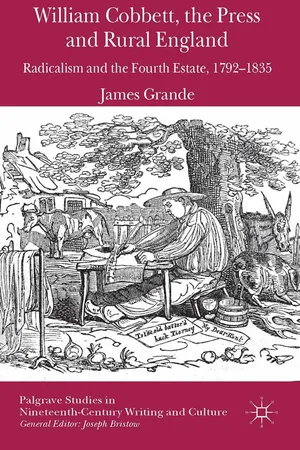
William Cobbett, the Press and Rural England
Radicalism and the Fourth Estate, 1792-1835
- English
- ePUB (mobile friendly)
- Available on iOS & Android
eBook - ePub
William Cobbett, the Press and Rural England
Radicalism and the Fourth Estate, 1792-1835
About this book
William Cobbett, the Press and Rural England offers a thorough re-appraisal of William Cobbett (1763-1835), situating his journalism and rural radicalism in relation to contemporary political debates.
Information
1
From the Soldier’s Friend to Peter Porcupine
Cobbett made his name as a journalist three thousand miles from ‘Old England’, in post-revolutionary Philadelphia. While he would dramatically revise his views after his return to England in 1800, his writing remained indebted to the colloquial, intensely partisan and thoroughly undeferential political culture of 1790s America. Admirers of his later career have often glossed over his formative period as an anti-Jacobin journalist, while accounts of his early writings have failed to tie these years to his later radicalism. One exception is David Wilson’s important study of Cobbett and Paine. As Wilson argues,
Cobbett’s American experience was central to his career as a political writer. Not only did he establish himself as one of the most widely read pamphleteers and journalists in the Anglo-American world, he also acquired his characteristic writing style and his distinct political mentality during these years.1
The present chapter shows how Cobbett’s literary apprenticeship in Philadelphia laid the foundations for his later radicalism. During the 1790s, Cobbett taught himself to navigate and reformulate the competing arguments of the day, an ability that would be vital to his success. Paine’s model is, as Wilson shows, an important part of this process, although writing as a fiercely patriotic Tory in America also involved a strategic appeal to ideas of national character and patriotism, sowing the seeds for Cobbett’s English ruralism.
Before considering Cobbett’s years in Philadelphia, however, the first part of this chapter examines his first, anonymous foray into print, which can now be more confidently attributed and more precisely dated. Cobbett’s first intervention in political debate, at a key moment in the ‘revolution controversy’ of the 1790s, demonstrates the strength of his initial commitment to Painite radicalism, before his emigration to America and reincarnation as Peter Porcupine. Evidence from newspapers and government archives shows the alarm that this pamphlet caused both his publisher and the British authorities.
The Soldier’s Friend and the Revolution debate
Following a seven-year tour of duty with the 54th (West Norfolk) Regiment of Foot, Cobbett returned to Portsmouth in November 1791 and received an honourable discharge from the army on 19 December. During his military career in the Maritimes, he had completed a remarkable course of self-education, grounded in Lowth’s Grammar, been promoted to the rank of sergeant major and discovered that officers in the regiment were embezzling money from the soldiers’ pay. Having collected evidence in New Brunswick and waited until he was safely beyond the reach of military discipline, he was now determined to bring these officers to justice. He began proceedings for a court martial and ‘went strait to London’ to petition the Secretary at War, Sir George Yonge.2
Cobbett’s return to Britain coincided with a key moment in the pamphlet war generated by the end of the ancien régime: for an aspiring political writer, the timing could hardly have been more auspicious. Burke’s counter-revolutionary polemic, Reflections on the Revolution in France, had appeared in November 1790, presented as a letter of advice to a young Frenchman but aimed at English Dissenters such as Richard Price, whose sermon on the anniversary of the Glorious Revolution had been published as A Discourse on the Love of our Country (1789). Burke’s florid and emotional reading of events was refuted by Paine in Rights of Man, published in March 1791. At this stage, Paine still hoped that Louis XVI would fulfil his destiny as the father of the Revolution. However, by the end of the year, Paine had travelled to Paris, become heavily involved in republican politics in the aftermath of the flight to Varennes and was now back in London and working on a sequel. In Rights of Man, Part Two, published on 16 February 1792, Paine argued for radical reform in Britain, including representative democracy on the American model and a national welfare system funded by progressive taxation. In the months after its publication, Rights of Man was read aloud in taverns and coffee houses and disseminated by reform societies, including the Society for Constitutional Information, the Norwich Revolution Society and new, more plebeian, organizations such as the Sheffield Society for Constitutional Information and London Corresponding Society.
After his years on the colonial frontier, where he had ‘never … read even a newspaper’, Cobbett was now at the centre of political debate.3 His early exposure to books had been limited. Reading Swift’s A Tale of a Tub (1704), purchased at the age of eleven with his last three pence, had been a seminal experience in his early life: ‘it produced what I have always considered a sort of birth of intellect’. He carried the book around with him until, in a brilliant materialization of the title of Swift’s satire, he lost it overboard in the Bay of Fundy (‘the loss gave me greater pain than I have ever felt at losing thousands of pounds’).4 As a new recruit at Chatham, he had been a member of a circulating library, read most of the books ‘more than once over’ and ‘learnt more than I had ever done before’: ‘novels, plays, history, poetry, all were read, and nearly with equal avidity’.5 Now, ‘full of indignation at the abuses which I myself had witnessed’, Cobbett ‘took up the book of Paine (just then published)’ and immersed himself in the controversy.6 But this period was to be short lived: less than five months after his return to Britain, he was convinced that he would not receive a fair hearing for his allegations and would himself be tried, on trumped-up charges of sedition. According to his later account, he discovered that men from his regiment had agreed to swear they had heard him toast ‘the destruction of the House of Brunswick’.7 At the end of March, Cobbett fled to France with his new wife, Anne Reid, the daughter of an artillery sergeant, whom he had met in St John, New Brunswick, five years earlier and married in Woolwich on 5 February.
Shortly after his departure, a sixpenny pamphlet appeared, entitled, The Soldier’s Friend; or, Considerations on the Late Pretended Augmentation of the Subsistence of the Private Soldiers. While the title offered a synopsis of its argument, the motto from Goldsmith’s The Traveller, or A Prospect of Society (1764) gave a clear indication of its radical tone: ‘Laws grind the poor, and rich men rule the law.’8 The specific occasion for the pamphlet was a House of Commons debate on the Army Estimates, which had taken place on 15 February. In this debate, Sir George Yonge, Secretary at War – who Cobbett had recently petitioned for justice in his own regiment – asked Parliament for extra funds to restore the pay of the private soldier to three shillings a week. Yonge’s evasive admission that ‘it had so happened of late years, that the Solider had had only eighteen pence or two shillings a week for his subsistence’ (p. 6) provoked the ‘Soldier’s Friend’ to exclaim:
It has “so happened!” and for years too! astonishing! It has “so happened” that an act of Parliament has been most notoriously and shamefully disobeyed for years, to the extreme misery of thousands of deluded wretches (our countrymen), and to the great detriment of the nation at large; it has “so happened,” that not one of the offenders have been brought to justice for this disobedience, even now it is fully discovered; and it has “so happened,” that the hand of power has made another dive into the national purse, in order—not to add to what the Soldier ought to have received; not to satisfy his hunger and thirst; but to gratify the whim or the avarice of his capricious and plundering superiors. (pp. 6, 8–9)
The minister’s speech had been ‘an impudent absurdity’ (p. 7), and confirmed that nothing said ‘in that wise and equal representation of the People, called the House of Commons’ deserved ‘a thought from a man of sense’ (pp. 5–6). In his peroration, the author tells the soldier that, ‘you are not the servant of one man only; a British Soldier never can be that. You are a servant of the whole nation, of your countrymen, who pay you, and from whom you can have no separate interests’ (p. 21).
The practice that Cobbett was trying to expose in his own regiment, of officers making fraudulent deductions from the soldiers’ pay, had been revealed as widespread and the pamphlet would eventually be attributed to him. The only name on the title-page was that of the bookseller ‘J[ames] Ridgway, York Street, St. James’s Square’, however, and Cobbett denied writing the pamphlet until very late in his career. While most biographers and critics have accepted the work as his, others have been more cautious about accepting this eventual acknowledgement. The standard bibliography describes it as ‘authorship dubious, probably written with Cobbett’s assistance’, and Michael Durey has argued that Cobbett ‘was only marginally involved in the publication’.9 Instead, Durey suggests that his evidence of corruption was exploited by more experienced and committed reformers, who reworked an early draft into a more ‘polished’ production.10 Durey also suggests that a more complex, and less heroic, story lay behind Cobbett’s escape to France, involving his betrayal by a corrupt officer and fellow reformer.
Durey is right to urge caution in accepting Cobbett’s later accounts, which are (at the very least) self-serving, contradictory and hard to corroborate. However, a review of the evidence strengthens the case for Cobbett’s authorship and points to the influence it may have had on his decision to flee the country. First of all, The Soldier’s Friend contains strong internal evidence for Cobbett’s authorship. The direct dialogue with Parliament, based on personal experience of corruption, and the distinctive rhythms, italicization, use of invective and insistent rhetorical questions, all anticipate his later journalism. For example, the pamphlet asks if the Secretary at War deems ‘the sublime mysteries of the Army a subject of too high and too delicate a nature to be discussed by the Assembly to which he was speaking’: the kind of satirical response to the circumlocutory language of Parliament that would come to characterize the Political Register (pp. 9–10). The description of a standing army as ‘the great instrument of oppression’, far from being part of a classical republican tradition which ‘Cobbett would never have accepted’, shows the influence of Country Party writers including Swift, who had denounced standing armies in A Tale of a Tub, The Conduct of the Allies and Gulliver’s Travels (p. 18).11 Finally, the closing address to the common soldier is in a manner and tone that would come to define Cobbett’s writing:
It particularly becomes you, the British Soldier, to look upon this matter in its proper light. The pretended addition to your subsistence is, in fact, no addition at all; you will now receive no more than you always ought to have received … the ruling Powers look upon your Officers as Gentlemen, and upon you as Beasts. (pp. 19–21)
In The Soldier’s Friend, Cobbett brings together his experience of corruption in the army, his reading of Swift and the Country Party tradition, the Commons debate on the Army Estimates and his reading of Rights of Man, Part Two, which was published a day after the debate. As Olivia Smith has argued, this first publication shows him to be an adept student of Paine’s ‘intellectual vernacular prose’: his ‘prose is easy to read, attentive to its readers, and paced with the energy and rhythm of spoken language. No other radical writings are as close to Paine’s either in style or in firmness of attack.’12 The transfer of influence seems to have been virtually seamless and The Soldier’s Friend is also indebted to Paine on the level of argument. One possible source for the title is in Paine’s account of the fate of soldiers under monarchical government, which appears in the final pages of Rights of Man, Part Two:
As soldiers have hitherto been treated in most countries, they might be said to be without a friend. Shunned by the citizens on an apprehension of being enemies to liberty, and too often insulted by those who commanded them, their condition was a double oppression. But where general principles of liberty pervade a people every thing is restored to order; and the soldier civily treated, returns the civility.13
Paine advocated a smaller army, with better pay and pensions. The Soldier’s Friend was so close to Paine in style and argument that a government-sponsored biography of Paine, designed to discredit him, suggested that the pamphlet might be his work.14
Support for the common soldier, founded on his own experiences in the army, would be a ...
Table of contents
- Cover
- Title
- Copyright
- Dedication
- Contents
- List of Figures
- Acknowledgements
- List of Abbreviations
- Introduction: Digging up the 1790s
- 1 From the Soldier’s Friend to Peter Porcupine
- 2 William Windham and the Hampshire Hog
- 3 Prison, Paper Money and Cobbett’s ‘Two-Penny Trash’
- 4 Long Island Pastoral
- 5 Cobbett and Queen Caroline
- 6 Rural Rides and the 1820s
- 7 ‘Rural War’ and the July Revolution
- Postscript: Cobbett’s Legacies
- Notes
- Bibliography
- Index
Trusted by 375,005 students
Access to over 1.5 million titles for a fair monthly price.
Study more efficiently using our study tools.
Frequently asked questions
Yes, you can cancel anytime from the Subscription tab in your account settings on the Perlego website. Your subscription will stay active until the end of your current billing period. Learn how to cancel your subscription
No, books cannot be downloaded as external files, such as PDFs, for use outside of Perlego. However, you can download books within the Perlego app for offline reading on mobile or tablet. Learn how to download books offline
Perlego offers two plans: Essential and Complete
- Essential is ideal for learners and professionals who enjoy exploring a wide range of subjects. Access the Essential Library with 800,000+ trusted titles and best-sellers across business, personal growth, and the humanities. Includes unlimited reading time and Standard Read Aloud voice.
- Complete: Perfect for advanced learners and researchers needing full, unrestricted access. Unlock 1.5M+ books across hundreds of subjects, including academic and specialized titles. The Complete Plan also includes advanced features like Premium Read Aloud and Research Assistant.
We are an online textbook subscription service, where you can get access to an entire online library for less than the price of a single book per month. With over 1.5 million books across 990+ topics, we’ve got you covered! Learn about our mission
Look out for the read-aloud symbol on your next book to see if you can listen to it. The read-aloud tool reads text aloud for you, highlighting the text as it is being read. You can pause it, speed it up and slow it down. Learn more about Read Aloud
Yes! You can use the Perlego app on both iOS and Android devices to read anytime, anywhere — even offline. Perfect for commutes or when you’re on the go.
Please note we cannot support devices running on iOS 13 and Android 7 or earlier. Learn more about using the app
Please note we cannot support devices running on iOS 13 and Android 7 or earlier. Learn more about using the app
Yes, you can access William Cobbett, the Press and Rural England by James Grande in PDF and/or ePUB format, as well as other popular books in Literature & Literature General. We have over 1.5 million books available in our catalogue for you to explore.