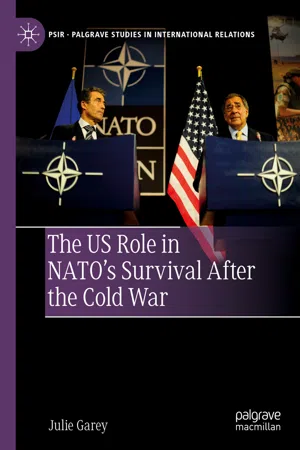
This book takes a new approach to answering the question of how NATO survived after the Cold War by examining its complex relationship with the United States. A closer look at major NATO engagements in the post-Cold War era, including in the Balkans, Afghanistan, Iraq, and Libya, reveals how the US helped comprehensively reshape the alliance. In every conflict, there was tension between the United States and its allies over mission leadership, political support, legal precedents, military capabilities, and financial contributions. The author explores why allied actions resulted in both praise and criticism of NATO's contributions from American policymakers, and why despite all of this and the growing concern over the alliance's perceived shortcomings the United States continued to support the alliance. In addition to demonstrating the American influence on the alliance, this works demonstrates why NATO's survival is beneficial to US interests.
- English
- ePUB (mobile friendly)
- Available on iOS & Android
eBook - ePub
The US Role in NATO’s Survival After the Cold War
About this book
Information
© The Author(s) 2020
Julie GareyThe US Role in NATO’s Survival After the Cold WarPalgrave Studies in International Relationshttps://doi.org/10.1007/978-3-030-13675-8_11. Introduction
Julie Garey1
(1)
Department of Political Science, Northeastern University, Boston, MA, USA
The persistence of the North Atlantic Treaty Organization (NATO) challenges the existing frameworks for understanding the formation, evolution, cohesion, and dissolution of military alliances. Much is understood about the conditions under which states ally, and better explanations for alliance cohesion have emerged in recent decades. To date, however, explanations for the persistence of military alliances in peacetime are incomplete. International relations theory has long asserted the improbable possibility of these arrangements lasting outside of war. Only recently have scholars and policymakers developed better explanations for the reasons and conditions under which alliances persist. Still, the significance of peacetime alliances is not fully understood.
The post-Cold War period is one of the first to have a military alliance persist in the absence of an imminent threat. In many ways, NATO is inconsistent with the frameworks for understanding military alliances. It is one of the longest-standing alliances of the contemporary period, with a “high degree of institutionalization unprecedented in military pacts” (Rafferty 2003). Authorized under Article 51 of the United Nations Charter and established by the 1949 North Atlantic Treaty, the alliance embodies the fundamental principles of collective defense: NATO membership requires a commitment to support and defend other member states in the event of an attack. At best, previous explanations of NATO persistence are disconnected pieces to the larger puzzle: none of the existing theories of alliances are wholly satisfactory in explaining the alliance’s continuation. Thus, the case of NATO in the post-war period merits further investigation. This book answers the question: why has the NATO alliance persisted in the post-Cold War period, and why does it matter?
NATO Persistence: The Sum of Unequal Parts
In the months leading up to his election on November 8, 2016, Donald Trump’s campaign zeroed in on NATO as one of the United States’ most detrimental relationships. In March 2016, candidate Trump gave an interview to The Washington Post editorial board in which he stated “NATO was set up at a different time. NATO was set up when we were a richer country…I think the distribution of costs has to be changed. I think NATO as a concept is good, but it is not as good as it was when it first evolved.” He expanded on this point hours later in an interview with CNN anchor Wolf Blitzer, arguing “it’s costing us too much money. And frankly they have to put up more money. They’re going to have to put some up also. We’re playing disproportionately. It’s too much” (Freisleben 2017).
The theme of the Americans bearing the burden of NATO while the remaining allies sat idly by continued in the following months. Efforts to make the alliance more capable, such as increasing its counterterrorism initiatives in the wake of attacks in Paris, Brussels, and elsewhere were met with praise (for both the alliance and for his self-acclaimed ability to singlehandedly force change within the alliance) from candidate Trump . Still, the “America contributes too much and the Europeans too little” rhetoric continued, relenting only after the election. In April 2017, when President Trump met with NATO Secretary General Jens Stoltenberg, Trump said “(t)he Secretary General and I had a productive conversation about what more NATO can do in the fight against terrorism. I complained about that a long time ago, and they made a change. Now they do fight terrorism. I said it was obsolete. It’s no longer obsolete” (Johnson 2017).
The perspectives of the European allies could not have been in starker contrast to those of President Trump . Though his remarks were successful in reigniting debate over member states’ inability or unwillingness to meet the two percent defense spending threshold,1 Trump’s comments also increased worry over the United States’ commitment to Article 5, the Washington Treaty’s collective defense clause. Secretary General Stoltenberg reminded American policymakers of NATO’s value while reasserting the need for commitment, stating “Solidarity among allies is a key value for NATO. This is good for European security and good for U.S. security. We defend one another. We have seen this in Afghanistan, where tens of thousands of European, Canadian and partner-nation troops have stood shoulder to shoulder with U.S. soldiers.” British Defense Secretary Michael Fallon said “Article 5 is an absolute commitment. It doesn’t come with conditions or caveats” (Chan 2016). Following a week of meetings, including the NATO Brussels Summit and a meeting of the G-7, German Chancellor Angela Merkel told the German public “The times in which we could rely fully on others – they are somewhat over…this is what I experienced in the last few days.” She went on: “We have to know that we must fight for our future on our own, for our destiny as Europeans… I can only say that we Europeans must really take our fate into our own hands – of course in friendship with the United States of America, in friendship with Great Britain and as good neighbors wherever that is possible also with other countries, even with Russia” (Smale and Erlanger 2017).
Trump’s perspective of the alliance was delivered to the allies and the public unconventionally, but the sentiments expressed by both the Americans and the Europeans were nothing new. The evolution of NATO has been hotly contested since the end of the Cold War. In the decades since, NATO expanded its membership from 16 to 29 members, and several other states—including former Soviet satellite states—continue striving to meet the recommendations of NATO’s Membership Action Plan (MAP) in the hopes of someday obtaining NATO membership. Many of the allies, however, regularly failed to meet the alliance’s collective defense spending requests, and NATO suffered from the continuing decline in contributions. Several of the allies ended military conscription and deactivated thousands of troops, shrinking the size of their deployable forces. In addition to not meeting the two percent threshold, the European allies collectively provided only one-quarter of NATO’s defense expenditures, with the remaining resources provided by the United States (Stoltenberg 2014; Londoño 2014; The Economist 2017).
In addition to the gap between US and European defense spending and contributions to the alliance, many of the allies adopted divergent perspectives regarding European security and the role of NATO in future conflicts. Immediately following the collapse of the Soviet Union, some allies pushed for the establishment of a European-only collective defense mechanism similar to NATO, but interventions in Bosnia and Kosovo demonstrated Europe was unprepared to move forward without the United States. France, Germany, and others continued to advocate for the development of non-US-led defensive measures while stressing the importance of diplomacy and the United Nations. Some allies were reluctant or unwilling to engage in the United States and NATO’s interventions without explicit authorization from the UN Security Council.
Nonmember states regularly raised concerns regarding NATO’s persistence as well, despite the alliance’s efforts to expand its partnerships. Russia insisted that NATO persistence was a direct threat to the possibility of long-standing peace between East and West and feared the alliance would attempt to intervene in its own disputed territories. Although Russia partnered with the alliance to address many issues pertaining to international security, Russian President Vladimir Putin’s annexation of Crimea and escalating hostility in Ukraine seemingly negated these concerns while also reigniting allies’ fears of Russian aggression and the threat to European stability (Flenley 2009; Goldgeier 2009; Nau 2009; Pourchot 2009; Braun 2008; Vershbow 2015). Additionally, Russia regularly attempts to prevent NATO from using force by threatening to veto UN Security Council resolutions authorizing international intervention. Russia advocated against NATO intervention in the Balkans (both in Bosnia and later Kosovo) and in Libya, as well US intervention in Iraq. Syrian President Bashar al Assad, regularly relied on Syria’s relationship with Russia to prevent the United Nations, NATO, or individual states from intervening to stop ongoing humanitarian abuses stemming from both the occupation of the Islamic State of Iraq and Syria (ISIS) and its civil war.
Despite continuing disagreements between member states, changes to the geopolitical and strategic environment, opposition from allies and adversaries to the actions of the alliance, the United States and the European allies have remained committed to NATO. Thus, the question of NATO’s persistence becomes pivotal. To answer this question, I examine another important piece of the NATO puzzle: the role of the United States and its relationship to the alliance.
An Argument in Support of US-Centric Analyses
Whereas NATO scholars are inclined to attribute the alliance’s persistence to institutional factors or a changing international order, scholars of the US-NATO relationship largely frame NATO’s survival and evolution as an unintended consequence of American actions, at best. However, in very few of these works is NATO’s persistence treated as an intentional or predictable consequence of the post-war era, nor is it acknowledged as favorable for US power projection, the transatlantic relationship, or international peace and stability. Unlike the existing scholarship on NATO persistence, I posit that the relationship between the United States and NATO is the key explanatory variable to understanding the alliance’s persistence after the Cold War.
In many ways, the United States has struggled in its relationship with NATO and the rest of the international community. In the immediate aftermath of the Cold War, the United States’ political, economic, and military power was unrivaled. This, coupled with the web of internati...
Table of contents
- Cover
- Front Matter
- 1. Introduction
- 2. Alliances, NATO, and the Post-Cold War Era
- 3. The 1999 Kosovo Intervention
- 4. September 11, 2001, and the War in Afghanistan
- 5. The 2003 Iraq War
- 6. The 2011 Libyan Intervention
- 7. The Evolution and Persistence of NATO
- 8. The United States and Multilateralism
- Back Matter
Trusted by 375,005 students
Access to over 1.5 million titles for a fair monthly price.
Study more efficiently using our study tools.
Frequently asked questions
Yes, you can cancel anytime from the Subscription tab in your account settings on the Perlego website. Your subscription will stay active until the end of your current billing period. Learn how to cancel your subscription
No, books cannot be downloaded as external files, such as PDFs, for use outside of Perlego. However, you can download books within the Perlego app for offline reading on mobile or tablet. Learn how to download books offline
Perlego offers two plans: Essential and Complete
- Essential is ideal for learners and professionals who enjoy exploring a wide range of subjects. Access the Essential Library with 800,000+ trusted titles and best-sellers across business, personal growth, and the humanities. Includes unlimited reading time and Standard Read Aloud voice.
- Complete: Perfect for advanced learners and researchers needing full, unrestricted access. Unlock 1.5M+ books across hundreds of subjects, including academic and specialized titles. The Complete Plan also includes advanced features like Premium Read Aloud and Research Assistant.
We are an online textbook subscription service, where you can get access to an entire online library for less than the price of a single book per month. With over 1.5 million books across 990+ topics, we’ve got you covered! Learn about our mission
Look out for the read-aloud symbol on your next book to see if you can listen to it. The read-aloud tool reads text aloud for you, highlighting the text as it is being read. You can pause it, speed it up and slow it down. Learn more about Read Aloud
Yes! You can use the Perlego app on both iOS and Android devices to read anytime, anywhere — even offline. Perfect for commutes or when you’re on the go.
Please note we cannot support devices running on iOS 13 and Android 7 or earlier. Learn more about using the app
Please note we cannot support devices running on iOS 13 and Android 7 or earlier. Learn more about using the app
Yes, you can access The US Role in NATO’s Survival After the Cold War by Julie Garey in PDF and/or ePUB format, as well as other popular books in Politics & International Relations & American Government. We have over 1.5 million books available in our catalogue for you to explore.