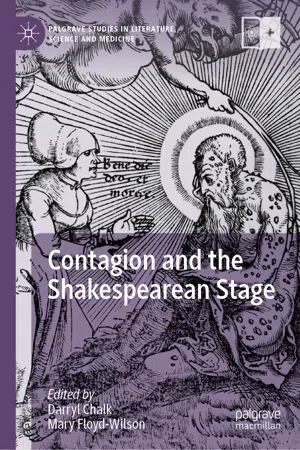
This collection of essays considers what constituted contagion in the minds of early moderns in the absence of modern germ theory. In a wide range of essays focused on early modern drama and the culture of theater, contributors explore how ideas of contagion not only inform representations of the senses (such as smell and touch) and emotions (such as disgust, pity, and shame) but also shape how people understood belief, narrative, and political agency. Epidemic thinking was not limited to medical inquiry or the narrow study of a particular disease. Shakespeare, Thomas Middleton, Ben Jonson, Thomas Dekker and other early modern writers understood that someone might be infected or transformed by the presence of others, through various kinds of exchange, or if exposed to certain ideas, practices, or environmental conditions. The discourse and concept of contagion provides a lens for understanding early modern theatrical performance, dramatic plots, and theater-going itself.
eBook - ePub
Contagion and the Shakespearean Stage
- English
- ePUB (mobile friendly)
- Available on iOS & Android
eBook - ePub
Contagion and the Shakespearean Stage
About this book
Information
© The Author(s) 2019
D. Chalk, M. Floyd-Wilson (eds.)Contagion and the Shakespearean StagePalgrave Studies in Literature, Science and Medicinehttps://doi.org/10.1007/978-3-030-14428-9_11. Introduction: Beyond the Plague
Darryl Chalk1 and Mary Floyd-Wilson2
(1)
University of Southern Queensland, Toowoomba, QLD, Australia
(2)
University of North Carolina at Chapel Hill, Chapel Hill, NC, USA
In the absence of germ theory, what constituted contagion in the minds of the early moderns? This was undoubtedly a period of frequent epidemics of a variety of illnesses and when medicine was still dominated by the classical medicine of Galen and Hippocrates, which posited disease as a largely internal problem caused by humoral imbalance. Lethal afflictions like the bubonic plague and syphilis were clearly able to spread and infect new bodies despite the real micro-organic culprits remaining invisible to observers of such endemic illnesses. It might be easy, therefore, to presuppose that there was simply no understanding of contagion in this period. As this volume seeks to demonstrate, however, early modern writers devoted constant attention to the possibility of contagious transmission, the notion that someone might be infected or transformed by the presence of others, through various kinds of exchange, or if exposed to certain ideas, practices, or environmental conditions, and they often did so in ways not limited to medical inquiry or the narrow study of a particular disease.
One of the most prominent and familiar examples of this can be seen in antitheatrical writing during this period, which repeatedly identifies the theater and its constituent attributes as kinds of contagion. From Stephen Gosson’s The School of Abuse (1579) to William Prynne’s Histrio-mastix (1633), contagion remains the consistent definitive image of antitheatrical invective.1 William Rankins, in A Mirrour of Monsters (1587), regards the players’ art as a “poison [that] spreddeth itself into the vaines of their beholders.” He compares the stage to the deadly entrance to Hades, the lake “Avernus, which striketh dead those which come within the sente of the same … such is the infectious poison of these men, and such danger is [it] to be neare the view of their vitious exercise.”2 The metaphorical resonance is clear: Theater is likened to the long-standing theory of plague as a miasma, a vaporous, invisible poison that hangs in the air and attacks the bodies of its victims via the senses. The smells, sights, and sounds of the playhouse were all considered part of this sensory assault on the spectators by theater’s contagious effects. The players are contaminated through the apparent dangers of acting, the audience by their proximity, being “neare the view,” to such contagious spectacle. In A Second and Third Blast of Retrait from Plaies and Theaters (1580), Anthony Munday suggests that this dual capacity for infection is peculiar to the theater, averring: “Al other euils pollute the doers onlie, not the beholders, or the hearers … Onlie the filthiness of plaies, and spectacles is such, as maketh both the actors and beholders giltie alike.” They might be silent witnesses to this act, but “they by sight and assent be actors.”3
The theater’s most dangerous quality, then, is that its histrionic “evils” might be spread by the playgoers themselves, as they become unwitting vectors of the contagion through imitation. Prynne, who suggests that “Playhaunters are contagious in quality, more apt to poison, to infect all those who dare approach them, than one who is full of plague sores,” characterizes theater as an entity first able to enter the body of the spectator by way of their eyes and ears.4 After arguing that playhouses were “the very worst evill,” since spectators leave them senseless of the fact that they are now “diseased,” Prynne suggests that from theater “both by the eyes, and by the eare, a disease may proceed to the very soule itself: they imitate the calamities and mischances of others from whence the contagion of filthinesse gets into ourselves.”5 To Prynne, the affective plague of theater generates “contagious persons”6 who then threaten to become a full-blown epidemic of theatricality since they now “swarme thicke of late on the streets of our metropolis.”7
Plague and associated ideas of contagion thus become repetitive weapons in the arsenal of tropes used to demonize the theater. To the antitheatricalists, however, this is not necessarily mere metaphor. It is often expressed in quite tangibly material ways. John Rainolds, in Th’overthrow of Stage -Playes (1599), largely follows the metaphorical logic of his peers in denouncing, “how the maners of all spectators commonlie are hazarded by the contagion of theatricall sights.”8 But he also constructs acting as a practice capable of manifesting real diseases in the bodies of the players:
Seeing that diseases of the mind are gotten far sooner by counterfaiting, then are diseases of the body: … diseases of the body may [also] be gotten so, as appeareth by him, who, faining for a purpose that he was sick of the gowte, became (through care of couterfeiting it) gowtie in deede. So much can imitation … doe .9
According to Rainolds, imitation is so transformative that pretending to have a disease leads to contracting a real one. This adds a more literal capacity to his idea that acting is “a venom and poison [which could] spred it selfe abroad through more parts of your body” than any other affliction, making it likely that “you would instill the same humour … into the rest of your players” and beyond to the audience.10 Playing is thereby not only like a contagious disease, it is itself habitually rendered in antitheatrical discourse as a genuine somatic infection that can be spread and reproduced in others. As the essays in this collection will show, this slippage from the metaphorical to the material, and from the figurative to the literal, is a common feature of writings about contagious phenomena.
If the playhouse is a site of contention with regard to theories about contagious affect in the period, it is also a location for representing and playing out various kinds of contagious operations. Contagion and the Shakespearean Stage, then, is a collection of twelve scholarly essays that focus on the variety of things or conditions, material and immaterial, thought able to pass between individuals, or to cause action at a distance, that fall under the wide-ranging banner of contagion in early modern English culture, with particular attention to the frequent representation of such phenomena in the period’s popular drama. In addition to its engagement with the history of disease transmission, this collection considers how the language of contagion shapes dramatic narratives, contemporary understandings of theater-going, the history of emotion, and the perception of natural and preternatural phenomena. Much has been said in recent criticism about the plague in relation to literature and the early modern theatrical enterprise. In particular, the works of Rebecca Totaro in Suffering in Paradise, and Ernest B. Gilman in Plague Writing in Early Modern England, along with their collection of essays, Representing the Plague in Early Modern England, have firmly established that plague is the near-ubiquitous concern as both material phenomenon and metaphorical force in the period’s thought and discourse.11 This volume seeks to move the discussion well beyond the plague and into a much more comprehensive consideration of the extensive array of pathological states understood to be communicable in early modern culture.
This broader conception can be seen in the work of the respected Dutch physician Levinus Lemnius, who offers an understanding of contagion in early modern terms through an account of pathogenic transmission long before the advent of microbiology. In the preface to his 1559 treatise Occulta Naturae Miracula (translated into English as The Secret Miracles of Nature in 1658), Lemnius makes discerning the mysterious workings of contagious phenomena the key concern of the book. He outlines that “there are many hidden and secret things in nature, of an hidden and unknown effect” that are “destitute of reason” because they do not “present a manifest demonstration to the sense and understanding.”12 These “hidden qualities” might provide an “abundance of difficulty” to fathom but, he suggests, “a probable reason may be devised, and the cause of the effect shewed very likely, if not apparently, and clearly.” In the list of illustrative examples that follows, he includes the way bleared or bloodshot eyes “doth happen to corrupt the eyes of others,” how wolves cause “hoarsenesse” if they but “come near a man” with their “venemous breath” and that women “having their Monthly terms flowing from them” will make mirrors dusky, kill garden herbs, blunt the edges of swords, and “not onely deform everyone that she meets, but her own self with spots and blemishes.”13 These occurrences he compares to “how far a contagious disease may extend itself, especially in the winter season … because of the thicknesse and grossnesse of the Ayre” and through the “stinking damp and strong smelling breath” of the infected “that unlesse you stand farther off they would strike every one they meet, with the contagion of their breath and kill them.” But this airborne contagion has a specific transmissive passageway since “men do breath forth the greatest infection to men, where they stand just opposite” and thus care can be taken to ensure that its path is thwarted, “which very thing I more diligently observe, when I go to assist those that are sick of a contagious disease, so that when I talk with them I am always turned away.” What is striking about Lemnius’s account is that the condition in question is not the plague per se but “contagious disease[s]” in general.14 That diseases and other phenomena are contagious is not in dispute here—the focus is on how the seemingly hidden force of contagion can be comprehended and, perhaps, apprehended and prevented. In doing so, he combines a scientific approach with magical thinking and this mix sits alongside his empirical observations as a practicing physician.
This explanation of contagion’s secretive operation as consisting of both knowable material conditions and unseen but understandable occult properties is suggestive of a much more flexible and multi-faceted approach to defining contagion than has been seen in post-microbiological science. Pre-modern thinking about the causes of sickness and the spread of a variety of conditions is as much a continuation of classical models even as early modern writers responded to emerging etiological theories. The invisible, or perhaps sub-visible, mode of contagious diseases tested the limits of the classical but still authoritative medical knowledge, represented particularly by Galen and Hippocrates, whose theories were considered largely compatible with the natural philosophy of Aristotle. Mary Thomas Crane has recently suggested that the observably contagious spread of disease epidemics shook the very foundations of the once seemingly immutable scientific or medical models. She states:
We can see some signs of threat to the G...
Table of contents
- Cover
- Front Matter
- 1. Introduction: Beyond the Plague
- Part I. Contagious Sensations
- Part II. Spreading Abjection
- Part III. Viral Ideas
- Back Matter
Trusted by 375,005 students
Access to over 1.5 million titles for a fair monthly price.
Study more efficiently using our study tools.
Frequently asked questions
Yes, you can cancel anytime from the Subscription tab in your account settings on the Perlego website. Your subscription will stay active until the end of your current billing period. Learn how to cancel your subscription
No, books cannot be downloaded as external files, such as PDFs, for use outside of Perlego. However, you can download books within the Perlego app for offline reading on mobile or tablet. Learn how to download books offline
Perlego offers two plans: Essential and Complete
- Essential is ideal for learners and professionals who enjoy exploring a wide range of subjects. Access the Essential Library with 800,000+ trusted titles and best-sellers across business, personal growth, and the humanities. Includes unlimited reading time and Standard Read Aloud voice.
- Complete: Perfect for advanced learners and researchers needing full, unrestricted access. Unlock 1.5M+ books across hundreds of subjects, including academic and specialized titles. The Complete Plan also includes advanced features like Premium Read Aloud and Research Assistant.
We are an online textbook subscription service, where you can get access to an entire online library for less than the price of a single book per month. With over 1.5 million books across 990+ topics, we’ve got you covered! Learn about our mission
Look out for the read-aloud symbol on your next book to see if you can listen to it. The read-aloud tool reads text aloud for you, highlighting the text as it is being read. You can pause it, speed it up and slow it down. Learn more about Read Aloud
Yes! You can use the Perlego app on both iOS and Android devices to read anytime, anywhere — even offline. Perfect for commutes or when you’re on the go.
Please note we cannot support devices running on iOS 13 and Android 7 or earlier. Learn more about using the app
Please note we cannot support devices running on iOS 13 and Android 7 or earlier. Learn more about using the app
Yes, you can access Contagion and the Shakespearean Stage by Darryl Chalk, Mary Floyd-Wilson, Darryl Chalk,Mary Floyd-Wilson in PDF and/or ePUB format, as well as other popular books in Literature & European Literary Criticism. We have over 1.5 million books available in our catalogue for you to explore.