eBook - ePub
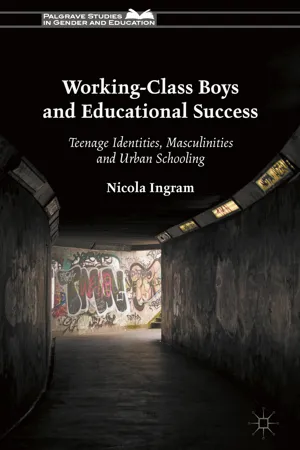
Working-Class Boys and Educational Success
Teenage Identities, Masculinities and Urban Schooling
- English
- ePUB (mobile friendly)
- Available on iOS & Android
eBook - ePub
Working-Class Boys and Educational Success
Teenage Identities, Masculinities and Urban Schooling
About this book
This book examines the complex relationship between working-class masculinities and educational success. Drawing on a small sample of young men attending either a selective grammar or a secondary school in the same urban area of Belfast, the author demonstrates that contrary to popular belief, some working-class boys are engaged with education, are motivated to succeed and have high aspirations. However, the structures of schooling in a society where working class-ness is seen as feckless, tasteless and cultureless make the processes of becoming successful more challenging than they need to be. This volume reveals the unique processes of reconciling success and identities for individual working-class boys, and the important role schools have to play in this negotiation. Highly relevant to those engaged in teacher training in socially unequal societies, this book will also appeal to practitioners, sociologists of education, scholars of social justice and Bourdieusian theorists.
Information
© The Author(s) 2018
Nicola IngramWorking-Class Boys and Educational SuccessPalgrave Studies in Gender and Educationhttps://doi.org/10.1057/978-1-137-40159-5_11. The Class Feeling
Nicola Ingram1
(1)
Department of Educational Research, Lancaster University, Lancaster, UK
Introduction
I’m so sorry, that I’m not what you want me to be.With summer hair and jeans like Autumn leaves,I bet you’d never even dream like me.Without a care, and dreams that seem to please,I bet you’ve never even lived like me.
I’m not sorry for what I am,And I have no regrets on what I used to be tonight.I’m not sorry and I have no regrets at all (Mick, aged 16)
I begin this book with song lyrics written by a 16-year-old working-class boy from Belfast. He gave them to me the day after I interviewed him about how he sees himself within school and beyond the school gate, during which he spoke at length about the complexities involved in reconciling his background with educational success. The lyrics are written to be sung by a female member of his band and are addressed to her mother. They are about a young woman ‘escaping’ her family background and oscillating between a state of regret for not being what her mother wants her to be and a state of defiance—not being sorry for what she is. The words tell a painful story of disconnection from family, of dreams that are outside of family expectations. The sentiments of the lyrics are echoed in the story of the young man who wrote them and will be further explored in subsequent chapters. They resonate with me and my history of growing up in a working-class family, and my experience of sadly being pulled away from my working-class culture through becoming educationally successful. I remember all too painfully how I had to write my school notes myself because my mother couldn’t spell, nor construct grammatically correct sentences, and also used a curious and random mix of capitals and lowercase letters. She was embarrassed by her poor literacy and asked me to write the notes. More importantly, she impressed on me the value of a good education. “Don’t be like me”, she would say, and those words would stab at my heart because I knew that she meant more than just getting educational qualifications. She wanted my life to not be hers, not simply to be better than hers. There is something very dark about a parent telling their child that their life and their way of being are not to be valued. The vast majority of educated people will never know how that feels—the heart-wrenching sorrow of being ripped and torn. The ambivalence and pain associated with losing part of one’s identity is the central theme of this book, which focuses on working-class teenage boys as they negotiate academic success. Through exploring the tensions involved in these processes I pay particular attention to the ways in which working-class identity is reconciled and irreconciled with success. This is a study of successful teenage boys from one locality in Belfast. The boys attend either the local grammar or local secondary school, which are located in close proximity to one another. The book draws upon data gathered from a nine-month ethnography of boys from one neighbourhood, attending the two schools. The data collection was within the schools, but I have drawn on their lives beyond the school gates (Ingram 2011). Working-class boys, success, locality, and institution are the key elements of this book, which shows, contrary to popular belief, that some working-class boys are engaged with education, are motivated to succeed, and have high aspirations. However, the structures of schooling in a society where working-classness is seen as feckless, tasteless, and cultureless make the processes of becoming successful more challenging than they need be. The book shows that the reconciliation of success and identity plays out differently for individual working-class boys, and that schools have an important role to play in this negotiation.
The book provides one of the first detailed accounts of successful working-class teenage boys and their sense of identity (see also Ward’s (2015a) thoughtful study of young men’s adaption to deindustrialisation in the Welsh Valleys, which touches on issues of success and masculinity) and seeks to develop new ways of understanding how educational success and identity are negotiated when the demands of the locality and the demands of the school are not aligned. In particular, I am interested in the connection or disconnection between the influences of home/neighbourhood and the influences of school in shaping identity. Moreover, I am interested in the differing ways in which the two schools affect the dispositions of the boys therein. Working-class boys are often presented in homogeneous terms, but this study explores heterogeneity in ways of being a working-class boy. In doing so, an alternative perspective on working-class masculinity is presented that challenges essentialising perceptions of young men as pathological. Using an overall Bourdieusian theoretical framework I seek to understand the complexities of being educationally successful and working class. I work with Bourdieu’s overall theory of human action, but am particularly guided by his concepts of habitus, field, and capital. Specifically, I work with the idea that habitus forms within a multiplicity of fields, and explore the ramifications of the alignment or misalignment of the schemes of perception that these fields promote and produce. For some boys this involves difficulty in reconciling conflicting schemes of perception from different fields, and this can instigate a ‘habitus tug’ (or pull on identity) (Ingram 2011), with concomitant emotional implications. In order to explain the processes involved in the internalisation of plural schemes of perception, I have developed a four-way typology that considers differences in the impact of this conflict. In doing so, this study contributes to an understanding of the psycho-social implications of educational success for working-class boys, an area which has had little attention. The methodological approach is integral to gaining this understanding and I have developed a methodological approach for working sensitively with young men and eliciting in-depth responses through the use of visual methods. The research questions were as follows:
- What is the role of locality in the construction of working-class boys’ identities?
- How do academically successful working-class boys negotiate educational success and reconcile this with their working-class identity?
- How do schools interact with working-class boys and affect this negotiation and reconciliation?
- How do schools come to internalise certain dispositions towards their pupils through their structures and ways of organisation?
As the research focuses on those working-class boys who are achieving highly within school, the chapter will consider the complexities of reconciling identity with educational success. This literature, for the large part, is made up of reflections from once-working-class academics discussing their own experiences. There are some notable exceptions of empirical research with young people attempting to achieve highly within the education system and these important studies are discussed. Issues relating to class identification and class definitions are also explored. The chapter highlights key areas that have not had enough attention within research relating to working-class boys and schooling; namely, how working-class boys negotiate educational success and reconcile this with identity. It ends with detail on the structure of the rest of the book.
Being Educationally Successful and Working Class
There is a tension between becoming educationally successful and being working class. This tension is not explicit in much educational literature, but has been more recently explicated through ‘once-working-class feminist academics’ reflections on their own stories of managing being both educationally successful and working class (Mahony and Zmroczek 1997). While this literature is both illuminating and thought provoking, it highlights for me the lack of attention this subject has been given generally. Most of the literature within this area focuses on female perspectives, and little is known about how working-class boys negotiate this tension, as well as the potential emotional toll it may take. Studies that have dealt specifically with the experiences of working-class boys have not engaged with the emotional experience of being working class (a notable exception is Diane Reay’s ‘Shaun’s Story’ (2002), which focuses on the case of a single boy). Nevertheless, there is a lot to be gained from considering the reflections of working-class female academics:
I have long experienced myself being read through the grid of elitist values – a powerful complex of ideologies and cultural practices which splits cleverness … from working-classness. (Hey 1997, p. 142)
This quotation by Valery Hey calls forth the question of whether it is possible to be working class and clever, or more accurately: is it possible to be perceived as working class and perceived as being clever? A growing body of literature, often reflecting on the experiences of once-working-class academics, suggests that working-class identity is not easily reconciled with educational success (see, e.g., Reay 1997; Maguire 1997; Reinfelder 1997; Hey 1997; Skeggs 1997b; Ingram and Abrahams 2016). For these, and other academics, their success within the education system has depended on a revalourisation of cultural identity (see, e.g., Morley 1997; Hey 2006), and success has come with great emotional cost through a sacrificing of one’s working-class identity (Reay 2001; Walkerdine et al. 2001; Skeggs 1997b). The reflections of these academics support the argument that through the education system, working-class children are subjected to a lack of recognition of their cultural identity and can come under pressure to conform to middle-class attitudes and dispositions through experiencing what is ‘appropriate’ in terms of language, behaviour, and taste (Bourdieu 1984; Bourdieu and Passeron 1990; Ingram 2009) and through f...
Table of contents
- Cover
- Front Matter
- 1. The Class Feeling
- 2. Success, Class, and Masculinities
- 3. Negotiating with Bourdieu
- 4. Researching with Working-Class Teenage Boys: A Working-Class Feminist Approach
- 5. Systemic Social Segregation
- 6. Congruent and Discordant Habitus
- 7. Negotiating Habitus
- 8. Conclusion
- Back Matter
Trusted by 375,005 students
Access to over 1.5 million titles for a fair monthly price.
Study more efficiently using our study tools.
Frequently asked questions
Yes, you can cancel anytime from the Subscription tab in your account settings on the Perlego website. Your subscription will stay active until the end of your current billing period. Learn how to cancel your subscription
No, books cannot be downloaded as external files, such as PDFs, for use outside of Perlego. However, you can download books within the Perlego app for offline reading on mobile or tablet. Learn how to download books offline
Perlego offers two plans: Essential and Complete
- Essential is ideal for learners and professionals who enjoy exploring a wide range of subjects. Access the Essential Library with 800,000+ trusted titles and best-sellers across business, personal growth, and the humanities. Includes unlimited reading time and Standard Read Aloud voice.
- Complete: Perfect for advanced learners and researchers needing full, unrestricted access. Unlock 1.5M+ books across hundreds of subjects, including academic and specialized titles. The Complete Plan also includes advanced features like Premium Read Aloud and Research Assistant.
We are an online textbook subscription service, where you can get access to an entire online library for less than the price of a single book per month. With over 1.5 million books across 990+ topics, we’ve got you covered! Learn about our mission
Look out for the read-aloud symbol on your next book to see if you can listen to it. The read-aloud tool reads text aloud for you, highlighting the text as it is being read. You can pause it, speed it up and slow it down. Learn more about Read Aloud
Yes! You can use the Perlego app on both iOS and Android devices to read anytime, anywhere — even offline. Perfect for commutes or when you’re on the go.
Please note we cannot support devices running on iOS 13 and Android 7 or earlier. Learn more about using the app
Please note we cannot support devices running on iOS 13 and Android 7 or earlier. Learn more about using the app
Yes, you can access Working-Class Boys and Educational Success by Nicola Ingram in PDF and/or ePUB format, as well as other popular books in Social Sciences & Education General. We have over 1.5 million books available in our catalogue for you to explore.