eBook - ePub
Liberal Barbarism
The European Destruction of the Palace of the Emperor of China
- English
- ePUB (mobile friendly)
- Available on iOS & Android
eBook - ePub
About this book
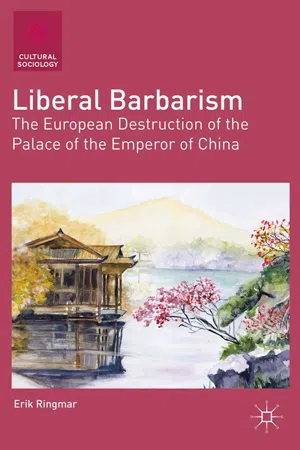
In Liberal Barbarism, Erik Ringmar sets out to explain the 1860 destruction of Yuanmingyuan - the Chinese imperial palace north-west of Beijing - at the hands of British and French armies. Yuanmingyuan was the emperor's own theme-park, a perfect world, a vision of paradise, which housed one of the greatest collections of works of art ever assembled. The intellectual puzzle which the book addresses concerns why the Europeans, bent on "civilizing" the Chinese, engaged in this act of barbarism. The answer is provided through an analysis of the performative aspect of the confrontation between Europe and China, focusing on the differences in the way their respective international systems were conceptualized. Ringmar reveals that the destruction of Yuanmingyuan represented the Europeans' campaign to "shock and awe" the Chinese, thereby forcing them to give up their way of organizing international relations. The contradictions which the events of 1860 exemplify - the contradiction between civilization and barbarism - is a theme running through all European (and North American) relations with the rest of the world since, including, most recently, the US war in Iraq.
Information
P A R T I
INTRODUCTION
C H A P T E R 1
LIBERALS AND BARBARIANS
YUANMINGYUAN WAS THE PALACE OF THE EMPEROR OF CHINA, BUT THAT IS A HOPE-lessly deficient description since it was not just a palace but instead a large compound filled with hundreds of different buildings, including pavilions, galleries, temples, pagodas, libraries, audience halls, and so on. Yet Yuanmingyuan was not only a set of buildings but also a set of gardens filled with trees, flowers, lakes, streams, man-made mountains, and much else besides. The Europeans called it a “summer palace,” but this is not correct either since this was where most Qing dynasty emperors spent most of their time, including the winters. The real summer palace was instead located in Chengde, in inner Mongolia, beyond the Great Wall.1 Yuanmingyuan is sometimes referred to as a “European palace,” and it is true that there were European-style buildings within the compound, but they occupied only a small fraction of the whole and replicas of various Chinese and many other kinds of buildings featured much more prominently.2 What, then, was Yuanmingyuan? “In order to describe it,” said Maurice d’Hérisson, an interpreter to the French who came here in 1860, I would need to “dissolve all known precious stones in liquid gold and paint a picture with a diamond feather whose bristles contain all the fantasies of a poet of the East.”3 Yet an Englishman, John Barrow, who visited in 1791, found nothing much to praise: “I saw none of those extravagant beauties and picturesque embellishments which had made Yuanmingyuan famous throughout Europe.”4
The fact that the descriptions of Yuanmingyuan are contradictory, inconclusive, and often plain wrong is not surprising. The imperial garden compound was not built to be described, but instead it was quite explicitly built to be indescribable; it was not meant to be a place as much as a world, an alternative reality filled with as much detail, secrets, and surprises as the world outside. In addition, it was not intended to be shown but to be hidden. Obscured by a 15-foot wall, it was quite impossible for outsiders to see what was going on inside, and even those guests who occasionally were invited, never saw more than a small portion of the buildings and gardens.5 This was the secluded world intended for the exclusive use of only one individual—the emperor of China. This was where he lived and worked, surrounded by his women, children, and eunuch courtiers, but it was also where he relaxed and was entertained. It was a perfect world; an ideal world that answered perfectly to the emperor’s wishes. Like all gardens, only more so, Yuanmingyuan was a vision of paradise, a place without worry or strife; a place of abundance, harmony, and peace. “There are flowerbeds, screens of trees,” wrote Emperor Yongzheng after he moved here in 1725, “and there is no need to water them to see them prosper.”
The birds in their nests, the fish in their ponds, happy to fly and swim, gather as they wish, no doubt because of the healthy and happy configuration of the site, so fertile and good. Everything comes together in serenity to prosper and reside here, to give peace and splendor.6
This was the world into which a combined Anglo-French army suddenly burst in the fall of 1860. In the evening of October 6, French troops under the command of General Charles Cousin-Montauban scaled the walls and took possession of the compound from which Emperor Xianfeng had departed hastily two weeks earlier. The following morning, despite orders from the commanders not to touch anything, the imperial collections were sacked. The soldiers, including many officers, ran from room to room, “decked out in the most ridiculous-looking costumes they could find,” looking for loot.7 The ceramics were smashed, the artwork pulled down, the jewelry pilfered, and rolls of the emperor’s best silk were used to tie up the army’s horses. “Officers and men seemed to have been seized with a temporary insanity”; “a furious thirst has taken hold of us”; it was an “orgiastic rampage of looting.”8 Then on October 18, James Bruce, the Eighth Lord Elgin, the highest-ranking diplomat and leader of the British mission to China, decided to burn the entire compound to the ground. Since most of the buildings were made of cedar wood, they burned easily and quickly, but since the compound was so large, it still took two days to complete the task. “When we first entered the gardens,” said Garnet Wolseley, a British officer and author of an eyewitness account of the campaign, “they reminded one of those magic grounds described in fairy tales; we marched from them upon the 19th October, leaving them a dreary waste of ruined nothings.”9 “Not a vestige remains of the palace of palaces,” said Robert M’Ghee, chaplain to the troops. “Now back again to Pekin, a good work has been done.”10
LIBERAL BARBARIANS
There is a word for people who behave this way—we call them “barbarians.” To be a barbarian is the opposite of being civilized. Civilization is what distinguishes human beings from animals. Animals are completely determined by material circumstances and by their desire for food, drink, and sex. Humans are animals too, of course, but in addition we reflect on our circumstances and the results of our reflections leave traces in the form of philosophy, science, and arts. Human history is more than anything the stories that can be told about these traces. In the European tradition, barbarians are intruders who think nothing of laying in ruins that which human culture has built up; they are jealous of the achievements of others and destroy the things they cannot understand because they cannot understand them. By obliterating the traces of the past, they deny their own humanity as well as the humanity of others. As such they are the enemies not only of the people they are attacking but also of us all.
It was ostensibly for the exact opposite reason that the Europeans had arrived in China. They were there to civilize the Chinese; they were going to show them the superiority of European civilization and convince them to follow its examples. There are many ways to describe mid-nineteenth century European societies and no label will cover all complexities and nuances, but “liberal” captures an important, perhaps a dominant, aspect. As applied to relations between states, liberalism stood above all for freedom of exchange, a faith in the values of civilization and in international law. These three concerns were interrelated: the unimpeded circulation of goods, money, people, and ideas assured that civilization would spread, and the more civilized the countries of the world became, the more attentive they would be to the stipulations of international law. A lack of circulation, liberal Europeans were convinced, was China’s problem.11 The Chinese had closed themselves off from the rest of the world, built walls around their kingdom and their minds, and this had made them both ignorant and weak. The Europeans were going to open China up: expose the country to the world, that is, expose it to the forces of civilization.
The destruction of Yuanmingyuan does not fit easily into this account. Liberalism, according to the liberals’ own self-understanding, is a matter of fundamentally good people doing fundamentally good things for fundamentally good reasons. Since all connections to barbarism are ruled out by definition, liberals can never properly understand themselves. Instead liberal Europeans have preferred to blame the event on “bad apples” within their ranks, or, more commonly, they have preferred not to remember the event at all.12 History textbooks used in European schools rarely mention the North China Campaign of 1860; there is no book in English that exclusively deals with the destruction of the imperial palaces and gardens, and the event is quickly passed over in most accounts of British imperialism.13 Even eminent historians of European relations with Qing dynasty China deal with it only in a very cursory manner.14
To the Chinese, the destruction of Yuanmingyuan only confirmed what they always had known—that the Europeans were ferocious, ignorant, and utterly devoid of cultural values. The Europeans were indeed barbarians, yet a barbarian, in the Chinese tradition, was not a destroyer of civilization as much as uncouth outsiders who had not yet benefited from the privileges of a Chinese-style education, and as such they were more to be pitied than feared.15 Barbarians were ignorant children—without knowledge of morality, philosophy, and proper ritual—and this was indeed why they had showed up at China’s borders. The foreigners had, in the Chinese expression, “come to be transformed.”16 Thus, if the Chinese only combined firmness with benevolence and patience, the foreigners would either go away by themselves or change to the point where they no longer constituted a problem. This was indeed the policy employed by the Qing dynasty in relation to the Europeans who arrived on their shores in the first part of the nineteenth century. Yet these particular foreigners did not go away and, in the end, it was China that was transformed. In fact, the defeat symbolized by the destruction of Yuanmingyuan was the beginning of the end for the empire. In the showdown between Europe and China, European civilization won—thanks to its barbarian methods.
The European liberals were wrong about themselves and the Chinese were right. There is indeed an intrinsic connection between liberalism and barbarism, and it is this connection that the present book will explore. The object is to investigate not only which motives guided the Europeans but also how these motives can best can be understood and explained. To understand and explain motives is to put them into their historical context and to try as far as possible to recreate the worldview in which they once made sense. That is, we need to write a history of liberal aspirations, of free trade, international law, and the practices of warfare; of imperialist dreams and fears; of racism and aggression; and of mid-nineteenth century conceptions of self and other. Only by writing such a history can we hope to understand the contradiction that is a barbarian on a civilizing mission. Only in this way can we explain why the Allied armies destroyed Yuanmingyuan.
This, in other words, is not a book about China or even about the emperor’s palaces and gardens, but instead a book about Europe and the European way of relating to China and by implication to the rest of the world. Although this book may have the appearance of a book on a historical subject, that is, unfortunately, not the case. The story of European barbarism began far earlier than 1860 and in the twenty-first century new chapters continue to be added to it. What this book really tries to discover is who these people are—these Europeans and their cousins in the former European territories in North America. They appear so well intentioned and kindly and clearly, in many cases, they are personally quite attractive. Yet they unapologetically harbor the most megalomaniacal dreams of world conquest and domination. In their hubris, the Europeans have taken it upon themselves to impose their cultural values, their political systems, and their economic doctrines on everyone else. “Whose work are we engaged in,” as Lord Elgin asked himself while overseeing the bombing of Guangzhou in December 1857,
when we burst thus with hideous violence and brutal energy into these darkest and most mysterious recesses of the traditions of the past? I wish I could answer that question in a manner satisfactory to myself.17
This book is an attempt to answer Elgin’s question. Hopefully in a manner satisfactory to ourselves.
AWE AND DESTRUCTION
We may indeed wonder why the fury of the Europeans descended on a garden. Gardens are peaceful, secluded, places where anger is difficult to sustain and violence is out of place. There is surely something wrong with people who make war on pavilions of cedar wood, on gilded pagodas, hills, and trees. Such people remind us of Don Quixote, fighting not windmills but figments of their own imagination. That the destruction of Yuanmingyuan was no ordinary act of warfare is clear from the way both the sacking and the final incineration were executed. The sacking, mainly carried out by French soldiers on October 7, 8, and 9 was, the perpetrators themselves admitted, an “act of temporary insanity,” an “orgiastic rampage of looting.”18 The decision to burn down the palace, on the other hand, carried out by the British on October 18 and 19, was reached after an extended period of rational deliberation. While Yuanmingyuan was looted in hot blood, it was burned down in cold. In order to make sense of these respective actions, it is necessary to understand more about the role that the palace of the emperor of China has played in Europe’s fantasies of the East.
From the time the first Europeans arrived in China, during Pax Mongolica in the thirteenth and fourteenth centuries, the palace of its rulers was...
Table of contents
- Cover
- Title
- Part I Introduction
- Part II Paradise Destroyed
- Part III Practices and Performances
- Part IV Conclusion
- Appendix
- Notes
- Index
Trusted by 375,005 students
Access to over 1.5 million titles for a fair monthly price.
Study more efficiently using our study tools.
Frequently asked questions
Yes, you can cancel anytime from the Subscription tab in your account settings on the Perlego website. Your subscription will stay active until the end of your current billing period. Learn how to cancel your subscription
No, books cannot be downloaded as external files, such as PDFs, for use outside of Perlego. However, you can download books within the Perlego app for offline reading on mobile or tablet. Learn how to download books offline
Perlego offers two plans: Essential and Complete
- Essential is ideal for learners and professionals who enjoy exploring a wide range of subjects. Access the Essential Library with 800,000+ trusted titles and best-sellers across business, personal growth, and the humanities. Includes unlimited reading time and Standard Read Aloud voice.
- Complete: Perfect for advanced learners and researchers needing full, unrestricted access. Unlock 1.5M+ books across hundreds of subjects, including academic and specialized titles. The Complete Plan also includes advanced features like Premium Read Aloud and Research Assistant.
We are an online textbook subscription service, where you can get access to an entire online library for less than the price of a single book per month. With over 1.5 million books across 990+ topics, we’ve got you covered! Learn about our mission
Look out for the read-aloud symbol on your next book to see if you can listen to it. The read-aloud tool reads text aloud for you, highlighting the text as it is being read. You can pause it, speed it up and slow it down. Learn more about Read Aloud
Yes! You can use the Perlego app on both iOS and Android devices to read anytime, anywhere — even offline. Perfect for commutes or when you’re on the go.
Please note we cannot support devices running on iOS 13 and Android 7 or earlier. Learn more about using the app
Please note we cannot support devices running on iOS 13 and Android 7 or earlier. Learn more about using the app
Yes, you can access Liberal Barbarism by E. Ringmar in PDF and/or ePUB format, as well as other popular books in Social Sciences & Asian History. We have over 1.5 million books available in our catalogue for you to explore.