- English
- ePUB (mobile friendly)
- Available on iOS & Android
eBook - ePub
About this book
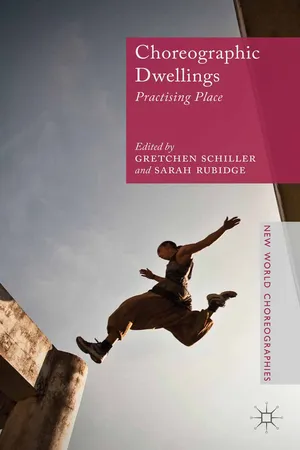
Choreographic Dwellings: Practising Place offers new readings of the kinaesthetic experiences of site-specific and nomadic performance, parkour, installation and walking practices. It extends the remit of the choreographic by reframing the kinaesthetic qualities of place as action.
Information
Subtopic
Art General1
Introduction
Gretchen Schiller and Sarah Rubidge
How does it feel to inhabit a sandy beach in Norfolk or the desert in Morocco? How does it feel to squeeze between the rails and up walls as a traceur in London, or to perform samba de roda in a crowded café in Bahia, Brazil? How can we consider these ‘places as action’, as kinaesthetic forms of inhabitance? Choreographic Dwellings: Practising Place asks these questions.
As practising choreographers we have been steeped for several years in a dance heritage that has challenged and reconceived the notion of choreography as a practice. This has led us to a long-lasting exploration of new understandings of the choreographic in terms of both its presentation and public experience. Our artistic projects, which have all been collaborations with different forms of choreography, computer science, cognitive science, painting, architecture, music and performance1 have contributed to the development of a new form of choreographic practice, known variously as movement environments or ecosystems, installations or dispositifs. Collectively these artistic forms facilitate the physical participation of the public. At times the public’s actions alter the movement qualities embedded in interactive installations such as Shifting Ground (Schiller, 1998), trajets (Schiller and Kozel 1999 [v1] 2007 [V7]) and Sensuous Geographies (Rubidge-MacDonald 2003). At other times, with artistic works such as Falling into Place (Schiller 2012) and Fugitive Moments I (Rubidge, Lotto and Le Martelot 2006), the public’s attention to their physical bodies is intentionally choreographed to highlight and encourage their kinaesthetic experiential actions and condition. The practical and conceptual implications of these embodied and experiential artworks have influenced the way in which kinaesthetic inhabitance is read as an integral part of the choreographic. These artworks we suggest are choreographic dwellings, places for ‘creative action, providing enough protection to encourage experimentation (if not outright exploration) without being overly confining’ (Casey 2009, 122).
Here the notion of kinaesthetic inhabitance and the role of the public as performative agents is central. Here constructed spaces become embodied places for the public. Here we slip outside of the traditional forms of choreographic practice.
This shift of practice has led us to embrace an expansion of the remit of the choreographic and to share with our readers some of the other ways in which the experience of place as action explicitly forms and facilitates the choreographic as dwelling. As such, Choreographic Dwellings: Practising Place articulates and challenges our corporeal sensibilities of place by focusing on the ways in which place becomes action in the guided physical practices, processes and forms found in installations, walking projects, circus, street interventions, Parkour, site-specific and nomadic performances.
Susan Foster’s detailed examination of choreography shows that the notion of choreography has gradually become integrated into twenty-first-century thought (Foster 2011). As a dance practice, choreography has two distinct dimensions. One concerns the transformation, manipulation and elaboration of the movement possibilities afforded by the human body. This deliberate creation, nuancing and organisation of gestural patternings is the raw material of the art of the dance. The other dimension of choreography concerns the ‘orchestration of bodies in motion’ (Foster 2011, 15). Whilst acknowledging these fundamentals of choreographic activity, in this book the migration of the term ‘choreography’ from the theatrical to its manifestation as an immersion in the architecture of the everyday also allows notions of dwelling as a choreographic experience, of kinaesthetic topologies as the interplay of multiple sources of sensation, and the transformation of place into action.
Choreographic Dwellings: Practising Place articulates and triangulates three perspectives of our choreographic thinking. The first is that choreographic activities and events do not only have to be seen as belonging to the domain of dance. Rather we conceive of the choreographic as a process that engages, mobilises and transforms participants’ kinaesthetic sensibilities and understandings of movement and place, and at the same time materialises new inhabited corporealities. Here the choreographic is considered as a relational net or architecture made up of the behaviours of the public, performers and place, and also as paying close attention to the inhabitance of movement repertoires in and through place(s). We therefore understand the choreographic to take form as an intricate manifold of sensation, action and environment, a reciprocal and differential and dynamic matrix that, in Chapter 2, we are arguing is kinaesthetic and topological.
The second is the ways in which the choreographic activities, physical practices and performances presented in this book imbue the public with kinaesthetic agency, drawing their attention to the sensibilities of place as manifesting new forms of kinaesthetic inhabitance: these we are calling choreographic dwellings. This form of inhabitance privileges corporeality by affording new embodied states as a public enters the process of becoming choreographic dwellers when agency and environment entwine.
The third involves the ways in which the traces of our movement experiences are processes that linger in a state of continual transformation in our bodies, environments and artefacts. The ongoing residual consequences and impact between such a kinaesthetic system and the environment are manifested both by and through movement actions, which we are describing as platial2 efforts. Platial efforts here are the qualitative micro and macromovements that result within each choreographic dwelling’s corporeal and contractual engagement of place as action.
Although Foster concentrates on the application of the term choreography in the context of dance in Choreographing Empathy (Foster 2011), in this book extended uses of the term ‘choreography’ are of particular interest. By bringing the public’s kinaesthetic sensibilities to the fore and introducing them to new physical vocabularies and modes of engagement the performers, artists, scholars and practitioners who author the chapters in this collection demonstrate how actions and events that take place in a variety of environments and corporeal contexts can extend and challenge more conventional notions of the choreographic.
The projects in Choreographic Dwellings: Practising Place work with principles similar to those developed by architects such as Bernard Tschumi. Tschumi’s architectural projects do not create forms, but create the conditions for the movement of bodies in space by actively involving the public in shaping space and creating place (Tschumi and Walker 2004). However, by explicitly initiating the process through movement they also highlight the generation of new physical signatures of time and space, kinaesthetic ambiences, sensations of space and time, and understandings of place.
Many of the practices and projects explored in Choreographic Dwellings: Practising Place facilitate or generate different forms of choreographic inhabitance, but do not necessarily come from choreography per se. In this book we illuminate how the notion of choreographic dwelling is permeating creative practices, public interaction and our relationship with our bodies. As choreographers we believe this impacts the ways in which we inhabit place and, consequently, alters our understanding of the choreographic. Each chapter highlights physical practices that encourage, but equally articulate nuances of difference in kinaesthetic agency, and in doing so generates a distinctive relational net of sensation and stirs the contextual ground of the choreographic as dwelling. Here a tapestry of environment, action and sensation is materialised, a form of weaving that encompasses the minutiae of the interiority of the body, but also expands to the effects of space and place.
It is through these projects that the chapters in this book draw attention to practices that are mobilising our understanding of place as action and physical modes of innovative participatory agency. For the editors, the book has been written through a choreographic prism of motif finding and pattern building that unravelled or brought to the surface the tropes and traits of choreographic dwelling and their kinaesthetically topological turn.
Before you travel to, arrive in and dwell through the physical inscriptions and platial efforts of each page to come, we offer a corporeal compass by shifting the direction of attention from choreographic space to choreographic place. Chapter 2, ‘Practising Place’, leads the reader on to an exploration of the processes of practising place, elaborating on and extending historical and contemporary notions of embodied place, which human geographers and philosophers see as being kinaesthetically informed. Perspectives drawn from the psychology of human perception, philosophy and architecture are used as critical footprints as we walk and sift through the thematic overlaps and conceptual motifs running across and slipping between the chapters of the book. Moving between the experiential, the processes that underlie it and a consideration of place as action, Chapter 2 untangles the notions of choreographic dwelling and kinaesthetic topologies as both procedures and dynamic entities, bringing into play the work of psychologist J. J. Gibson and philosophers such as Brian Massumi and Edward Casey. Our inheritance from these thinkers generated a triadic interplay of agency, affordance and affect, and provided the conceptual ground from which our thinking of choreographic dwelling as kinaesthetic and topological emerged.
In the succeeding nine chapters, which are introduced by the editors with short prologues, different modes of inhabitance and enaction of place are explored. The chapters have been written in diverse cultural contexts, including the United States, United Kingdom, France, Belgium, Germany and Brazil. Three of the chapters (4, 7 and 10) have also moved through the linguistic and cultural challenges of translation between the language of the contributing authors and that of the editors. Translating authors’ ideas from French and Portuguese to English has been a challenge to both authors and the editors, not only linguistically but also in terms of developing an understanding of cultural differences in our ways of thinking. As a result we became aware that the process of translation also transforms thought. We have endeavoured to maintain the cultural nuances embedded in the ideas presented in the authors’ texts to situate the specificities of thought inherent in each place of origin.
Chapter 3, ‘Enduring Gravity: Footnotes of Walking and Duration’, asks: does the weight of a footstep place time? Through her performance work Misha Myers becomes a ‘choreographic dweller’ of place. She reveals the way that the physical efforts of walking take on a new form of specificity in her slow-motion durational projects, creating a temporal register she refers to as a ‘lentosphere’. Experimenting with an alternative structure in her writing, she addresses the autotopographical and physical experiences of walking, which is considered in this collection as an emergent mode of the choreographic. In a series of footnotes that leave their footprints not only along a given journey but also in the walker’s bodily movements and in her writing, this chapter unfolds the practical and theoretical embodied consequences of walking journeys taken by Myers and other theorists and artists. In common with Christine Quoiraud’s dance-walks (Chapter 7), Myers challenges time, space, gravity and endurance with her walking projects. Through the technical act of durational performance, she questions contemporary obsessions with acceleration and speed, and uses the ‘footnote’ to punctuate the reader’s flow with pause and rhythm.
In Chapter 4, ‘Corpographia: A Processual Concept of the Urban Body’, Brazilian scholars Fabiana Dultra Britto and Paola Berenstein Jacques draw together the worlds of the choreographic and the urban in the Corpocidade platform. This experimental research project questions the impact of the footsteps of the urban dweller and the way the city is embodied. They ask: how do we move the city as body? In this chapter the body becomes a form of resistance to the everyday physical experience of the city. Here the reader tracks the Corpocidade Platform as it moves between Brazil, Germany and France addressing the reciprocal corporeal implications between the urban and our corporeal condition. This corporeal interplay Dultra Britto and Berenstein Jacques describe as corpographia. Reminding us that movement is sensed rather than seen, the authors argue that the urban experience is inscribed in a body that lives the experience as an involuntarily reorganisation of bodily patterns generated by the ongoing interactive process between bodies and their environment. These inscriptions are constantly modified by the continuous reorganisation of the body’s sensory-motor conditions during interactions between body, memory and environment. This process echoes those in Gretchen Schiller’s ‘Body Libraries’ (Chapter 9), although in Corpocidade the reorganisation of the body’s corporeality is often not comfortable, harmonious and restful.
In contrast, Chapter 5, ‘Practising Heritage: Weaving Actions and Meaning in the Silence of the Lands’, asks: can sound place heritage? In her Silence of the Lands project Elisa Giaccardi, an interaction researcher in design, invited small groups of participants to turn their attention to the sound of place, and to capture and share their sonic experiences of an unspoiled wilderness in Colorado. In this project, the sound of place is foregrounded not as a record for an archive, but as a creative resource that facilitates social dialogues, as well as an opportunity to practice and enhance perception in place. Here, experience is explored in terms of an embodied temporality of duration and pause rather than through Myer’s notions of duration and weight (Chapter 3). Through a combination of mobile computing, collaborative web mapping and a tangible social interface, in Silence of the Lands participants became immersed in the minutiae of the hidden sounds that permeate any landscape as they collected and shared their impressions of sounds with others. During the project they created a processual acoustic map that changed over time as new perceptions and interpretations of their environmental setting were introduced, revealing that heritage is a cultural process subject to change through interaction.
On the other side of the ocean Helen Paris and Caroline Wright’s performance Out Of Water, like Giaccardi’s Silence of the Lands, takes place in a dynamic natural environment. No longer in the countryside but on the seashore of Norfolk, the chapter asks: can nostalgia activate in-dwelling? ‘Still.Moving’ (Chapter 6) describes the process of anticipating and scoring a performative journey that displaces the audience along a seashore-as-stage. This allows us to see how the environment has a performative relationship with the scripted text and song, and the invited public who watch, walk, listen and physically enact gestures. Out of Water implaces the public along the littoral of the shoreline with real and imagined narratives. The sense of nostalgia is evoked through and with the lyrics of memories, the harmonious soundtrack counterpointed with the physical realities of feeling the environment on one’s body. Together these comfortable and uncomfortable felt performative rhythms provide a tensional twist of being in place and travelling in time.
In Luc Boucris’s ‘Territoires, Fraying at the Edges’ (Chapter 7) readers travel across diverse locations, landscapes and ‘stages as places’. The chapter asks: do borders create places of inhabitance? With works created by French artists Christine Quoiraud, Mathurin Bolze and Christophe Haleb the readers find themselves again moving along country roads, this time in Morocco and France, ending up in the open air in different forms of mobile stages. Boucris reveals how these artists are blurring traditional scenic signposts for the public as they mobilise and fray the edges of the scenic conditions of live performance. He asks how stages that resemble itineraries can be theorised and how the spectator is solicited as new stagings of performance work emerge. He identifies three different models of spectating, the metaphorised (Haleb), the dramatised (Quoiraud) and the hyperbolised (Bolze). As...
Table of contents
- Cover
- Title
- Copyright
- Contents
- List of Illustrations
- Series Editors’ Preface
- Acknowledgements
- Notes on Contributors
- 1 Introduction
- 2 Practising Place
- 3 Enduring Gravity: Footnotes of Walking and Duration
- 4 Corpographia: A Processual Concept of the Urban Body
- 5 Practising Heritage: Weaving Actions and Meaning in the Silence of the Lands
- 6 Still.Moving
- 7 Territoires, Fraying at the Edges
- 8 Chula in the City: Traditions, Translations and Tactics in the Brazilian Samba de Roda
- 9 The Body Library: Chor(e)ographic Approaches to Movement, Memory and Place
- 10 Cena 11: The Remote-Controlled Body
- 11 Game Maps: Parkour Vision and Urban Relations
- Bibliography
- Index
Trusted by 375,005 students
Access to over 1.5 million titles for a fair monthly price.
Study more efficiently using our study tools.
Frequently asked questions
Yes, you can cancel anytime from the Subscription tab in your account settings on the Perlego website. Your subscription will stay active until the end of your current billing period. Learn how to cancel your subscription
No, books cannot be downloaded as external files, such as PDFs, for use outside of Perlego. However, you can download books within the Perlego app for offline reading on mobile or tablet. Learn how to download books offline
Perlego offers two plans: Essential and Complete
- Essential is ideal for learners and professionals who enjoy exploring a wide range of subjects. Access the Essential Library with 800,000+ trusted titles and best-sellers across business, personal growth, and the humanities. Includes unlimited reading time and Standard Read Aloud voice.
- Complete: Perfect for advanced learners and researchers needing full, unrestricted access. Unlock 1.5M+ books across hundreds of subjects, including academic and specialized titles. The Complete Plan also includes advanced features like Premium Read Aloud and Research Assistant.
We are an online textbook subscription service, where you can get access to an entire online library for less than the price of a single book per month. With over 1.5 million books across 990+ topics, we’ve got you covered! Learn about our mission
Look out for the read-aloud symbol on your next book to see if you can listen to it. The read-aloud tool reads text aloud for you, highlighting the text as it is being read. You can pause it, speed it up and slow it down. Learn more about Read Aloud
Yes! You can use the Perlego app on both iOS and Android devices to read anytime, anywhere — even offline. Perfect for commutes or when you’re on the go.
Please note we cannot support devices running on iOS 13 and Android 7 or earlier. Learn more about using the app
Please note we cannot support devices running on iOS 13 and Android 7 or earlier. Learn more about using the app
Yes, you can access Choreographic Dwellings by G. Schiller, S. Rubidge, G. Schiller,S. Rubidge in PDF and/or ePUB format, as well as other popular books in Media & Performing Arts & Art General. We have over 1.5 million books available in our catalogue for you to explore.