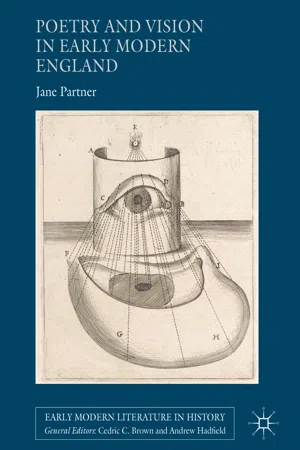
In seventeenth-century England, the reliability of the eye as an intermediary between external reality and interior experience was a matter of widespread controversy. What was the nature of the perceived images created in the eye or the brain , and did they offer the observer any access to truth about the external world? These fundamental questions about the veracity of sight were profoundly important for thinkers working in the numerous interconnected cultural fields that were concerned with establishing truth. Disciplines that included empirical science, philosophy, theology, artistic theory and political polemic all contested the accuracy of vision and debated the right way to look at the world. In all these discourses, central concerns about the fundamental processes of perception were also linked to broader enquiries about the nature of the perceiving subject , as it was disputed how far perceptions of the outside world were conditioned by the inward nature of the embodied self.
Many of these questions about vision and identity are ancient, but there are numerous reasons why they acquired new urgency during the seventeenth century. The period that forms the central focus of this study, which spans from the death of Charles I in 1649 to the publication of Milton’s Paradise Regained in 1671, is marked out by an exceptionally rich visual culture that was the product of a range of intersecting factors. The newest and most important of these was the advent of lens technology in the practice of experimental science. The microscope and telescope invested the eye with new authority, as members of the Royal Society (founded in 1660) sought to establish incontestable truth through procedures that relied upon technologies of magnification and protocols of witnessing. Whilst the accuracy of optically-enhanced vision remained controversial even amongst natural philosophers, Robert Hooke went so far as to claim that the lens could redress the dimming of sight that man had suffered at the Fall , bringing humankind closer to God through the more accurate perception of his works. As will become evident in the following chapters, the publication of Hooke’s Micrographia (1665, under the imprimatur of the Royal Society ), with its spectacularly enlarged fold-out illustrations of minute objects, caused his ideas to have a particularly wide circulation and to stimulate numerous poetic responses. Newton’s transformational work on light and vision was also being carried out during the period in question here, but it did not influence poetry until after the publication of his Opticks in 1704, which is treated in my Conclusion. The expansion of scientific experimentalism during the 1660s intersected with other kinds of philosophical enquiry, as Rationalist, Empiricist and Sceptical philosophers all scrutinised the veracity of sense perception, considering how far the inward experience of the individual could be verified or communicated. Theologians and devotional authors of this same period naturally expressed more circumspect opinions, however, about the perceptions of the fallen eye. Writing in the wake of the Reformation, and under the influence of the ongoing controversies over devotional conformity and the status of ecclesiastical ritual and images, many writers on theological subjects—including Milton, Marvell and Traherne—enjoined believers to privilege inward vision, and to look beyond the appearances of the material world in order to find deeper spiritual insight.
The production and circulation of actual physical images formed a significant part of all these discourses during the 1650s and 1660s, and visual representation inspired commentary of its own in scientific treatises and artistic theory, as well as in theological, political and literary writing. The presence in England of illustrious Continental painters like Van Dyck (who died in London in 1641 after a decade of intermittent residence), had already done much to raise the status of the visual arts. Peter Paul Rubens and Balthazar Gerbier were similarly attracted by the new possibilities of patronage that were opened up by the aristocratic fashion for collecting that had been initiated by the Earl of Arundel and Charles I. The resulting association between the visual arts and social authority meant that the idea of painting became a prominent means for the expression of political commentary. As I will consider in Chap. 5, this connection was also reinforced by the widespread use of painting alongside the imagery of lens es, optical distortion, blindness and clear sight, to form one of the most prominent figurative systems in polemic about the Civil War and its political consequences.
The decades of the 1650s and 1660s witnessed a particular florescence of ideas about sight. This period was extensively informed by the optical ideas of the previous decades, but this rich heritage was transformed for the new environments of the Interregnum and Restoration. Poets accordingly opened up dizzying new metaphorical possibilities when they reimagined familiar figurative ideas about perception and perspective in the light of the radical changes that took place in philosophy and science. The central authors that I treat in this study are diverse in their aims, methods and particular subject matter, but they all share a common interest in the lens (whether it is understood as an instrument of exhilarating revelation or, more often, as a mechanism of perilous distortion), and they each relate that device to a different range of other visual practices. In doing so, these poets joined with thinkers across a range of diverse but intersecting cultural fields to ask the same central questions: What kind of vision reveals true images? How does the identity of the individual condition what they see?
The four poets that are central to this study all wrote simultaneously during the Interregnum and Restoration and were all substantially concerned with sight: Margaret Cavendish (1623?–1673), Thomas Traherne (c.1637–1674), Andrew Marvell (1621–1678) and John Milton (1608–1674). Each of these poets used contesting models of vision drawn from a range of disciplines to examine the inward experience of the perceiving subject and their relationship with external reality; a topic that also provided authors with many opportunities to reflect upon the truthfulness—or otherwise—of poetry itself as a mediator. My investigation will reveal how the theories of sight advanced by philosophy, theology, political polemic, artistic theory and empirical science all contributed to an expansive literary vocabulary that could be used to articulate the conflicted relationships between seeing, knowing, imagining and representing.
There are two principal ways in which attention to the cultures and techniques of vision can enlarge the understanding of the poetry of the 1650s and 1660s. The first is the extent to which increased sensitivity to visual ideas can enhance the appreciation of figurative language. Seventeenth-century poetry more generally is marked out by an exceptional richness of intricate and extended metaphor, much of which operates through the mapping of the metaphysical and the abstract onto the physical.1 It is my contention that the mechanisms of vision and the actions of light combined to provide the single most nuanced and extensive vehicle for metaphor that was employed during this period. This study aims to deepen our understanding of the ways that tropes based upon the actions of light and sight—images of reflection and refraction , of perception and perspective —formed the basis for images of surpassing beauty, flexibility and precision that allowed the ineffable to be made concrete to the imagination.
Secondly, I place these close readings of figurative language within the framework of a larger intellectual history. The outstanding aesthetic richness of seventeenth-century poetry is accompanied and enabled by a parallel intellectual expansiveness. I suggest that this conceptual plenitude can in part be understood as the result of poetry’s unique status as the only discourse in which ideas from right across the cultural spectrum—from philosophy, theology, experimental science, political polemic and visual art—were brought together, tested and compared. In investigating what made the poetry of this period exceptional in its intellectual scope and dynamism, I will therefore be using vision as a means to examine disciplinarity in the Early Modern period, and in particular as a point of entry for considering the role of literature in the ways that culturally circulating ideas about truth were generated, disseminated and challenged. What was the positioning of poetry, I ask, in relation to other kinds of text that also made claims to express o...