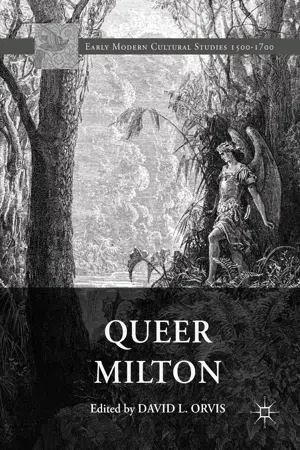
Queer Milton is the first book-length study dedicated to anti-heteronormative approaches to the poetry and prose of John Milton. Organized into sections on "Eroticism and Form" and "Temporality and Affect," essays in this volume read Milton's works through radical queer interpretive frameworks that have elsewhere animated and enriched Renaissance Studies. Leveraging insights from recent queer work and related fields, contributions demonstrate diverse possible futures for Queer Milton Studies. At the same time, Queer Milton bears witness to the capacity for queer to arbitrate debates that have shaped, and indeed continue to shape, developments in the field of Milton Studies.
eBook - ePub
Queer Milton
About this book
Information
© The Author(s) 2018
D. L. Orvis (ed.)Queer MiltonEarly Modern Cultural Studies 1500–1700https://doi.org/10.1007/978-3-319-97049-3_11. Rude Milton: Gender, Sexuality, and the Missing Middle of Milton Studies
Erin Murphy1
(1)
Boston University, Boston, MA, USA
A few years ago, I had a somewhat disorienting scholarly experience. In the process of doing a review of the critical literature on gender and sexuality in studies of Milton, I reread Gregory Bredbeck’s chapter, “Milton’s Sodomite,” from his 1991 book Sodomy and Interpretation. It had been almost 25 years since the piece originally appeared in PMLA, and about fifteen years since I had first read it in graduate school. Encountering the text again, I was surprised and elated by its response to the sometimes bitter debates about Milton’s misogyny that had marked the seventies and eighties. Bredbeck writes, “Throughout the major poems the discourses of sex and gender (and they always happen in the plural) read more like syntagmatic units or extended phonemes than as transparent narratives in their own right; that is, various sexual discourses appear, but only as sounds that must be taken together in order to determine a ‘content,’ ‘intention,’ or ‘meaning.’ … The mapping of this economy—rather than the mapping of a position within it—is the real object of analysis presented to us in Milton’s canon.”1 Even when Bredbeck wrote this in 1991, there was nothing surprising about the idea of moving beyond Eve to reexamine how gender means in the text. What surprised me was that, within a year of Eve Sedgwick’s groundbreaking Epistemology of the Closet (the books were probably in production at about the same time), Bredbeck was using Foucault to try to understand this as not just a feminist project, but a queer one. Of course, Bredbeck does not yet use the term queer. The concept of “queer” theory or “queer” studies as a coherent, recognized academic field of study was just emerging. For instance, Sedgwick does not yet use the word in this sense, instead deploying the term “antihomophobic inquiry.”2 Still, Bredbeck strives to use a Foucaldian reading of the history of pastoral to reveal homoerotic meaning in Milton’s texts. In pointing to the presence of homoeroticism in Paradise Regained , Bredbeck works in the same vein as Claude Summers , whose almost-simultaneous essay builds on John Shawcross’s biographical questions about “whether Milton was homosexual” to consider how the brief epic represented male homosexuality as part of the “range of fully human sexual possibilities.”3 By revisiting and refusing C. S. Lewis’s homophobic reading of the angels in Paradise Lost as anachronistic, however, Bredbeck moves beyond identifying moments of male homoeroticism to embark on a queerer analysis that undermines any simple sense of the poem’s heteronormativity. Arguing that “For Milton, issues of gender , sex , and sexuality are more negotiated than articulated and are at play in a general economy of variable terms,” he builds on arguments about Milton’s misogyny as he starts to offer the kind of non-identitarian formulation characteristic of queer critique.4
As someone who writes and teaches about both queer theory and Milton, why hadn’t I paid more attention to this piece before? Why had I never read more Bredbeck? Why had I never met him? For the first time ever, I started to write a fan e-mail. What I quickly learned is that Bredbeck died in 2007. After his early days as an academic wunderkind, he turned away from his work on the Renaissance to later literature and seems to have stopped publishing completely by 1997.5 As I reread Bredbeck’s proto-queer piece, I kept thinking of Milton’s elegy Lycidas , in which he mourns the death of a classmate he barely knew, as I found myself in the very peculiar state of mourning a young man I had never met five years after he died.
Perhaps even more than the poet of Lycidas, who notoriously uses the occasion of death for his own ends, what I was really mourning was not this particular person.6 Instead, I was longing for a community of scholars interested in both Milton and queer studies. As Drew Daniel notes in his essay in this collection, this experience of queer critical loneliness is paradoxically not unique, but I want to clarify that my longing was not about a search for queer ancestors, nor a need for emotional rescue.7 Instead, it was about the quite banal need for shared critical conversation, and the humbling reminder that scholarship rarely moves forward based on a model of “one just man,” but usually requires community. As I began this project, I thought of myself as joining a recent wave of Milton critics who have mounted a vigorous and collective effort of self-reflection through the careful charting of centuries of scholarly debate on Milton and his works.8 Rather than tracing a critical genealogy, however, I thought of this endeavor as paradoxically elegiac as I worked to trace a critical history that never happened, a body of thought on gender and sexuality in Milton’s work that never developed as scholars either left the field or turned to the enabling project of feminist historicism.
As I followed leads in Bredbeck’s acknowledgments, I was once again surprised to learn that Joseph Wittreich had hosted a meeting of the North East Milton Society on “Queering Milton,” which included presentations by Bredbeck, Peter Stallybrass , and William Readings in the early 1990s. This fact makes it even more remarkable that it still took two decades before the 2014 publication of the Early Modern Culture special issue of “Queer Milton.”9 (The absence of any essays on Milton in Jonathan Goldberg’s groundbreaking 1993 collection, Queering the Renaissance, shows that this lag was not characteristic of early modern studies more generally.) With the arrival of this special issue, as well as the appearance of Karma DeGruy’s article on Milton’s “desiring angels” and Reginald Wilburn’s piece on William Craft’s queer engagement with Milton, the number of queer essays on Milton has almost doubled.10 Happily, this development makes this project of taking stock less elegiac. Still, I want to risk the mode of being belated, out of fashion, even passé, that so many queer scholars have embraced as characteristically queer.11 Like the swain of Lycidas , I will venture being just a bit rude as I try to make contact with the unrealized potential of a queer Milton criticism lost ere its prime. I want to return to the moment when queer theory emerged explicitly in the academy, considering why the seeds of a queerer Milton studies were sown (not just by Bredbeck , but also by James Holstun , Janet Halley , and Lee Edelman ) but never quite bore fruit, and to explore what it means to read Milton queerly in the face of this missing middle. Resisting the damaging thinking of scholarly supersession, in which feminist thinking gives way to queer theory which is eventually replaced by transgender theory, etc., I aim to attend to the inadequacy of narratives of linear scholarly progress and the overvaluing of innovation, reminding us that some scholarly projects require repetition and return.
Both before and after Bredbeck’s intervention, Shawcross , Summers , John Rumrich , and Gregory Chaplin crucially shed light on male homoeroticism in Milton’s work, but no one builds on Bredbeck’s proto-queer analysis explicitly until Bruce Boehrer’s “Lycidas: The Pastoral Elegy as Same-Sex Epithalamium” appeared in PMLA in 2002.12 Scholars interested in pursuing a queer analysis of Milton’s works are in a somewhat awkward position. It makes no sense to try to fill in the missing years of queer Milton criticism, diligently churning out anachronistic analyses in what Sedgwick termed the “paranoid” reading mode of the 1990s and early 2000s, yet it seems treacherous to launch into the more recent “reparative” mode of queer studies without the building blocks of an earlier critical moment. Despite some important interventions in the 2000s, including work by Thomas Luxon , Boehrer, Jonathan Goldberg , Stephen Guy-Bray , Will Stockton , and Melissa Sanchez , Milton studies never saw a full-throated queer critique of the author’s work, and these individual pieces did not coalesce into a broader conversation.13 Here, I will draw on Sedgwick’s call for a queer method that interweaves modes of “paranoid” and “reparative” reading in order to address this quandary of the missing middle.
Seeking Sustenance: Sedgwick’s Reparative Reading
I turn to Sedgwick’s rubric of “paranoid” versus “reparative” reading to begin considering the relationship between scholarship on Milton and gender and what might be considered anti-homophobic, proto-queer, and queer work on Milton for three reasons. First, I believe Sedgwick’s categories to be salutary for addressing a kind of primal wound associated wi...
Table of contents
- Cover
- Front Matter
- 1. Rude Milton: Gender, Sexuality, and the Missing Middle of Milton Studies
- Part I. Eroticism and Form
- Part II. Temporality and Affect
- Back Matter
Trusted by 375,005 students
Access to over 1.5 million titles for a fair monthly price.
Study more efficiently using our study tools.
Frequently asked questions
Yes, you can cancel anytime from the Subscription tab in your account settings on the Perlego website. Your subscription will stay active until the end of your current billing period. Learn how to cancel your subscription
No, books cannot be downloaded as external files, such as PDFs, for use outside of Perlego. However, you can download books within the Perlego app for offline reading on mobile or tablet. Learn how to download books offline
Perlego offers two plans: Essential and Complete
- Essential is ideal for learners and professionals who enjoy exploring a wide range of subjects. Access the Essential Library with 800,000+ trusted titles and best-sellers across business, personal growth, and the humanities. Includes unlimited reading time and Standard Read Aloud voice.
- Complete: Perfect for advanced learners and researchers needing full, unrestricted access. Unlock 1.5M+ books across hundreds of subjects, including academic and specialized titles. The Complete Plan also includes advanced features like Premium Read Aloud and Research Assistant.
We are an online textbook subscription service, where you can get access to an entire online library for less than the price of a single book per month. With over 1.5 million books across 990+ topics, we’ve got you covered! Learn about our mission
Look out for the read-aloud symbol on your next book to see if you can listen to it. The read-aloud tool reads text aloud for you, highlighting the text as it is being read. You can pause it, speed it up and slow it down. Learn more about Read Aloud
Yes! You can use the Perlego app on both iOS and Android devices to read anytime, anywhere — even offline. Perfect for commutes or when you’re on the go.
Please note we cannot support devices running on iOS 13 and Android 7 or earlier. Learn more about using the app
Please note we cannot support devices running on iOS 13 and Android 7 or earlier. Learn more about using the app
Yes, you can access Queer Milton by David L. Orvis in PDF and/or ePUB format, as well as other popular books in Literature & Literary Criticism Theory. We have over 1.5 million books available in our catalogue for you to explore.