eBook - ePub
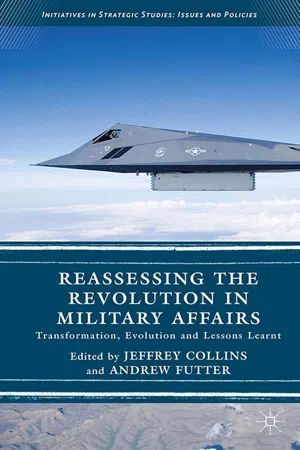
Reassessing the Revolution in Military Affairs
Transformation, Evolution and Lessons Learnt
- English
- ePUB (mobile friendly)
- Available on iOS & Android
eBook - ePub
Reassessing the Revolution in Military Affairs
Transformation, Evolution and Lessons Learnt
About this book
A generation after the First Gulf War, and in the wake of a decade of counterinsurgency operations and irregular warfare, this book explores how the concept of the Revolution in Military Affairs continues to shape the way modern militaries across the globe think about, plan and fight wars.
Information
1
The United States and the RMA: Revolutions Do Not Revolutionize Everything
Keith L. Shimko
The period between the conclusion of Desert Storm in 1991 and the onset of the Iraqi insurgency in the summer of 2003 may always be remembered as the heyday of the RMA. It was in the afterglow of the US-led coalition’s unexpectedly easy and lopsided victory over Iraq and the liberation of Kuwait that the RMA, previously little more than the obscure musings of a handful of military strategists and historians, emerged from the shadows of strategic thought to hog the limelight. The war and its outcome was, in the words of Colin Gray, “a flash in the sky of strategic consciousness.”1 For the next decade the language of revolution was ubiquitous. Journals were filled with articles (and even essay contests) about the nature, meaning and significance of the RMA.2 References to revolutionary technologies and capabilities were common whenever military officials testified before congressional committees, justifying virtually every weapons system by emphasizing its contribution to the revolution or, to use Donald Rumsfeld’s preferred terminology, “military transformation.” Defense Department posture statements and policy reviews became almost caricatures of RMA promotionalism, veritable grab bags of RMA mantras and jargon.3 Exuberance and rhetorical excess were the order of the day. But now the glow of easy victory has faded. And after more than a decade of difficult and ambiguous wars in Iraq and Afghanistan, the RMA bubble appears to have burst. Barry Watts notes that “given the protracted nature and exigencies of ongoing conflicts in Iraq and Afghanistan,” by 2008 and 2009 “very few in the US national-security establishment were giving much thought to RMAs and transformation.”4 And Frank Hoffman virtually consigns the RMA to the dustbin of strategic intellectual history, dismissing it as “a blast from the past, a piece of pre-9/11 prehistory.”5
What are we to make of this? Should we chalk it up to intellectual and policy faddishness, and inclination to latch onto the latest ideas and concepts only to abandon them when some rethinking is necessary? Was all that talk of an RMA mistaken, a mirage on the strategic landscape supported by little more than technological dreams and a handful of misleadingly easy military victories? Or has the exuberance and rhetoric dissipated because we have come, either explicitly or implicitly, to a more balanced assessment and understanding of the RMA, one tempered by more than two decades of military engagements revealing limitations that were too easily ignored in the face of initial military successes?
The contemporary American RMA: theory
It was Andrew Marshall who provided the most succinct and widely accepted definition of an RMA as “a major change in the nature of warfare brought about by the innovative application of new technologies which, combined with dramatic changes in military doctrine and operational and organizational concepts, fundamentally alters the character and conduct of military operations.”6 There are, of course, many other definitions that differ in nuance and emphasis, but almost all are relatively minor variations, similar themes, incorporating some element of technological, doctrinal and organizational changes that combine to significantly alter the manner in which force is applied and wars are fought. In reassessing the RMA after several decades of debate and experience, Marshall’s definition remains as good a place as any to start. Though at the end of the day, it is more important to understand what has changed (and what has not) than judge whether some arbitrary bar for “revolutionary” change has been surpassed, thus posing the question, are these terms still heuristically useful.
As matter of policy the RMA had its origins in the specific strategic challenges confronting the United States in the late 1970s and early 1980s. Emerging from its long and ultimately unsuccessful war in Vietnam, the United States found itself facing a Soviet Union that now enjoyed parity in strategic nuclear weapons as well as numerical superiority in conventional forces in Europe.7 With the Vietnam diversion and debacle out of the way, the more fundamental Soviet challenge remained. But how could a nation weary from a decade of war possibly turn around and devote the necessary human and economic resources needed to counter Soviet conventional power? Given the magnitude of the imbalance in manpower and material, was there sufficient political will to rise to the challenge and even things out? Fortunately, many did not think it necessary to replicate Soviet capabilities. Rather than match the Soviet Union soldier for soldier and tank for tank along the European front, Marshall and others advocated an “off-set strategy” in which US technological advantages and the new warfighting doctrines they made possible would allow NATO to prevail over a quantitatively superior adversary in the event of conflict in Europe. The Soviet advantage in numbers/quantity could be off-set by American advantages in technology. As Bruce Berkowitz explained,
A totalitarian country like the Soviet Union had to control the flow of information. The Soviet regime was so worried about the threat of Samizdat that in 1971 the average Soviet citizen could not get near a Xerox machine, never mind a computer. This was the great weakness that would help destroy the Soviet Union ... Marshall could see that as long as the Communists remained communists, the Soviets would never catch up. The United States, said Marshall, had to figure out how to use this advantage.8
In military terms this overall technological advantage was rooted in a suite of surveillance, communications, stealth and munitions guidance technologies that could help lift, though not completely eliminate, the proverbial fog of war and solve the age-old problem of target acquisition while reducing the vulnerability of US forces. These capabilities could be woven together into a “reconnaissance-strike complex.” Though many assumed that most important advantage of these technologies was the minimization of collateral damage and civilian casualties, the primary military benefit was actually the ability to hit a large number of targets in a short period of time over a large battle space. This was critical to most of the key doctrinal innovations associated with the RMA, including AirLand Battle, John Boyd’s ideas about speeding up the OODA (observation, orientation, decision and action) loop so as to leave an adversary hopelessly confused and overwhelmed, John Warden’s strategy of using airpower to paralyze an opponent, and even Ullman and Wade’s infamous “shock and awe.”9 All of these doctrines were predicated on hitting an array of widely dispersed tactical, operational and strategic targets reliably and almost simultaneously. Minor differences aside, they were all manifestations of a more general conception of “parallel warfare,” an approach to the application of force that “reconfigure[s] the basic elements of warfare by distributing mass along a time line that is narrow but a space continuum that is broad ... allow[ing] mass to become concentrated in time but not in space.”10 This was evident when “the Gulf War began with more targets in one day’s attack plan than the total number of targets hit by the entire Eighth Air Force in all of 1942 and 1943 – more separate air attacks in 24 hours than ever before in the history of warfare.”11
Of course, these technologies were not developed or acquired in the 1970s and 1980s with an eye toward fighting and defeating Iraq. Iraq was not even on the radar screen of potential threats (indeed after the 1979 Iranian revolution Iraq was considered something of a strategic ally, a bulwark against the spread of radical Islamic fundamentalism). As the technological foundation of the off-set strategy, the reconnaissance-strike complex was a child and orphan of the Cold War and its strategic challenges the United States faced. AWACS (Airborne Warning and Control System) and JSTARS (Joint Surveillance and Target Attack Radar System) planes were expected to roam the skies over Europe to see far behind the line of battle as stealth fighters and bombers avoided detection en route to their targets in Eastern Europe and the Soviet Union to wreak havoc. But this was not to be. Thanks to the collapse of the Soviet Union and end of the Cold War, the world fortunately never found out if all of this would have played out as planned. Instead, over the course of the next two decades RMA technologies and doctrines would be put to the test against some unexpected adversaries in missions and settings very different from those originally anticipated.
Conceptually, it should not have been difficult to discern the potential limitations of a reconnaissance-strike complex (and, thus, the RMA it supposedly supported) from its constituent elements – persistent surveillance, rapid communication, efficient task allocation, and precision strike. The complex’s sequence begins with the identification of relevant targets relying almost exclusively on national technical means – satellites, AWACS, JSTARS, UAVs (Unmanned Aerial Vehicles), etc. – rather than human intelligence. The information gathered is then disseminated in real-time, providing an unprecedented degree of situational awareness to widely dispersed forces as the task of attacking specific targets is assigned to those best positioned to strike. A succession of targets could then be attacked rapidly with precision when needed. The ideal is for this “sensor to shooter cycle” – that is, the time between the identification of targets and their destruction – to be condensed as much as possible. Once a target is identified it should be hit in minutes or hours, not days. These two ends of the reconnaissance-strike complex are most relevant for understanding its limitations and the conditions that would enhance as well as detract from its utility.
On the reconnaissance/sensor end, the architecture depends on the ability to identify the most important targets largely by the national technical means. If we think in terms of more traditional interstate conflicts pitting one national military against another, most militarily relevant targets are of this type. Communications facilities, radar installations, airfields, defense ministries, tank columns, battalions and similarly large and distinct assets can usually be located and tracked through technological reconnaissance. US systems were designed to identify these very types of targets since they would have been numerous and critical in any war against the Soviet Union in Europe. As Warren Chin emphasizes with respect to AirLand battle,
Of particular importance was the development of VISTA (very intelligent surveillance and target acquisition) technologies. These systems were able to see into the operational depth of the enemy’s positions. Improvements in data processing ... allowed information to be provided almost instantaneously, and from this it would be possible to create a real-time picture of enemy activity. The enemy’s command and control, transportation infrastructure, logistical facilities and force concentrations could then be attacked in long-range precision strikes.12
The critical first step in this scenario, of course, is the detection of “command and control, transportation infrastructure, logistical facilities and force concentrations” by this “very intelligent surveillance.” Everything else flows from this. The ability to find targets is obviously the necessary precondition for attacking them.13 The self-evident problem is that not every conflict/mission is going to present the same target set as would a conventional war in Europe. Every adversary is not going to be like the Soviet Union. And if such targets are scarce or even non-existent because of the nature of the enemy or setting/environment, the complex’s overall effectiveness is severely diminished. The guided munitions that constitute the public face of the RMA are useless without equally precise information about the location of the targets they are supposed to hit.
At the strike/shooter end the major limitation of the complex is perhaps less obvious. Here the issue is the military and political value of destroying/disabling assets. The complex is most useful not only when these assets can be found but also when disabling/destroying them will help achieve military and political ends. Destruction, after all, is never an end in and of itself. There is (or at least certainly should be) an ultimate political objective for any use of force. In AirLand Battle Soviet forces and assets would have been destroyed in order to maintain the political independence of Western Europe. In this scenario striking and destroying these targets beyond the front would have been critical, even essential, to achieving this political objective. But not all conflicts are the same in terms of the purely military contribution to the eventual attainment of political ends. The value of “kinetic” military action varies. Counterinsurgencies, for example, have long been seen as different. In countering an insurgency the primary challenge is not weakening the enemy militarily but rather earning the loyalty of populace. As David Galula explained several decades ago in his classic analysis, in combatting an insurgency,
A victory is not the destruction in a given area of the insurgent’s forces and his political organization. ... A victory is that plus the permanent isolation of the insurgent from the population, isolation not enforced upon the population, but maintained by and with the population. ... In conventional warfare, strength is assessed according to military or other tangible criteria, such as the number of divisions, the position they hold, the industrial resources, etc. In revolutionary warfare, strength must be assessed by the extent of support from the population.14
So to the extent that a contemporary RMA rests on capabilities and technologies co...
Table of contents
- Cover
- Title
- Introduction: Reflecting on the Global Impact of the RMA
- 1 The United States and the RMA: Revolutions do Not Revolutionize Everything
- 2 A Peculiarly British Revolution: Missing the Point or Just Avoiding Change?
- 3 The Perpetual Search for Efficiency: The Canadian Approach to the RMA and Military Transformation
- 4 The Interruption and Evolution of Australias RMA
- 5 The Israeli Revolution in Military Affairs and the Road to the 2006 Lebanon War
- 6 The Russian Response to the RMA: Military Strategy towards Modern Security Threats
- 7 RMA and India: Nothing Revolutionary about It
- 8 RMA, European Militaries and the Limits of Modernization
- Conclusion: Reflecting on the RMA Concept
- Index
Trusted by 375,005 students
Access to over 1.5 million titles for a fair monthly price.
Study more efficiently using our study tools.
Frequently asked questions
Yes, you can cancel anytime from the Subscription tab in your account settings on the Perlego website. Your subscription will stay active until the end of your current billing period. Learn how to cancel your subscription
No, books cannot be downloaded as external files, such as PDFs, for use outside of Perlego. However, you can download books within the Perlego app for offline reading on mobile or tablet. Learn how to download books offline
We are an online textbook subscription service, where you can get access to an entire online library for less than the price of a single book per month. With over 1.5 million books across 990+ topics, we’ve got you covered! Learn about our mission
Look out for the read-aloud symbol on your next book to see if you can listen to it. The read-aloud tool reads text aloud for you, highlighting the text as it is being read. You can pause it, speed it up and slow it down. Learn more about Read Aloud
Yes! You can use the Perlego app on both iOS and Android devices to read anytime, anywhere — even offline. Perfect for commutes or when you’re on the go.
Please note we cannot support devices running on iOS 13 and Android 7 or earlier. Learn more about using the app
Please note we cannot support devices running on iOS 13 and Android 7 or earlier. Learn more about using the app
Yes, you can access Reassessing the Revolution in Military Affairs by Andrew Futter, Jeffrey Collins, Andrew Futter,Jeffrey Collins in PDF and/or ePUB format, as well as other popular books in Politics & International Relations & International Relations. We have over 1.5 million books available in our catalogue for you to explore.