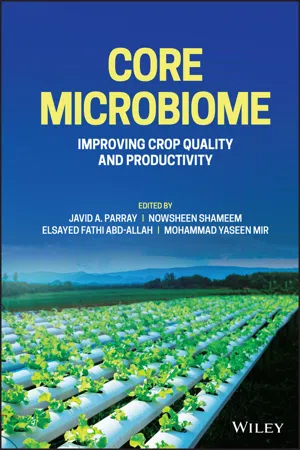
Core Microbiome
Improving Crop Quality and Productivity
- English
- PDF
- Available on iOS & Android
Core Microbiome
Improving Crop Quality and Productivity
About this book
Improve the quality and productivity of your crops through selecting positive and effective interactive core-microbiomes
As microbial cells are present in overwhelming numbers in our soil, it is perhaps inevitable that microbes are found extensively in plant and animal tissue. The role of microbiomes on the regulation of physiological processes in animals has been extensively researched in recent years, but the overarching role of the plant microbiome has yet to be discovered.
Core Microbiome: Improving Crop Quality and Productivity is an attempt to remediate some of that deficit, as the first book to summarize feature of microbial communities that make up the plant microbiome. There is substantial evidence that these communities are crucial in disease control, enhanced nutrient acquisition, and stress tolerance—a feature more important than ever due to climate change. A further focus on improving how core microbiomes interact so that they are both phenotypically and genotypically very adaptive and sustainable will allow the reader to improve the quality and productivity of crops so that they may be considered sustainable agriculture.
Core Microbiome readers will also find:
- Descriptions of the basic structure of core microbiomes and their functions across various habitats
- New and cutting-edge trends and technological innovations highlighted that use core microbiomes to harness plant microbiome interaction
- The structure, classification, and biotechnological applications of aquatic core microbiomes, in addition to the material on plant microbiomes
As a broad introduction to the interaction of core microbiome and plant productivity, Core Microbiome is ideal for researchers and scientists working in the field of environmental science, environmental microbiology, and waste management. Similarly, undergraduate and graduate students in these fields, as well as in agriculture, biotechnology, biosciences, and life and environmental sciences will also benefit from this work.
Frequently asked questions
- Essential is ideal for learners and professionals who enjoy exploring a wide range of subjects. Access the Essential Library with 800,000+ trusted titles and best-sellers across business, personal growth, and the humanities. Includes unlimited reading time and Standard Read Aloud voice.
- Complete: Perfect for advanced learners and researchers needing full, unrestricted access. Unlock 1.4M+ books across hundreds of subjects, including academic and specialized titles. The Complete Plan also includes advanced features like Premium Read Aloud and Research Assistant.
Please note we cannot support devices running on iOS 13 and Android 7 or earlier. Learn more about using the app.
Information
Table of contents
- Core Microbiome
- Contents
- List of Contributors
- Preface
- 1 A Review of Endophytic Microbiota of Medicinal Plants and Their Antimicrobial Properties
- 2 Plant Microbiome: A Key to Managing Plant Diseases
- 3 Impact of Microbiomes to Counter Abiotic Stresses in Medicinal Plants- A Review
- 4 Uses of Compost in Agriculture and Bioremediation – A Review
- 5 Metagenomics and Microbiome Engineering: Identification of Core Microbiome and Improvement of Rhizosphere
- 6 Core Microbiome: Plant Growth and Development
- 7 Microbiome Engineering and Biotechnology: The Real Finenesses of a Robust Rhizosphere
- 8 Role of Rhizospheric Microbiome in Enhancing Plant Attributes and Soil Health for Sustainable Agriculture
- 9 Toxic Effects of Some Herbicides on the Fatty Acid Profile of Wheat Varieties: A Phytomicrobiome Study
- 10 Microbial Prospects in Sediment Denitrification of Eutrophic Wetland Ecosystems
- 11 Role of Plant Microbiome in Carbon Sequestration for Sustainable Agriculture
- 12 Functions and Emerging Trends of the Microbial Community in Heavy Metals Bioremediation: A Review
- 13 Microbiomics and Sustainable Agriculture: New Frontiers
- 14 Role of Nanotechnology in Soil Microbiome and Agricultural Development
- 15 Microbial Biofilms: Optimal Genetic Material Exchange in a Microbiome Environment
- 16 Rhizosphere Improvement: Role of Biotechnology and Microbioengineering
- 17 Exploring Biological Agents and Core Microbiomes as a Tool for Reclamation of Abandoned Mines
- 18 Mycorrhizal Strategy for the Management of Hazardous Chromium Contaminants
- Index
- EULA