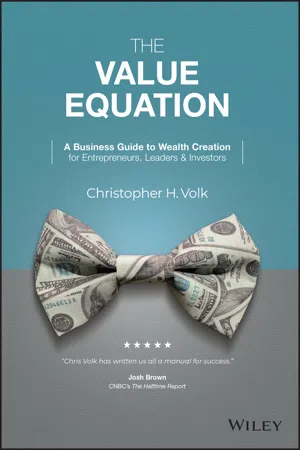
Discover one of the surest means to create personal wealth by building a profitable business
Every now and then, a business book comes along that offers original insights and a fresh perspective. In The Value Equation: A Business Guide to Creating Wealth for Entrepreneurs and Investors, veteran executive, entrepreneur, and investor Chris Volk delivers an engaging, straightforward explanation about how businesses work and provide wealth for entrepreneurs and investors. The author's signature approach is centered on his award-winning wealth creation formula in a book designed to simplify complex subjects with math no more complicated than what you learned in middle school.
Readers will become acquainted with the characteristics of successful business models, together with insights into how leaders can improve their own models in ways that generate personal and collective wealth. The author's framework presented in The Value Equation is the foundation upon which most of the largest personal fortunes were built.
Chris Volk also provides supplemental materials including interactive Excel spreadsheets, illustrations, and sample corporate financial models on a companion website. There is even a link to an award-winning video series created by Volk that served as his inspiration for the book. Full of illustrative case studies that highlight crucial business and finance concepts The Value Equation includes:
Explorations of the true value of using OPM (Other People's Money) and capital stack variations to build and grow your company.
Advice on business assembly, growth, mergers, acquisitions, and corporate reengineering, including discussions of valuation multiples, common risks, and capital options.
Guidance on how to valuate business models, delivered with help from a variety of stories and case studies. Uniquely, the author also draws on his own background, including the introduction of three successful companies to the public markets, two of which he was instrumental in founding.
The Value Equation is an indispensable addition to the libraries of anyone interested in growing wealth and capital through business, whether as a business leader, entrepreneur or investor.
In the United States, businesses—large and small, public and private—create the beating heart of individual and national wealth creation. At the end of 2018, our nation boasted more than 32 million enterprises, of which just over 6 million had paid employees.1 The latter equated to a business for every 55 Americans, or, better still, a business having paid employees for roughly every 30 Americans in the labor force.
Given those statistics, if one were to look at the total number of businesses, there would be a business for every five Americans in the labor force, which is astounding.
How has this been made possible?
The abundance of businesses in America owes itself to three factors: An educated workforce, a ready supply of capital, and a strong rule of law. The United States is not alone in this; in no small way, these contributors to business formation lie at the foundation of the economy of every highly developed nation.
In the Beginning Is the Idea
Most businesses start with an idea, which usually takes the form of a solution to a problem. The key question is how to build a profitable business model around the idea.
In 1995 Larry Page and Sergey Brin, who had met as graduate students at Stanford, saw that searching the internet for relevant information was a cumbersome process. Their idea was to make internet searches efficient, productive, and user-driven, applying the technology they created to drive a high level of search demand.
They didn't know how this idea could translate into a profitable business model. No one could have foreseen how dominant and profitable Google, the company they created, was to become. Certainly not Page and Brin, who in 1999 briefly entertained selling Google to Excite, a more established search engine company, for $750,000, which would have allowed them to turn a tidy profit and return to their graduate studies. No one could have blamed them for unloading their money-losing venture; that year, Google had posted a $3.1 million loss on revenues of just $220,000.
Sergey Brin, left, and Larry Page posing in a messy office setting in October 2002
Just two years later, the company would produce its first profit of $32 million on revenues of $86.4 million, and it would never look back. Three years after that, they took Google public. Between 2004 and 2019, Page and Brin sold over $10 billion of Google shares apiece, and yet still held onto corporate shares valued at more than $25 billion for each of them.
Over the next two years, the company they founded continued to prosper. By the end of 2021, with a net worth estimated by Forbes of $123 billion, Larry Page ranked as the fifth-richest person in the world. His former partner, Sergey Brin, was effectively tied at number six, with a reported net worth of $118.5 billion.
Unicorn Likelihood
This brings up the interesting topic of the likelihood of anyone—including you or me—becoming a billionaire. Looking to the richest among us makes an interesting study, because these subjects provide insight into the most compelling business models in each generation.
As of the end of 2020, there were over 3,200 billionaires in the world, of which over a quarter resided in the United States.2 The odds of an American being a billionaire are roughly 1 in 355,000, or far better than the extremely long odds of winning a Powerball lottery, which is approximately 1 in 300 million.
Of course, many of the world's richest inherited their wealth, and so might be excluded from the competition to become billionaires. A better question might be this: What are the odds of being a self-made billionaire? Not too bad, actually; of the global population of billionaires surveyed at the end of 2020, 60% were self-made, which is an astonishing statistic.3 The amount of wealth created in the 50 years between 1970 and 2020 is indeed almost without precedent. One would have to look to the same period a hundred years earlier for a comparative period of productivity and creativity. Instead of names like Bezos, Musk, Gates, and Buffett, one might have spoken of Rockefeller, Carnegie, and Morgan. Still, the numbers of the world's most affluent today dwarf those of the Gilded Age, or what is also called the Age of the Second Industrial Revolution.
Of course, much of the difference in the magnitude of today's superrich lies in population growth. Much is also owed to enhancements in capital formation, including resources such as the Small Business Administration, venture capital, and pervasive private equity firms. These resources, together with technological advances, gave rise to what is today called the Third Industrial Revolution, with economic and productivity growth propelled by digital and technology advances.
The numbers show that being a billionaire is statistically easier than winning the Powerball. It is also statistically easier than making a living on the PGA Tour. There were an estimated 927 billionaires in the US at the end of 2020. Meanwhile, the career earnings of the active golfer ranked 927 on the PGA Tour amounted to less than $25,000.4 There are more self-made billionaires in America than there are PGA Tour pros who can earn a good living playing the game.
Getting into the NBA is nearly equally hard, with just 450 players scattered across 30 teams, and each earning a median salary of approximately $3.5 million in 2019.5 Getting into the NFL is a little easier, with about 1,900 players and a far lower median salary under $850,000.6 Yet, you would be right to say that all these people are virtual “unicorns,” or mythical creatures, which is also a term used today for start-up businesses having valuations of a billion dollars and up.
Odds of Success
To my way of thinking, the real action in business lies in the middle markets, which I would characterize as companies having from $10 million to $1 billion in revenues. This is where most of the job growth and business creativity is in the United States. This is the most common fertile gro...
Table of contents
Cover
Table of Contents
Title Page
Copyright
Dedication
Preface
Introduction
Chapter 1: Free Enterprise and Wealth Creation
Chapter 2: Daymond John and the First Variable
Chapter 3: The Capital Stack and Two More Variables
Chapter 4: Three More Variables and Voilà!
Chapter 5: The Value Equation
Chapter 6: Business Model Evaluation
Chapter 7: Pulling the Corporate Efficiency Levers
Chapter 8: Choosing from Your OPM Options
Chapter 9: Opportunity Cost
Chapter 10: The Final Form of OPM
Chapter 11: A Look at Public Companies
Chapter 12: Animal Spirits
Chapter 13: Mergers and Acquisitions
Chapter 14: The Essential Ingredient
Chapter 15: The Art of the Possible
Glossary of Terms
The Value Equation Framework
Acknowledgments
About the Author
Index
End User License Agreement
Trusted by 375,005 students
Access to over 1.5 million titles for a fair monthly price.
Study more efficiently using our study tools.
Frequently asked questions
Yes, you can cancel anytime from the Subscription tab in your account settings on the Perlego website. Your subscription will stay active until the end of your current billing period. Learn how to cancel your subscription
No, books cannot be downloaded as external files, such as PDFs, for use outside of Perlego. However, you can download books within the Perlego app for offline reading on mobile or tablet. Learn how to download books offline
Perlego offers two plans: Essential and Complete
Essential is ideal for learners and professionals who enjoy exploring a wide range of subjects. Access the Essential Library with 800,000+ trusted titles and best-sellers across business, personal growth, and the humanities. Includes unlimited reading time and Standard Read Aloud voice.
Complete: Perfect for advanced learners and researchers needing full, unrestricted access. Unlock 1.5M+ books across hundreds of subjects, including academic and specialized titles. The Complete Plan also includes advanced features like Premium Read Aloud and Research Assistant.
Both plans are available with monthly, semester, or annual billing cycles.
We are an online textbook subscription service, where you can get access to an entire online library for less than the price of a single book per month. With over 1.5 million books across 990+ topics, we’ve got you covered! Learn about our mission
Look out for the read-aloud symbol on your next book to see if you can listen to it. The read-aloud tool reads text aloud for you, highlighting the text as it is being read. You can pause it, speed it up and slow it down. Learn more about Read Aloud
Yes! You can use the Perlego app on both iOS and Android devices to read anytime, anywhere — even offline. Perfect for commutes or when you’re on the go. Please note we cannot support devices running on iOS 13 and Android 7 or earlier. Learn more about using the app
Yes, you can access The Value Equation by Christopher H. Volk in PDF and/or ePUB format, as well as other popular books in Business & Business Development. We have over 1.5 million books available in our catalogue for you to explore.