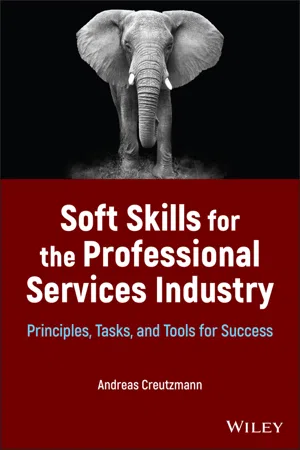
Soft Skills for the Professional Services Industry
eBook - ePub

Soft Skills for the Professional Services Industry

Principles, Tasks, and Tools for Success

  1. English
  2. ePUB (mobile friendly)
  3. Available on iOS & Android
eBook - ePub

Soft Skills for the Professional Services Industry

Principles, Tasks, and Tools for Success

About this book

Soft Skills for the Professional Services Industry

Auditors, accountants, lawyers, consultants, and other highly educated and trained professionals frequently hold impressive credentials and offer clients specialized expertise in complex areas. At the same time, these professionals understandably focus on the analytical and technical components of their jobs, sometimes to the point of excluding or ignoring important soft skills critical to the success of their careers and practices.

In Soft Skills for the Professional Services Industry: Principles, Tasks, and Tools for Success, veteran auditor and entrepreneur Andreas Creutzmann delivers an essential discussion of often overlooked professional competencies that can mean the difference between career, engagement, and business success or failure. In the book, you'll find accessible guidance on critical soft skills that can make a difference between fulfilment and success and failure on a professional and personal level. You'll learn to handle the blending of home and the home office, how to effectively manage staff, how to market yourself and your firm, practical strategies for client and colleague communication, and how to find happiness in your day-to-day work.

Each chapter stands alone and can be read in any order. They provide professionals with invaluable skills for navigating the modern—and digital—reality of work, showing you how to combine your professional education with the latest research and common sense on everything from client management to firm marketing.

Soft Skills for the Professional Services Industry uses the field of auditing as a template and guide, but it is highly relevant to all skilled professionals – including lawyers, consultants, medical professionals, and others. The book is a must-read for any knowledge worker trying to add to their toolbox of practical skills.

Critical guidance for practicing professionals on how to build often overlooked soft skills

Most highly educated and trained professionals aren't lacking in analytical or technical skills. Lawyers know the law, accountants understand double entry bookkeeping, and doctors know anatomy. However, many of us are less familiar with often overlooked—and equally essential—soft skills: client management, communication, staff and employee management, and others.

In Soft Skills for the Professional Services Industry, accomplished auditor, entrepreneur, and consultant Andreas Creutzmann walks you through how to build critical competencies, from self-marketing to balancing work and life when your office is in your house.

The book is made up of numerous, self-contained chapters that can be read in any order, and it demonstrates how to navigate increasingly digital and insistent professional demands on your time, effectively manage client and colleague relationships, and sell new clients on the services your firm offers.

An essential roadmap to achieving personal and career success, Soft Skills for the Professional Services Industry is an indispensable resource for lawyers, doctors, accountants, auditors, and any other extensively skilled professional. It offers practical tools in functional areas that are frequently neglected in formal professional training.

Information

Publisher
Wiley
Year
2022
Print ISBN
9781119875536
Edition
1
eBook ISBN
9781119875543

PART I
Principles of Successful Professionals

CHAPTER 1
Self‐Responsibility

THE PRINCIPLE OF SELF‐RESPONSIBILITY is becoming increasingly important in a time when others are to blame. In both professional and personal life, there are situations where others are to blame for mistakes.

EXAMPLE

Auditors in particular are accustomed by profession to seeking and finding fault with others. After all, the central question in assessing an internal control system is, “What could go wrong and who controls what?” Even if there is no four‐eyes principle, but only machine controls, there are people who are responsible for the programming. There is usually a “culprit“ when something goes wrong with a client's internal control system (ICS). Chances are it's not the auditor and their staff. Since the company's accounting and ICS are the subject of the audit, it appears that it is always the “others“ who are to blame for errors. The client's employees are then held responsible. Nevertheless, unless the auditor and his staff recognize that a control system is ineffective, they quickly get lost in excuses. Who likes to admit failures to a client?
In every company, one person, or a few people are in charge. It should go without saying for business owners that they are responsible for every project outcome. The larger the company, the more likely it is that unsuccessful projects will end up being just a matter of saving one's neck. The partner of a company blames his managers, or even customers (?) for the failure without realizing that perhaps they put together the wrong team, the tasks were not distributed properly, or the project control did not work.
Much worse, however, is often the complaining at all levels in the company and in private life and the proclamation of one's own helplessness.

NOTE

If you say, “I can't,“ you don't want to. Because, in reality, you can do everything. But everything has consequences. You can choose every day! And not to decide is also a choice. The point at which you stand today is based on earlier decisions and rejected alternatives. Everything that happens in the moment is the consequence of decisions in the past. And everything you do, you do voluntarily. However, everything has a price, and not everyone is willing to “pay“ the price for a particular decision.
An employee who rebels against their superior must expect the possibility of not being considered in the next career round. A partner who wins all engagements by competing on low prices should not be surprised about negative contribution margins and possibly lower partner compensation. A person who does not spend time with their life partner and their children must not be surprised if these people distance themselves.

NOTE

N o time“ means: Other things are more important to me. Everything in life is a question of priority: What you really want, you do! The exciting question, however, is: Why are you doing what you are doing right now?
This applies to both professional and personal life. The answers to these questions are important at every stage of life.
As an entry‐level professional, most of the time we receive directions from others. As we advance in our career, we move from being the recipient of instructions to being the person who gives instructions. Those who are at the top of the company only give instructions and usually no longer receive instructions from colleagues. Many times, people do not go through these career phases with an awareness that would be necessary to successfully lead themselves and others. Too often, behavioral patterns and role models are unconsciously adopted by superiors, and the professional does not realize that at the top of their career they are often only a reflection of their former superiors.
Therefore, the psychological knowledge of the following regularities is particularly important.

LAW OF CAUSE AND EFFECT

Everything has a reason, and every effect has its specific cause. Aristotle believed that we live in a world governed by laws and not by chance. He explained that there is a reason for everything, whether it is known to us, or not. There are one, or more causes for every effect. Every cause, or action has some effect. We do not always recognize the cause.
Based on this premise, success is no coincidence! Success has nothing to do with luck. Everything has a reason. However, this reason is not always apparent to everyone. “You reap what you sow” is a well‐known saying from the Bible. Newton's third law, also known as the principle of interaction, the principle of counteraction, or the principle of reaction (“actio equals reactio”), states that for every action there is an equal and an opposite reaction.
Thoughts are causes and circumstances are effects. By changing the way you think, you change your life. All it takes is making a decision. You become what you think most of the time. What you feel and how you react is not determined by what happens, but by how you think about it. It is your inner world that is responsible for the conditions of your life. You yourself determine your feelings and behaviors by the way you view your environment and how you think about the things that happen to you.

NOTE

No event has any power over me except that which I give it in my thoughts!
For professionals, the law of cause and effect is relevant. If an ICS does not work, there is a risk that things will go wrong in the company and be incorrectly reflected in accounting. Lawyers know that missed deadlines lead to the rejection of requests at court. The law of cause and effect does not only apply to these easily understandable facts but to one's own management as well as to the management of others that finds its way into our private lives.

TIP

Pay attention to your thoughts! You become what you think most of the time. Thoughts are causes and effects are circumstances. If you control your thoughts, you can change your life. This applies to your professional life as well as your personal life. You cannot always influence the events in your life. In particular, strokes of fate, or things that you did not cause can have a significant negative impact on your life. You cannot change these things. The only thing you can influence is how you think about the things that happen to you. Your interpretation of events has a direct impact on how you feel. Consider the Serenity Prayer by U.S. theologian Reinhold Niebuhr:
“God, grant me the serenity to accept the things I cannot change, the courage to change the things I can, and the wisdom to distinguish one from the other.“
Develop the habit of analyzing certain events to see if you or others were the cause. Be honest with yourself and take responsibility only where you were actually the cause of the event. This will be the case in many but not all instances. You are exactly where you are in your life now because of decisions you did or did not make in the past. Not deciding is also a decision. You are the cause of your life. Take responsibility for the choices you made in the past and make better choices in the future. Your thoughts are the key to a happy and successful future.

LAW OF FAITH

What we believe deep in our hearts becomes reality. We believe not what we see, but what we already believe. We reject information that contradicts our already established opinions, regardless of whether our beliefs –...

Table of contents

  1. Cover
  2. Table of Contents
  3. Additional Praise for Soft Skills for the Professional Services Industry
  4. Title Page
  5. Copyright
  6. Foreword
  7. Preface
  8. Acknowledgments
  9. Introduction: Professionals in a Digital World
  10. PART I: Principles of Successful Professionals
  11. PART II: Tasks
  12. PART III: Tools
  13. About the Author
  14. Bibliography
  15. Conclusion: Outlook into the Future
  16. Index
  17. End User License Agreement

Trusted by 375,005 students

Access to over 1.5 million titles for a fair monthly price.

Study more efficiently using our study tools.

Frequently asked questions

Yes, you can cancel anytime from the Subscription tab in your account settings on the Perlego website. Your subscription will stay active until the end of your current billing period. Learn how to cancel your subscription
No, books cannot be downloaded as external files, such as PDFs, for use outside of Perlego. However, you can download books within the Perlego app for offline reading on mobile or tablet. Learn how to download books offline
Perlego offers two plans: Essential and Complete
  • Essential is ideal for learners and professionals who enjoy exploring a wide range of subjects. Access the Essential Library with 800,000+ trusted titles and best-sellers across business, personal growth, and the humanities. Includes unlimited reading time and Standard Read Aloud voice.
  • Complete: Perfect for advanced learners and researchers needing full, unrestricted access. Unlock 1.5M+ books across hundreds of subjects, including academic and specialized titles. The Complete Plan also includes advanced features like Premium Read Aloud and Research Assistant.
Both plans are available with monthly, semester, or annual billing cycles.
We are an online textbook subscription service, where you can get access to an entire online library for less than the price of a single book per month. With over 1.5 million books across 990+ topics, we’ve got you covered! Learn about our mission
Look out for the read-aloud symbol on your next book to see if you can listen to it. The read-aloud tool reads text aloud for you, highlighting the text as it is being read. You can pause it, speed it up and slow it down. Learn more about Read Aloud
Yes! You can use the Perlego app on both iOS and Android devices to read anytime, anywhere — even offline. Perfect for commutes or when you’re on the go.
Please note we cannot support devices running on iOS 13 and Android 7 or earlier. Learn more about using the app
Yes, you can access Soft Skills for the Professional Services Industry by Andreas Creutzmann in PDF and/or ePUB format, as well as other popular books in Business & Business Skills. We have over 1.5 million books available in our catalogue for you to explore.