Cutting-edge global dialogue between Muslims and Christians
In late 2007 Muslim leaders from around the world together issued in the pages of
The New York Times an open letter to Christian leaders inviting cooperation as a step toward peace. That letter, "A Common Word between Us and You," acknowledged real differences between the two faiths but nonetheless contended that "righteousness and good works" should be the only areas in which they compete. The 138 signatories included over a dozen grand muftis, an ayatollah, and a Jordanian prince, and the document was widely considered a groundbreaking step toward reconciliation between Islam and Christianity—two major religions with a great deal in common.
That original letter and a collaborative Christian response—"Loving God and Neighbor Together"—both appear in this remarkable volume. Building on those original momentous documents,
A Common Word further includes subsequent commentary and dialogue between Muslim and Christian scholars addressing critical and frequently asked questions. All in all, this eventful book encapsulates a brave and encouraging move toward harmony and accord between two world religions so often seen to be at odds.
Contributors: Martin Accad, Judge Bola Ajibola, Habib Ali Al- Jifri, David Burrell, Harvey Cox, Joseph Cumming, John Kerry, Rick Love, Seyyed Hossein Nasr, Dr. Aref Ali Nayed, Andrew Saperstein, Reza Shah- Kazemi, Miroslav Volf, Melissa Yarrington, HRH Prince Ghazi bin Muhammad bin Talal
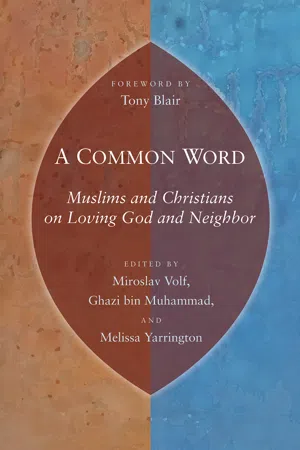
eBook - ePub
A Common Word
Muslims and Christians on Loving God and Neighbor
- 258 pages
- English
- ePUB (mobile friendly)
- Available on iOS & Android
eBook - ePub
A Common Word
Muslims and Christians on Loving God and Neighbor
About this book
Information
Topic
Teologia e religioneSubtopic
ReligionePART I
Invitation and Response
In the Name of God, the Compassionate, the Merciful May Peace and Blessings be upon the Prophet Muhammad
On “A Common Word Between Us and You”
H.R.H. PRINCE GHAZI BIN MUHAMMAD OF JORDAN
“A Common Word Between Us and You” was launched on October 13th 2007 initially as an open letter signed by 138 leading Muslim scholars and intellectuals (including such figures as the Grand Muftis of Egypt, Syria, Jordan, Oman, Bosnia, Russia, and Istanbul) to the leaders of the Christian churches and denominations of the entire world, including His Holiness Pope Benedict XVI. In essence it proposed, based on verses from the Holy Qurʾan and the Holy Bible, that Islam and Christianity share, at their core, the twin “golden” commandments of the paramount importance of loving God and loving one’s neighbor. Based on this joint common ground, it called for peace and harmony between Christians and Muslims worldwide.
Introduction: The Birth of “A Common Word”
In the middle of the eastern Jordanian desert, in a place called Safawi, miles away from anything, from any landmark or any human traces, there stands a unique, solitary tree. This tree is around 1500 years old and there are no other trees to be seen for dozens of miles in any direction. Despite its age and breadth, it is only about 6-8 meters tall. It is a butum tree, a kind of pistachio tree found in Jordan and surrounding countries, and it was under this particular butum tree that “A Common Word” was born. For in September 2007, one month before the launch of “A Common Word,” I had the privilege of visiting this tree twice — once in the company of a number of the scholars behind the “Common Word” initiative — and it was under this tree that we prayed to God (or at least I did) to grant “A Common Word” success.
In what follows, we will endeavor to outline the reasons why the Common Word initiative was so necessary at this time in history by describing the current state of Muslim-Christian relations, the causes for tension between these two religious communities, and the subsequent concerns for the future. After this background, we will describe the goals and motives for launching “A Common Word”; explain what we did not intend by this initiative; discuss the reasons for primarily engaging religious leadership; and, finally, summarize the initial results.
Background: The Current State of Muslim-Christian Relations
In the early 1990s, after the collapse of the Soviet Union, there surfaced various influential political theories regarding the future of the world, including Samuel Huntington’s 1993 thesis of a Clash of Civilizations, Francis Fukayama’s The End of History and the Last Man, written in 1992, and Robert Kaplan’s seminal article The Coming Anarchy of February 1994. In this article, Kaplan uses the image of a luxury car driving one way on a highway and a stream of destitute refugees walking the other way to suggest that while one part of the world is moving comfortably and prosperously forward, much of the rest of the world is suffering horribly and disintegrating due to poverty, disease, crime, conflict, tribalism, overpopulation, and pollution. Assessing each of these theories can help us better understand the historical context of where we are today.
Huntington gets a B. He was right about tension and conflict between Muslims and the West (e.g., Bosnia 1992-95; Kosovo 1996-99; Chechnya 1994-96, 1999-2001; 9-11-2001 and Afghanistan; Iraq 2003-07, etc.) but dead wrong about either side unifying, never mind Muslim countries uniting with China. Moreover, every single Muslim country in the world has denounced terrorism, and the vast majority of governments of Muslim countries have sided with the West in one way or another. Inside Syria and Iran, the two notable exceptions to siding with the West, Christian-Muslim relations are excellent (witness Orthodox Patriarch Ignatius of Antioch’s open letter rebuffing the Pope after his September 2006 Regensburg address).
Fukayama, who declared the triumph of Western-style democracy, gets a C. President George W. Bush’s plan for a new more “democratic” Middle East as outlined on November 6, 2003, to the National Endowment for Democracy still languishes. The most “democratic” (in the Western sense) Muslim countries in the Middle East (Iraq, Afghanistan, Palestine, and Lebanon) are either in civil war or close to it. And as we should know from Hitler’s 1933 election — or from the actions of the majority of Hutus in Rwanda in 1994, or of the majority of Serbs in Bosnia from 1992-95 — western-style democracy simply does not work where: (a) there are no preexisting democratic institutions that can overrule demagoguery; (b) there is no democratic culture that can control and channel fear and hatred; and (c) the majority seeks to gain power in order to slaughter the minority, for reasons that go back hundreds of years. Plato warns us of this in the eighth book of The Republic, and Herodotus hints at it in the third book of his Histories.
Kaplan gets an A-. He was right about increased anarchy and wealth in the world, but he failed to see the unique tensions existing between Muslims and the West. Since Muslims and Christians together constitute over 55% of the world’s population, his omission is significant.
So where are we now? Sectarian wars, and political and religious distrust dominate the peoples of the Middle East and its relationship to the West. Chaos, conflict, and disease ravage the horn of Africa and Darfur. Terrorism threatens everywhere in the world. We pray conflict does not break out in the Persian Gulf.
It is true that polite and educated company all over the world make positive and optimistic comments about the other side, but there is not enough trickle-down to the masses and to popular culture. Moreover, as the current Pew Global survey shows, religious attitudes between Muslims, Christians, and Jews are generally hardening and getting worse, not better. A cursory review of the world’s biggest bookseller, Amazon.com, shows that Americans are buying more books about Islam written by vitriolic former Muslims now touted as experts and sponsored by Christian fundamentalist groups than written by serious Muslim or non-Muslim scholars. In the West there are whispers of a “Long War” — an idea which in the Islamic world is taken to be directed against all Muslims.
Roots: Causes for Tension in Muslim-Christian Relations
We will only briefly sketch some of the major causes of tension, as they are well known. On the Western side are the fear of terrorism; a loathing of religious coercion; suspicion of the unfamiliar; and deep historical misunderstandings. On the Islamic side is first and foremost the situation in Palestine: despite the denial of certain parties, Palestine is a grievance rooted in faith (since Muslim holy sites lie occupied). Added are discontentment with Western foreign policy (especially the Iraq War and Occupation 2003-09); fear and resentment of the massive missionary movements launched from the West into the Islamic World; wounded pride arising from the colonial experience, poverty and unemployment, illiteracy, ignorance of true Islam and of the Arabic language, social and political oppression, and a technology gap. On both sides are vast centrifugal forces unleashed by fundamentalist and extremist movements, and by missionary activity. These far outweigh the centripetal forces set in motion by hundreds of interfaith and intercultural centers all over the world and by world governments (e.g., the Spanish-Turkish “Alliance of Civilizations”; the Russian “Dialogue of Civilizations”; the Kazakh “Dialogue of Confessions”; the Amman Message; the French Atelier-Culturel; the British Radical Middle Way; the Malaysian Islam Hadari; the new Saudi Interfaith Initiative of 2008; etc. — and the umpteen “declarations” of this or that city). The fundamentalists are better organized, more experienced, better coordinated, and more motivated. They have more stratagems, more institutes, more people, more money, more power, more influence.
We are reminded of the words of W. B. Yeats:
Turning and turning in the widening gyre
The falcon cannot hear the falconer;
Things fall apart; the centre cannot hold;
Mere anarchy is loosed upon the world,
The blood-dimmed tide is loosed, and everywhere
The ceremony of innocence is drowned.
The best lack all conviction, while the worst
Are full of passionate intensity.
In short, Muslim-Christian relations are characterized by deeply rooted, historical, cultural, and racial misunderstanding, suspicion, and even loathing. Thus now, according to the results of the largest international religious surveys in history (as outlined in a recently-published seminal book by Professor John Esposito and Dalia Mogahed and discussed at the Yale conference), 60 percent of Christians harbor prejudice against Muslims and 30 percent of Muslims reciprocate. Quite clearly, the grounds for fear of war and religious genocides are starkly real.
Fears: The Future of Muslim-Christian Relations
With such an explosive mix, popular religious conflicts — even unto genocides — are lurking around the corner. Indeed, one such conflict took place a few hundred miles away from where the Pope sits only fifteen years or so ago (that is, from 1993-95) in the heart of Europe, when 300,000 innocent Muslim civilians were slaughtered and 100,000 Bosnian women were raped as a method of war. And our feeling is still that, God forbid, a few more terrorist attacks, a few more national security emergencies, a few more demagogues, and a few more national protection laws, and then internment camps (like those set up for Americans of Japanese origin during World War II) — if not concentration camps — are not inconceivable eventualities in some places, and that their fruition would inevitably spawn global counter-reactions.
The Holocaust of six million Jews — then the largest religious minority in Europe — occurred sixty-five years ago, still within living memory. This is something that Muslims in the West, now the largest minority, should contemplate as seriously as Jews do. For unfortunately we are not now inherently immune to committing the crimes of the past — our nature and worst potential has not fundamentally changed. Moreover, as the Gallup survey showed, we are now actually at the stage where we (as Christians and Muslims) routinely mistrust, disrespect, and dislike each other, if not popularly and actively trash, dehumanize, demonize, despise, and attack each other. This is the stage at which Hutus and Tutsis (both Christian tribes, by their own confession at least) were in Rwanda before the popular genocide-by-machete of nearly one million people in 1994. How much easier would it be for Muslims and Christians — who ha...
Table of contents
- Cover
- Title Page
- Copyright
- Contents
- Foreword, by Tony Blair
- Preface
- Part I. Invitation and Response
- Part II. Muslim Perspectives
- Part III. Christian Perspectives
- Part IV. Frequently Asked Questions
- Part V. Political Significance of “A Common Word”
- Appendix 1: The Addressees and Signatories of “A Common Word Between Us and You”
- Appendix 2: The Signatories of the Yale Response, “Loving God and Neighbor Together”
- Contributors
Trusted by 375,005 students
Access to over 1.5 million titles for a fair monthly price.
Study more efficiently using our study tools.
Frequently asked questions
Yes, you can cancel anytime from the Subscription tab in your account settings on the Perlego website. Your subscription will stay active until the end of your current billing period. Learn how to cancel your subscription
No, books cannot be downloaded as external files, such as PDFs, for use outside of Perlego. However, you can download books within the Perlego app for offline reading on mobile or tablet. Learn how to download books offline
Perlego offers two plans: Essential and Complete
- Essential is ideal for learners and professionals who enjoy exploring a wide range of subjects. Access the Essential Library with 800,000+ trusted titles and best-sellers across business, personal growth, and the humanities. Includes unlimited reading time and Standard Read Aloud voice.
- Complete: Perfect for advanced learners and researchers needing full, unrestricted access. Unlock 1.5M+ books across hundreds of subjects, including academic and specialized titles. The Complete Plan also includes advanced features like Premium Read Aloud and Research Assistant.
We are an online textbook subscription service, where you can get access to an entire online library for less than the price of a single book per month. With over 1.5 million books across 990+ topics, we’ve got you covered! Learn about our mission
Look out for the read-aloud symbol on your next book to see if you can listen to it. The read-aloud tool reads text aloud for you, highlighting the text as it is being read. You can pause it, speed it up and slow it down. Learn more about Read Aloud
Yes! You can use the Perlego app on both iOS and Android devices to read anytime, anywhere — even offline. Perfect for commutes or when you’re on the go.
Please note we cannot support devices running on iOS 13 and Android 7 or earlier. Learn more about using the app
Please note we cannot support devices running on iOS 13 and Android 7 or earlier. Learn more about using the app
Yes, you can access A Common Word by Miroslav Volf, Prince Ghazi bin Muhammad bin Talal, Mellisa Yarrington, Miroslav Volf,Prince Ghazi bin Muhammad bin Talal,Mellisa Yarrington in PDF and/or ePUB format, as well as other popular books in Teologia e religione & Religione. We have over 1.5 million books available in our catalogue for you to explore.