In 1970 a scraggly, antiheroic man from North Carolina by way of Massachusetts began presenting a comforting yet biting new sound. Within a year, when young ears sought the latest in rock, there was "Fire and Rain" and "You've Got a Friend," and a new Southern California-fed branch of pop music. James Taylor was its reluctant leader.
Remarkably, Taylor has survived: his 2015 release,
Before This World, edged out Taylor Swift and went to No. 1 on the charts. Today he is in better physical (and probably mental) condition than during the whirlwind era when he influenced music so heavily, the decade when magazines and newspapers printed feverish stories about his gawky hunkiness, his love affair with Joni Mitchell, his glittery marriage to Carly Simon, his endlessly carried-out heroin habit, and sometimes even his music. Despite it all, Taylor has become the nearest thing to rock royalty in America.
Based on fresh interviews with musicians, producers, record company people, and music journalists, as well as previously published interviews, reviews, and profiles,
Sweet Dreams and Flying Machines is the definitive biography of an elusive superstar.
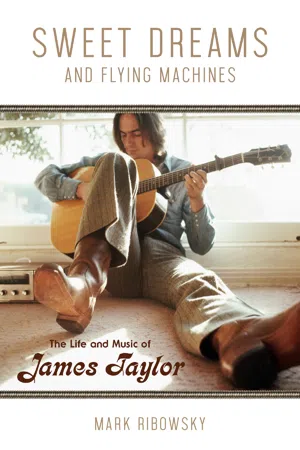
- 416 pages
- English
- ePUB (mobile friendly)
- Available on iOS & Android
eBook - ePub
About this book
Information
Subtopic
Music Biographies1
HOW SWEET IT IS
Sunrise, Florida, November 15, 2014
Sunrise, a city sitting on the west end of Broward County that borders the swamps of the Everglades, one of those wistfully named Florida hamlets that draws people of all sorts to its sleepy hollows, gets James Taylor tonight. Which means the newly rooted baby boomers will congregate in the town’s glittery corporate jewel, the BB&T Center, for another exercise in uncluttered nostalgia and yuppie contentment, as they did when Elton John christened the place in 2001. On a cool night on what passes for autumn here, under the palm leaves encircling the parking lot of the arena, only half the spaces are filled just minutes before Taylor will take the stage. Though lines wait to get through the doors, the pace is orderly, calm; no one seems in a hurry. Wedged between two midlife-crisis symbols, a BMW and a Porsche, a card table has been set up, and two couples who look to be in their late fifties or early sixties sit around it, lounging, sipping, talking, laughing, the men in pleated slacks and short-sleeve Hawaiian shirts, the women in white jeans and low-cut tops.
“What’s going on here?” a stranger joshes them.
“Having a little wine and cheese party,” one of the women says.
“Shouldn’t you be getting inside? Show time’s eight o’clock.”
“James will wait for us.”
“Why? You guys know him?”
“No, but with James, it’s like he knows us. You know, we’re his audience. He’ll wait for us.” She has a thought. “You know, I probably never had wine and cheese before I heard James. Something about him, it makes you feel like you want to have wine and cheese.”
The party at the table laughs, then goes back to their Whole Foods crackers and breezy conversation.
Inside, the feel is of a larger but still intimate wine and cheese party. The spacious arena seems full, every opulent luxury box lit, but the entire top tier of the hall has a dark curtain all around it, closed off because not enough tickets were bought for up there, sparing embarrassment to Taylor, who can still move tickets but not as many or for as much money as the next two high-level acts who’d come through Sunrise, John Mellencamp and Fleetwood Mac. To his relief, though, tickets were moving quite well for a Taylor show at Madison Square Garden in early December.
In the now teeming lower level, the almost all-white crowd waits, still without impatience; the two couples in the lot will indeed make it in time. At around 8:15, the place is darkened but for an illuminated stool on the stage. With no introduction, a solitary six-foot-four-inch man emerges from the dark, at first to silence, then building applause. He walks to the front of the stage, shakes a few hands, then sits on the stool, guitar in hand. The face is overly familiar, recognizable even from a distance, craggy but soft, the square chin and eagle-like eyes of a Grant Wood portrait. Indeed, Time magazine as far back as 2001 noted that Taylor had “a great American face . . . a face out of Steinbeck, long and spare, radiating intelligence and surprising strength for a man known for his soft lyric.” Fourteen years on, one could almost call that face Rushmore-like.
But not old, really. Eagle eyes don’t squint and they don’t sink. They peer into other animals’ souls. James Taylor is about to do that, once again, just looking at his audience. As he does, the feeling is palpable through the hall: Does this man, who has long been shrouded in self-imposed, semi-isolation from society, ever change? Not only are his songs frozen in time—Taylor is.
“He’s wearing the same thing he wore on the Troubadour Tour in 2010!” a woman who has known Taylor for years muses, referring to the Taylor “uniform”: loose, dusty pants, white and well-worn shirt, linty brown sport jacket, all looking like he’d slept in them.
He is a proud kind of fossil. Even now, he can neither write music nor read it; he only plays and sings it. As he eases into his first song, the now antediluvian “Something in the Way She Moves,” it is like almost every other title in his long catalog, reflective of himself. Years after he lost his freak-flag hair and Harry Reems mustache, there is surely something in the way he moves through a song. The voice. Good God, the voice. No instrument on earth that has been around as long as his throat has accumulated as little rust or evidence of age. It has the same timbre, the same faintly Irish-folk hue, the same restrained power. This must be a tribute to the most obvious irony of all for Taylor—clean living. Bell-clear and nuanced at every rise and fall, Taylor’s tight baritone range is unconfined because of nuances that constantly color different aural-visual images, allowing for a typically eclectic set list on this night, a remarkably deep and broad palette of musical styles, meters, and influences, and of one man’s ability to perform them flawlessly.
It will take him three hours to render them all, with an intermission, in the manner of a Bruce Springsteen concert. The set list is a far-reaching buffet that, after “Something,” includes “Today Today Today,” “Lo and Behold,” “Copperline,” “Everyday,” “Country Road,” “Millworker,” “Carolina in My Mind,” “One More Go Round,” “Sweet Baby James,” “Shower the People,” “Stretch of the Highway,” “You and I Again,” “Raised Up Family,” “Handy Man,” “Steamroller,” “Only One,” “Fire and Rain,” “Up on the Roof,” “Mexico,” and “Your Smiling Face.” The encore begins with “How Sweet It Is (To Be Loved by You),” and “You’ve Got a Friend.” And he will seem as fresh and energetic at the end as he was at the start, kept buoyant by the backing unit billed as Taylor’s “all-star” band—Andrea Zonn on fiddle; horn men Lou Marini and Walt Fowler; guitarist Mike Landau; bass player Jimmy Johnson; pianist Larry Goldings; percussionist Luis Conte; drummer Steve Gadd, who first teamed with Taylor in ’91 on the New Moon Shine album; and backup singers Zonn, Kate Markowitz, Arnold McCuller, and David Lasley, the last a Taylor accomplice since the early ’70s.
For decades, Taylor was probably the least animated and happy act in rock to see live. In 1971, one review of a Taylor performance began: “As opposed to coming on strong in the time honored tradition of super-stars—James Taylor comes on weak! He is the first and the foremost of the low-key rock and roll stars and onstage presents the public image of a vulnerable, ambulated American string-bean with braces.” Another scold sniffed about the then new wave of singer-songwriters that “the basic problem with both British and American artists in this genre is an overpowering intensity and a shocking lack of humor.”
By that, he really meant James Taylor—who one writer said had “massive egotism and exhibitionistic tendencies”—fought tooth and nail with his natural depressive tendencies, agoraphobia, and insecurity. Not surprisingly, future holy man Cat Stevens’s first impression of him was that he was “James Taylor of the disturbing voice and eye.” Taylor’s justifications for being antisocial often reeked of pomposity. “I enjoy selling my music. I don’t enjoy selling myself,” he said in 1971. “Photographers and reporters are mostly after me. They want to know what I read and what I’m like and I don’t really know myself so how can I tell them? I’d just like to see a lot of this confusing rubbish go away and get back to those old times. If I could go back I would. I’m looking forward to being able to retire from being a public figure and being able to afford to be myself!”
He was all of twenty-three when he said that.
It has taken decades for it to happen, as an elder statesman and national asset, with a Medal of Freedom medallion to show for it. And so here he was, one-nighting in the glades of Southern Florida, exhibiting a shocking sense of humor, telling stories about songs so offhandedly that one could forget that there are maybe two humans in the world who could say something like this, as he does after “Something in the Way She Moves”:
“That song means a lot to me. Um, in 1968 I played it for Paul McCartney and George Harrison in a little room in London. They were starting Apple Records. It was my audition and, well, um, you know the rest.”
Taylor can also crack on himself. “Don’t pay attention to the lyrics,” he coos before embarking on “One More Go Round,” a song from the 1991 New Moon Shine album that he had not sung live before this tour. Funny enough, given its nonsensical rhyming—“Running around the room / In my Fruit o’ the Loom / A cup of coffee from King Tut’s tomb.” He also makes mocking reference to one or another of the most familiar tunes as “old” or “a sixties song” or “a little bullshit thing I did for the Sweet Baby James album,” bringing lusty laughter from the hoary boomers, not above a little self-effacement themselves.
Some songs will run in stark minimalism, others enlivened by a light show—not one that Pink Floyd would lift an eye at but one that, for a Taylor gig, is dazzling to the eye. And there is the Taylor, well, inscrutability. Telling as he has for four decades the genesis of “Sweet Baby James” and the baby famously named after him by his ill-fated brother Alex (“It’s touching . . . if you like kids”), he further muses, “Just goes to show that anyone can have a kid,” to nervous titters, the tragic demise of Alex being known to all, except perhaps Kathie Lee Gifford. An alternate line he often uses about Alex Taylor is “You take your eyes off them for a minute and they divide.” Maybe only a shrink would understand why lines like that seem funny to him.
What one is left with, however, is not his attempts at humor but how he can still keep an arena spellbound with a few notes. During “Fire and Rain” and “You’ve Got a Friend,” when the place becomes a mass, quiet sing-along, sniffles can be heard as old tears begin to run again. But not for long. With Taylor, pop bleeds into blues, and tonight when he reprises his funky blues foray “Steamroller”—written as a send-up of white blues bands in Britain during his sojourn there, and first played live on February 6, 1970, at the Jabberwocky in Syracuse—his long legs unfold and he rises into a happy dance across the stage, making his face a rubbery mask of Louis Armstrong.
“Who is that guy?” says someone in the audience. “I’ve never seen him like this. It’s like . . . he’s having fun.”
Of course, his signature emotion is and always will be that of loneliness. Of all his peerage, his voice is closest to that of the human heart. A song like “Don’t Let Me Be Lonely Tonight,” heavily influenced by Roy Orbison and subsequently influencing other great soft-rock pleadings like Bob Seger’s “We’ve Got Tonight,” carries an essential truth—that of, as Cheech Marin once said, “the greatest pickup song in the history of the world. If you can’t get laid to that song . . .”
No one knows this better than Taylor, who can make any song an aphrodisiac and has tried strenuously to not make himself into Barry (Very) White. His song catalog is so long, so diverse, that he has always been able to indulge his lesser-known but personally edifying numbers, and when the heat of the crowd cools a bit, crank up a master work. Thus, making them wait for “Fire and Rain” until the eighteenth song, deep into the second act, a wonderful case of not shooting one’s wad too soon; in fact, it strategically shifted the show into its home stretch, with four humdingers culminating in “Your Smiling Face” and the rousing encore.
Even here, though, Taylor had a curve ball, the last song of the night being his folksy, searching cover of Francis McPeake’s 1957 arrangement of an old Scottish folk tune by nineteenth-century poet Robert Tannahill, “The Wild Mountain Thyme.” Its refrains about “the blooming heather” bring to mind a reviewer’s take that Crosby, Stills and Nash’s “Clear Blue Skies” was “the kind of dippy ‘aren’t-trees-nice’ song that makes James Taylor so annoying.” And while it sent many baby boomers out into the night while he was still singing it, such is part of the price of admission to see Taylor, a man who needs you to know he is comforted not by fame but by God’s good earth and his place in a great universal something.
After the last note is sung and the last chord played in Sunrise, Taylor took bows with his band and backup singers, then engaged in individual and group hugging, then some handshaking with the fans. It took him a good fifteen minutes before he was ready to take his leave. As a parable for his enduring popularity and viability, it worked; the guy who once couldn’t run from the stage fast enough is happy to overstay his welcome.
“We love you!” a woman screams from further back, piercing a softening din.
He looks up, trying to locate where it came from. “Love you, too . . .” he is compelled to call out, awkwardly, then seems to wonder if he’s given a little too much of his inner self.
“. . . I guess,” he adds, almost under his breath.
For James Taylor, love is never given or taken easily, or without cause. Jokes he can do. The working of the human heart and the baggage it always seems to leave, that’s nothing to trifle with. He probably was writing a song in his head about it as he shook his last hand.
2
“IF YOU’RE TAYLOR
AND A MALE . . .”
“Southern gentleman” James Vernon Taylor was not born in the South, nor was his lineage filled with many gentlemen. Indeed, in the matter of the Taylor men, perhaps the most charitable thing that can be said of them was that they knew how to make an almighty dollar, and asses of themselves. Unlike the famous scion who would sing so movingly about spiritual soul searching, the Taylor ancestral males were irreligious or outright atheistic, and frequently in a bunch of trouble. This heritage of rounders and bounders has been traced back, on his mother’s side, to seafaring commercial interests along the Angus coast of eighteenth-century Scotland. The late Billboard editor Timothy White, whose longtime close relationship with Taylor allowed him access to a sheaf of family research into Taylor’s lineage, dutifully shaped an obeisant 2000 authorized biography of Taylor written for a British publisher into a stupefying tale of intrepid seafarers and merchants, their wives only pertinent for the children they delivered. That odyssey labored on for forty-seven pages before Taylor’s birth seemingly intruded on the story.
The trail began in the early 1600s with one John Tailyeour, treasurer of the town council in Montrose, and his son, the intrepidly christened Hercules Tailyeour. Their descendants bled through Scotland, raking in money and sailing the wide seas, with perhaps apocryphal tales of being shipwrecked and daringly rescued. The first James Taylor—Hercules’s grandson—prospered along with his brother Robert in the mid- and late 1700s, and it was his son, Isaac Taylor, who moved the narrative across the sea, sailing with his brother John to the British colonies in America in 1790 to plant the Taylor flag in the New World. They settled in North Carolina, in the port town of New Bern, just off the snakelike Neuse River inlet—though maybe a more poetic destination might have been Scotland Neck, to the north—anglicized the family name, and planted that flag squarely in the soil of the most peaceful and thriving sector of America’s antebellum South, on a ...
Table of contents
- Cover Page
- Title Page
- Copyright Page
- Contents
- Introduction - The Troubadour
- 1 - How SweeT It Is
- 2 - “If You’re Taylor and a Male . . .”
- 3 - Carolina in My Mind
- 4 - The Need for Connection
- 5 - A Victim of Hippiephrenia
- 6 - Something’s Wrong
- 7 - Apple Scruff
- 8 - “It’s Like Being Dead”
- 9 - California Scheming
- 10 - Acts of God
- 11 - “Where’s Joni?”
- 12 - Granfalloon
- 13 - “That’s My Husband”
- 14 - “That James Taylor Thing”
- 15 - “A Functional Addict”
- 16 - “He Goes Away Forever Every Day”
- 17 - Mockingbirds
- 18 - Sparks in the Darkness
- 19 - Never Mind Feeling Sorry for Yourself
- 20 - Hourglass
- References
- Index
- Photo Insert
Trusted by 375,005 students
Access to over 1.5 million titles for a fair monthly price.
Study more efficiently using our study tools.
Frequently asked questions
Yes, you can cancel anytime from the Subscription tab in your account settings on the Perlego website. Your subscription will stay active until the end of your current billing period. Learn how to cancel your subscription
No, books cannot be downloaded as external files, such as PDFs, for use outside of Perlego. However, you can download books within the Perlego app for offline reading on mobile or tablet. Learn how to download books offline
Perlego offers two plans: Essential and Complete
- Essential is ideal for learners and professionals who enjoy exploring a wide range of subjects. Access the Essential Library with 800,000+ trusted titles and best-sellers across business, personal growth, and the humanities. Includes unlimited reading time and Standard Read Aloud voice.
- Complete: Perfect for advanced learners and researchers needing full, unrestricted access. Unlock 1.5M+ books across hundreds of subjects, including academic and specialized titles. The Complete Plan also includes advanced features like Premium Read Aloud and Research Assistant.
We are an online textbook subscription service, where you can get access to an entire online library for less than the price of a single book per month. With over 1.5 million books across 990+ topics, we’ve got you covered! Learn about our mission
Look out for the read-aloud symbol on your next book to see if you can listen to it. The read-aloud tool reads text aloud for you, highlighting the text as it is being read. You can pause it, speed it up and slow it down. Learn more about Read Aloud
Yes! You can use the Perlego app on both iOS and Android devices to read anytime, anywhere — even offline. Perfect for commutes or when you’re on the go.
Please note we cannot support devices running on iOS 13 and Android 7 or earlier. Learn more about using the app
Please note we cannot support devices running on iOS 13 and Android 7 or earlier. Learn more about using the app
Yes, you can access Sweet Dreams and Flying Machines by Mark Ribowsky in PDF and/or ePUB format, as well as other popular books in Media & Performing Arts & Music Biographies. We have over 1.5 million books available in our catalogue for you to explore.