eBook - ePub
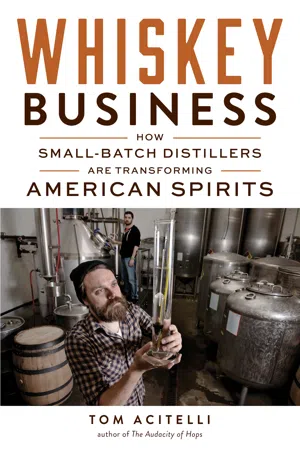
Whiskey Business
How Small-Batch Distillers Are Transforming American Spirits
- 352 pages
- English
- ePUB (mobile friendly)
- Available on iOS & Android
eBook - ePub
About this book
Discover the underdog story of the improbable rise of small-batch distilling in America. This bracingly written, fast-paced work traces the relationship of Americans to spirits such as bourbon, scotch, vodka, gin, and rum. And it presents the full story of a plucky band of entrepreneurs who disrupted the nation's conception of how those libations could appear and taste—and how much they could cost. Acitelli weaves the unlikely triumph of the small-batch distilling movement into other major trends, including a neo-Prohibitionism that nearly croaked the entire thing, America's re-embrace of cocktails, and the twin rises of craft beer and fine wine. He also expertly delves into the controversies currently wracking American spirits, ones that threaten to tank the movement at the moment of what should be its greatest triumph.
Information
Topic
ArtSubtopic
EntrepreneurshipPART I
“THAT SHIT WILL BLOW YOUR EARS OFF”
1953–1959|Loretto, Kentucky
Bill Samuels grew up around bourbon, though he did not particularly like the dark brown, corn-based spirit that had been distilled in Kentucky since before American independence. The Samuels family had been making bourbon commercially since at least the mid-1800s, perhaps even further back to when much of Kentucky was the far western frontier of the Commonwealth of Virginia. Samuels’s great-grandfather, T. W. Samuels, started an eponymous distillery in Deatsville, forty miles south of Louisville, in 1844. The ownership structure changed in the twentieth century, including before and after Prohibition in the 1920s and early 1930s, although it always involved the Samuels clan, which lived on Whiskey Road in nearby Bardstown. Neighbors included James Beauregard Beam, whose nickname and surname would grace perhaps the world’s most famous bourbon label. The brown-haired, slimly built Bill Samuels, then just twenty-six, took over management of the distillery in 1936, after his father died. Amid this change, one thing held constant: the iffy quality, and therefore taste, of T. W. Samuels’s whiskey, which, through its corn-heavy recipe, was technically from the bourbon branch of the stylistic spirit tree.
“That shit will blow your ears off.” That was the assessment of Marge Samuels, Bill’s wife, of bourbon in general in the 1950s. Distilled primarily from corn, bourbon distillers also typically added rye, a coarse grain that gave it a rougher mouthfeel, and barley, used primarily to spur fermentation. (Its enzymes broke down the grains’ starches into sugars, which yeast could then convert into ethanol.) The smell and taste of that alcohol was also front and center for most bourbon, condemning it to be the sort of firewater one knocked back quickly and with a chaser of beer, water, or something else coldly soothing, rather than sipped genteelly for the texture and aroma. Bill Samuels himself had a physical aversion to spiciness. He never ate Mexican food, for one thing, and he found drinking bourbon, even his family’s, a chore rather than a delight—something akin to a waking nightmare for a resident of Kentucky, which produced nearly all of the world’s bourbon and which very likely gave the spirit its name through its Bourbon County (which was once much bigger than its present-day borders). The state’s signature beverage was often described as a back-of-the-mouth drink best swallowed fast for a rollicking buzz, not a front-of-the-mouth one for a tippler to roll around the tongue and savor.
One reason for this perception was the rye-reliant tradition. Another was the larger bourbon industry itself, abetted by the federal government. American bourbon makers staggering out of Prohibition in 1933 faced stiff competition from foreign imports, particularly whiskeys from Ireland, Scotland, and Canada. The former two had never dealt with a widespread alcohol ban, and Canada’s experiment with prohibition ended long before that of the United States. To hurry up and compete, bourbon makers released wares that had not been sufficiently aged—bourbon usually spent at least a few years in new oak barrels, which had been charred on the inside first, before bottling. The resultant releases tasted terrible to seasoned bourbon drinkers, and they saddled the brownest of the brown whiskeys in America with a reputation as “swill,” according to one observer. Nothing in the rules, though, prevented distilleries from spilling this swill on to the market. Federal benchmarks dictated that a whiskey could call itself bourbon if at least 51 percent of its grain bill was corn, it was aged in previously unused oak barrels that had been charred on the inside, and it entered the aging barrel at a certain alcohol strength (or proof) and was bottled at a certain proof as well. These were not exactly exacting regulations, and some distillers took advantage to produce oceans of so-so product as more and more lighter whiskeys and blends flooded the market.
World War II placed the industry at a further disadvantage. The federal War Production Board took over the distilling industry nationwide and swung it from making ethyl-alcohol-based beverages such as bourbon to industrial alcohol. Materials such as grains and glass became scarcer, too, as the fight against fascism in Germany, Japan, and Italy gobbled up more and more resources. This caused much of the US bourbon industry to stand largely still in the 1940s, when it could have been using the time to ramp up its presence versus the foreign interlopers. Some people in the bourbon industry decided to get out of the game altogether. At the start of the 1940s, Robert Block, a Cincinnati businessman who partnered with the Samuels family during those anxious days after Prohibition, sold control of T. W. Samuels distillery in Loretto to a New York company that then changed the distillery’s name to Country Distilleries. Bill Samuels initially fought the sale and then, realizing there was nothing he could do, sold his shares and left the now-former family firm shortly afterward to launch his own distillery. He did not need the money—the sale of the shares ensured a comfortable life, as did some property he already owned. By all accounts, though, Bill Samuels Sr. was a restless sort, especially when it came to bourbon and his family’s history with it. He could not just sit around the house in Bardstown. He had to do something. The Samuels name in spirits could not be allowed to end with a partner’s sale to a third party out of New York City.
Legal wrangling over the new distillery’s use of the Samuels name held up Bill Samuels’s launch for a decade. An appellate court eventually affirmed a lower bench’s ruling that some aspects of the Samuels name could appear on the new distillery’s packaging, but it could not use T. W. Samuels as a brand name. That restriction would become a moot point shortly after 1953, the year Samuels purchased a two-hundred-acre farm in Loretto. The farm had been the site of an old distillery, built over ten buildings in the 1880s, that Prohibition forty years later wiped out. Samuels renamed his larger property Star Hill Farm and began restoring the distillery buildings with the aim of producing bourbon. Not just any bourbon, however. To smooth the drink’s rough edges, and for his own palatal edification, he developed a recipe that did not include rye and that instead leaned on winter wheat as the secondary ingredient after the style-defining corn, with barley making up the rest of the grain bill. It was not a particularly original pivot. The distillery at Star Hill Farm had made an industrial alcohol using wheat. As for spirits, George Washington’s distillery at his Mount Vernon, Virginia, estate had experimented with wheat a century and a half before, as had other distilleries more recently, including Stitzel-Weller in Shively, Kentucky, just southwest of Louisville. Traveling salesman Julian “Pappy” Van Winkle and a friend started Stitzel-Weller in 1935 after buying up a wholesaler and a distillery and then combining the two. Its brands, including Old Fitzgerald and Rebel Yell, used wheat. Samuels was friends with Van Winkle, and he was among those consulted as Samuels built the recipe for his new bourbon around wheat. The secondary ingredient, then, was not new, but the way Samuels intended to wield its effects was positively revolutionary for the early 1950s. Here would be a wheated bourbon deliberately crafted in small batches for drinkers to savor. Perhaps it would change the public’s entire perception of bourbon. Such an approach, with wheat at its back, flew in the face of both history and the marketplace.

Star Hill in bucolic Loretto.
MAKER’S MARK
The genesis of bourbon stretched back to at least the Seven Years’ War, a conflict between the United Kingdom and France over territories in the New World. The United Kingdom won in the early 1760s and took as part of its booty the area containing the future Commonwealth of Kentucky. Scotch and Scotch-Irish settlers pushed into the new British holding, taking with them their thirst for whiskey. That whiskey had relied upon grains such as barley and rye for its production, grains that were harder to come by in the new land, which the Appalachian Mountains cut off from suppliers on the East Coast and the terrain of which was not as fertile a ground for the sprouts. So the settlers instead grew corn, a crop that Native Americans had long cultivated in the area’s rockier, sandier soil. Corn, then, became the ballast for the settlers’ whiskey. They also borrowed from French Cognac makers and Caribbean rum distillers the idea of barrel aging, in this case in charred oak, so as to smooth out this harsher whiskey as much as possible (and, as it happened, to turn its color brown). The uniformity of aging for any greater length of time came later. The work involved in producing bourbon was too much for settlers living hand to mouth to have it end in waiting years for a sip. But by the dawn of the nineteenth century, the outline of bourbon as a distinct American spirit was clear—corn, charred barrels, some aging—so much so that the federal government in the following century would use that outline as the parameters for recognizing bourbon as “unlike other types of alcoholic beverages, whether foreign or domestic.”
As for the contour of that Bourbon County, it too became much clearer. The domain simply known as Bourbon, after the surname of the French royal family, had once encompassed some thirty-four of present-day Kentucky’s counties. It shrank to its current borders just northeast of Lexington in 1785, seven years before Kentucky broke off from Virginia as America’s fifteenth state. By that time, this newfangled whiskey style that the county had likely given its name to was spreading throughout the emerging nation via the Kentucky-bordering Mississippi and Ohio Rivers. Many of the industry’s first families, too, including the Samuelses and their neighbors, the Beams, were firmly established in the trade around this time. Bourbon and tobacco became the principal exports from Kentucky’s interior just after the start of the nineteenth century. Customs officials in Louisville recorded 2.25 million gallons of bourbon passing through just the Ohio River in 1822, a volume nearly ten-fold greater than just twelve years before. Technological improvements in the coming decades, especially the railroads, which shipped vast amounts of corn from newly settled territories such as Nebraska and Iowa, only boosted bourbon’s popularity and production numbers. Corn cultivation in the United States leaped from 838 million bushels just before the Civil War to 2.7 billion at the dawn of the twentieth century forty years later. As for that Civil War in the 1860s, it rent Kentucky, a slave state that stayed in the Union, with guerilla warfare, invasions and counterinvasions scarring its landscape. “I hope to have God on my side,” President Abraham Lincoln, a native Kentuckian, was reputed to have said at the start of the war, “but I must have Kentucky.”
Still, the bourbon flowed. So popular was it that unscrupulous distillers took advantage of its reputation, and of the technological advances, to churn out counterfeit bourbons, usually cheaply made, little-aged whiskey with no more than brown food coloring added. The federal government intervened forcefully, beginning with landmark legislation in 1897 that stipulated the origins and aging times of whiskey in general. The so-called Bottled-in-Bond Act also stipulated when taxes could be collected—generally, after the whiskey comes out of the barrel after years of aging—allowing distillers to better plan their payments. Previously, the federal government could collect at will. The new rules, though, did little to curb the production of inferior bourbons, especially ones that had not been aged sufficiently. Distillers with an eye more on the margins than the mouthfeel continued to churn out the ear-burning firewater that Marge Samuels so disdained.
Still, as Bill Samuels prepared to launch his own distillery on Star Hill Farm, it looked like Americans could not get enough of that corn-infused firewater. From 1951 to 1962, production of Scotch and Canadian whiskey, two of the lighter whiskeys that made their runs at bourbon following Prohibition and through World War II, increased by 12.4 million and 5.3 million gallons respectively. Bourbon production, however, catapulted to 37.5 million gallons during the same period. In 1950 bourbon accounted for nearly a quarter of the bottled whiskey in the United States. In 1961 it would claim just under half. One reason for this was a genuine thirst for the spirit, one born of decades of familiarity. Another reason was a concerted marketing effort on the part of distillers and, in some cases, their corporate parents. Paid advertising in newspapers and magazines painting bourbon as a natural accoutrement to any civilized evening increased several times over during the 1950s—in the case of magazines a stunning thirty-fold. That “shit” might “blow your ears off,” but more and more living rooms featured a cabinet stocked with not just one but a few brands of bourbon. Bourbon had entered a statistical golden age of robust demand, with sales on their way to increasing 200 percent for the twenty years after World War II and exports running to more than one hundred nations. The Kentucky-centric bourbon industry had survived Prohibition, the war, intense foreign competition, and its own questionable (and indifferent) quality. And it was thriving. Why mess with a steady success born of centuries of experience? What was T. W. Samuels’s great-grandson thinking?
It was not only that his bourbon recipe would substitute milder wheat for chalkier rye; it was also that Bill Samuels planned to produce his whiskey in smaller batches—and charge more for it. The trend as the industry boomed had been toward larger and more modern distilleries, complete with vast warehouse floors studded with stainless-steel vats, tuns for mashing, and tall column stills for large-scale distilling. Samuels’s operation would be out of the tinier nineteenth-century distillery in tiny Loretto, with its population of a few hundred souls. And it would lean heavily at first on squatter, more traditional pot stills instead of the long-necked column ones, which, while more efficient, generally did not impart as much complexity and texture to darker spirits such as bourbon (though bourbon makers often employed both, the pot stills were used in a second distillation for those complexities and textures). As for the price, Samuels’s bourbon would retail for perhaps as much as three dollars more per bottle than the wares of competitors such as Jim Beam. Not that too many people regarded Samuels’s start-up as serious competition. Even relatives saw it as more a hobby than anything. The trend was toward bigger, not smaller, and not just through greater production and grander production facilities. Jim Beam, for instance, conveniently made its bourbon available to bars near the rapidly multiplying number of US military bases worldwide. Besides, rye had worked just fine as the secondary grain in bourbon for as long as anyone could remember. Never mind that Samuels’s distillery was not simply out of context for bourbon in the 1950s, it was out of context for American food and drink in general. Americans, a postwar economic boom at their backs, wanted speed and sameness. Swanson introduced the first TV dinners in 1954. They could be zapped to edibility in minutes in microwaves, a newer invention that was on its way to outselling gas-range stovetops. The first McDonald’s franchises opened in the early 1950s, and supermarkets arose around the same period—one-stop food shopping for the first time in the histories of many cities and towns.
Nothing illustrated the national craving for sameness and speed in food better than what was happening in drink, specifically in beer and wine. The number of breweries had shrunk precipitously following World War II, as big producers such as Miller and Anheuser-Busch used their superior capital to scale up. Soon five breweries would produce more than half of the nation’s beers, and almost everything produced was a bland, watery spin on the classic Czech lager type called pilsner. It was easier to make than more nuanced lager and ale styles and could ship well far and wide on the nation’s new interstate highway system, which also grew up in the 1950s. As for wine, a similar consolidation was in order. The E. & J. Gallo Winery out of Modesto, California, was on its way to claiming an incredible one-third of the bottles sold in the United States. And most of those bottles, from Gallo and other competitors, were of sweeter, fortified wines made from nondescript, utilitarian grapes such as Carignan and Alicante Bouschet. Only a handful of wineries worked with the likes of Cabernet Sauvignon and Chardonnay, and their distribution was infinitesimal in comparison, as was the cultivation of grapes they used. Take Merlot grapes. By 1960 the variety covered only fifty acres of California, while Alicante Bouschet, a thick-skinned, pulpy workhorse comfortable with quick fermentations, covered twenty-five thousand. These decades-long trends seemed unlikely to reverse themselves. Analysts, for one thing, were predicting a single American brewery by the start of the twenty-first century.
As for spirits, a consolidation wave loomed for that industry, too, as one-time smaller family-owned operations took on partners to stay financially alive and then grew rapidly, bourbon distilleries especially. The idea of small-batch production in a smaller refurbished rather than brand-new distillery, with a major recipe shift to boot, seemed unnecessarily archaic, a recipe in itself for financial struggle and likely failure. Samuels did it anyway. In decades-long hindsight, it proved a crucial part of a seismic shift for American food and drink.
Nearly a half century after Samuels started distilling in Loretto, a private trade group called the American Distilling Institute attempted the first widely cited definition of what constituted a craft spirit in the United States. The initial part of the American Distilling Institute’s definition concerned ownership: “Craft spirits are the products of an independently-owned distillery.” Samuels’s operation was certainly independently owned as well as operated. The second part of the definition described reach: an American craft distillery should have “maximum annual sales of 52,000 cases” of twelve 750-milliliter bottles. Samuels’s output that first year, and for several years after, would number in the hundreds of cases. Finally, the institute declared that to call itself craft, a distillery’s product should be “PHYSICALLY distilled and bottled on-site.” That is exactly what Samuels did in tiny Loretto. Many would ignore, if not deride, the American Distilling Institute’s twenty-first-century attempt at defining a craft spirit. No one could, or would, i...
Table of contents
- Cover Page
- Title Page
- Copyright Page
- Contents
- Aperitif - And Then There Were Craft Spirits - 2013|Boston
- PART I
- PART II
- PART III
- PART IV
- Digestif - “Distilled in Indiana” - 2015–2016|Lawrenceburg, Indiana
- Acknowledgments
- Endnotes
- Selected Bibliography
- Index
Trusted by 375,005 students
Access to over 1.5 million titles for a fair monthly price.
Study more efficiently using our study tools.
Frequently asked questions
Yes, you can cancel anytime from the Subscription tab in your account settings on the Perlego website. Your subscription will stay active until the end of your current billing period. Learn how to cancel your subscription
No, books cannot be downloaded as external files, such as PDFs, for use outside of Perlego. However, you can download books within the Perlego app for offline reading on mobile or tablet. Learn how to download books offline
Perlego offers two plans: Essential and Complete
- Essential is ideal for learners and professionals who enjoy exploring a wide range of subjects. Access the Essential Library with 800,000+ trusted titles and best-sellers across business, personal growth, and the humanities. Includes unlimited reading time and Standard Read Aloud voice.
- Complete: Perfect for advanced learners and researchers needing full, unrestricted access. Unlock 1.5M+ books across hundreds of subjects, including academic and specialized titles. The Complete Plan also includes advanced features like Premium Read Aloud and Research Assistant.
We are an online textbook subscription service, where you can get access to an entire online library for less than the price of a single book per month. With over 1.5 million books across 990+ topics, we’ve got you covered! Learn about our mission
Look out for the read-aloud symbol on your next book to see if you can listen to it. The read-aloud tool reads text aloud for you, highlighting the text as it is being read. You can pause it, speed it up and slow it down. Learn more about Read Aloud
Yes! You can use the Perlego app on both iOS and Android devices to read anytime, anywhere — even offline. Perfect for commutes or when you’re on the go.
Please note we cannot support devices running on iOS 13 and Android 7 or earlier. Learn more about using the app
Please note we cannot support devices running on iOS 13 and Android 7 or earlier. Learn more about using the app
Yes, you can access Whiskey Business by Tom Acitelli in PDF and/or ePUB format, as well as other popular books in Art & Entrepreneurship. We have over 1.5 million books available in our catalogue for you to explore.