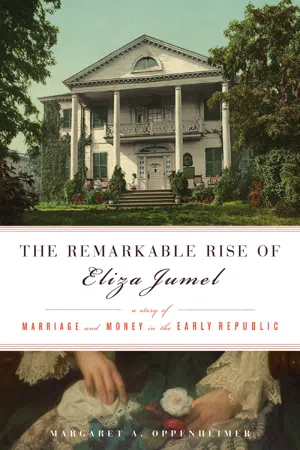
The notorious life and times of one of the wealthiest women in 19th-century America
Born into grinding poverty, Eliza Jumel was raised in a brothel, indentured as a servant, and confined to a workhouse when her mother was in jail. Yet by the end of her life, "Madame Jumel" was one of the richest women in New York, with servants of her own and mansions in Manhattan and Saratoga Springs. During her remarkable life, she acquired a fortune from her first husband, a French merchant, and almost lost it to her second, the notorious vice president Aaron Burr. Divorcing Burr amid lurid charges of adultery, Jumel lived on triumphantly to the age of 90, astutely managing her property and public persona. After her death, while family members extolled her virtues, claimants to her estate painted a different picture: of a prostitute, the mother of George Washington's illegitimate son, and a wife who ruthlessly defrauded her husband and perhaps even plotted his death. With this book, author Margaret A. Oppenheimer draws from archival documents and court filings, many untouched since the 1800s, to tell the true and full story of Eliza Jumel.
Most nights Betsy would have heard the buzz of voices rising from the rooms below. Occasionally men might shout a toast or bellow a bawdy song. But the bursts of noise, the clinking mugs and rattling dice, would have been the normal backdrop of her life.
She might have half awakened once or twice to the sound of footsteps on the stairs. There would be a man stumbling with drink, and a woman, giggling and whispering to him—Esther perhaps, or Debby or Black Bets, or even Betsy’s mother, Phebe.1 But then she could turn over and go back to sleep.
The night of July 22, 1782, would have been terrifyingly different.2 Furious rioters swarmed into the house. Reports of a similar incident, in which a “Bastille of Iniquity” was stormed and “gutted of its contents,” allow us to envision the chaos.3 “Furniture, beds, clothing, &c.” were “entirely destroyed.”4 “Petty-coats, smocks, and silks, together with the … feather beds” were “strewed to the winds.”5 “Mother Cary and her innocent Chickens” were “turned out to the inclemency of a midnight air.”6 The house “in a short time was intirely rased [sic] to the ground floor”—just as was the one in which Betsy had been living.7
Brothel riots, such as the one in Providence, Rhode Island, that ensnared seven-year-old Betsy Bowen and her mother, Phebe, were rare but not unknown in eighteenth-century America. Communal attempts to enforce social norms, they most often occurred when local authorities could not or would not act. They might happen when a customer felt cheated or a girl was thought to have been lured in against her will.8
The cause of the riot in Providence is unknown. But the city had changed dramatically since the outbreak of the American Revolution in ways that must have upset long-term residents. On the face of it, Providence was still a pastoral place, looking much as a clergyman had found it in 1754, with “two streets of painted houses” on the northeast side of the Providence River, surmounted by “a most delightful hill, gradually ascending to a great distance, all cut into gardens, orchards, pleasant fields, and beautiful enclosures.”9 There was “a fine harbor of shipping,” “a well-built bridge,” and, on the southwest side of the river, a suburb “less elegant than on the northeast, but [containing] two or three streets of well-built houses.”10 Yet this pleasant New England settlement was bulging at the seams. Wartime Providence was filled with refugees from Rhode Island’s largest city, Newport, which was occupied by the British from late 1776.11 Young men had left for the armies, and others had arrived. By 1781, American troops and their French allies were encamped outside of Providence.12 Rhode Island College (Brown University today) had been turned into a military hospital.13
Already a magnet for transients, the growing city attracted yet more.14 Men worked on farms, in the shipyards, or for the army. Women became laundresses or servants in wealthy households, took a boarder or two into their rented rooms, or sometimes sold themselves.15 Taverns and brothels sprung up to serve soldiers and sailors, not to mention local residents looking for feminine company. Houses that hosted “females of ill fame” attracted “large Collections of Men of dissolute Character” who disturbed the city’s “quiet & peaceable Inhabitants.”16
The dwelling Betsy and Phebe had lived in, an old jail converted into a residence, had come to the attention of the authorities as early as 1780, when four women residing there—including the aptly named Judah Wanton—were determined to be people of “bad character and reputation.”17 The four were pushed out, but the women who replaced them followed the same profession.
The morning after the riot that destroyed the building, Jabez Bowen, deputy governor of Rhode Island (no relation of Phebe and Betsy), wrote a letter to the Providence Town Council. “Gentlemen,” he began, “You cannot be uninformed of the riot last night and that a dwelling house in the compact part of town was entirely destroyed.”
The councilmen were at least partially to blame, he implied: “We have good and wholesome laws. We have chosen officers to execute them; if they are not faithful to do their duty, they ought to be displaced with disgrace and others elected in their room who will be more faithful.” In the meantime, action was required to deal with the aftermath of the riot. Bowen lived in Providence himself and knew what the town had become at night.
The council members must convene immediately, he instructed. They “should order all the people that dwelt in the old gaol to appear before them,” “break up the wicked nest by ordering all that are not inhabitants [of Providence] to leave,” and surprise “all [the] other bad houses.” We must “all exert ourselves,” he added with a flourish, “for the restoration of order and virtue in our town.” 18
Later that day, town sergeant William Compton and one of his constables stepped out, warrant in hand. “In the name of the Governor and Company of the State of Rhode Island &c You are hereby commanded to Summon & Require the Following persons …”19
Elizabeth Gardner’s name was near the top. Described variously as “an Indian or Molattto [sic] woman”—no one was quite sure which she was—Gardner (whose first name was actually Sarah) had been a thorn in the side of the town council for more than a decade, earning her living by prostitution and producing a quiver full of children. She had been ejected from Providence before—but she always came back.20
Patience Ingraham appeared on the list as well. She was “to be examined on a Charge of keeping a Common, ill-governed, and disorderly House, and of permitting to reside there, persons of Evil Name and Fame, and of dishonest conversation, drinking, tippling, Whoring, and Misbehaving themselves to the Damage and Nuisance of the town and great disturbance of the public Peace.” Her two female lodgers were summoned also, along with a Mrs. McCollough “at the House of Joseph Willson.”21
Then there was another name Compton would have recognized: “Margaret Fairchild, alias Margaret Bowler.”22 A former slave who lived in Providence, Bowler had been the leaseholder at the old jail-turned-residence, but thanks to the prior night’s riot, that building was gone.
On Wednesday morning, July 24, the town council met at the statehouse, a handsome brick building fronted by a spacious lawn. A long walkway terminated at the imposing central door. Theodore Foster, the clerk of the council, took the minutes as Bowler was examined. She stated
that she was the servant of Major Fairchild, who verbally gave her her Freedom … about five years ago. That she hath lived in different Parts of the Town, having kept House [i.e., rented rooms to others] the whole of the time. That she hired the old Gaol House of Mr. Joshua Burr, and agreed to pay him fourteen hundred dollars paper currency Rent per Year, when she first went into it. That When the House was pulled down by the Mob on Monday Night last, there were with her, lodging in the House, Phebe Bowen and her daughter Betsy—another white woman in company with the said Phebe Bowen, called Debby—a Negro Woman called Black Bets, belonging to Sandwich, and a Mulatto Girl about eighteen or nineteen years of Age, called Esther, who hath since gone to Smithfield.23
It was no coincidence that three of the six residents of the brothel were black or biracial.24 The rising tide of abolitionist sentiment in New England meant that a growing number of slaves were being given their freedom. Yet employment possibilities for people of color, especially women, remained scarce and poorly paid.25
Phebe Bowen’s prospects—and those of her daughter Betsy—were little better than those of the darker-skinned occupants of the house. Phebe was by birth a resident of Taunton, a town near Boston in the province of Massachusetts Bay. Her parents, John Kelly and Hannah Owen Kelly, were unable to support her, it seems. By the time she was four or five years old, she was living in North Providence with her maternal grandfather, John Owen. Soon she was sent to Providence proper to stay with a married sister—perhaps Owen was unwilling to be burdened with the care of a young child. If so, her sister was equally unenthusiastic. When she moved away, she left Phebe behind.26
From then on, Phebe was “bound out”—apprenticed—as a servant in exchange for her room and board. It was an unstable existence. Most families needed an extra hand only sporadically, perhaps when there was a new baby in the cradle or extra spinning on hand.27 A bound-out girl’s master might send her to help out in other households when he didn’t need her services, offloading the costs of feeding and clothing her onto the hosts.28 Phebe—a young, vulnerable girl whose parents were absent or already dead—had worked in five different homes by her early teens.
She told her story matter-of-factly:
After my Sister Removed from Providence, I then went out and lived with John Brown Riger, and from thence I went and lived with Abraham Whipple, and from thence I went to Dwell with James Lovet, and from said Lovets I went and lived with John Nash, and from thence back to said Lovets again and now I live at David Wilkinsons.29
Phebe spoke these words at a meeting of the town council in the then-brand-new statehouse on September 29, 1769. She was fourteen, impoverished, illiterate, and pregnant.30
The purpose of that audience was to d...
Table of contents
Cover
Title Page
Copyright
Dedication
Contents
Prologue
1. Beginnings
2. A House of Bad Fame
3. A Death in the Family
4. The Making of a Merchant
5. Transitions
6. Reinvention
7. Marriage
8. Mrs. Jumel
9. Bloomingdale
10. The Fortunes of War
11. Mount Stephen
12. France Beckons
13. An Imperial Interlude
14. Paris
15. The Collector
16. Separate Lives
17. Indecision
18. Place Vendôme
19. The Panic of 1825
20. All about Money
21. Deception
22. The Reunion
23. An Arranged Marriage
24. Enter Aaron Burr
25. A Calculated Courtship
26. An Optimistic Beginning
27. The Unraveling
28. The Duel
29. Financial Shenanigans
30. The Widow’s Mite
31. A Second Family
32. Madame Jumel
33. Eliza Burr Abroad
34. A Romantic Widow
35. The End of an Era
36. A Disputed Inheritance
37. Proliferating Pretenders
38. Enter George Washington
39. On the Home Front
40. Murder Most Foul?
Epilogue
Acknowledgments
A Note on the Sources
Notes
Image Credits
Trusted by 375,005 students
Access to over 1.5 million titles for a fair monthly price.
Study more efficiently using our study tools.
Frequently asked questions
Yes, you can cancel anytime from the Subscription tab in your account settings on the Perlego website. Your subscription will stay active until the end of your current billing period. Learn how to cancel your subscription
No, books cannot be downloaded as external files, such as PDFs, for use outside of Perlego. However, you can download books within the Perlego app for offline reading on mobile or tablet. Learn how to download books offline
Perlego offers two plans: Essential and Complete
Essential is ideal for learners and professionals who enjoy exploring a wide range of subjects. Access the Essential Library with 800,000+ trusted titles and best-sellers across business, personal growth, and the humanities. Includes unlimited reading time and Standard Read Aloud voice.
Complete: Perfect for advanced learners and researchers needing full, unrestricted access. Unlock 1.5M+ books across hundreds of subjects, including academic and specialized titles. The Complete Plan also includes advanced features like Premium Read Aloud and Research Assistant.
Both plans are available with monthly, semester, or annual billing cycles.
We are an online textbook subscription service, where you can get access to an entire online library for less than the price of a single book per month. With over 1.5 million books across 990+ topics, we’ve got you covered! Learn about our mission
Look out for the read-aloud symbol on your next book to see if you can listen to it. The read-aloud tool reads text aloud for you, highlighting the text as it is being read. You can pause it, speed it up and slow it down. Learn more about Read Aloud
Yes! You can use the Perlego app on both iOS and Android devices to read anytime, anywhere — even offline. Perfect for commutes or when you’re on the go. Please note we cannot support devices running on iOS 13 and Android 7 or earlier. Learn more about using the app
Yes, you can access The Remarkable Rise of Eliza Jumel by Margaret A. Oppenheimer in PDF and/or ePUB format, as well as other popular books in Social Sciences & Historical Biographies. We have over 1.5 million books available in our catalogue for you to explore.