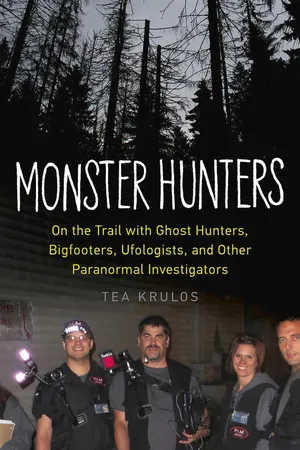
Do ghosts exist? What about the Bigfoot, or Skinwalkers? And how will we ever know? Journalist Tea Krulos spent over a year traveling nationwide to meet individuals who have made it their life's passion to hunt down evidence of entities that they believe exist, but that others might shrug off as nothing more than myths, fairytales, or overactive imaginations.
Follow along with Krulos as he joins these believers in the field, exploring haunted houses, trekking through creepy forests, and scanning skies and lakes as they collect data on the unknown—poltergeists, Chupacabras, Skunk Apes (Bigfoot's stinky cousins), and West Virginia's Mothman. Along the way, he meets a diverse cast of characters—true believers, skeptics, and hoaxers—from the credible to the quirky. And in the end, Krulos leaves it to the reader to decide: are these people tilting at supernatural windmills, or are they onto something?
eBook - ePub
Monster Hunters
On the Trail with Ghost Hunters, Bigfooters, Ufologists, and Other Paranormal Investigators
- 295 pages
- English
- ePUB (mobile friendly)
- Available on iOS & Android
eBook - ePub
Monster Hunters
On the Trail with Ghost Hunters, Bigfooters, Ufologists, and Other Paranormal Investigators
About this book
Information
Print ISBN
9781613749814
« 1 »
THE MONSTER HUNTER AND HIS MUSEUM

AVON STREET, in the Arts District of Portland, Maine, is a small, narrow avenue that seems more like an alleyway. As I turned onto it and stepped onto the sidewalk—more of a curb—everything seemed all too much of an urban reality. A large graffiti-style mural covered the side of a building, and spray-painted orange arrows pointed out the uneven street. Squiggly graffiti tags surrounded a NO PARKING sign. The traffic of Congress Street hummed along, a car honking. Approaching 11 Avon Street, I stopped to wonder if this were the right place. But then I spotted the flag flapping in the breeze. It said INTERNATIONAL CRYPTOZOOLOGY MUSEUM.
I walked through a bland steel door, down the hall, and, hearing strains of classical music playing on a radio, turned, and there I was, inside the museum.
More often than not, if he’s not on the road, the museum’s founder, Loren Coleman, is at the door to greet visitors. His neatly trimmed white beard and hair, bright blue eyes, and jet-black eyebrows give him an Obi-Wan Kenobi Jedi master appearance. Dressed in a safari style shirt and khakis, he seems wise and scholarly, but he has a certain boyishness to him. That mixture suits him, because Coleman has a unique profession: he is a cryptozoologist.
Cryptozoology, from the Latin, means “study of hidden animals” and purports to study evidence of creatures like Bigfoot and Lake Monsters.* These unknown animals are called cryptids.
I learned about this field through an online program—actual college courses are few and far between. My lessons included “The Foundations of Cryptozoology,” “Existing Species that Were Once Cryptids,” and “Bigfoot Evidence.”
“We are the world’s only cryptozoology museum,” Coleman explained to me soon after I walked through the door. “We’ve become the reservoir for a lot of people’s collections, as well as my own fifty-three years of collecting.”
The museum now has about ten thousand cryptozoology-related items, Coleman said. These are rarities that you won’t find anywhere else in the world. There is a hair sample from a Yowie, Australians’ variant of Bigfoot, a huge hairy creature that wanders the outback.
Another display is dedicated to the Jersey Devil, a horse-faced, bat-winged creature said to terrorize the Garden State. A statue of a Cadbrosaurus, a mysterious Sea Serpent that supposedly swims the Pacific coast of North America, glides through a display in a corner of the museum.
Always a labor of love, the museum opened in 2003 and for its first five years was based out of Coleman’s home. Eventually he found a small public space, sharing it with the Green Hand, a mystical bookstore just up the street on Avon and Congress.
“In 2011 we moved to this space, became a nonprofit, and really expanded,” Coleman told me. The building is more than a hundred years old, and the museum space was originally used as a showroom for a furrier. It is now a two-room boutique museum, a mix of Victorian sensibility and monster folklore.
Handing me a photocopied hand-drawn map of the museum layout, Coleman began to show me around. The first room was called the Evidence Room, he explained, and he led me to the first display: “Classic Animals of Discovery.”
“There’s really two forms of cryptids,” Coleman explained. “The cryptids that are actually new species—brand-new discoveries—and cryptids that are extinct animals that may still be around.”
For example, the International Cryptozoology Museum’s mascot—featured as part of its logo—is the coelacanth, which Coleman called a “darling of cryptozoology.” There was a model of one hanging near the front door of the museum.
“This is the full-size replica of the first living coelacanth ever discovered in 1938 off of Africa,” Coleman explained, pointing at the model. “They’re bright blue like that, five and a half feet long. It had not been seen in sixty-five million years.”
This prehistoric fish embodies the philosophy of cryptozoology: if we didn’t know that the coelacanth still swam in our oceans, despite declaratively being categorized as “extinct,” what other unknown fauna is alive out there?
Underneath the coelacanth Coleman had a display case featuring models of many examples of animals that were formerly known as cryptids. The mountain gorilla, for example, was sort of a nineteenth-century version of Bigfoot. Reports of the animals date back to 1861, but explorers believed the stories were village myth until Captain Robert von Beringe and his crew shot two of them in 1902.
The examples go on and on. The weird-looking megamouth shark, first discovered in 1976. Even the platypus was originally written off as a hoax. Scientists believed a duck’s beak had been sewn to a beaver’s body by a jokester taxidermist.
“What happens is people come in and they begin to understand that we’re interested in animals, we’re interested in mysteries, and new species being discovered, which happens all the time. In cryptozoology, the celebrity cryptids are Bigfoot, Yeti, Lake Monsters, Sea Serpents, and Chupacabras,” Coleman said as we walked through the museum.
“Those get the press, but it’s all these little ones—like the new animal discovered in South America a couple weeks ago related to the raccoons [the olinguito], or a new turtle was discovered in Pearl River, Mississippi [the Pearl River map turtle]. I’m happy when people see we’re skeptical of most of the bizarre cases and really grounded zoologically and anthropologically about normal animals being discovered.”
Discovery of new animals is an ongoing process, even in this modern day and age. A new species of tapir, the kabomani tapir, was discovered in South America in 2013. The animal was known to locals and evidence had been gathered in the past, but it wasn’t scientifically confirmed until December 2013. “The [kabomani tapir’s] discovery was definitely cryptozoological, as this species first came to Western Science’s attention based on ethnoknown information,” Coleman declared in his year-end “Top Cryptozoology Stories of 2013,” on his blog CryptoZooNews (www.cryptozoonews.com).
Also in 2013 a team captured the first video of the giant squid, tempted out of hiding with a bioluminescent lure. Although bodies of the animal had been found, this was the first live footage of the animal that is thought to be the basis of the mythological sailor lore of the Kraken. And so, while some of the inhabitants of the International Cryptozoology Museum might seem bizarre and far-fetched, some of them potentially could be real, and it is this excitement of discovery that the museum tries to tap into.
“All of us—myself, [assistant director] Jeff Meuse, [tour guide and “Crypto Queen”] Sarah McCann—try to be passionate with people here at the museum, in a short term,” Coleman said. He quoted Bernard Heuvelmans, Belgian-French scientist, founding father of cryptozoology and author of seminal cryptozoology book On the Track of Unknown Animals: “He said cryptozoology is about two things: patience and passion.”
THE PANGBOCHE HAND

Pangboche Hand replica.
COURTESY OF JEFF MEUSE / INTERNATIONAL CRYPTOZOOLOGY MUSEUM
SOME OF THE MANY ITEMS with an interesting story behind them in the International Cryptozoology Museum are the artifacts related to the Pangboche Hand, which come from a monastery in Nepal.
These artifacts were gathered during the 1959 Slick-Johnson Snowman Expedition, which searched for evidence of the Yeti in the Himalaya Mountains. It was bankrolled by Texas millionaire and adventurer Tom Slick and his friend in the oil business F. Kirk Johnson Sr. A large expedition had been undertaken the previous year that featured a trek into the mountains by a team including Irish big game hunters Peter and Bryan Byrne and more than a dozen Sherpas. The expeditions and others sponsored by Slick are documented in Loren Coleman’s book Tom Slick: True Life Encounters in Cryptozoology.
After hearing a legend of a mummified Yeti hand in the Pangboche monastery from a monk visiting the expedition camp, Peter Byrne stopped by for a visit and took pictures of the artifact. The Pangboche lamas forbade him from taking the hand or part of it, saying that it must not leave the temple.
Determined to get evidence, Peter Byrne returned to the Pangboche monastery as part of the 1959 expedition. According to an account he gave Unsolved Mysteries in 1992, Byrne gave the lama who had introduced him to the artifact a bottle of scotch. When the lama passed out, Byrne set to work and removed parts of two of the fingers from the Pangboche Hand. He replaced them with bones from a human skeleton, carefully wiring them into place.
“I shall not go into the details of how we got the thumb and phalanx of the Pangboche hand, but we have them. The main thing is that we have them, and that the lamas at the monastery do not know we have them,” Byrne wrote Tom Slick on February 3, 1959.
Now he just needed to sneak them out of Tibet. Byrne turned to an unlikely ally, a friend of expedition bankroller Johnson: actor Jimmy Stewart. Byrne crossed the border into India, where he met Stewart and his wife, Gloria, in Calcutta. The famous couple smuggled the fingers out of the country in Gloria’s underwear bag and took them to England. From India, the samples made their way back to Slick and Johnson, who had them scientifically analyzed. The results were inconclusive.
In 1960 Sir Edmund Hillary voyaged to Nepal to conduct his own hunt for the Yeti, sponsored by World Book Encyclopedia. Hillary visited the Pangboche monastery and examined the hand, and he and his experts concluded that “this is essentially a human hand, strung together with wire, with the possible inclusion of several animal bones.” As Coleman pointed out in his book, Hillary and the world at large were unaware that Byrne had indeed replaced part of the hand with human bones and wired it together.
The ICM has an artist’s representation of the hand on display, along with a skin sample from the hand as well as hair and, yes, even a fecal sample, all of which were also collected on the expedition. “These were donated to me by the scientist who was Slick’s collection point for extra samples not tested, as he was dying,” Coleman said. A letter from Jimmy Stewart to Coleman, which confirms the actor’s involvement in the events, is also part of the exhibit.
Coleman saw the incident as a controversial but historic chapter of cryptozoology. “I strongly disagree with the tactics of mutilating this sacred relic and with the apparent theft of the hand’s parts from Nepal. But I also understand this event in the context of the 1950s and the strong notion that by proving the existence of the Yeti, the Slick-Johnson Snowman Expedition personnel hoped to establish the Yeti’s place in zoology,” Coleman wrote in his book on Tom Slick.
Young Cryptozoologist
Coleman grew up in Decatur, Illinois. He was the oldest of four, the son of a firefighter and a housewife. “I was a shy young nerd. It’s fascinating that I became a university professor for twenty years and have been on TV, because I started out a quiet boy, and there still is a little bit of that quiet boy in me.”
Coleman’s mother was supportive of him and encouraged him to get books with his spending money. Although his father sometimes helped out by giving him permission to go on jaunts with game wardens, Coleman said, “He was challenged by my intellect. We would get into tussles over who was smarter. I saw my father and I did everything he didn’t do. I was the only one in the family to get an education, I didn’t drink, I didn’t smoke, and I didn’t abuse women, so there’s a lot. In psychology it’s called reaction formation. I decided to be different from him, but I appreciated baseball* like he did.”
Loren Coleman’s introduction to cryptozoology came about when he was twelve and saw a movie that would forever change his life. As he writes in his 2003 book, Bigfoot! The True Story of Apes in America:
I now look back on one March evening in 1960 as a critical juncture that changed my life. I was watching the broadcast on the local Decatur TV station of a science fiction movie, a Japanese picture entitled Half Human: The Story of the Abominable Snowman (Ishiro Honda, 1957), about the search for the Abominable Snowman in the mountains of Asia. It was fascinating, for even though I knew it was fiction, there appeared to be an underlying truth to this tale of an expedition in pursuit of an unknown species of hairy, upright creature. One does not pick their entries into mysteries, I suppose; for me this just happened to be the one.
I went to school the next week and asked my teachers about this elusive, mysterious creature called the Abominable Snowman. They were discouraging and lacked interest. They told me I was wasting my time on a “myth.” But their words did little to put ...
Table of contents
- Cover
- Title Page
- Copyright
- Dedication
- Contents
- Introduction: Invisible Monsters
- « 1 » The Monster Hunter and His Museum
- « 2 » Time Stamp
- « 3 » The Slaying of the Chupacabras
- « 4 » Lake Monster Fever
- « 5 » What Was That?
- « 6 » International UFO Congress
- « 7 » The Terror and Subsequent Pride of Point Pleasant
- « 8 » Drama with the Dead, Problems with the Living
- « 9 » Squishes
- « 10 » We Come to Whup Demons
- « 11 » Somethin’ Skunky
- « 12 » The Accidental Werewolf Chronicler
- « 13 » Night Visits
- « 14 » The Case of the Haunted Honky-Tonk
- Epilogue: The Bogeyman
- Acknowledgments
- Notes
Trusted by 375,005 students
Access to over 1.5 million titles for a fair monthly price.
Study more efficiently using our study tools.